


Written by: Cosmo Jiang and Sam Lehman, Pantera Capital
Translated by: Yangz, Techub News
The viral rise of OpenClaw (formerly Clawdbot) marks a generational leap in autonomy. When these AI entities begin to interact with each other and even autonomously negotiate and complete transactions in certain scenarios, the future of the agent economy moves from science fiction to real-world applications.
OpenClaw is just a step in this acceleration journey. Trillions of dollars are flooding into the construction of artificial intelligence infrastructure. The spending of just the colossal data center operators in the United States on AI is expected to exceed $650 billion by 2026, about ten times the inflation-adjusted cost of the Apollo program.
What started as simple chatbot technology is rapidly evolving into fully autonomous AI systems with agency. These AI agents will no longer be just content generators; they will become real economic entities. They will be able to reason, act, trade, debate, coordinate, and more—all without human oversight in real-time. The impacts of this large-scale construction will be ubiquitous, but the business realm may feel it most acutely.
Some estimates suggest that by 2030, AI agents could facilitate $3 to $5 trillion in global consumer commerce transactions. Even if only 10% of that transaction volume becomes agent-to-agent programmatic commerce, it means hundreds of billions in machine-native settlement flow each year.
This naturally raises the question: what type of financial and coordination rails are reasonable for the native business activities of AI agents?
The current business system is designed around humans, involving identity verification, banking intermediaries, legal contracts, settlement cycles, and manual reviews across multiple stages. Autonomous software cannot walk into a bank branch to open an account, cannot sign documents in person, and cannot wait days for ACH settlement. The infrastructure that agents need should inherently be programmable, always online, globally accessible, permissionless, and machine-verifiable.
Blockchain can meet these demands, and we are already seeing this trend emerge.
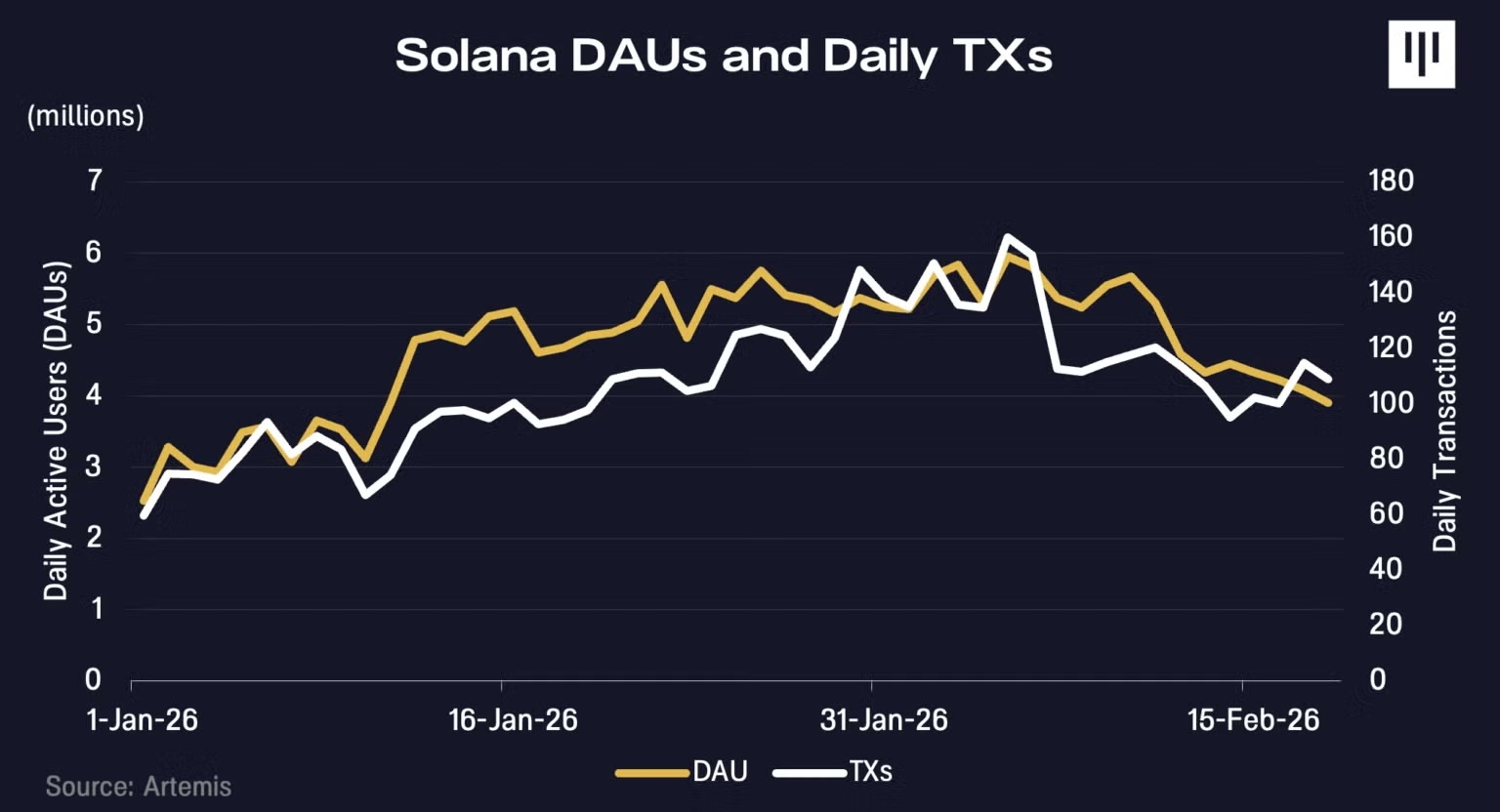
Coinciding with OpenClaw's rapid rise in January, Solana's trading volume and active address count also started to climb. Evidence from the AI agent social network Moltbook suggests they may have contributed to this growth.
x402 is an internet-native payment protocol developed by Coinbase that allows AI agents to pay for digital resources in real-time without accounts or complex, high-friction verification. Since its launch in 2025, transaction volumes have been accelerating.
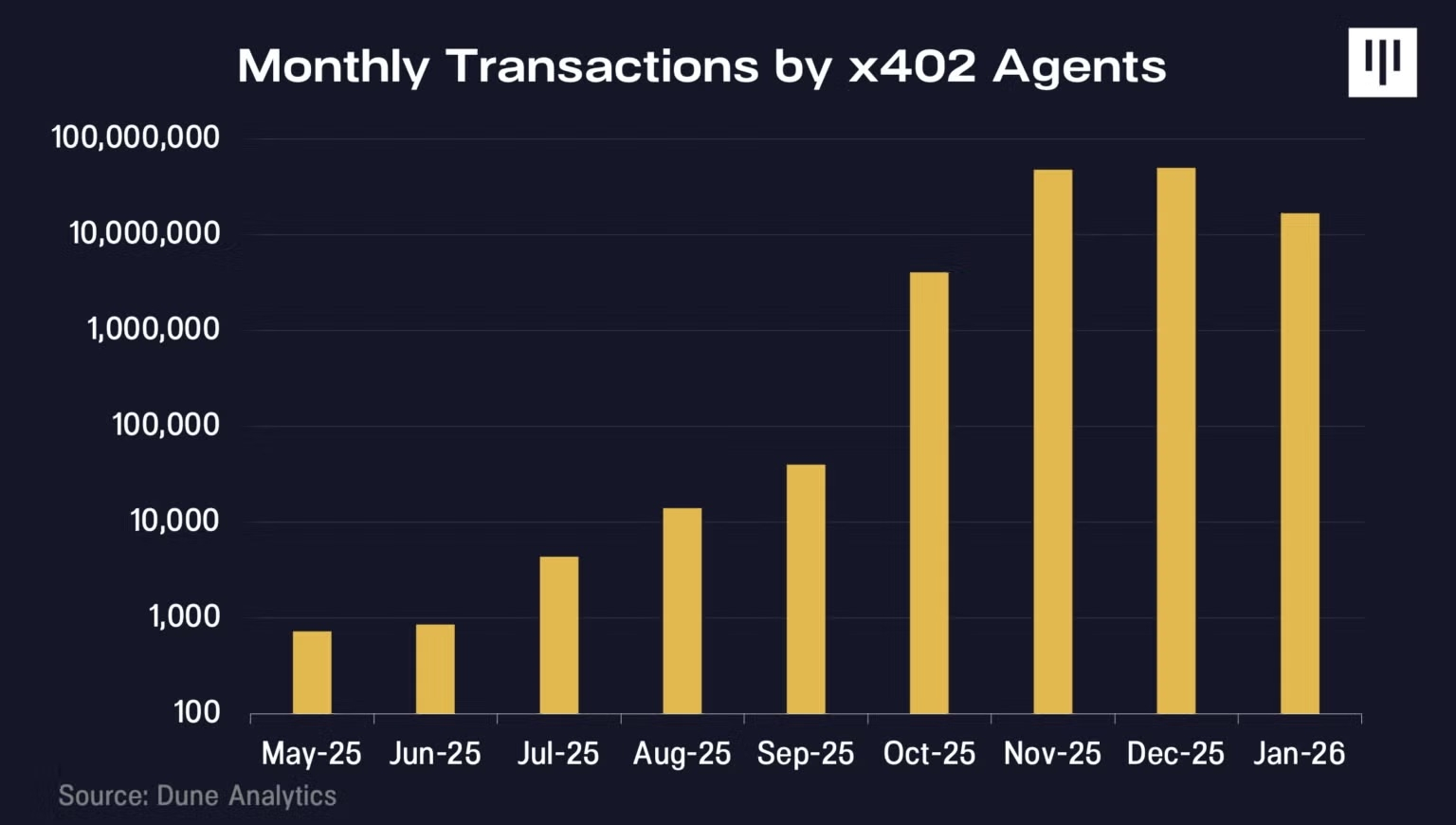
We're still in the early stages, with current cases being more directional than definitive. But if investors are excited about the potential of AI innovation, we can't overlook why we believe that blockchain infrastructure will be the cornerstone for unlocking a fully autonomous agent world.
Autonomy Levels
Many people would correctly point out that today’s AI agents do not need blockchain. This is true in the short term, but we consider it a shortsighted view.
McKinsey recently released a framework outlining six levels of automation for AI-driven business, from basic subscription assistance (Level 0) to fully autonomous agent-to-agent business (Level 5). The key insight is that levels 0 to 4 do not require new financial infrastructure. At each of these levels, there are human identities behind the transactions. Users have been verified via ChatGPT, Amazon, or Perplexity and have archived credit card information. When agents conduct transactions, they act as proxies for that human, inheriting their identity, payment credentials, and legal status.
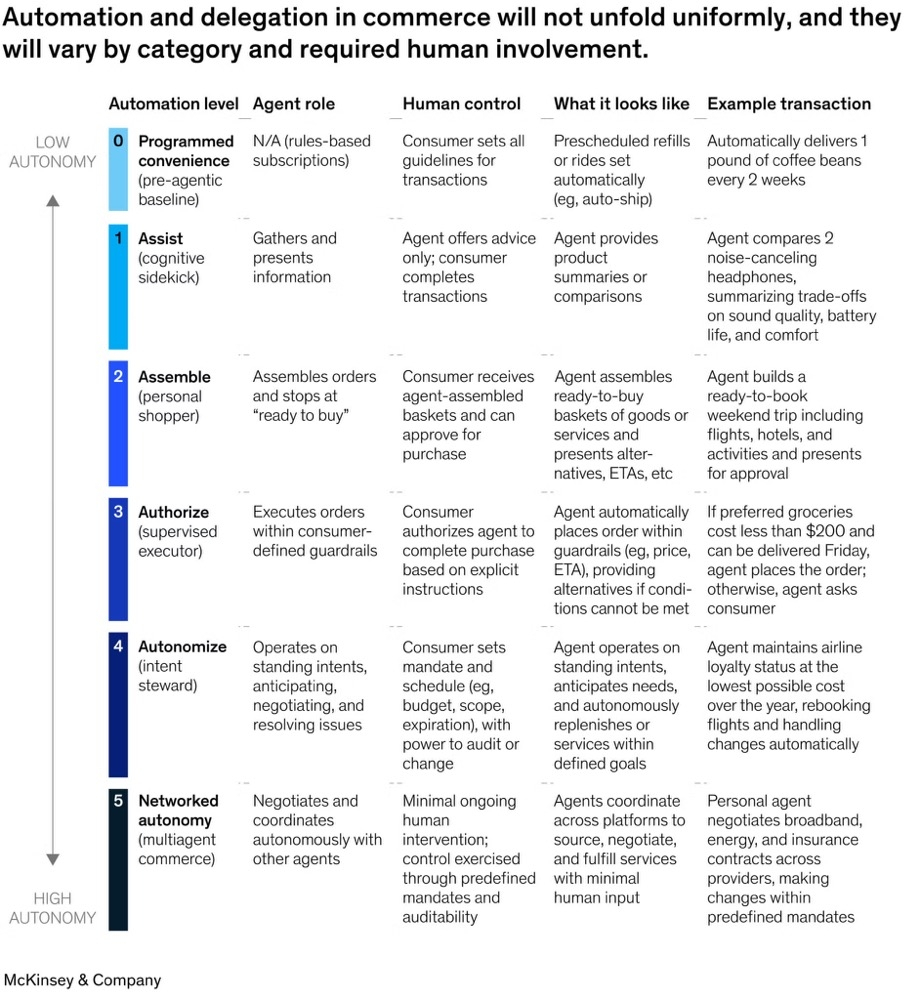
The foundations of this type of business, including shared payment tokens, refund systems, and fraud detection infrastructures, already exist through institutions like Visa or Stripe and are functioning quite well.
At levels 5 and above, such as when agents trade directly with other agents without human prompts; when there is no human identity to inherit; when payments must be programmable, conditional, and settled in milliseconds; and when agents need cross-platform portable reputations, blockchain rails become crucial.
As long as humans still bear economic responsibility, traditional rails will suffice. Once agents become economically independent actors, the constraints change.
Agent-based Finance
To understand where value will accumulate and why blockchain is crucial, we need to envision the logical endpoint of agent-based AI. We're moving towards a world where agents are not just human assistants but independent economic entities. Some will be created by companies or individuals, while others will be generated by the agents themselves, forming increasingly autonomous systems capable of reasoning, capital allocation, and trading without human oversight.
If no human specifies the transaction channel (e.g., going to a bank, using Stripe, launching a blockchain wallet), the agent will rationally choose those that maximize speed, reliability, and global coverage while minimizing friction and dependencies. When the alternative is to open a bank account and wait for ACH settlement within limited banking hours, agents will naturally opt for permissionless, around-the-clock blockchain rails.
We believe there are three key constraints that will drive agents toward blockchain rails:
Identity and Access: How do we track the unique identities of AI entities that trade and register services with each other? What should the new reputation systems look like when traditional credit scoring and fraud detection systems are built for humans with a physical footprint operating within jurisdictions?
Money and Payments: What form of currency is needed when agents perform countless micropayments, execute conditional payments, and greatly increase cross-border commercial demands? What form of accounts are needed when agents cannot walk into a bank to open an account?
Minimizing Trust-based Transactions: How can AI agents avoid the friction caused by disputes that require human arbitration or other centralized trust systems (which they may not be able or willing to access)?
Identity and Access
Before an agent makes a payment, the counterparty must know who or what they are dealing with. Traditional identity systems are built for humans. They rely on government-issued IDs, signatures, and other credentials presuming the other end is a legal entity.
Autonomous AI agents don’t have these. They can’t walk into a bank to open an account or legally sign contracts. However, if we want agents to trade autonomously, they need some way to prove they are legitimate and authorized to act.
If you connect an agent to your bank account, the problems multiply. How do you perform anti-money laundering checks on software? If the agent acts autonomously, who is responsible? What if it gets manipulated?
In simple cases, agents can inherit the credentials of their owners (like ChatGPT Checkout). But this model fails at scale. Multiple agents need separable permissions and spending limits. Malicious activities must be isolated without freezing all agents. These scenarios require agents to have their own verifiable identities rather than borrowing from human identities.
This is where blockchain-based identity technologies come into play. Using cryptographic techniques, agents can prove they are authorized to act on behalf of a specific person or company without revealing sensitive information about that individual. Think of it as a digital power of attorney that anyone, anywhere, can verify instantly without calling a lawyer or querying a database.
Emerging standards like Ethereum's ERC-8004 propose on-chain registries that allow agents to establish verifiable credentials and accumulate transaction history and reputation over time. An agent that has completed thousands of transactions without dispute holds a credibility that is incomparable to a new agent with no history, and this reputation can be transferred across different platforms.
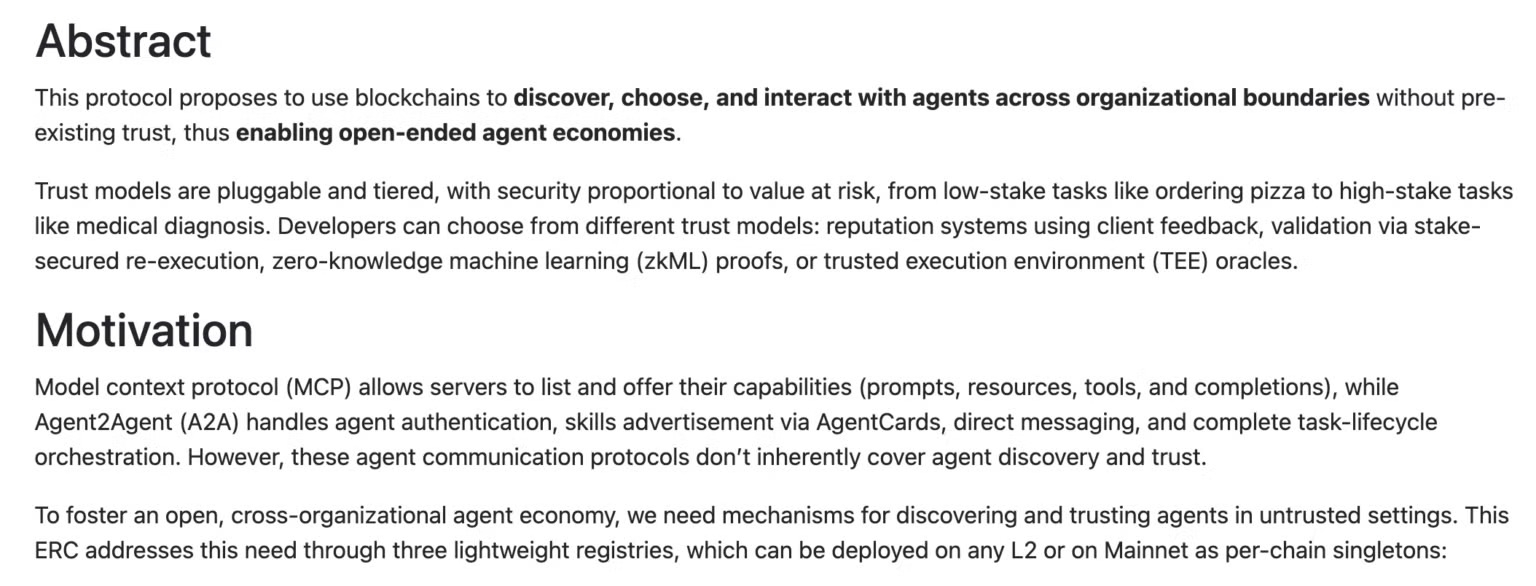
This is important because trust is the foundation of commerce. Merchants spend years building systems to intercept bots and crawlers, and in an agent-driven economy, they need to figure out how to let the right bots through. A cryptographically secure and verifiable identity can give merchants confidence without needing human guarantees.
Programmable Money and Micropayments
Traditional payment rails are designed for human-scale transactions. When you pay for a cup of coffee or a pair of jeans, the credit card transaction fees (typically 2-3% plus about 30 cents per transaction) are negligible. But the operational scale for agent-to-agent business activities is completely different. An agent writing code might initiate 10,000 API calls in a single task. An agent conducting price comparisons might query hundreds of data providers. Payments need to occur in milliseconds, repeatedly, and amounts can be as small as fractions of a cent.
Credit card networks are not optimized for this behavior. The minimum fees make micropayments uneconomical. Fraud detection systems tend to freeze accounts that exhibit high traffic, akin to machine activity. Compared to high-performance blockchain protocols, their transaction speeds are quite sluggish.
In this regard, stablecoins and programmable currencies can truly shine. On-chain transactions can be subdivided into tiny units with settlement costs approaching zero. More importantly, since payments are programmable, they can be conditional, such as only paying when an API returns valid data, or releasing funds only when a computational task is completed, streaming payments in real-time as services are consumed rather than pre-paying for a capacity you may not utilize.
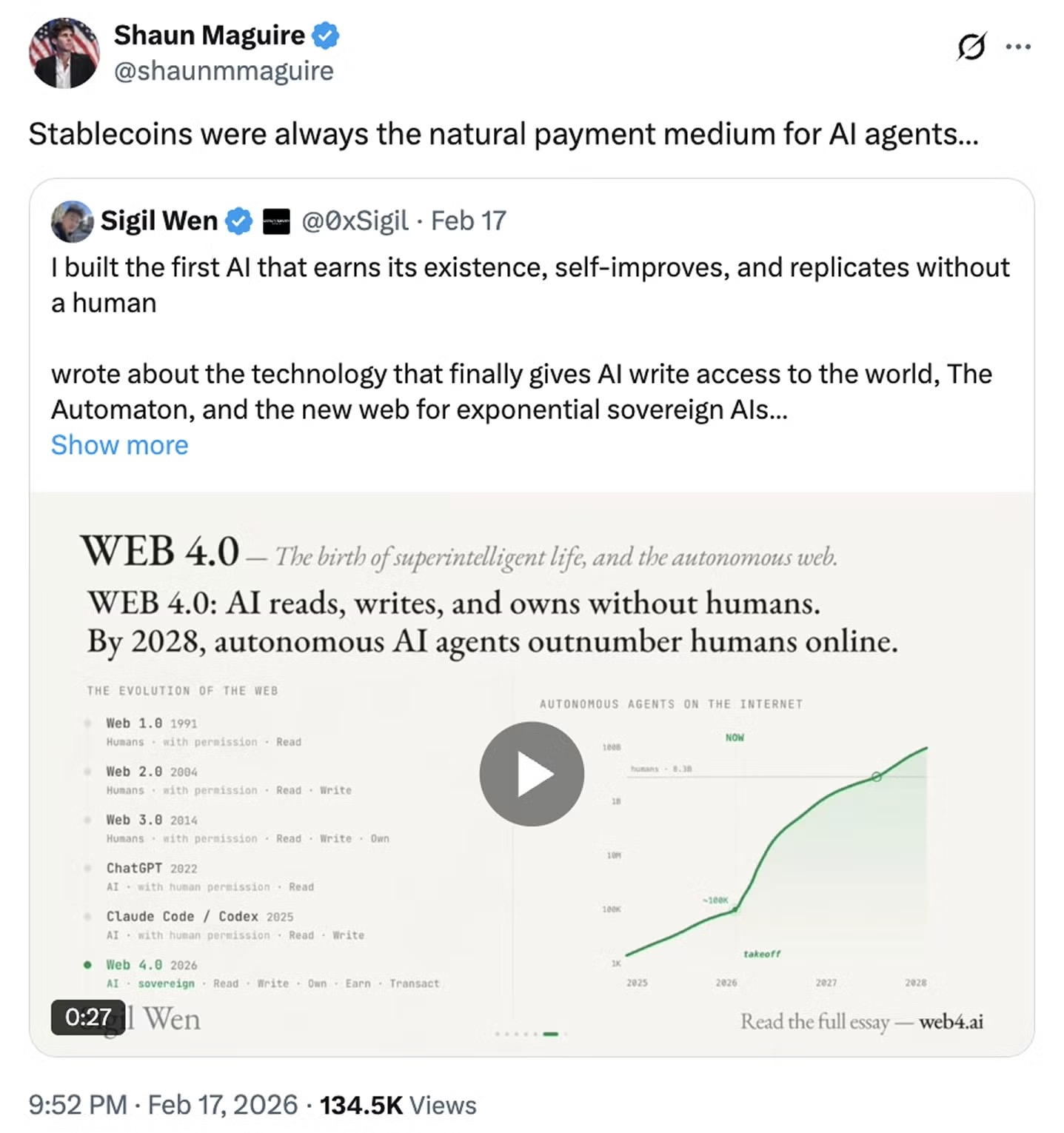
Programmability also enhances capital efficiency. Nowadays, to enable your agent to access a new service, you typically need to pre-fund the account. You need to estimate usage and lock in funds in advance. Through smart contracts and on-chain collateral, agents can prove their solvency before service delivery without transferring payments.
The financial infrastructure supported by blockchain aligns with how agents should ideally operate: autonomously, at high frequency, conditionally, and with capital efficiency.
Minimizing Trust-based Transactions
Traditional business models build trust on intermediaries. Payment processors handle chargebacks, banks provide settlement guarantees, courts adjudicate disputes, and the execution of contracts ultimately relies on human legal systems.
When billions of micropayments occur across multiple jurisdictions, this framework becomes inefficient. When AI agents trade with other AI agents, they may not have access to or choose to rely on legal systems specific to certain jurisdictions. Cross-border enforcement can be slow, expensive, and fraught with uncertainty.
Blockchain reduces reliance on these potentially fallible trust systems by encoding execution mechanisms directly via smart contracts. For example, smart contracts allow funds to be programmatically escrowed and only released when preset conditions are met. Settlements are deterministic, not subject to refund risks. The rules are transparent, and both parties can verify them in advance. There’s no need to rely on legal remedies.
For large-scale operations of autonomous agents, minimizing reliance on centralized intermediaries and human arbitration can reduce friction, enhance predictability, and allow businesses to scale programmatically. This low-friction infrastructure could expand the scope of economic activities that would otherwise be uneconomical under traditional execution models. Agent-based commerce supported by blockchain rails may accelerate global GDP growth.
This is just the beginning.
The question is not whether agent-based commerce is coming, but on what kind of infrastructure it will run.
As AI agents become autonomous economic actors, the number of economic agents in the global economy will grow exponentially. Agents will need digitally native financial rails capable of handling programmable settlements, high-throughput micropayments, permissionless coordination, and minimizing trust-based identity systems. These principles are the cornerstone of blockchain design.
One could argue that the rapid proliferation of AI agents is becoming a long-term structural advantage for blockchain development. Evidence already suggests that this is happening, and we believe most investors are underestimating the value creation opportunities it holds.