



⭐ If you're a gambler, love to YOLO, thrive on wild swings, crave excitement, and enjoy the quick rush, you're probably not too concerned about position management;
⭐ If you're drowning in debt and getting daily reminders from online lenders, you likely don't have the patience to learn about position management; all you're chasing is the dream of sudden wealth and fantasy.
⭐ If you're a seasoned bag holder who's really felt the pain of losses, been wrecked by the market, and experienced multiple liquidations, you probably already have a sense of position management and experience.
⭐ Most of the casualties in this market aren't due to failed strategies or poor skills, but rather from mistakes in position management, whether it's over-leveraging or adding to losing positions.
🤡 They’ll say: If you’re too cautious, how will you make big money?
🤡 They’ll say: How can I control my human nature? It’s impossible!
🤡 They’ll say: I’m a degenerate gambler; don’t preach to me about being steady!
🤡 They’ll say: I have little capital and no infinite margin, so how can I flip my situation?
🤡 They’ll say: Gambling isn’t this complicated. Just get in—either you make a killing or get wrecked. Isn’t that what speculation is about? If not, why are you in this market? Go stick to traditional investments!
The wealth will be redistributed in this market based on understanding, according to the knowledge possessed by individuals.
🌞 Here’s the hard truth, tailored for crypto newbies on position management, which also applies to seasoned traders who just can’t seem to change their ways.
🔥 Let go of the subjective notion that high leverage equals high risk.
Many newbies in crypto, even those who have been around for a while, still don’t understand the difference between high and low leverage or are terrified of high leverage, thinking it’s the source of all evil and the cause of liquidation. Many influencers only tell you to avoid high leverage without discussing position management, leaving you unaware that your liquidation and losses are directly related to your position size, not the leverage itself. It’s not high leverage that causes liquidations; it’s the size of your position that does. Understanding this basic logic is crucial.
🔥 Give up the habit of opening positions based on percentage gains.
Those who equate high leverage with high risk tend to open positions based on percentage gains or fixed margin amounts without understanding how many coins they’ve actually opened. When you realize your liquidation price is right in front of you, it’s a wake-up call. So, be mindful; precision in position management is crucial—input the number of coins manually and stop focusing solely on your USD amount. You’re not an infinite margin whale; don’t pretend to be a big shot by casually opening positions.
🔥 Learn to build positions in batches + take profits in batches (spot + futures).
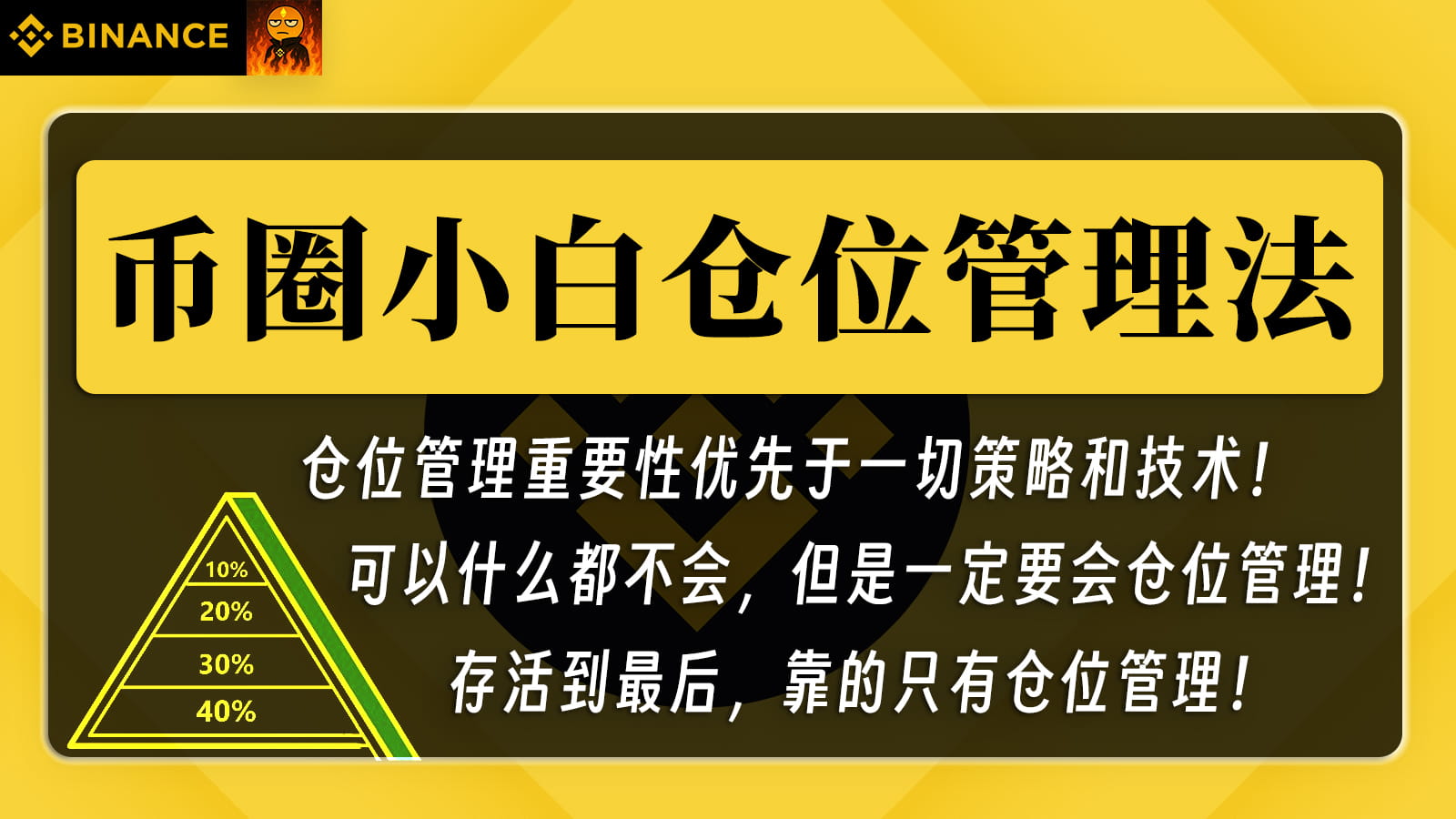
In crypto investment, effective position management is the core strategy for controlling risk and enhancing returns. Here are analyses and operational key points for three mainstream position management methods:
I. Rectangular position management method (suitable for choppy markets).
Operational logic: Divide your capital into 3-5 equal parts (e.g., 100,000 USD divided into 5 parts of 20,000 USD), and enter positions using fixed amounts. If you want to be meticulous, you can divide it into eight or ten parts; don’t shy away from the details. Your survival and minimizing risk are the most important.
Advantages: Cost averaging, suitable for uncertain, choppy markets.
II. Funnel position management method (left-side bottom-fishing strategy).
Operational logic: Start with a small position (10%), then increase your position size as the price drops (15%→20%→25%→30%).
Applicable scenario: Anticipating a bottom area after a prolonged decline. For example, when Ethereum drops from 4000U to 2000U, enter in increments of 10%-30%, ultimately achieving an average price lower than if you bought all at once.
Risk warning: Always reserve enough funds to avoid running out of bullets too soon.
III. Pyramid position management method (right-side trend strategy)
Operational logic: Start with a heavy position (50%), and reduce your position size as the price rises (30%→20%). This isn’t commonly used but is suitable for rolling positions when the direction is correct.
Partial profit-taking is also essential. Don’t rigidly wait for your target price or the precise take-profit point given by an instructor; if it doesn’t hit and falls back, you’ll look foolish. Always maintain the habit of securing profits bit by bit, aiming to get close to your target price, rather than believing it will definitely reach it. We ultimately aim for an average take-profit price!
🔥 Reduce your margin utilization to a safe threshold.
Once your position is established, try to keep your margin utilization at 3%-5% or lower. Of course, if you’re going heavy with stops, you can take risks. Different strategies imply different levels of stability; if you seek stability, don’t expect high returns in the short term.
🔥 In a full-position mode, your simultaneous holdings should not exceed 3 assets.
Aside from isolated margin trading, when trading multiple assets in full margin mode, your liquidation price is variable. In extreme market conditions, even initially secure liquidation prices can rapidly approach your entry point as floating losses accumulate, leading to disaster. Many confident traders fell victim to this last August and this February, especially those who continued to add to their positions without top-up margins, ultimately losing everything.
🔥 Your initial position should ideally not have a liquidation price (for longs).
Without a liquidation price, you can trade with a peace of mind, even when adding to your position later. Some say only infinite margin offers no liquidation price; that’s a misconception. If your position is small enough relative to your margin, it’s akin to having 'infinite margin' relatively.
If you’re going long, you can input your position size at the entry point to see the estimated liquidation price, testing how much you can safely open without triggering liquidation. You can also carefully calculate how many coins to open without facing liquidation.
When going long, (your maximum opening quantity without a liquidation price) = your total contract margin ÷ the leverage chosen ÷ (the margin used for opening 100 coins) * 100.
This is the maximum position size you can hold without facing liquidation.
When shorting, there’s always a liquidation price, so ensure you set a stop loss when shorting. No sloppiness!
🔥 Learn to open positions based on the number of coins rather than how much USD.
Position management is a good habit; you'll understand it better over time. If you like to open positions based on percentage gains or have a habit of using a fixed margin, but don’t even know how many coins you’ve opened, switch your display to show the number of coins instead of just the leveraged USD amount. Watching the USD value will desensitize you to numbers, making it hard to understand your position and safety levels.
🔥 Always set stop losses or trailing stops on unrealized gains; never let them turn into unrealized losses.
If you're day trading or swing trading, don’t be greedy or play tricks. The safest and most reliable thing is to act when the market shows its hand. If you’re in the right direction, set a break-even or a trailing stop to lock in some profits quickly. Don’t let unrealized gains turn into losses because you got too comfortable. Of course, if you’re holding long-term positions and not actively watching the charts, don’t sweat the short-term fluctuations; unrealized gains and losses will come and go.
🔥 Find ways to eliminate your human tendencies from trading.
Greed, fear, stubbornness, the urge for revenge, and getting tortured by one coin repeatedly... these human flaws are hard to shake off when trading, right? It’s not impossible; it just takes some self-discipline. Controlling human nature is a form of self-cultivation. If you can’t manage it, we can always discuss it live.
🔥 Set stop losses wisely; avoid unnecessary stops.
A tight stop loss without considering pressure points above or support levels below is like giving money to the market for free; it just erodes your capital. You’ll keep feeling the thrill of getting rekt. Each coin has its own quirks, and stop losses should be tailored to each asset—some need wider stops, some can be tighter. If you’ve already entered a long position at the bottom of a larger cycle, you can anticipate some dips and might not need a stop loss for now. Adjust your stop loss based on your position size and risk tolerance.
🔥 Don’t add positions too closely; spacing is key. Adding positions that can’t effectively move your average price is useless.
Don’t be too casual with adding to your position. If your initial position is light but you keep averaging down on a losing trade, it’s easy to end up over-leveraged. You might find yourself adding at every dip, and suddenly your average price is stuck, with no room left to add more. When the price doesn’t move much, and the market suddenly takes a nosedive, you’ll realize you can’t add any more.
Always space out your position adds, preferably at support and resistance levels. The ratio of your position adds should be appropriate. Once your full position is deployed, you’ll end up with an average entry price, which you then use to set your take profit and stop loss. When the market is fluctuating frequently, learn to continuously add and reduce your positions to optimize your average entry price.
Don’t find adding to your position a hassle; safety and profits aren’t obtained by sitting back—they come from actively managing your trades.
🔥 If you manage to close your position at a loss, understand when to exit. If your entry was poor, just getting back to even is already a win. Don’t expect to snag more.
If you’ve managed to hold your position for a long time and it finally comes back, thank the market for the mercy. It just shows how poor your entry point was to give you a chance to escape. Always prioritize safety first; set a break-even stop or at least plan your exit strategy. Even if you think you’ve clawed back some gains, don’t cling to the hope of making a killing.
Everyone needs to develop their own set of position management experiences. What I shared is just personal insight and might not suit everyone. If you want to survive in this market long-term, prioritize position management as your top concern.
To be continued...~~~~~~~
💪 Updated on October 26, 2025.
🥘 Only by surviving long enough can you thrive. In this market, as long as you have funds left, maintain a zero-sum mindset daily, regardless of whether you made big gains or suffered losses the day before.
🥘 The market only offers you small bites 95% of the time. To catch that 5% big move, you might have to risk your entire capital, so you can choose not to gamble.
🥘 'Infinite margin' refers to your position size, not that you need a ton of money.
🥘 In the face of technical analysis, controlling the human tendencies that hinder trading comes first, followed by position management. You can skip the technicals, but the first two must be prioritized.
🥘 When you stop constantly fixating on returning to break-even, you’ll achieve the basic mindset required for trading.
🥘 When you trade most of the time devoid of human emotions, your thinking will become clearer. If you can’t master your emotions, you won’t go far in trading.
🥘 Getting stuck is the norm. For both futures and spot trading, never open positions all at once. You’re not just lying around waiting for the market to do you favors. Gradual entry is the most effective method; if you can enter 10 times, don’t limit yourself to 5.
🥘 Small positions aren’t shameful; don’t underestimate them. They can improve your mindset, skills, and position management. Often, it’s small positions that restore your confidence and provide positive emotional value. Even whales test their skills with small positions.
💪 Updated on January 24, 2026.
👊 If you’re not a complete newbie, then any opinion or strategy from anyone, including KOLs, should only serve to support your own views—not guide you. Following strategies should be based on double confirmation (your judgment + corroboration). Even if you incur losses, it should be clear and without regrets. If you lack your own viewpoint, work on enhancing your trading knowledge. A good beginner book would be on naked candlestick trading (you can find it in my book recommendations on November 12).
👊 If you’re not a one-time all-in type of trader but prefer systematic position management and phased entry, don't panic emotionally until all your positions are filled. Your focus shouldn’t be on where to stop loss, but rather on calculating your average price if you fully deploy your planned position. Set your stop loss below the support level that crosses your average price.
👊 After a coin hits a historical high or low (especially new coins), candlestick technical analysis loses its reference value, especially for heavily controlled markets. Be prepared for a risk operation with a mindset of 10 losses for every 9 gains.
👊 Three good habits for short-term holdings:
When unsure whether to take profits on unrealized gains, take half off and set the rest to break even; you can't go wrong. After realizing some gains, habitually set a break-even stop or trailing stop as your baseline; don’t let it turn into a loss. Always treat your profit target as a goal, not something to obsess over.
👊 Suggested position management ratios for phased entry:
For two-entry ratio: 3:7 or 2:8.
For three-entry ratio: 2:3:5 or 1:2:4.
For four-entry ratio: 1:2:3:4.
👊 Only add to positions at support and resistance levels, while you can reduce positions anytime when in profit.
👊 90% of traders operate during 95% of the market's garbage time. Only 10% have room to maneuver during the 5% of effective trading time. Learn to trade with small positions and control your impulses; this is harder than quitting smoking.
👊 Wealth doesn’t come rushing in; quick cash won’t stick around. Unfortunately, the crypto market is no longer a place where dreams of getting rich overnight thrive.
👊 Trend traders and day traders are two different species; don’t try to understand or doubt each other's trading logic. There’s no hierarchy or superiority. Identify your trading habits and align your operations accordingly, ensuring consistency between knowledge and action.