


Author: Hotcoin Research
1. Introduction
Recently, the BNB Chain celebrated its fifth anniversary, evolving from being viewed as an 'Ethereum clone' to a super blockchain network with over 600 million users, a daily transaction volume in the millions, and more than 5,000 ecosystem projects. Initially attracting DeFi users with low fees and high throughput, BNB Chain has now expanded into diverse sectors including GameFi, NFT, RWA, social, and AI, completing its transformation from a follower to an ecological giant. This evolution is backed by continuous performance upgrades and security mechanism iterations, as well as the strong empowerment of the Binance exchange. The Web3 wallet and Alpha platform launched by Binance in early 2025 have become key engines driving BNB Chain into a new cycle of prosperity, channeling millions of users who were previously on centralized platforms to the blockchain, resulting in a leap in active addresses and transaction volume for BNB Chain. Alpha has also become an important space for project incubation and user education, injecting a continuous stream of fresh blood into BNB Chain.
This article first outlines the development process of BNB Chain over the past five years, revealing its evolution from DeFi explosion to ecological diversification; secondly, it compares on-chain data with competitors like Ethereum, Solana, and Base to comprehensively present the ecological panorama and competitive landscape of BNB Chain; then, it focuses on how Binance Alpha and the Web3 wallet promote ecological prosperity, and explores the performance of emerging tracks such as memes, RWA, and AI; finally, it evaluates the potential of representative tokens within the BNB ecosystem and looks ahead to the opportunities and challenges in the next five years. Through this panoramic analysis, this article aims to help readers understand the unique position of BNB Chain in the industry landscape and its long-term value outlook in technology, compliance, and innovation.
2. BNB Chain's Five Years: From Rise to Prosperity
Source: https://www.bnbchain.org/en/blog/5-years-of-bnb-chain-accelerating-the-future-of-web3
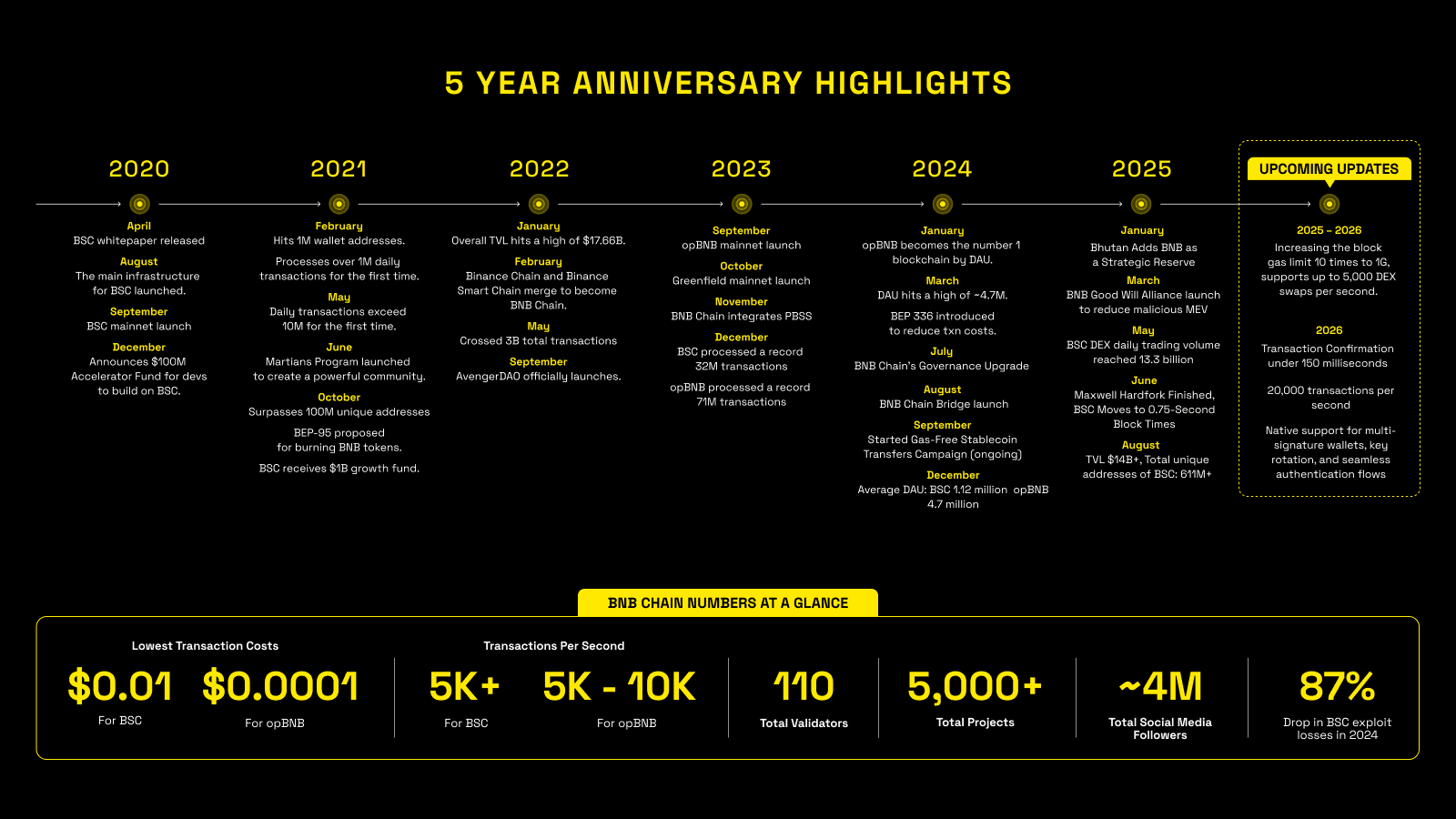
1. Initial Positioning: A Low-Cost, High-Performance Alternative to Ethereum. In April 2019, Binance launched the early Binance Chain (now called BNB Beacon Chain), primarily used for the issuance of BNB tokens and decentralized exchanges. However, the real surge of the BNB ecosystem began with the launch of Binance Smart Chain (BSC) in September 2020. Since its inception, BSC aimed to solve Ethereum's congestion and high costs by adopting the Proof of Staked Authority (PoSA) consensus, with only 21 validators, giving it the advantages of fast block production and low transaction fees. At that time, the DeFi wave was strong, and Ethereum's high Gas fees hindered ordinary users' participation, while BSC provided nearly 100 times the performance of Ethereum and transaction fees of just a few cents, positioning itself as 'a faster and cheaper Ethereum' quickly gaining market favor.
2. The 2021 Outbreak: The DeFi Copycat Wave and User Surge. From the end of 2020 to the beginning of 2021, the DeFi 'mining' craze propelled the BSC ecosystem to soar rapidly. The price of BNB surged along with the DeFi boom in early 2021, and the market began to revalue it as a mainstream public chain token. DEXs like PancakeSwap first rose on BSC, replicating the Uniswap model and introducing high liquidity mining incentives, attracting immense funds. Following closely, a batch of protocols like Venus (lending protocol), Alpaca (leveraged mining), and Mdex (cross-chain DEX) also went live, mimicking Ethereum's star projects. During this phase, BSC's on-chain TVL grew exponentially, reaching about $20 billion at its peak in 2021, with daily transaction volume hitting record highs, sometimes exceeding 10 million daily transactions, far surpassing Ethereum's average of around 1 million at that time. The number of daily active addresses also reached a historical peak of about 1.5 million by the end of 2021. A large number of new users entered the BSC ecosystem through Binance exchange's bridge and promotion, with the total number of addresses on BSC exceeding 100 million by the end of 2021. BSC has clearly become one of the important battlegrounds for DeFi users and developers.
3. Ecological Diversification: The Rise of GameFi and NFTs. With the bull market in the crypto market in 2021, in addition to DeFi, new hotspots such as GameFi and NFTs began to emerge in the BSC ecosystem. In terms of GameFi, BSC is very suitable for gaming DApps due to its low costs and high TPS, with many 'P2E (Play to Earn)' games choosing to deploy on BSC. For instance, role-playing games like CryptoBlades and Faraland, and farming games like Plant vs Undead were very popular in 2021. The NFT farm game Mobox and the metaverse concept of BinaryX also led to a brief prosperity in the BSC gaming sector. In the NFT space, although Ethereum dominates the high-end NFT market, BSC has also seen the emergence of platforms like BakerySwap that integrate DEX and NFT markets, as well as applications like NFTb focused on NFT lending. Binance's own NFT market further drove the trading of artworks and collectibles on BSC. The 2021 BSC ecosystem can be said to be vibrant, gradually forming the embryonic forms of GameFi and NFTs beyond DeFi.
4. Adjustments in 2022: Brand Restructuring and Security Incidents. In 2022, the crypto market entered a bear phase, and the BSC ecosystem also underwent a round of reshuffle and adjustment. In February 2022, Binance officially unified the names 'Binance Smart Chain' and 'Binance Beacon Chain' to 'BNB Chain,' downplaying the Binance brand imprint. This move aims to highlight the development vision of BNB Chain as an independent public chain ecosystem. During the bear market, BSC's locked value significantly decreased from its peak, with the ecological TVL falling to below $3 billion by the end of 2022, shrinking over 80% from its peak. Some high-froth projects, such as certain GameFi projects, quickly declined. However, BNB Chain continued to invest resources in incubating projects during the bear market, supporting developers through initiatives like the Most Valuable Builder (MVB) accelerator. During this period, BNB Chain also faced security challenges: in October 2022, its cross-chain bridge suffered a major hack, with approximately $100 million worth of assets stolen. Fortunately, timely suspension of on-chain validators prevented greater losses. Additionally, many copycat projects on BSC collapsed or exited during the transition from bull to bear, which somewhat affected BSC's ecological reputation. In response to challenges, the BNB Chain team began to enhance security measures, such as launching the AvengerDAO community security alliance and working to improve decentralization levels. Despite the sluggish market, the user scale on the BNB Chain continued to grow: by the end of 2022, the total number of on-chain addresses exceeded 200 million, with a large number of new user addresses still flowing in during the bear market.
5. Recovery and Technological Upgrades in 2023. In 2023, the crypto market gradually warmed up, and the BNB Chain ecosystem showed signs of recovery. Firstly, new technologies such as the LayerZero cross-chain protocol were applied on BSC, bringing innovative scenarios for cross-chain bridges and full-chain lending. For example, the Radiant Capital cross-chain lending protocol was deployed on BSC in early 2023, and the Stargate bridging business reached a daily transaction volume of over 200,000 transactions on BSC. These cross-chain applications enhanced BSC's activity. Secondly, social finance became a highlight: the 'Quiz to Earn' model launched by Hooked attracted a large number of novice users, and CyberConnect landed on Binance Launchpad in the second half of 2023, with its token launch garnering attention. Additionally, in 2023, BNB Chain underwent multiple hard fork upgrades: completing the Planck and Luban hard forks successively, introducing parallel processing and other optimizations to improve performance and security. The opBNB Layer 2 network based on Optimistic Rollup went live on the mainnet in September 2023. opBNB further reduces fees (to just $0.0001 per transaction) and enhances throughput, ushering the BNB ecosystem into a new phase of coexistence of multiple chains. The BNB Greenfield decentralized storage chain is also undergoing testing at the end of 2023 to support data storage applications. Through these efforts, by the end of 2023, the average daily number of active addresses on BNB Chain had recovered to around 1.4 million, close to the high point of 2021's bull market. The BNB Chain ecosystem's TVL rebounded to over $5 billion in the second half of 2023, following the market's rebound. It can be said that in 2023, BNB Chain has emerged from its low point, laying the foundation for future growth in both technological infrastructure and ecological applications.
6. Acceleration in 2024-2025: Performance Leap and On-Chain Real Assets. Entering 2024-2025, BNB Chain accelerates network upgrades and ecological layouts around the vision of 'the next wave of Web3 users.' In terms of performance, the Maxwell and Lorentz hard forks in 2024 shortened BSC's block speed from 3 seconds to 0.75 seconds, and Gas fees dropped to around $0.001. The substantial optimization of TPS and confirmation times has ushered BNB Chain into the sub-second block era. Regarding security, BNB Chain launched the Goodwill Alliance protection mechanism in 2024, effectively curbing on-chain MEV front-running and reducing sandwich attack occurrences by 95%, with losses due to hacking vulnerabilities on BSC decreasing by 87% year-on-year. Meanwhile, BNB Chain is seizing the industry opportunity in RWA and actively introducing compliant assets on-chain: since 2024, U.S. asset management firm VanEck has issued U.S. treasury yield tokens vBILL on BNB Chain through Securitize, and Backed Finance has brought tokenized stocks of Apple, Tesla, and other U.S. stocks to BNB Chain and traded on Kraken. The DeFi platform Ondo has also provided trading for its institutional treasury fund shares on BNB Chain. BNB Chain has set up incentive programs for RWA to attract more traditional financial assets on-chain. These initiatives made BNB Chain the top-ranked blockchain for on-chain stablecoin trading and active user numbers in 2024, with the on-chain stablecoin market cap exceeding $11 billion, the total number of on-chain addresses surpassing 611 million, and the number of ecological projects exceeding 5,000. BNB Chain has evolved from a single-chain network five years ago to a massive multi-chain ecosystem, boasting over 4 million community fans across more than 100 countries globally.
BNB Chain officially released its future technology roadmap on the occasion of its fifth anniversary: achieving a 10-fold increase in Gas limits to 10G (supporting 5,000 DEX transactions per second) by 2025-2026, shortening transaction confirmation times to around 150 milliseconds, increasing overall TPS to 20,000, and introducing seamless account abstraction, key custody rotation, and multi-signature support among other next-generation security mechanisms, building infrastructure for the next generation of DeFi, gaming, and AI applications. It is foreseeable that BNB Chain is gearing up to meet the opportunities and challenges of the next five years.
3. Ecological Panorama of BNB: On-Chain Data and Competitive Landscape
After five years of development, BNB Chain has become one of the mainstream public chains, second only to Ethereum, with its user scale and transaction activity ranking among the top in the industry. The following depicts the ecological panorama and network position of BNB Chain based on on-chain data and comparisons with other public chains.
Source: https://defillama.com/chain/bsc
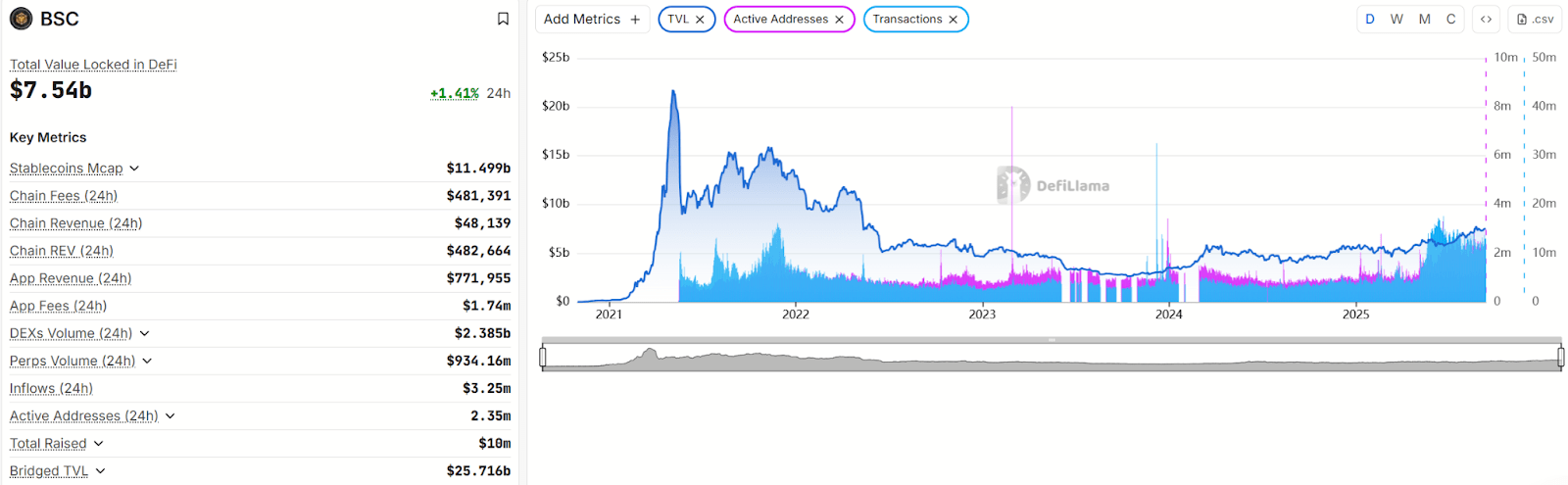
1. Overview of On-Chain Data: Users and Transactions Lead. As of September 2025, BNB Chain (including BSC mainnet and opBNB) has shown strong performance in multiple indicators: the number of daily active addresses remains in the millions, with the average daily transaction volume on the BSC mainnet fluctuating between 10 million and 15 million. Statistics show that on a single day in September 2025, the number of transactions reached 13.72 million, an increase of over 330% compared to a year ago. The cumulative total number of on-chain transactions has reached hundreds of billions. In terms of the number of on-chain addresses, BNB Chain has accumulated over 630 million unique addresses, an increase of about 34% compared to the same period in 2024. Additionally, BNB Chain is one of the networks with the highest decentralized trading volume: from 2023 to 2024, it has frequently surpassed Ethereum in average daily DEX trading volume. In terms of the circulating market value of stablecoins, the BSC chain once reached a scale of over 10 billion USD. The data above indicates that BNB Chain is far ahead of most public chains in terms of user base and on-chain transaction frequency, achieving large-scale participation from the general public.
2. Performance and Cost: Advantages of High Throughput and Low Fees. BNB Chain has chosen a performance-first development route. The BSC mainnet adopts the PoSA (Proof of Staked Authority) consensus, with only 21 active validating nodes (approximately 40-50 total candidate nodes) elected by token holders. This allows BSC to compress the block interval to about 0.75 seconds, processing a large number of transactions in parallel. While Ethereum has transitioned to PoS, it requires consensus confirmation from the entire network, with block times around 12 seconds. Although Solana claims high TPS, its complex PBFT consensus and extremely high hardware requirements have led to multiple network outages. Currently, BNB Chain's peak TPS has reached thousands, with plans to expand to 20,000 TPS in the future. In terms of transaction fees, BNB Chain maintains very low transaction fees of around $0.001-$0.01 by reducing the Gas cap and increasing block Gas capacity, significantly lowering the user entry barrier. Additionally, in recent years, BNB Chain has also balanced performance and decentralization, proposing a plan to expand the number of validators to 100, introducing a 'Balanced Mining' reward model and a validator reputation system to enhance network security and decentralization levels. Overall, in terms of performance/cost dimensions, BNB Chain still maintains a leading user experience, providing a foundation for winning the mass market in competition.
3. Decentralization and Compliance: Trade-offs Compared to Competitors. BNB Chain has long been controversial regarding its level of decentralization. Although its validating nodes are not directly operated by Binance, the vast majority have close ties with Binance, and decision-making governance also shows signs of Binance's influence. Therefore, some argue that BNB Chain resembles a 'company chain' rather than being neutral like Ethereum. This centralization has also brought about efficient execution and resource allocation in recent years, allowing for rapid expansion of the BNB Chain ecosystem. In contrast, Ethereum is known for its decentralization and security, boasting the highest number of developers globally and the richest DeFi blue-chip projects. However, its high Gas fees and slow scaling issues are prominent, necessitating reliance on Layer 2 solutions to accommodate the general public. Solana follows a different technological route than BNB Chain: it is not EVM compatible but operates independently, achieving high TPS and low fees through innovative consensus while maintaining a relatively high level of decentralization with thousands of nodes participating. However, the Solana network has experienced multiple outages since 2021, raising concerns; fortunately, by 2023, Solana's performance gradually stabilized and regained development momentum through explorations in U.S. stock settlement and decentralized social media. Base, launched by Coinbase in 2023, is an Ethereum Layer 2 network that emphasizes compliance and attracting millions of exchange users. However, Base is currently still primarily operated by Coinbase as the sole sequencer, and its actual level of centralization is comparable to BSC, with its ecosystem still in the early stages and projects being few. Nevertheless, with compliance licenses and the U.S. market backing it, Base is poised to carry institutional and compliant assets in the future, making it a strong competitor to BNB Chain.
4. Ecological Features: Democratized User Structure. The BNB Chain ecosystem exhibits a distinct 'democratized' characteristic: users are largely retail investors from emerging markets, favoring low-threshold, high-yield applications. This is evident from the popularity of meme coins and games on BSC. Many young investors from Southeast Asia, South Asia, and Latin America participate in the speculative boom on BSC through wallets like Trust Wallet. In contrast, Ethereum has a higher concentration of high-net-worth participants and institutions, emphasizing asset security and rational returns. The Solana community tends to lean towards tech geeks, NFTs, and meme players from Europe and the U.S. Base, backed by Coinbase, has also attracted many compliant users from Europe and the U.S. The community distribution of BNB Chain is broader, with a large user base in Asia, especially China and Southeast Asia, as well as users from Turkey, Russia, and Africa, where there is a strong demand for low-fee environments. In terms of user behavior, small-value high-frequency trading is very common on BNB Chain, with many users engaging in swaps, yield farming, and chain games daily, leading to frequent on-chain interactions, contrasting with the occasional large transactions of high-net-worth users on Ethereum.
Overall, BNB Chain has a leading advantage in terms of user scale and overall activity. However, in terms of developer ecology and innovative original projects, Ethereum remains the industry's source, and Solana and others are also on the rise. Many early BSC projects are primarily forks, with few truly groundbreaking protocols. Additionally, regulatory and compliance risks are unavoidable issues for BNB Chain—due to its association with Binance, BNB Chain's development is often affected by the regulatory pressures encountered by Binance as a whole. In contrast, Base and others are favored more by regulatory agencies. In scenarios requiring compliance, such as RWA, although BNB Chain has taken the lead in layout, whether it can gain recognition from regulators in various countries remains to be seen. BNB Chain is seeking a 'de-Binance' community governance transformation, but in the short term, Binance's support remains an important pillar of its ecosystem.
4. Binance Alpha and Web3 Wallet Boosting BNB Chain's Ecological Prosperity
The Binance wallet and Alpha platform have lowered the barriers for users to participate in on-chain trading, bringing a large number of assets that were originally on centralized platforms onto the chain, significantly boosting the activity and liquidity of on-chain funds on BNB Chain. The innovative TGE + airdrop model of Binance Alpha effectively activates the participation enthusiasm of existing users. Alpha combines a points reward system with an airdrop speed competition mechanism to encourage users to engage deeply in early project stages. This approach enhances user stickiness and helps new projects gain a large following right from the start.
1. Growth of On-Chain Users: Exchange Traffic and Increased User Activity
At the beginning of 2025, after Binance launched its built-in Web3 wallet and upgraded the Alpha platform, the number of users on BNB Chain saw a significant increase. On one hand, Binance directed a massive number of CEX users to the chain with a low barrier: users can activate the Binance Web3 wallet with one click in the Binance App to directly access BNB Chain's DApps and DeFi services. This seamless connection lowered the entry barrier for Web2 users into Web3, greatly expanding the user base of BNB Chain. In the first quarter of 2025, the number of new users of the Binance Web3 wallet exceeded 2 million, with about 40% of users first encountering and using BNB Chain through participating in Binance Alpha's token generation event (TGE). Thanks to this, the number of daily active addresses on BNB Chain continuously set new highs in 2025: the average daily active addresses rose from about 1.2 million at the beginning of the year to 1.6 million in Q2, and daily transaction volume surged from 6 million to over 15 million, approaching 2 million active addresses. The effect of centralized exchanges leading to on-chain user conversion is quite significant: one-click wallet access enabled millions of former Binance users to become participants on BNB Chain, driving a leap in on-chain user scale and activity.
2. On-Chain Funding Activity and TVL Trends
The launch of Binance Alpha and the Web3 wallet has also brought considerable incremental funding to BNB Chain, reflected in the increase in TVL and decentralized trading activity. In Q2 2025, the total locked value of DeFi on BNB Chain rose to about $9.9 billion, a 14% increase from the previous quarter. An important reason for this is the new projects launched by Binance Alpha attracting a large influx of on-chain funds. For example, the token issuance conducted through the Alpha platform attracted the locking of 3,200,000 BNB, equivalent to nearly $100 million, significantly boosting the capital accumulation on BNB Chain. At the same time, on-chain trading liquidity reached new highs: during Q2 2025, the average daily trading volume of DEXs across BNB Chain reached $3.3 billion, ranking first among all blockchains. To accommodate the surge in trading volume, BNB Chain underwent a network upgrade in the first half of 2025, reducing the average Gas fee by 90% to around 0.1 gwei and shortening the block production time to 0.75 seconds, effectively ensuring stable low-fee operation under high concurrent transactions. These measures further incentivized users to keep their assets on-chain to participate in DeFi and trading, creating a virtuous cycle.
3. Increased DApp Activity: User Interaction and Gas Consumption
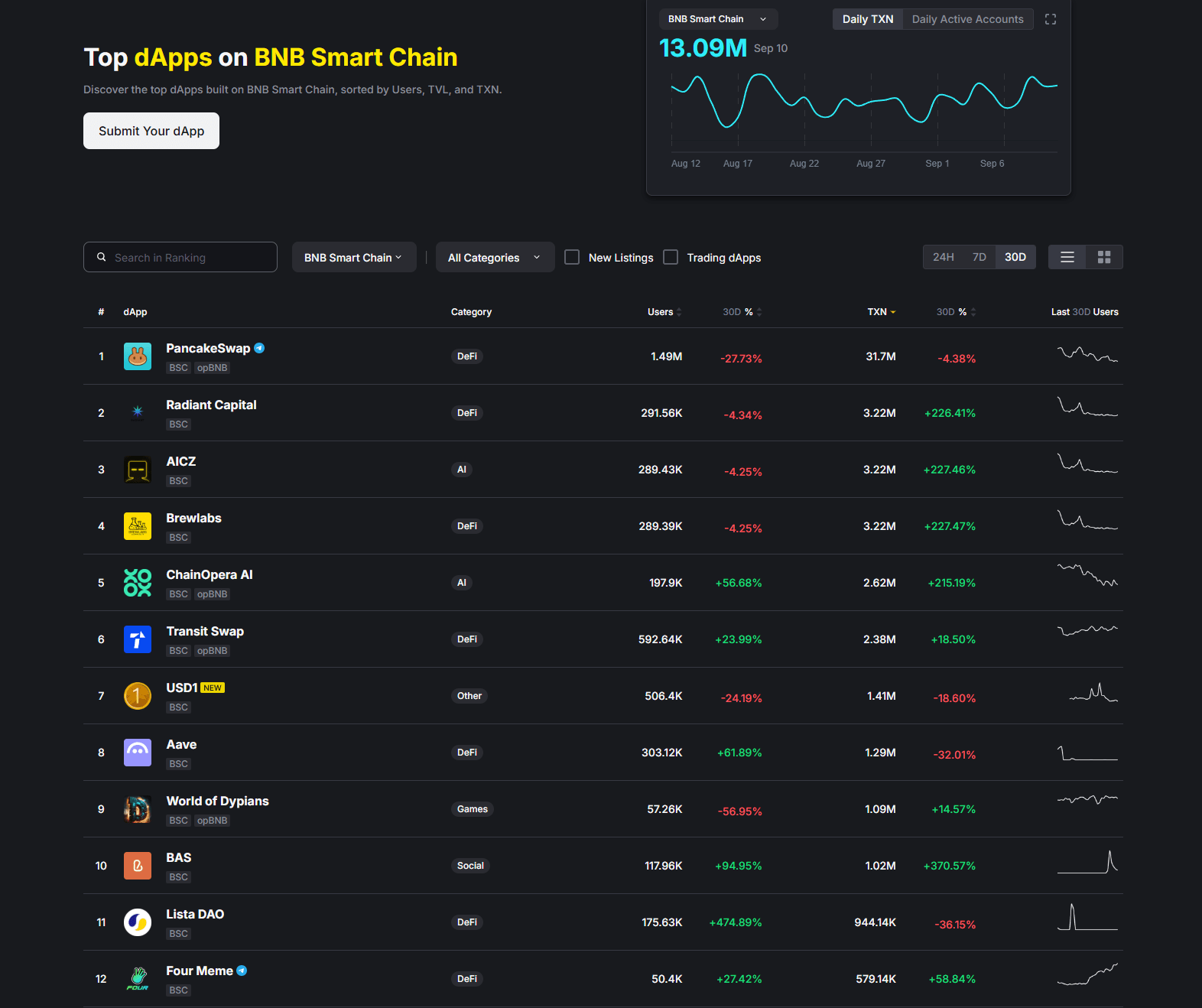
With the popularization of Binance Alpha platform and wallet, the activity of DApps on BNB Chain has significantly increased. After a large influx of new users onto the chain, the number of users and interaction frequency of various DApps have both risen: in the first half of 2025, the average daily transaction volume on BNB Chain more than doubled compared to 2024, reaching nearly ten million. PancakeSwap remains the king of on-chain traffic, contributing about 85% of BNB Chain's DEX trading volume. The Four.Meme protocol, born from the meme coin wave, once generated $747,000 in fee revenue within 24 hours, close to one-fifth of PancakeSwap, making it one of the highest-fee-earning protocols on BNB Chain. The increase in user interaction frequency is also reflected in the change in on-chain Gas consumption rankings: in addition to traditional high Gas contracts like DEX and lending, meme coin-related contracts and airdrop interaction contracts have begun to occupy a significant proportion, indicating a more diversified range of user activities on the chain. opBNB, as the rollup network for BNB Chain's expansion, also attracted a certain amount of traffic after its mainnet launch in mid-2025, with cross-chain bridge inflow funds rapidly increasing—the cross-chain TVL reached approximately $64.9 million in the first half of the year. As opBNB provides lower Gas fees and higher TPS, many gaming and social DApps have begun to deploy on it, adding vitality to the overall BNB Chain ecosystem.
Source: https://dappbay.bnbchain.org/ranking
4. The Resurgence and Impact of Meme Coins
At the beginning of 2025, a new wave of meme coin fervor ignited in the Binance community, injecting tremendous vitality and traffic into the BNB Chain ecosystem. In February, CZ casually mentioned the name of his pet 'Broccoli' on the X platform, and the community immediately responded by launching a meme token of the same name, with trading volume soaring to $30 million within two days. In March, CZ symbolically purchased the new tokens 'MUBARAK' and 'TEST' with 1 BNB, which the market viewed as a signal. As a result, MUBARAK's market capitalization skyrocketed from a mere $6,000 to $200 million within 48 hours, an increase of 25,000%, while TEST's market cap surged to $50 million. He Yi promoted the artistic meme coin BUBB on social media, sparking discussions, causing BUBB's market cap to surge from $3 million to $34 million, an increase of over tenfold. This meme frenzy led to explosive growth in on-chain users and transactions: during the 'Meme Season' of February and March, the average daily transaction volume on BNB Chain briefly exceeded 4 million, and the number of active addresses rose to around 4.4 million. To respond to and guide this trend, the BNB Chain Foundation established a 'Meme Coin Support Program,' incorporating it into a new ecological incentive category. This meme coin craze can be said to have brought unprecedented community excitement to the BNB Chain ecosystem in the first half of 2025, attracting many new users and prompting the official response to leverage resources to transform short-term speculation into long-term retained users and project resources.
5. Empowerment of AI, RWA, GameFi, and Other Tracks
The Binance Alpha platform and its wallet ecosystem introduced incremental traffic and funding to multiple key tracks of BNB Chain in 2025.
AI Track: Binance Alpha has selected a batch of AI + blockchain projects to launch, making BNB Chain a major incubator for AI track projects. For example, SIREN launched on Alpha is an AI-driven meme coin concept project that has sparked discussions in the community. Additionally, BNB Chain's official MVB accelerator and hackathons have also prioritized AI as a key direction, providing funding and technical support for AI startups. It is foreseeable that as the Alpha selection mechanism matures, more quality projects in the AI track will stand out through the BNB Chain ecosystem.
RWA Track: In May 2025, Binance launched a special incentive program for RWA, allocating millions of dollars to subsidize compliant asset issuance on-chain. This greatly facilitates the tokenization of traditional assets on BNB Chain. For instance, BlackRock’s on-chain treasury fund (BUIDL) has attracted a scale of $2.87 billion on BNB Chain, and Ondo Finance's treasury yield token OUSG has locked in $446 million.
GameFi and Other Web3 Hotspots: Binance's $100 million ecological fund, launched at the end of 2024, not only invests in DeFi and meme but also focuses on supporting games, social applications, and more. In the first half of 2025, several new GameFi games were tested on BNB Chain, gaining early user feedback on the Alpha platform, with some outstanding projects later landing on Binance Launchpad or mainboard trading. Additionally, BNB Chain has also funded DeSci projects that utilize blockchain to raise research funding and share outcome data. Although these applications are still in their early stages, they indicate that the BNB Chain ecosystem is extending into broader Web3 application fields.
In 2025, nearly half of the new trading pairs launched by Binance first appeared on the Alpha platform, making Alpha a reliable filter for selecting quality Web3 projects. Once these projects incubated by Alpha transition to Launchpad or go public directly, they often perform impressively, injecting fresh blood and investment opportunities into the BNB Chain ecosystem. The combination of Binance's Alpha platform and Web3 wallet has brought significant incremental users and funding to BNB Chain through capital support + traffic introduction + innovative gameplay. Not only has it incubated a batch of high-potential new projects, but it has also driven the success of projects on Launchpad/Launchpool, achieving a win-win for ecological prosperity and Binance platform development.
5. Conclusion and Outlook
From its launch in 2020 to forming a global and diverse ecosystem by 2025, BNB Chain has gone through a brilliant journey in five years. Along the way, there were both bright moments and the tempering of low valleys. Today’s BNB Chain ranks among the industry leaders in terms of daily active users and transaction volume, with sectors such as DeFi, GameFi, and RWA all thriving, giving rise to phenomenal applications like PancakeSwap and Four.meme, and establishing a large and diverse community foundation. In competition with rivals like Ethereum, Solana, and Base, BNB Chain has won favor in the mass market due to Binance's strong support and its own performance and cost advantages.
Looking ahead to the next five years, BNB Chain needs to focus on several areas to achieve 'new heights':
First, continuous technological upgrades are the foundation, and only by maintaining high performance and enhancing decentralization and developer friendliness can more quality DApps be attracted.
Secondly, ecological innovation and originality are the source of long-term vitality. BNB Chain needs to produce innovative projects that belong to its own paradigm, rather than merely following Ethereum's successful model.
Furthermore, compliance and mainstream acceptance will be key factors in determining how far BNB Chain can go. It needs to actively embrace compliance and participate in setting industry standards, making BNB Chain a blockchain infrastructure that traditional institutions are willing to use.
Finally, community governance and independence cannot be ignored. As Binance potentially faces regulatory restrictions, BNB Chain must be capable of 'weaning' itself to form a truly community-driven governance system; only then can it earn broader trust within the industry.
As the BNB Chain official blog states: 'The past five years have proven that anything is possible, and the next five years will set industry standards.' After five years of refinement, BNB Chain is ready to write more possibilities in the next five years.
About Us
Hotcoin Research, as the core research institution of Hotcoin Exchange, is committed to turning professional analysis into your practical tool. Through (Weekly Insights) and (In-Depth Research Reports), we dissect market trends for you; leveraging exclusive columns (Hotcoin Selection) (AI + Expert Dual Screening), we identify potential assets to reduce trial and error costs. Each week, our researchers will also interact with you live, interpreting hot topics and predicting trends. We believe that warm companionship and professional guidance can help more investors navigate cycles and seize the value opportunities of Web3.
Risk Warning
The cryptocurrency market is highly volatile, and investing carries risks. We strongly advise investors to invest only after fully understanding these risks and under a strict risk management framework to ensure the safety of their funds.
Website: https://lite.hotcoingex.cc/r/Hotcoinresearch
X: x.com/Hotcoin_Academy
Mail: labs@hotcoin.com