

The robotics conversation often starts with model quality, speed, and demonstration videos. Those matter, but they are not enough for real operations. The harder question is reliability at network scale: when robots perform tasks across different operators and environments, who verifies outcomes, who resolves disputes, and how are rules upgraded without trusting one private coordinator?
Fabric Foundation's framing is interesting because it treats those questions as protocol design, not post-launch patchwork. The architecture discussion around Fabric focuses on identity rails, challenge-based verification, validator participation, and policy governance inside one open coordination stack. In practical terms, that means robot work can be checked, challenged, and settled through explicit mechanisms instead of closed dashboards.
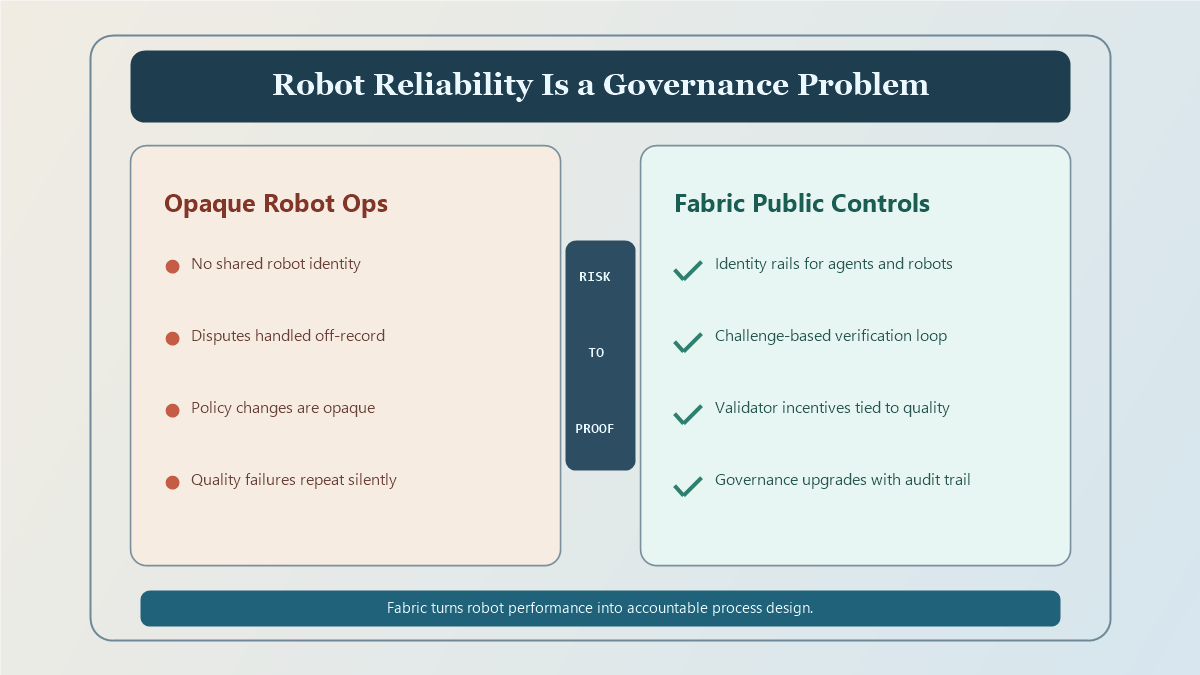
From a builder perspective, this is the difference between "a robot that can do something once" and "a robot economy that can run repeatedly with measurable trust." Teams need more than capability. They need auditable logs, economic penalties for bad behavior, and upgrade paths for safety policies as edge cases appear. Fabric's public-mechanism approach is aligned with that operational reality.
$ROBO is relevant in this context because the token is positioned as utility and governance infrastructure for network activity, not as a narrative placeholder. If execution stays disciplined, the protocol can become a shared reliability substrate where participants coordinate incentives around verified outcomes.
The key watchpoint now is implementation quality over time: onboarding developers, maintaining validator integrity, and proving that dispute processes remain usable under real load. But the direction is clear and worth attention. Robot capability is only half the story; robust coordination architecture is the other half.