


Yesterday, a friend of mine who works in mining in Siberia posted on his WeChat Moments: He received his Russian conscription notice.
This is not a joke; it is the most surreal reality of 2026.
Those Chinese who left China to mine Bitcoin back then are now facing a deadly choice: either pack up their machines and leave, or pick up a gun and go to the front lines.
Want to legally mine for rubles in Russia? First, take a trip to the crossfire zone.
Heaven turned into hell with just a single decree.
After China shut down cryptocurrency mining in 2021, countless miners fled to Siberia with their equipment. Electricity there costs only a few cents, and the natural low temperatures make it a mining paradise.
But Putin's Presidential Decree No. 821 turned paradise into hell overnight.
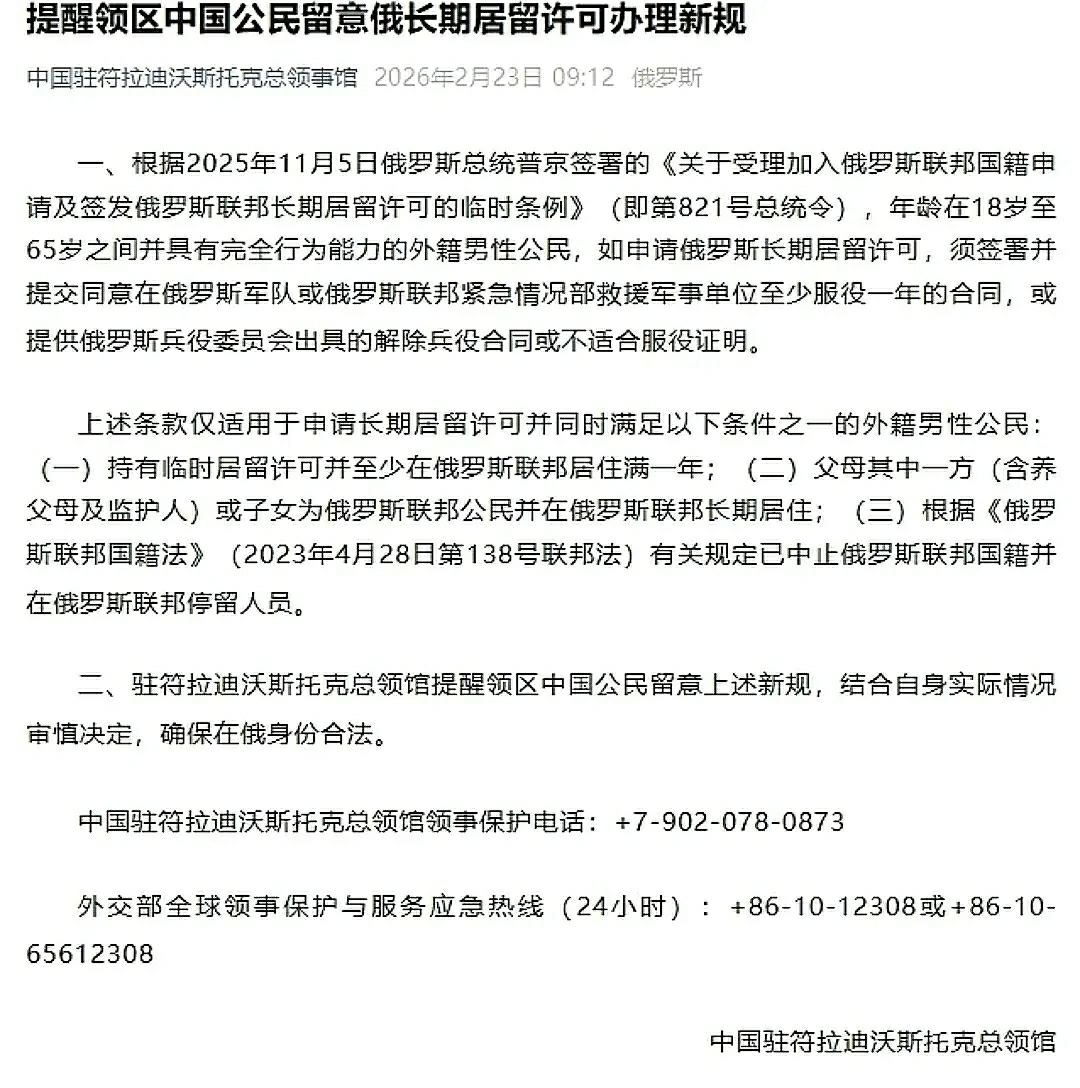
The law is simple: foreign men aged 18 to 65 who want a long-term residence permit in Russia must serve in the Russian military for at least one year.
You think you're there to mine Bitcoin, but in the eyes of wartime machines, you're the "mine."
A three-step killing scheme specifically designed to prey on foreign miners.
This was not a spur-of-the-moment decision, but a meticulously planned series of traps.
Step 1: Luring them out. In 2024, Russia legalized cryptocurrency mining, requiring large-scale miners to register with their real names and report their wallet addresses and income. Failure to report resulted in fines and confiscation of equipment.
Step Two: Identity Lockdown. To legally register for mining, a Russian long-term residence permit is required. This is the most insidious move in the entire operation.
Step Three: Strike at the heart of the problem. With the new law taking effect in 2026, the conditions for obtaining a residence permit have changed: either submit a military service contract or prove you are unfit for military service.
The closed loop is locked. To mine legally, you need to register with your real name; to register with your real name, you need a residence permit; to get a residence permit, you need to be prepared to go to the front lines.
First, they lure you into revealing yourself with the bait of legalization, then they force you to comply with the law with severe penalties, and finally they use a residence permit to turn you into a source of soldiers.
The gray area is also disappearing.
Since obtaining long-term residency is risky, would it be feasible to rely on business visas for guerrilla-style travel?
The answer is no. This path is also blocked.
In February 2025, Russia's "Register of Controlled Persons" came into effect, meaning that if a visa issue arises, bank accounts will be instantly seized and controlled. Police can arrest and deport individuals within 48 hours.
Even more drastic is the new criminal law, which defines illegal mining as a criminal offense, punishable by up to five years in prison. Previously, it was at most considered a violation; now, it leads directly to jail.
The new law in February 2026 is even more extreme: courts can directly confiscate mining equipment and Bitcoin.
People, actions, assets, and hiding places—all four paths are blocked.
The power is out.
Even if they manage to secure their identities and weather the risks, the electricity supply won't be able to keep up.
By the end of 2024, mining had consumed 1.5% of Russia's total electricity, causing grid overload in many areas. With people needing heating and infrastructure maintenance, these "electricity giants" naturally became the first targets for crackdown.
Even BitRiver, Russia's largest mining company, couldn't withstand the pressure. It wasn't the price of Bitcoin that defeated it, but rather the combination of legal debt collection, account freezes, and regional power rationing.
Foreign miners? Under the triple strangulation of immigration restrictions, energy controls, and asset confiscation, they will be the first to be sacrificed.
Computing power cannot compete with the state apparatus
When they withdrew from China in 2021, everyone was betting that: with the emperor far away, as long as there was electricity, they could survive.
Four years later, the facts have given a harsh answer: you can outrun the regulations of one country, but you can't outrun the conscription order of another.
The miners and machines still in Siberia are running out of time.
In the story of global miner migration, Russia's chapter is coming to an end. Where will they go next? Nobody knows.
But one thing is certain: there is no eternal mining paradise in this world.
