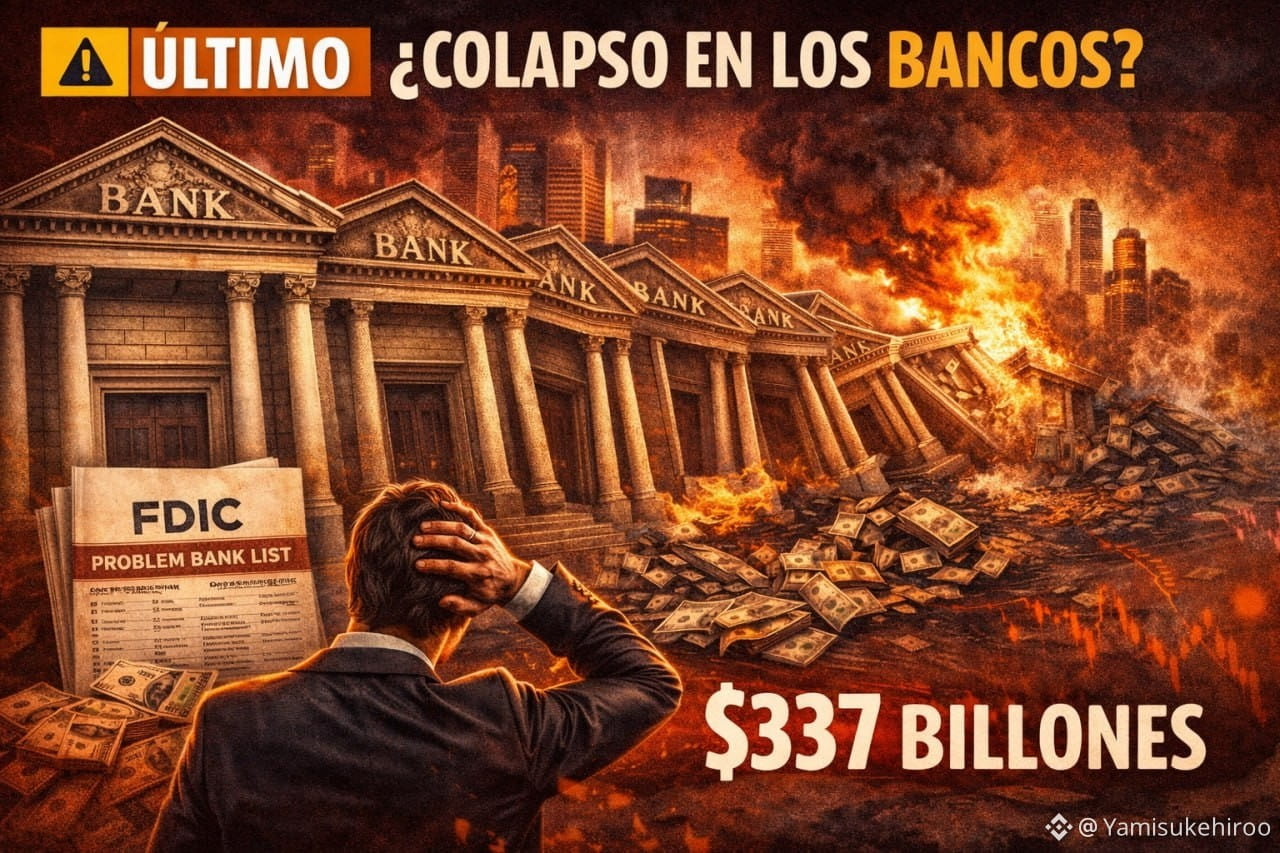
⚠️LAST⚠️
IS THERE A COLLAPSE AND DOMINO EFFECT IN BANKS?
👉The banking system is once again under strain:
🏦 Previously, we saw that there are 57 banks on the FDIC's "problematic" list.
🩸 The system has accumulated USD 337.000 billion in unrealized losses.
🩸 It has been 14 consecutive negative quarters, matching the streak of 2006-2009.
🩸 That figure is 6 times greater than the peak in 2008.
Why is this happening⁉️ There are several issues to consider:
▪️ Many banks bought bonds when rates were low.
▪️ The aggressive rate hike collapsed the value of those bonds.
▪️ As long as they don't sell, the loss is "accounting".
▪️ If they need liquidity and sell… the loss becomes real.
💀On January 30, 2026, Metropolitan Capital Bank & Trust in Chicago collapsed.
💀It was small, with $261 million in assets.
💀The FDIC transferred the deposits and there were no losses for clients.
👉It is not a mass contagion. But it does revive nerves.
Where is the real risk⁉️
🏢 Commercial Real Estate (CRE).
▪️ In 2026, $936.000 billion in commercial real estate debt matures.
▪️ The problem: many of these loans were taken out with interest rates of 3% or 4%.
▪️ When renewing them today, banks demand rates of almost double, and many buildings are no longer worth what they were before, so owners cannot refinance.
▪️ On the other hand, delinquency in offices is approaching 12%... In many cities, office vacancy has exceeded the levels of the 2008 financial crisis due to hybrid work.
▪️ Additionally, some buildings are selling at discounts of 50-70% compared to pre-pandemic values.
👉The problem is the concentration.
👉Regional banks have 5 times more exposure to CRE than large banks.
👉In some cases, real estate loans are equivalent to 300-400% of their capital...
👉A single failed loan can destabilize the entire balance.
👉In fact, the bank that collapsed in January fell largely due to a problematic loan of USD 4.5 million.
IS THERE A COLLAPSE AND DOMINO EFFECT IN BANKS?
👉The banking system is once again under strain:
🏦 Previously, we saw that there are 57 banks on the FDIC's "problematic" list.
🩸 The system has accumulated USD 337.000 billion in unrealized losses.
🩸 It has been 14 consecutive negative quarters, matching the streak of 2006-2009.
🩸 That figure is 6 times greater than the peak in 2008.
Why is this happening⁉️ There are several issues to consider:
▪️ Many banks bought bonds when rates were low.
▪️ The aggressive rate hike collapsed the value of those bonds.
▪️ As long as they don't sell, the loss is "accounting".
▪️ If they need liquidity and sell… the loss becomes real.
💀On January 30, 2026, Metropolitan Capital Bank & Trust in Chicago collapsed.
💀It was small, with $261 million in assets.
💀The FDIC transferred the deposits and there were no losses for clients.
👉It is not a mass contagion. But it does revive nerves.
Where is the real risk⁉️
🏢 Commercial Real Estate (CRE).
▪️ In 2026, $936.000 billion in commercial real estate debt matures.
▪️ The problem: many of these loans were taken out with interest rates of 3% or 4%.
▪️ When renewing them today, banks demand rates of almost double, and many buildings are no longer worth what they were before, so owners cannot refinance.
▪️ On the other hand, delinquency in offices is approaching 12%... In many cities, office vacancy has exceeded the levels of the 2008 financial crisis due to hybrid work.
▪️ Additionally, some buildings are selling at discounts of 50-70% compared to pre-pandemic values.
👉The problem is the concentration.
👉Regional banks have 5 times more exposure to CRE than large banks.
👉In some cases, real estate loans are equivalent to 300-400% of their capital...
👉A single failed loan can destabilize the entire balance.
👉In fact, the bank that collapsed in January fell largely due to a problematic loan of USD 4.5 million.