

In early 2026, the global financial market experienced a 'massacre of precious metals' that was significant enough to be recorded in history. On January 29, gold and silver both soared to historical highs—gold prices reached $5,595 per ounce, while silver prices broke through $120.46. However, just a few days later, the market underwent a dramatic shift, with gold plunging 12% in a single day, and silver experiencing a catastrophic drop of 35%-37% in just one day, wiping out approximately $7 trillion in market value in a single trading day.
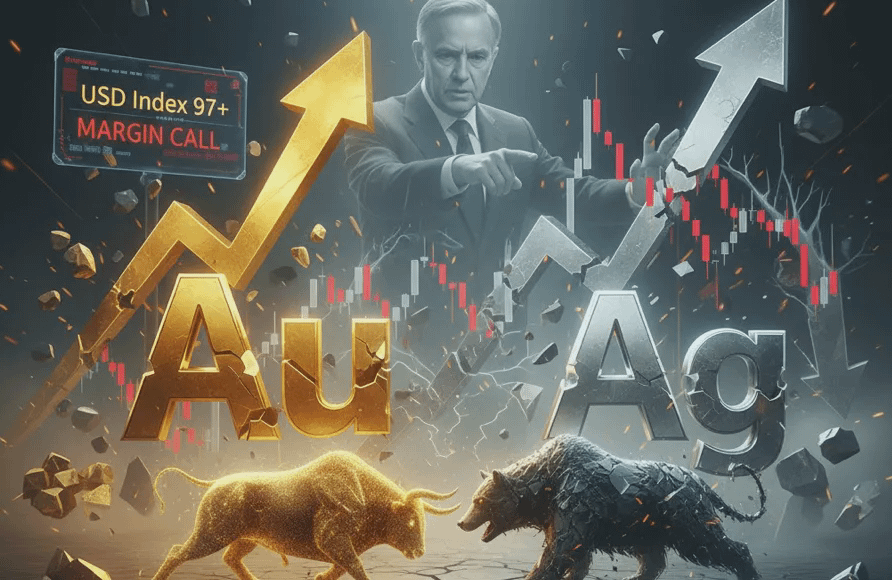
This is not a simple technical callback, but an extreme event of '7-Sigma' (seven standard deviations) triggered by the three factors of policy, geography, and mechanism.
1. Peak moment: Why can gold and silver rise to the point of 'questioning life'?
Before the crash, the crazy rise in precious metals stemmed from a deep erosion of fiat currency credit.
Sovereign debt crisis erupts: The U.S. national debt has risen to an astonishing scale of 38 trillion dollars, and the market's distrust of the dollar's long-term purchasing power has prompted funds to flow into the 'ultimate safe haven.'
Central bank strategic accumulation: Emerging market central banks, led by China and Turkey, have shown strong 'de-dollarization' demand in early 2026, with gold prices continuously breaking records supported by nearly 800 tons of physical buying from central banks each year.
The 'physical' gap in the silver market: Silver is experiencing its sixth consecutive year of supply shortages. The expansion of AI computing hardware and the popularity of N-type photovoltaic cell technology have created rigid demand for silver, which has seen a monthly increase of up to 54% in January.
2. The 'trigger' for the crash: the Fed's hawkish nomination and the 'Warsh effect'.
The direct trigger for the crash was a major nomination by the leadership of the Federal Reserve (Fed). On January 30 at 1:45 PM EST, Trump announced the nomination of Kevin Warsh as the next chairman of the Federal Reserve.
A 180-degree turn in policy expectations: previously, the market bet that the White House would force the Federal Reserve to lower interest rates indefinitely and tolerate high inflation. However, Warsh is a staunch 'monetary hawk,' advocating that 'tapering takes precedence over rate cuts' and emphasizing the international reserve status of the dollar.
The 'resurrection' of the dollar: After the news of Warsh's nomination, the dollar index (DXY) rebounded sharply, breaking through the 97 mark. For non-interest-bearing assets like gold and silver, a stronger dollar means an increase in holding costs and risk premiums, turning hundreds of billions of speculative long positions betting on a 'dollar collapse' into lambs waiting to be slaughtered.
3. Geopolitical 'fever reduction': the rapid return of safe-haven premiums.
In addition to the impact of policy, unexpected shifts in geopolitical situations have withdrawn the 'safe haven base' from the market. In the same week that prices peaked, the U.S. government revealed that it had contacted Iran through various channels, confirming that both sides intended to explore the framework of a nuclear agreement through diplomatic means, leading to a rapid cooling of the situation in the Middle East. The 'war premium' that had entered the gold and silver markets due to fears of regional war was quickly liquidated, with funds flowing from precious metals to previously oversold tech stocks and dollar assets.
4. The 'driving force' behind the crash: the violent increase in exchange margin requirements.
Although the fundamentals have changed, the real devil behind the 30% or more decline in gold and silver (especially silver) lies in the trading mechanism.
Reform of the margin system: The Chicago Mercantile Exchange (CME) changed the margin from a 'fixed amount' to 'a certain percentage of the total contract value' in January 2026.
Deadly 'margin calls':
On January 30, the CME raised the margin ratios for gold and silver futures to 8% (gold) and 15% (silver), respectively.
For speculators fully invested at high levels, this means they must pay tens of millions of dollars in margin within hours.
The 'death spiral' of mutual liquidation: Due to the market capacity of silver being only one-tenth that of gold, liquidity is extremely weak. When the first batch of accounts could not meet margin calls and were 'forced to liquidate' by the system, the resulting sell orders drove down prices, triggering more stop-loss orders, leading to a crash dominated by algorithmic trading. Silver triggered $38 billion in chain stop-loss orders in just 28 minutes.
5. Gold vs. Silver: Why is the difference in declines so huge?
Many investors are confused as to why gold has fallen by about 10%, while silver has dropped by nearly 40%.
Differences in buyer structure: Gold has global central banks as 'structural bottom feeders.' When gold prices fell below $5,000, central bank buying provided strong support.
The density of speculative leverage: the proportion of retail speculative funds in the silver market is much higher than that in gold. The silver RSI indicator once reached 91, indicating that the market was extremely overbought, and the severity of the 'bull squeeze' naturally increased exponentially.
The return of the gold-silver ratio: before the crash, the gold-silver ratio dropped to as low as 45:1, the lowest level in 14 years, indicating that silver was severely overvalued relative to gold. After the crash, the gold-silver ratio quickly rebounded to above 60, which was actually a normal valuation correction.
6. Outlook for the future: Is it a bubble burst or an investment opportunity?
The current crash resembles a 'big washout' for highly leveraged speculators, rather than the end of a bull market.
Where is the bottom? Technically, gold shows strong support around $4,400 (50-day moving average), while silver has stabilized in the $70-75 range and attracted a large amount of physical buying.
Long-term logic remains unchanged: regardless of who runs the Federal Reserve, America's debt problem cannot be solved in the short term, and the industrial consumption of silver due to the AI and energy revolution is a hard reality. JPMorgan still maintains a target price forecast of $6,300 for gold and $125-133 for silver this year.
Investment advice: For readers, the lesson from this incident is to 'respect leverage.' Physical precious metals or unleveraged ETFs (like PSLV) remain effective tools for coping with long-term currency depreciation, but in years with volatility up to 7-Sigma, any high-leverage operations are tantamount to suicide. The current deep correction may represent the best entry ticket for long-term investors without positions in 2026.