


Author: 0xjacobzhao | https://linktr.ee/0xjacobzhao
Undoubtedly, Pendle is one of the most successful DeFi protocols in this round of the Crypto cycle. While many protocols have stagnated due to liquidity depletion and narrative retreat, Pendle has successfully become the 'price discovery venue' for yield-bearing assets, thanks to its unique yield splitting and trading mechanism. By deeply integrating with stablecoins, LST/LRT, and other yield-bearing assets, it has established its unique positioning as the 'DeFi Yield Rate Infrastructure'.
In the report (The Intelligent Evolution of DeFi: The Evolution Path from Automation to AgentFi), we systematically sorted and compared the three stages of intelligent development in DeFi: Automation Tools, Intent-Centric Copilot, and AgentFi (On-chain Agents). Besides the two most valuable and easily applicable scenarios of Lending and Yield Farming, in our advanced conception of AgentFi, Pendle's PT/YT yield rights trading is regarded as a highly aligned high-priority application for AgentFi. Pendle, with its unique 'Yield Splitting + Expiration Mechanism + Yield Rights Trading' structure, provides natural strategy orchestration space for agents, enriching the possibilities for automated execution and yield optimization.
1. The basic principles of Pendle
Pendle is the first protocol in the DeFi space focused on yield splitting and trading. Its core innovation lies in tokenizing and separating the future yield streams of on-chain yield-bearing assets (such as LSTs, stablecoin deposit certificates, and lending positions), allowing users to flexibly lock in fixed yields, amplify yield expectations, or engage in speculative arbitrage in the market.
In short, Pendle has built a secondary market for the “yield curve” of crypto assets, allowing DeFi users not only to trade “principal” but also to trade “yields.” This mechanism is highly similar to zero-coupon bonds + coupon splitting in traditional finance, enhancing the pricing accuracy and trading flexibility of DeFi assets.
Pendle's yield splitting mechanism
Pendle splits a yield-bearing base asset (Yield-Bearing Asset, YBA) into two tradable tokens:
PT (Principal Token) represents the principal value that can be redeemed at maturity but does not accrue yield.
YT (Yield Token) represents all yields generated by the asset before maturity but will be zeroed out after maturity.
For example, depositing 1 ETH stETH will be split into PT-stETH (redeemable for 1 ETH at maturity, principal locked) and YT-stETH (receiving all staking yields before maturity).
Pendle is not merely a token split; it also provides a liquidity market for PT and YT through a specially designed AMM (Automated Market Maker) (equivalent to the secondary liquidity pool of the bond market). Users can buy or sell PT or YT at any time to flexibly adjust their yield risk exposure; among them, the price of PT is usually lower than 1, reflecting its “discounted principal value,” while the price of YT depends on market expectations of future yields. More importantly, Pendle's AMM has been optimized for assets with maturity dates, allowing different maturities of PT/YT to form a yield curve in the market, highly similar to traditional financial bond markets.
It is important to note that among Pendle's stablecoin assets, PT (Principal Token, fixed income position) is equivalent to a chain bond, locking in fixed rates through discounts at the time of purchase and redeemable for stablecoins at maturity at a 1:1 ratio, providing stable returns with relatively low risk, suitable for conservative investors seeking certainty in returns; while the Stablecoin Pool (liquidity mining position) is essentially AMM market-making, with LP returns coming from fees and incentives, with a highly variable APY and accompanying impermanent loss risk, making it more suitable for active investors who can withstand volatility and seek higher returns. In actively trading and incentivized markets, Pool yields can significantly exceed PT fixed income; conversely, in quiet trading and insufficient incentives, Pool yields often fall below PT, and may even incur losses due to impermanent loss.
Project Stablecoin PT Stablecoin Pools Asset form Bond-type tokens (redeemable for stablecoins at maturity) AMM liquidity pool (PT+YT trading market) Yield source Fixed interest rate (principal discount locking) Trading fees + mining incentives Risk level Relatively low (close to risk-free fixed income) Relatively high (IL risk + liquidity risk) Suitable for people Seeking capital preservation with fixed income Wanting to earn trading fees and incentives, able to withstand volatility LP
The PT/YT trading strategy of Pendle mainly covers four major paths: fixed income, yield speculation, inter-period arbitrage, and leveraged yield, which can meet the investment needs of different risk preferences. Users can lock in fixed income by buying PT and holding it until maturity, equivalent to obtaining a fixed interest rate; they can also choose to buy YT, betting on rising yields or increased volatility for yield speculation. At the same time, investors can exploit price differences between different maturities of PT/YT for inter-period arbitrage or use PT and YT as collateral to layer lending protocols, thus amplifying yield exposure.
Boros's funding rate trading mechanism
In addition to yield splitting in Pendle V2, the Boros module further assetizes the funding rate, transforming it from merely the passive cost of perpetual contract holdings into an independently priced and tradable tool. Through Boros, investors can engage in directional speculation, risk hedging, or arbitrage opportunities, effectively introducing traditional interest rate derivatives (IRS, basis trading) into DeFi, providing new tools for institutional-grade fund management and steady yield strategies.
In addition to PT/YT trading, AMM pools, and the Boros funding rate trading mechanism, Pendle V2 also offers several extended features, although they are not the focus of this article, but still constitute important supplements to the protocol ecosystem:
vePENDLE: A governance and incentive model based on the vote-escrow mechanism, allowing users to obtain vePENDLE by locking PENDLE, thus participating in governance voting and enhancing yield distribution weight, which is central to the protocol's long-term incentives and governance.
PendleSwap: A one-stop asset exchange entry, helping users efficiently switch between PT/YT and native assets, enhancing the convenience of fund utilization and protocol combinability, essentially serving as a DEX aggregator rather than an independent innovation.
Points Market: Allows users to trade various project points in the secondary market in advance, providing liquidity for airdrop capture and point arbitrage, leaning more towards speculation and topical scenarios rather than core value.
2. The panoramic view of Pendle strategies: market cycles, risk layering, and derivative extensions
In traditional financial markets, retail investors' investment channels mainly concentrate on stock trading and fixed-income financial products, making it difficult for them to participate directly in high-threshold bond derivative trading. Correspondingly, in the Crypto market, retail users are similarly more inclined to accept token trading and DeFi lending. Although Pendle has greatly lowered the threshold for retail investors to enter “bond derivative” trading, its strategies still require a high level of expertise, necessitating investors to conduct in-depth analysis of the changes in the yield-bearing asset rates across different market environments. Based on this, we believe that in different market phases such as the early bull market, bull market frenzy, bear market downturn, and range-bound oscillation, investors should match differentiated Pendle trading strategies according to their own risk preferences.
Bull market rising phase: market risk appetite gradually recovers, lending demand and interest rates remain low, making YT pricing on Pendle relatively cheap. At this point, buying YT is equivalent to betting on future yield increases, and once the market enters an accelerated upward phase, both lending rates and LST yields will rise, thereby increasing the value of YT. This is a typical high-risk, high-return strategy suitable for investors willing to position early and capture amplified returns in a bull market.
During the bull market frenzy, high market sentiment drives a surge in lending demand, causing DeFi lending protocol rates to often climb from single digits to over 15-30%, boosting the value of YT on Pendle while PT shows significant discounts. At this point, if investors buy PT with stablecoins, it is equivalent to locking in high rates at a discount, redeemable 1:1 for the underlying asset at maturity, effectively hedging against volatility risk through “fixed income arbitrage” in the late bull market. The advantage of this strategy lies in its stability and rationality, ensuring fixed income and principal safety during market corrections or the onset of a bear market, but at the cost of giving up potentially larger gains from continuing to hold volatile assets.
During the bear market downturn, market sentiment is low, lending demand plummets, and interest rates fall sharply, with YT yields approaching zero, while PT performs more like a risk-free asset. At this point, buying PT and holding it to maturity means still being able to lock in a certain return in a low-interest environment, equivalent to establishing a defensive position; for conservative investors, this is the main strategy to avoid yield volatility and preserve principal.
In the range-bound oscillation phase, market interest rates lack trend, and market expectations diverge significantly, leading to frequent short-term misalignment or pricing discrepancies between Pendle's PT and YT. Investors can engage in inter-period arbitrage between different maturities of PT/YT or capture yield mispricing caused by market sentiment fluctuations to obtain stable spread returns. These strategies require higher analytical and execution capabilities and are expected to yield stable returns in a non-trending market.
Global perspective: Pendle strategy full market cycle comparison table
Market stage Market characteristics PT strategy YT strategy Stablecoin pool Arbitrage strategy Deep bear (low plateau) Extremely low interest rates, undervalued asset prices, cold sentiment Minimal significance (PT almost no discount) ✅ Best time: YT extremely cheap, betting on future interest rate recovery, leveraged yield flow (especially stETH) ⚪ Low yield, nearly idle positions ⚪ Limited interest spread, few opportunities Slow bear (gradual decline) Prices slowly decline, interest rates remain low, market lacks direction ⚪ Fixed income not high, average appeal ❌ YT lacks substance, potential for loss ✅ Defensive first choice: stablecoin pools preserve capital, relaxed mindset ⚪ Small-scale arbitrage can be performed across platforms, but with limited space Early bull market (upward rebound) Lending demand rises, interest rates begin to rise ⚪ PT starts to show discounts but not significant ✅ Strong explosive power: YT undervalued → interest rates rebound → yield leverage ⚪ Stablecoin pools are not as interesting as volatile asset pools ⚪ Can lay out PT fixed income vs floating interest rate differences Mid-bull market (accelerated increase) Interest rates rise significantly, sentiment warms ✅ Lock in fixed income: PT heavily discounted, locking in 10-20% annualized returns ✅ Yield doubles: YT price increases, continue to increase positions betting on rising interest rates ⚪ Fixed income opportunities are not as good as PT/YT ✅ Best period for arbitrage: Pendle fixed income vs Aave floating interest rate difference is significant Bull market frenzy (peak) Lending rates soar, market goes wild ✅ Best strategy: PT deeply discounted, locking in 20-30% fixed income ❌ High risk: YT premium too high, prone to losses ⚪ Stablecoin pool interest rates are high but not as attractive as PT ✅ Institutional plays: term arbitrage, cross-market arbitrage, low-risk profit locking Bull market pullback period Market reversal, interest rates fall rapidly ⚪ PT discount narrows, appeal weakens ❌ YT value drastically decreases, prone to zeroing out ✅ Capital shifts to defense, stablecoin pools return to mainstream ✅ Engage in hedging arbitrage to reduce volatility risks
Risk layering: Pendle decision tree under conservative vs aggressive strategies
Of course, the overall strategy emphasizes stable yields, with the core logic of achieving a balance between risk and return through buying PT, buying YT, or participating in stablecoin pool mining under different market cycles. For aggressive investors with higher risk tolerance, more offensive strategies such as selling PT or YT can be chosen to bet on interest rate movements or market misalignments. Such operations require higher professional judgment and execution skills, and the risk exposure is also greater; therefore, this article will not elaborate further, and it is for reference only, with specific details shown in the decision tree below.
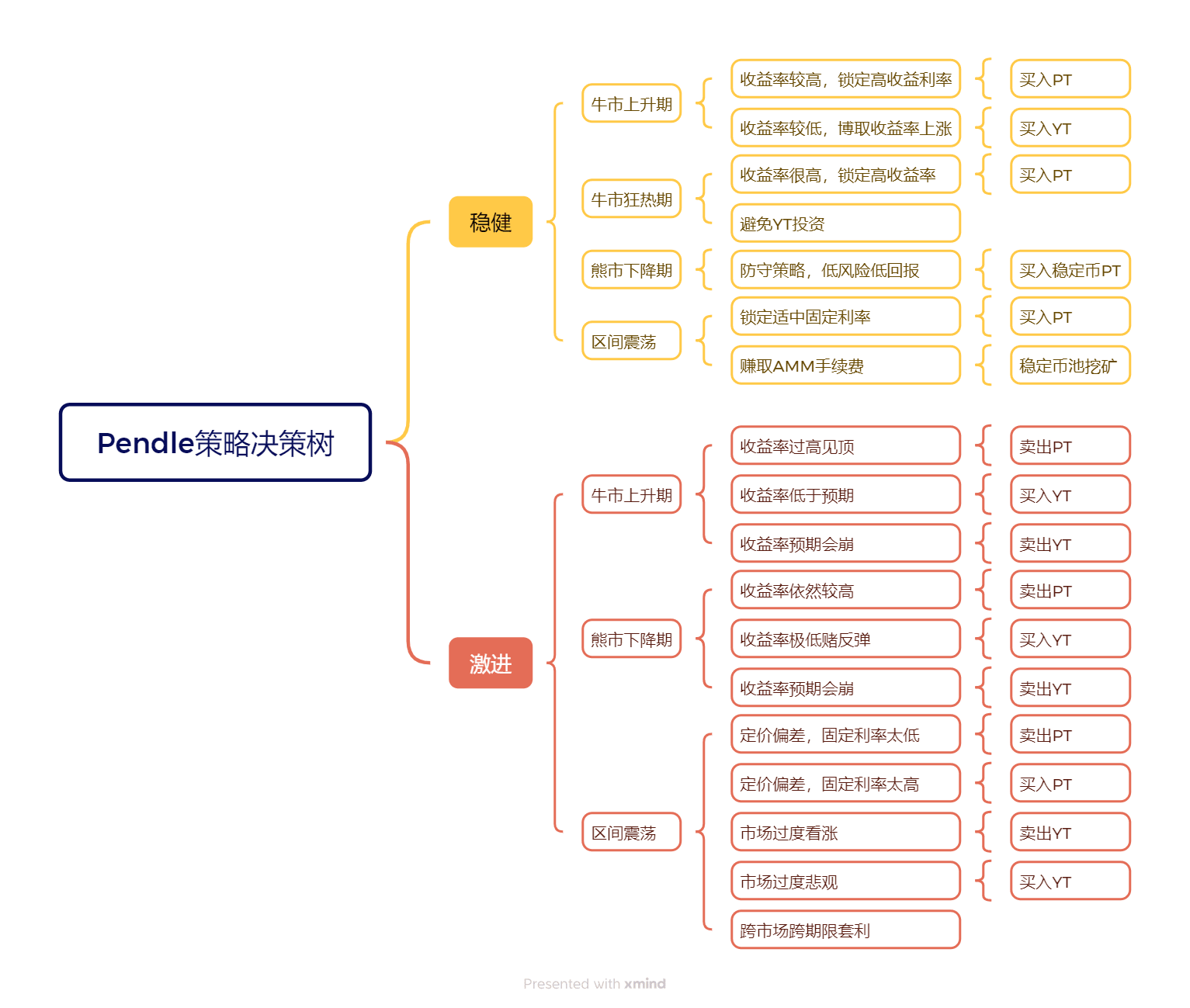
Pendle currency-based strategy: comparison of stETH, uniBTC, and stablecoin pools
Of course, the above analysis of Pendle strategies is based on a U-based perspective. The focus of the strategy is on how to achieve excess returns by locking in high rates or capturing interest rate fluctuations; in addition, Pendle also provides currency-based strategies for BTC and ETH.
ETH is generally regarded as the best target for currency-based strategies due to its ecological status and long-term value certainty: as the native asset of the Ethereum network, ETH not only serves as the settlement base for most DeFi protocols but also provides stable cash flow sources through staking yields. In contrast, BTC has no native rate, and its yields on Pendle mainly depend on protocol incentives, making its currency-based logic relatively weak; while stablecoin pools are more suitable as defensive allocations, serving the role of “preservation + waiting”.
Under different market cycles, the strategy differences of three asset pools are significant:
Bull market: The stETH pool is the most aggressive, and YT is the best strategy for leveraged ETH accumulation; uniBTC can serve as a supplement but leans more towards speculation; the appeal of stablecoin pools is relatively reduced.
Bear market: The low-price YT provides the core opportunity for accumulating ETH; stablecoin pools take on the main defensive function; uniBTC is only suitable for small-scale short-term arbitrage.
Volatile market: The PT-YT misalignment of stETH and AMM fees provide arbitrage opportunities; uniBTC is suitable for short-term gambles; stablecoin pools provide stable supplementation.
Assets Yield sources Risk Currency-based effects Bull market Bear market Volatile market stETH Pool ETH Staking Native yield (3–5% APY) ETH price fluctuation ✅ ETH-based increase (YT can amplify returns) Buy YT: bet on rising interest rates, capture leveraged Staking yields; buy discounted PT: lock in high rates Buy cheap YT: obtain leveraged ETH Staking yields, achieve ETH-based growth Inter-period arbitrage/PT-YT misalignment: suitable for profiting from AMM fees and price fluctuations uniBTC Pool Lending rates / protocol incentives (non-native yields) BTC No native rate, returns depend on incentive sustainability ⚠️ Currency-based logic is weak When lending demand is strong Short-term buy YT, aiming for incentive returns Returns are unstable, suitable for small speculative positions YT price fluctuations can be gambled on short-term or cross-market arbitrage Stablecoin Pool Stablecoin lending rates (2–5% APY) Low rates, limited appeal of PT/YT ❌ Non-currency-based growth Fixed income is not as attractive as volatile assets, suitable for extremely conservative investors Core defense: lock in stable rates, wait for market recovery Small interest arbitrage, providing low-volatility supplementary income
Boros strategy panorama: interest rate swaps, hedging, and cross-market arbitrage
Boros assetizes the floating variable of funding rates, effectively introducing traditional financial interest rate swaps (IRS) and basis trading/carry trading into DeFi, transforming funding rates from an uncontrollable cost element into a configurable investment tool. Its core certificate, Yield Units (YU), supports three main strategy paths: speculation, hedging, and arbitrage.
In terms of speculation, investors can bet on rising funding rates through Long YU (receiving fixed rate Implied APR, paying floating rate Underlying APR) or bet on falling funding rates through Short YU (receiving fixed rate Implied APR, paying floating rate Underlying APR), similar to traditional interest rate derivative trading.
In terms of hedging, Boros provides institutions with tools to convert floating funding rates into fixed rates for large perpetual contract positions;
Hedging funding rate risk (Funding Rate Hedging): Long Perp + Long YU, locking floating funding rate expenditures as fixed costs.
Locking in funding rate income (Funding Rate Income Hedging): Short Perp + Short YU → locking floating funding rate income as fixed returns.
In terms of arbitrage, investors can obtain relatively stable spread returns by using a stable gain portfolio (Delta-Neutral Enhanced Yield) or stable arbitrage (Arbitrage / Spread Trade), utilizing pricing differences across markets (Futures Premium vs Implied APR) or across terms.
Overall, Boros is suitable for professional funds for risk management and stable gains, but its friendliness to retail users is limited.
Strategy type Operation method Suitable groups Comparison with traditional tools Funding Hedge (expenditure/income hedging) Hedging funding rate expenditures: going long on Perp on CEX/DEX while also going long on Boros Long YU;
Funding rate income hedging: shorting Perp on CEX/DEX while borrowing Boros Short YU
Large long and short positions, Basis Trader interest rate swaps (Payer/Receiver Swap) Delta-Neutral fixed income Spot staking (e.g., stETH to obtain 4% baseline yield) + shorting Perp to hedge price risk + locking in fixed funding yields in Boros Short YU Stable institutions, hedging funds Cash & Carry + Swap cross-market/term arbitrage Cross-market arbitrage: comparing Futures Premium with Boros Implied APR, shorting the overvalued side and going long on the undervalued side;
Term arbitrage: When there is a pricing difference between YUs of different maturities, short the overvalued maturity and long the undervalued maturity.
Professional arbitrage funds Government bond yield curve arbitrage
3. Complexity of Pendle strategies and unique value of AgentFi
Based on the analysis above, Pendle's trading strategies are essentially complex bond derivative trades; even the simplest action of buying PT to lock in fixed income still requires considering multiple factors such as maturity rollovers, interest rate fluctuations, opportunity costs, and liquidity depth, not to mention YT speculation, inter-period arbitrage, leveraged combinations, or dynamic comparisons with external lending markets. Unlike floating yield products such as lending or staking, which can generate returns with a single deposit, Pendle's PT (Principal Token) must have a clearly defined maturity date (usually several weeks to months), after which the principal is redeemed 1:1 for the underlying asset. If one wishes to continue earning yields, they must re-establish positions. This periodic maturity constraint is a necessary prerequisite for the fixed income market and is a fundamental difference between Pendle and perpetual lending protocols.
Currently, Pendle has not built an automatic renewal mechanism, while some DeFi strategy vaults provide an “Auto-Rollover” option to strike a balance between user experience and protocol simplicity. Currently, it is divided into passive, smart, and hybrid Auto-Rollover modes.
Passive Auto-Rollover: Simple logic, where PT automatically reinvests in new PT upon maturity, providing a smooth user experience. However, it lacks flexibility; if the floating rates from Aave or Morpho are higher, forced renewal can lead to opportunity costs.
Intelligent Auto-Rollover: The Vault dynamically compares Pendle fixed interest rates with floating rates in the lending market, avoiding “blind renewal,” maintaining flexibility while enhancing returns, more aligned with yield maximization needs.
If Pendle fixed interest rate > floating interest rate of lending → reinvest PT to lock in more certain fixed income;
If the Pendle fixed interest rate > floating interest rate of lending → transfer to Aave/Morpho and other lending protocols to obtain a higher floating interest rate.
Mixed allocation: part of the funds are locked in PT fixed interest rate, while part flows into the lending market, forming a combination that balances stability and flexibility, avoiding being “thrown off” by a single interest rate environment in extreme situations.
Therefore, AgentFi holds unique value in Pendle trading strategies: it can automate complex interest rate games. The PT fixed interest rate of Pendle and the floating interest rates in the lending market fluctuate in real-time, making it difficult for humans to continuously monitor and switch; ordinary Auto-Rollover is merely passive renewal, while AgentFi can dynamically compare interest rate levels, automatically adjust positions, and optimize position allocation based on user risk preferences. In the more complex Boros strategy, AgentFi can also undertake operations such as funding rate hedging, cross-market arbitrage, and term arbitrage, further unleashing the potential for professional yield management.
4. Pulse: The first AgentFi product based on Pendle PT strategy
In previous AgentFi series reports (A new paradigm for stablecoin yields: from AgentFi to XenoFi), we introduced the stablecoin yield optimization agent ARMA (https://app.arma.xyz/) based on the Giza infrastructure layer. This product is deployed on the Base chain and can automatically switch between lending protocols such as AAVE, Morpho, Compound, Moonwell, maximizing cross-protocol yields and has consistently ranked among the top tier of AgentFi.
In September 2025, the Giza team officially launched Pulse Optimizer (https://app.usepulse.xyz/) — the industry's first AgentFi automated optimization system based on the Pendle PT fixed income market. Unlike ARMA, which focuses on stablecoin lending, Pulse focuses on Pendle fixed income scenarios: using deterministic algorithms (not LLMs) to monitor multi-chain PT markets in real time, dynamically allocating positions using linear programming while considering cross-chain costs, maturity management, and liquidity constraints, and automatically completing rollovers, cross-chain scheduling, and compounding. Its goal is to maximize portfolio APY under controllable risk conditions, abstracting the complex process of “finding/APY/swapping/cross-chain/timing” into a one-click fixed income experience.
Core architecture components of Pulse
Data collection: Real-time fetching of Pendle multi-chain market data, including active markets, APY, maturity time, liquidity, and cross-chain bridge costs, and modeling slippage and price impacts to provide precise inputs for the optimization engine.
Wallet management: As the hub of assets and logic, generating portfolio snapshots, managing cross-chain asset standardization, executing risk control (such as minimum APY improvement thresholds, historical value comparisons).
Optimization engine: Based on linear programming modeling, comprehensively considering fund allocation, cross-chain sources, bridge fee curves, slippage, and market maturity, outputting optimal allocation plans under risk constraints.
Execution planning: Transforming optimization results into sequences of trades, including liquidating inefficient positions, planning bridging and swap paths, rebuilding new positions, and triggering full exit mechanisms when necessary, forming a complete closed loop.
Components Key mechanisms Output results Data collection Integration of Pendle API and multi-chain price sources, monitoring market and slippage Real-time market data flow Wallet management Portfolio snapshots, asset standardization, cross-chain conversion, risk control Portfolio state and reallocation control Optimization engine Fund allocation modeling, cross-chain cost curves, diminishing return constraints Optimal allocation plan Execution planning Liquidate old positions → Plan bridging/Swap → Establish/exit Executable cross-chain trading scripts
5. Core functions and product progress of Pulse
Pulse currently focuses on ETH-based yield optimization, dynamically managing ETH and its liquid staking derivatives (wstETH, weETH, rsETH, uniETH, etc.) and performing dynamic allocation across multiple Pendle PT markets. The system uses ETH as the base asset, automatically completing cross-chain token conversions for optimal allocation. It is now live on Arbitrum mainnet and will be extended to Ethereum mainnet, Base, Mantle, Sonic, etc., achieving multi-chain interoperability through the Stargate bridge.
Pulse user experience full process
Agent activation and capital management: Users can one-click activate the Pulse Agent on the official website (www.usepulse.xyz), a process that includes wallet connection, network authentication, whitelist verification, and depositing a minimum of 0.13 ETH (approximately $500). Once activated, funds are automatically deployed to the optimal PT market and enter a continuous optimization cycle. Users can add funds at any time, and the system will automatically rebalance and redistribute, with no minimum threshold for subsequent deposits. Large funds can enhance portfolio diversification and optimization effects.
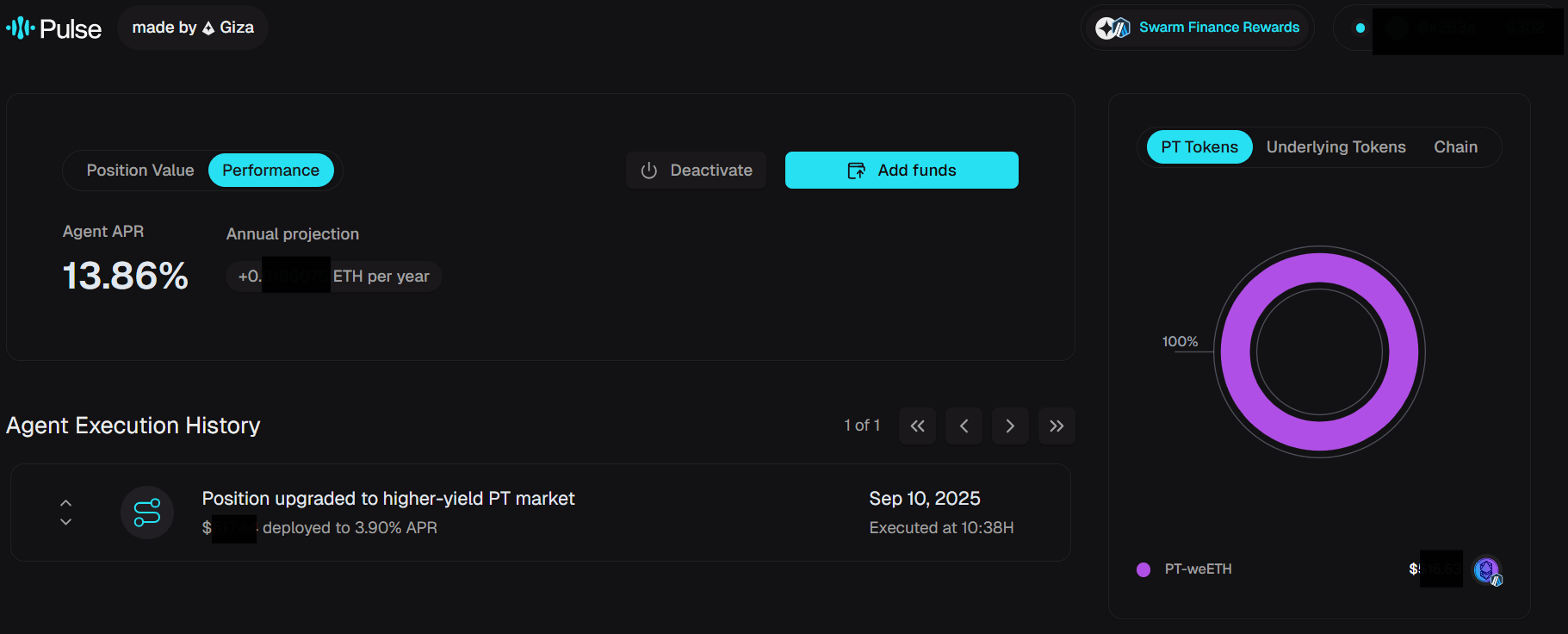
Data dashboard and performance monitoring
Pulse provides a visual data dashboard to track and evaluate investment performance in real time:
Key metrics: total asset balance, cumulative investment, growth rates of principal and yield, distribution of positions across different PT tokens and cross-chain positions.
Yield and risk analysis: supporting trend tracking at daily/weekly/monthly/yearly dimensions, combined with real-time monitoring of APR, annual forecasts, and market comparisons to help measure the excess returns brought about by automated optimization.
Multi-dimensional breakdown: displayed by PT Token (e.g., PT-rETH, PT-weETH), Underlying Token (LST/LRT protocols), and cross-chain distribution.
Execution transparency: Complete retention of operation logs, including rebalancing time, operation type, fund scale, yield impact, and on-chain hash, ensuring verifiability.
Optimization results: prompts for rebalancing frequency, APR improvement extent, diversification level, and market response speed, comparing with static holdings or market benchmarks to assess real returns after risk adjustment.
Exit and asset withdrawal: Users can close the Agent at any time, and Pulse will automatically liquidate PT tokens and exchange them back for ETH, charging only a 10% success fee on profits, with the principal fully refunded. Before exiting, the system will transparently display yield and fee details, with withdrawals typically completed within minutes. After exiting, users can reactivate at any time, with historical yield records fully preserved.
6. Swarm Finance: Active liquidity incentive layer
In September 2025, Giza officially launched Swarm Finance — an incentive distribution layer designed for active capital. Its core mission is to connect protocol incentives directly to the agent network through standardized APR feeds (sAPR), thereby realizing true “intelligence” of capital.
For users: capital can achieve real-time, automated optimal allocation across multiple chains and protocols without manual monitoring or reinvestment, capturing the best yield opportunities.
For the protocol: Swarm Finance resolves the issue of TVL loss due to Pendle and other projects' maturity redemption, bringing more stable and sticky liquidity while significantly reducing governance costs for liquidity management.
For the ecosystem: capital completes cross-chain and cross-protocol migration in a shorter time, improving market efficiency, price discovery ability, and capital utilization.
For Giza itself: All incentive flows routed through Swarm Finance will partially flow back to $GIZA, initiating the Tokenomics flywheel through fee capture → buyback mechanisms.
According to Giza's official data, Pulse achieved approximately 13% APR when launching the ETH PT market on Arbitrum. More importantly, Pulse addresses the issue of TVL loss caused by Pendle's maturity redemption through an automatic rollover mechanism, establishing a more robust capital retention and growth curve for Pendle. As the first practical application of the Swarm Finance incentive network, Pulse not only demonstrates the potential for intelligent agency but also marks the formal commencement of a new paradigm for active liquidity in DeFi.
7. Summary and Outlook
As the first AgentFi product based on Pendle PT strategy in the industry, the Pulse launched by the Giza team undoubtedly holds milestone significance. It abstracts the complex PT fixed income trading process into a one-click smart agent experience, achieving full automation in cross-chain configuration, maturity management, and automatic compounding, significantly lowering the operational threshold for users while enhancing the capital utilization efficiency and liquidity of the Pendle market.
Pulse currently still mainly focuses on ETH PT strategies. Looking ahead, as the product continues to iterate and more AgentFi teams join, we expect to see:
Stablecoin PT strategy product — providing matching solutions for investors with more conservative risk preferences;
Intelligent Auto-Rollover — dynamically comparing Pendle fixed interest rates with floating rates in the lending market, maintaining flexibility while enhancing returns;
Market cycle-based panoramic strategy coverage — modularizing Pendle's trading strategies in different stages of bull and bear markets, covering YT, stablecoin pools, and even more advanced plays such as shorting and arbitrage;
Boros strategy-based AgentFi product — achieving a smarter Delta-Neutral fixed income and cross-market/term arbitrage than Ethena, promoting further specialization and intelligence in the DeFi fixed income market.
Of course, Pulse also faces risks that any DeFi product encounters, including protocol and contract security (potential vulnerabilities in Pendle or cross-chain bridges), strategy execution risks (failure of maturity rollover or cross-chain rebalancing), and market risks (interest rate fluctuations, insufficient liquidity, incentive decay). Additionally, Pulse's yields rely on the ETH and its LST/LRT markets; if the price of Ethereum drops significantly, even if the amount of ETH-based increases, there may still be losses when priced in USD.
Overall, the birth of Pulse not only expands the product boundaries of AgentFi but also opens up new imaginative spaces for the automation and scaling of Pendle strategies in different market cycles, representing an important step in the intelligent development of DeFi fixed income.
Disclaimer: This article was assisted by ChatGPT-5 AI tools during creation. The author has done their best to proofread and ensure the information is true and accurate, but some omissions may still exist, for which understanding is appreciated. It is particularly noted that there are often discrepancies between project fundamentals and secondary market price performance in the cryptocurrency asset market. The content of this article is for informational integration and academic/research communication only, does not constitute any investment advice, and should not be viewed as any token trading recommendation.