
In the recent market, I believe everyone's feelings are a bit complicated. The market has pulled back, and there is a sea of blood, but one coin has surged against the tide, rising over 40% in a week; it is the native token of Hyperliquid.$HYPE Many people are asking, what happened? On February 2nd, while everyone was trembling at the market, Hyperliquid quietly released a big move: the HIP-4 proposal, officially entering the prediction market! As soon as the news broke, HYPE surged by 10% that day.
So the question arises, is it a big deal for a Perp DEX to enter the prediction market? Isn't Polymarket already thriving? What exactly does Hyperliquid's move intend to replicate Polymarket, or is there a greater ambition behind it? Is this wave of counter-trend growth the starting point for the next hundredfold coin, or is it a carefully designed trap?
Today, let's dive deep into what Hyperliquid's HIP-4 is and how it will reshape the landscape of on-chain derivatives.

HIP-4 is not just as simple as 'guessing win or lose.'
First, we need to clarify what HIP-4 really is. The official name is 'Outcome Trading.' It sounds a bit complicated, but in simple terms, it is a tool that allows you to bet on a certain 'outcome' in the future, and it is a safer and simpler way to play.
The perpetual contracts we are playing now are quite familiar to everyone, with no expiration date, high leverage, and the risk of liquidation if not careful. But the HIP-4 Outcome contract is almost the opposite: it has an expiration date, full collateral, no leverage, and therefore, no liquidation risk!
For example, you might wonder, 'Can Trump win the U.S. election?' or 'Can BTC break 100,000 USD by the end of March?' On Polymarket, you buy the corresponding shares, and if you guess correctly, you make money; if you guess wrong, you lose your principal. HIP-4 follows a similar logic, where you can only lose the principal you used to buy the contract, so you don’t have to worry about being forcefully liquidated in the middle of the night, and you definitely won’t owe the platform any money.
At this point, you might say, 'Hey, isn't this just a copy of Polymarket?'
If you only think this way, you underestimate Hyperliquid's ambition. The most powerful aspect of HIP-4 is not replication but 'composability.'

The real killer feature—'composability.'
Polymarket is already quite good, but it is an isolated platform. The contracts you buy there have no relation to any other assets in your wallet.
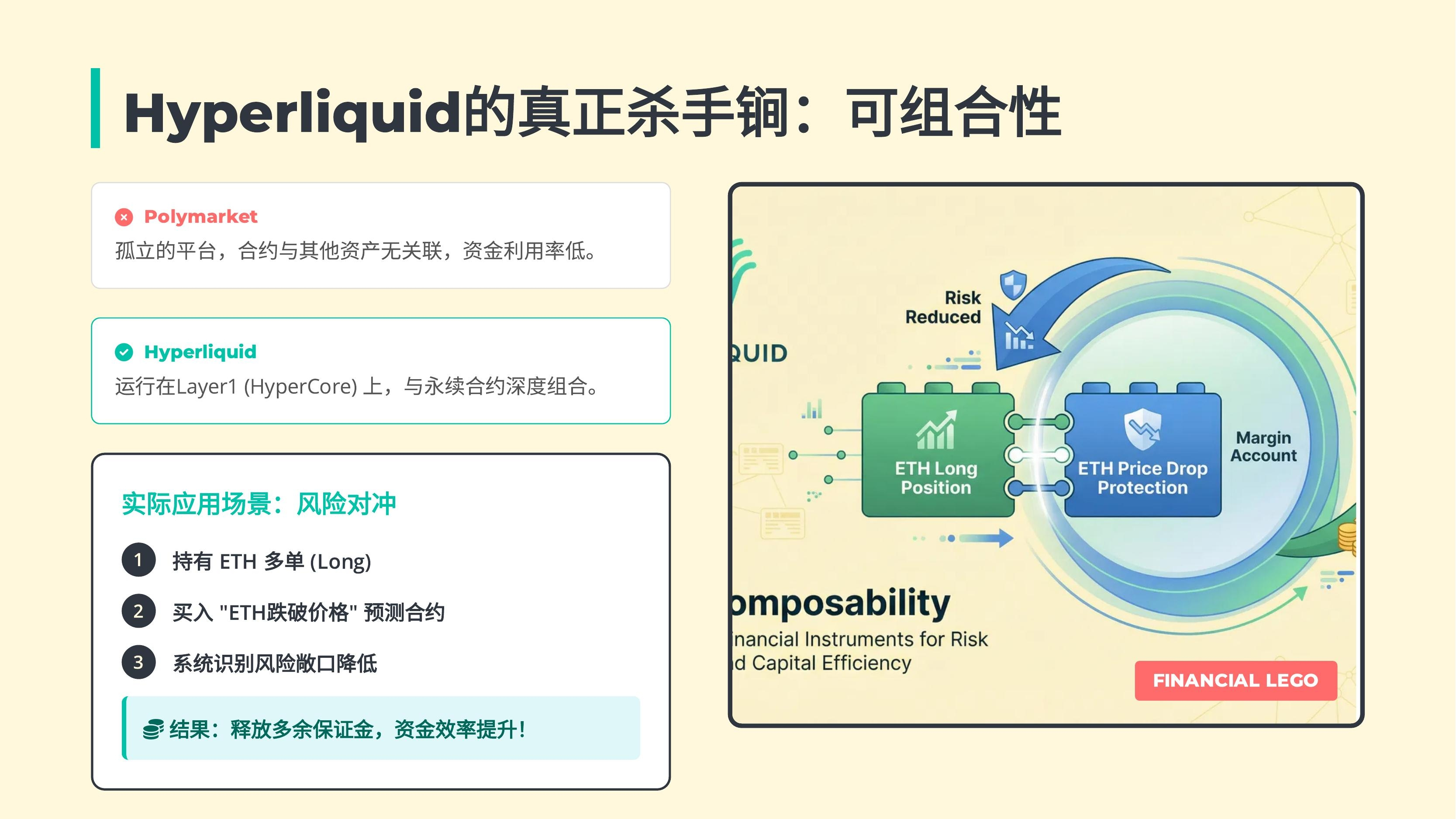
But HIP-4 is different; its Outcome contract runs directly on Hyperliquid's own Layer1—HyperCore. This means it can be integrated with the perpetual contracts on the platform!
This is the most fascinating aspect of DeFi—composability. Let me give you an example.
Suppose you currently have a long position in ETH, but you are worried that the market might suddenly crash. What should you do? You can simultaneously buy an Outcome contract that states 'ETH will fall below a certain price at a certain point in time' to hedge. Both positions are in the same margin account, and the system will automatically recognize that your risk exposure has decreased, thus releasing your excess margin!
Translated, this means: you are using less money to create a structured product with lower risk! This is something that only institutional investors could enjoy in traditional finance, and they also have to pay high fees to investment banks for the service. Now, Hyperliquid has turned it into a native on-chain tool that everyone can use, like 'LEGO blocks.'
This is its true killer feature. Polymarket cannot do this because it is just an 'event exchange,' while Hyperliquid is evolving from a Perp DEX into a full-category 'on-chain derivatives empire.'
From HIP-1 to HIP-4, from issuing assets and solving liquidity to opening permissionless perpetual contracts, and now adding Outcome contracts, Hyperliquid's founder Jeff Yan is gradually realizing his ambition: 'The house of all finance must be credibly neutral'—the house of all finance must be credibly neutral.
$HYPE's 'perpetual motion machine' flywheel
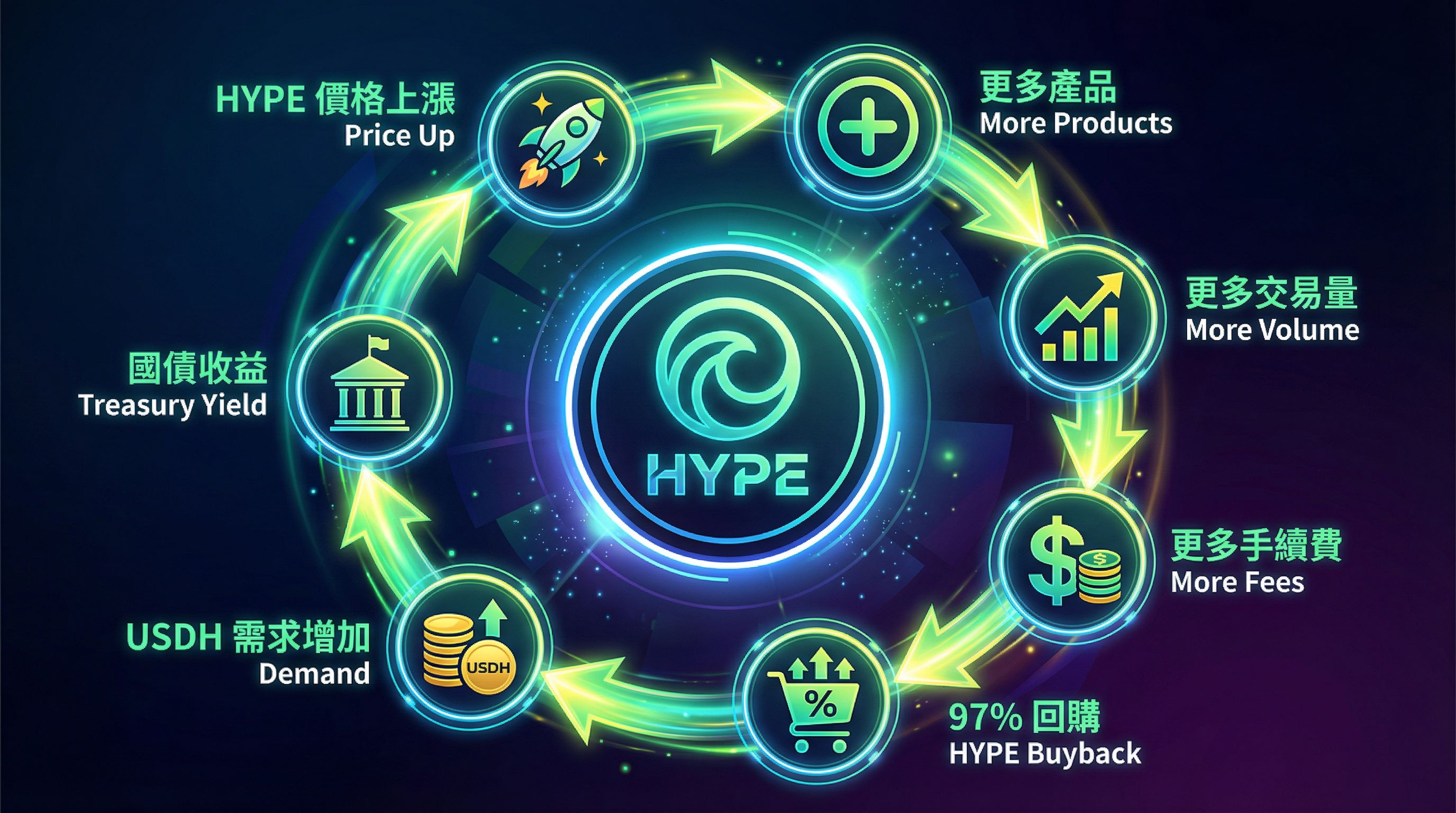
After discussing the product, let's talk about what everyone is most concerned about—the price of HYPE tokens. Why can HIP-4 make the price of $HYPE soar against the trend? Because it adds fuel to an already strong token economic model. Hyperliquid's model is very aggressive: 97% of the platform's trading fees are used to buy back and destroy $HYPE! On February 5th alone, the platform earned 6.84 million USD in one day, of which 5.25 million was used for buybacks! In just one day, 160,000 HYPE were bought back!
The launch of HIP-4 will bring more trading scenarios and trading volume, which means more fees, more buybacks, and directly driving up the value of HYPE. And that's not all.
All contracts of HIP-4 are priced in Hyperliquid's native stablecoin USDH. The revenue generated from USDH, backed by U.S. Treasury bonds, will also be used to buy back HYPE.
At this point, I believe everyone should have seen Hyperliquid's token flywheel.
More products bring more trading volume, generating more fees, which are used to buy back HYPE; at the same time, more products settle in USDH, driving up the demand for USDH, and the revenue from Treasury bonds will feed back into the buyback of HYPE. This series of operations supports the price of the HYPE token.
The risks behind the opportunities
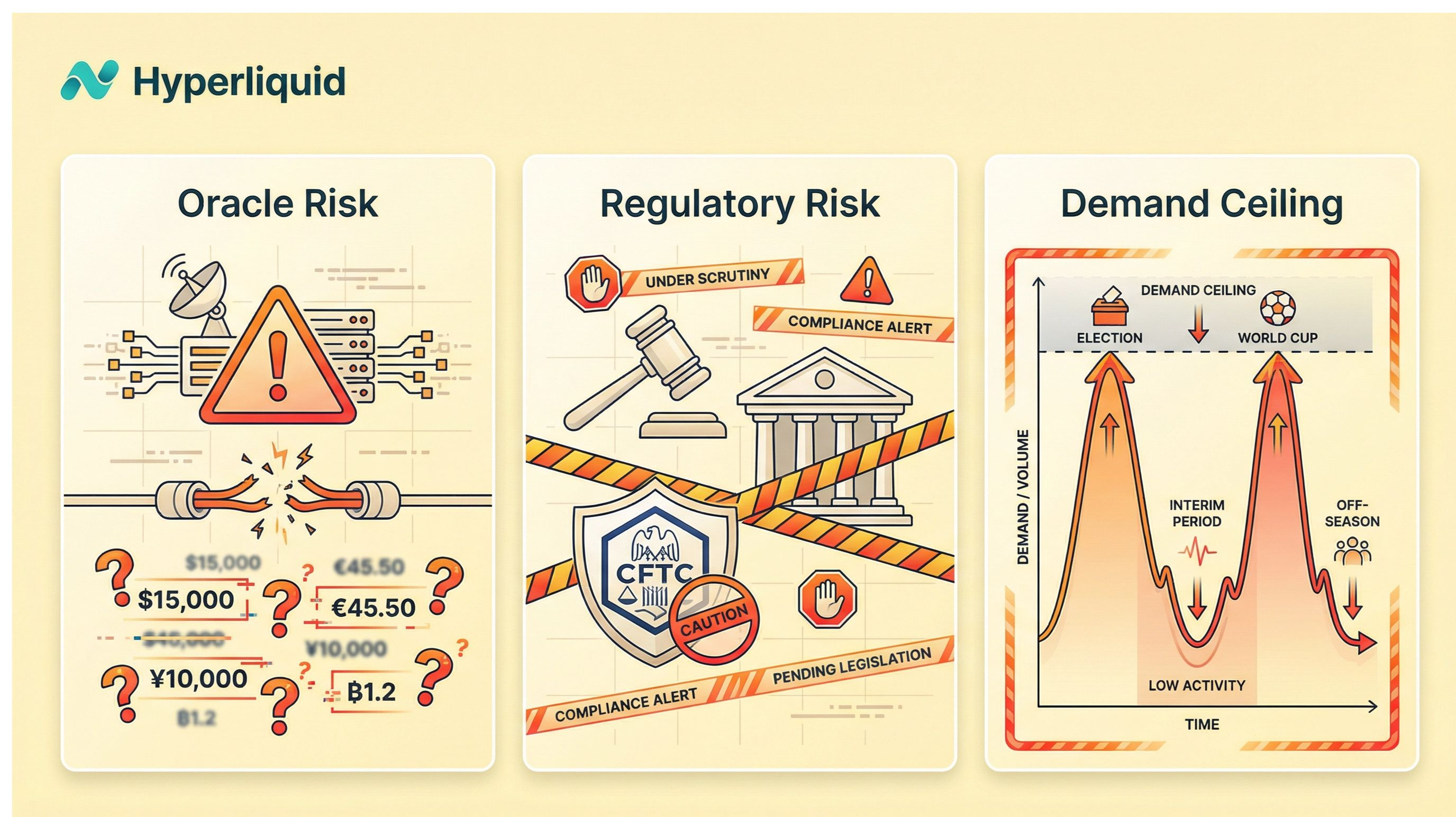
Speaking of this, does everyone feel an urge to immediately buy HYPE tokens? But I have to pour a bucket of cold water on everyone. There are indeed related risks behind this that are worth pondering. Let me break it down for you in detail.
First is the oracle risk. The settlement of prediction markets heavily relies on the accuracy of external data sources. Who won the election, what the price is—these all depend on the oracle feeding the price. If the oracle is attacked or fails, the consequences could be dire. Hyperliquid has not yet announced a specific oracle solution, which is a potential landmine.
Next is regulatory risk. Just last month, Kalshi, which is regulated by the CFTC, was ruled by the court to have sports contracts considered illegal gambling. Although decentralized protocols are currently out of the regulatory range in the short term, no one knows when they will face regulatory sanctions.
The last point is the demand ceiling. The prediction market is predicted to have a trading volume of 44 billion USD by 2025, a large portion of which is contributed by the U.S. elections. In years without such global hotspots, the actual demand is still a question mark. However, this year there is the World Cup, which may bring traffic to the prediction market, but in any case, this remains uncertain.
Summary and personal opinion
Hyperliquid's entry into the prediction market through HIP-4 is by no means a simple replication of Polymarket. Its true goal is to leverage 'composability,' the nuclear weapon of the DeFi world, to transform itself into a one-stop on-chain derivatives super factory, thereby empowering $HYPE and launching a powerful value flywheel.
Of course, the challenges of oracles, regulation, and genuine demand also exist objectively.
So, back to the question we opened with: Is this move by Hyperliquid a wealth code or a trap?
My view is: this feels more like a high-risk, high-reward gamble. The ambition, execution capability, and product iteration speed displayed by Hyperliquid are very rare in today’s crypto world. Although the risks cannot be ignored, what they are doing could indeed define the visage of the next generation of on-chain finance. For us investors, understanding what they are doing is more important than just jumping in.