
A validator on the XRP Ledger (XRPL) demonstrated that the network can easily accomplish the same task recently undertaken by the U.S. Department of Commerce on other blockchains.
The dUNL validator Vet of XRPL indicated: publishing official economic data on XRPL is not only simple but also extremely cost-effective. This has raised further questions about why the U.S. government excluded the XRP Ledger from its recent plans.
In context, the U.S. Department of Commerce recently announced that it has begun directly publishing key economic data on public blockchains, with the first data being GDP.
Officials stated that this move is a proof of concept aimed at making government data more transparent and credible.
In the trial run, the Ministry of Commerce published the encrypted hash of the GDP report on nine blockchains:
Bitcoin, Ethereum, Solana, TRON, Stellar, Avalanche, Arbitrum One, Polygon PoS, and Optimism.
The report will still exist in conventional formats such as PDF, but the blockchain makes it more secure and tamper-proof.
This initiative has sparked heated discussions in the crypto circle, as it indicates that the adoption of blockchain in the public sector is accelerating.
However, some XRP supporters noticed that XRPL is not on the list, even though it has long been proven to be a low-cost, high-efficiency data storage and trading platform.

Most people insist that XRPL is fully capable of handling this task.
Interestingly, to prove that the issue was not a matter of capability, Vet directly replicated the government's method on XRPL.
He stored the SHA256 hash of the GDP report in two ways:
Once as a transaction memo (similar to Bitcoin);
Once stored in an NFT, which contains the hash value and a link to the original file.
According to Vet, the entire process took only a few seconds, and the cost was even less than a cent.
He emphasized that all of this was accomplished using XRPL's native capabilities, without the need for any smart contracts.
In this regard, someone asked: If data can be published directly on XRPL, will services like Chainlink or Pyth lose their necessity?
Vet explained that while anyone can manually publish data, the advantages of Chainlink and Pyth lie in their distribution efficiency. They can quickly broadcast information to multiple blockchains, ensuring coverage and reliability.
When asked if publishing a large amount of data on XRPL for a long time would slow down the network, Vet pointed out:
memo and NFT have already proven to be reliable enough in large-scale applications.
Moreover, GDP data is only released once a quarter, which puts very little pressure on the network compared to real-time price oracles.
At the same time, XRPL Oracles can handle larger loads, providing greater scalability for XRPL.
Meanwhile, some suggested that the government may choose other chains because they support smart contracts, while XRPL has not yet supported it at the base level.
In this regard, Vet admits that smart contracts can indeed increase flexibility.
But he also reminds that the government has also chosen Bitcoin, and Bitcoin does not have a native smart contract.
Another critic argues that the government's decision indicates they do not trust XRPL.
But Vet disagrees.
He explained that the Ministry of Commerce relies on Chainlink and Pyth to distribute GDP data, but currently neither of them supports XRPL.
Therefore, the exclusion of XRPL is not due to bias, but simply because it 'has not been covered'.
XRPL is fully capable of handling the release of official economic data, and the method is simple and low-cost.
The reason it was not chosen is not due to technical or trust issues, but because the current distribution service providers (like Chainlink, Pyth) have not supported it yet.
💡 This also means that once XRPL is included in mainstream distribution channels, it will become a powerful choice for governments and enterprises to go on-chain.
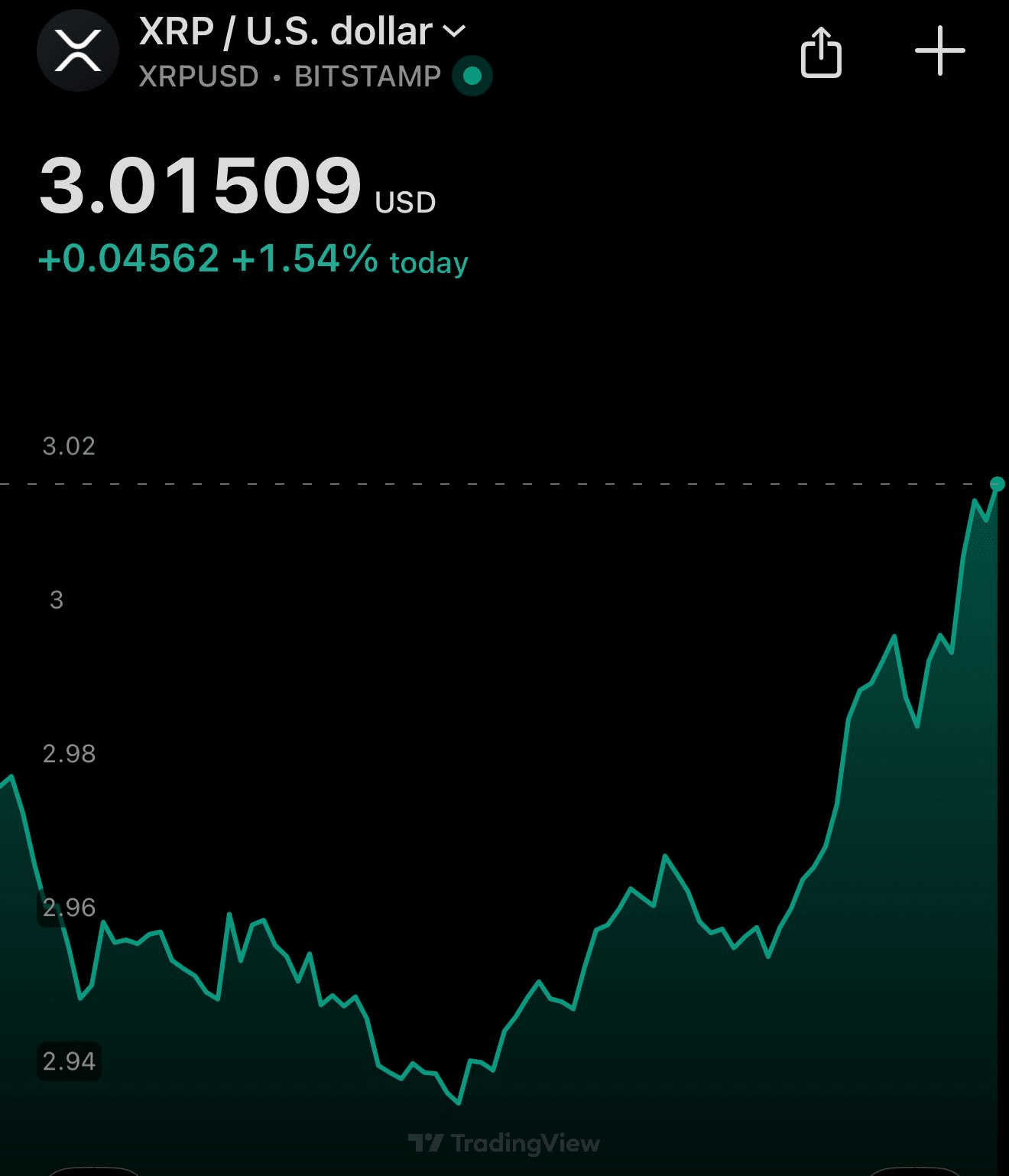
$XRP