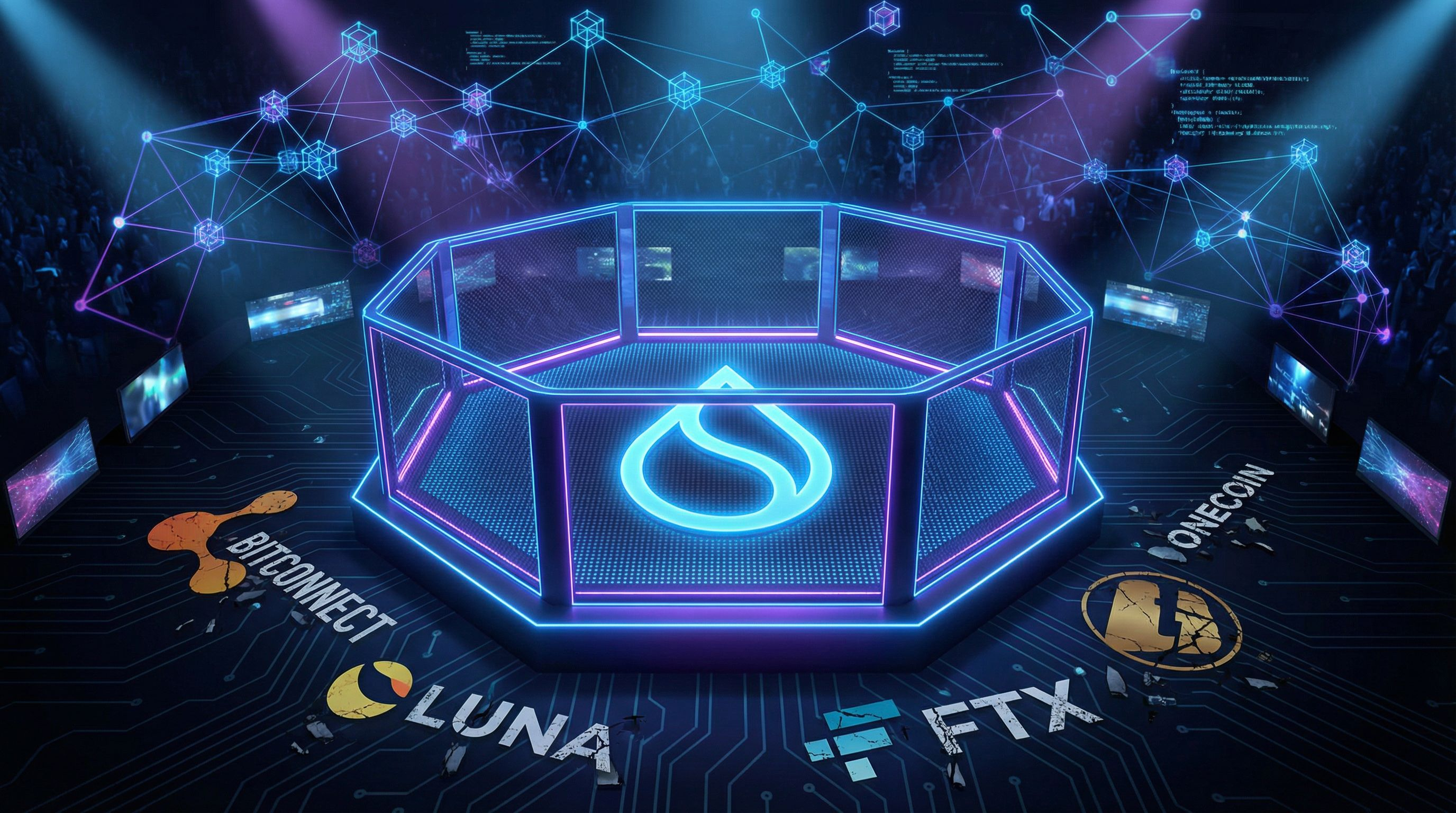
Survivor in the octagonal cage
The public chain track in 2025 is like a bloody octagonal cage fight. Many once-star projects have fallen, but there is one contestant that not only survived but has also developed new muscles, and that is --@Sui .
You may still remember the glory of Sui when it launched, with TVL once breaking 2 billion USD, but then it experienced a long silence. Many people are asking, does Sui still have a chance? What is it really holding back?
The transformation from public chain to platform
Today, we will unveil the mysterious veil of Sui. The answer may surprise you: Sui is no longer just a public chain; it is quietly transforming into a 'platform.'
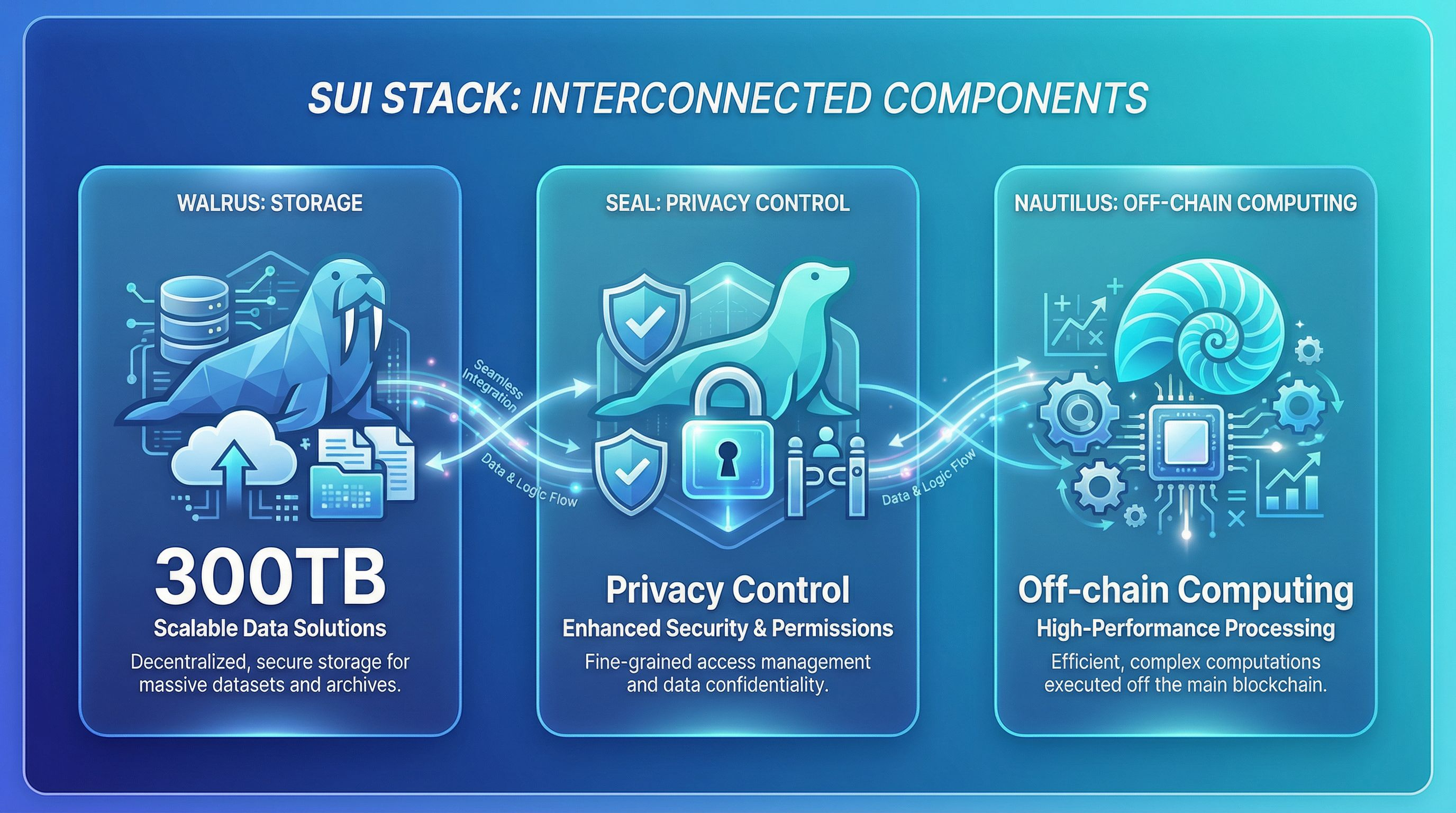
In 2025, Sui launched a combination called 'Sui Stack,' which completely changed its positioning. This combination includes three core weapons: Walrus, Seal, and Nautilus. Sounds complicated? Don't worry, I will break it down for you in the simplest way. Behind this may hide Sui's ambition to challenge Ethereum and Solana!

Sui Stack three-piece breakdown
The first weapon: @Walrus 🦭/acc . Walrus is a decentralized storage layer. Previously, developers had nowhere to store large files like images and videos when building applications on Sui and had to rely on third parties, which was very troublesome. Now with Walrus, Sui can handle it on its own, allowing developers to complete all work in one stop. In just 8 months since launch, the storage capacity is racing towards 300TB!
The second weapon: Seal. Seal is an on-chain permission control system. Simply put, it determines 'who can see, who can use, and for how long' your on-chain assets. This paves the way for true on-chain privacy and complex financial applications in the future. Imagine that future on-chain transfers could be as private as banks!
The third weapon: Nautilus. Nautilus is specifically responsible for off-chain computation. Some complex calculations are expensive and slow on-chain, and Nautilus allows them to be completed safely off-chain, with the results returned to the chain for verification. This model of 'off-chain computation, on-chain verification' greatly enhances the performance ceiling of Sui.
The SUI chain uses Walrus for storage, Seal for permissions, and Nautilus for computation, combined with the Sui mainnet itself. This 'Sui Stack' has transformed Sui from a simple track into a fully functional platform.
Ecosystem user impact
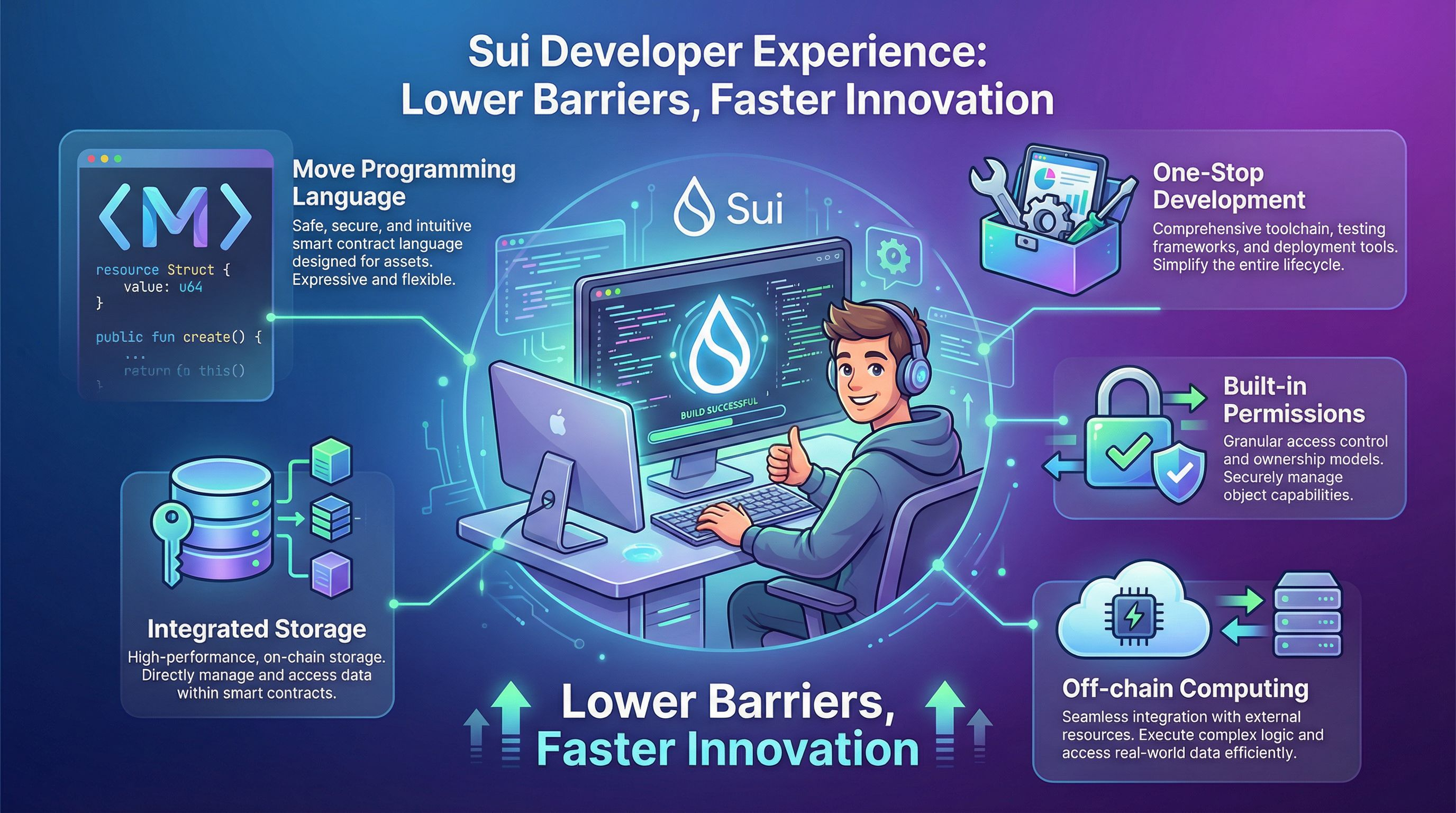
You might say, these technologies sound cool, but what does it have to do with me? In the short term, the impact on us is not significant since these improvements and upgrades are mainly aimed at developers, but from a long-term perspective, they will have a profound impact on us ordinary users.
First, for developers, the threshold has been greatly lowered. There are teams developing on Sui's native order book DeepBook, even 'without writing a single line of Move code.' This means that in the future, more and more interesting applications will be born on Sui, giving us as users more choices.
Secondly, this has attracted the attention of traditional financial giants. In 2025, institutions including Grayscale, VanEck, and Franklin Templeton began to lay out on Sui. Why? Because a 'full-stack platform' gives them a sense of security and certainty. At the same time, the entry of institutions is often a precursor to ecological explosions.
In-depth analysis three: Sui vs ETH vs Solana, whose strategy is more brilliant?
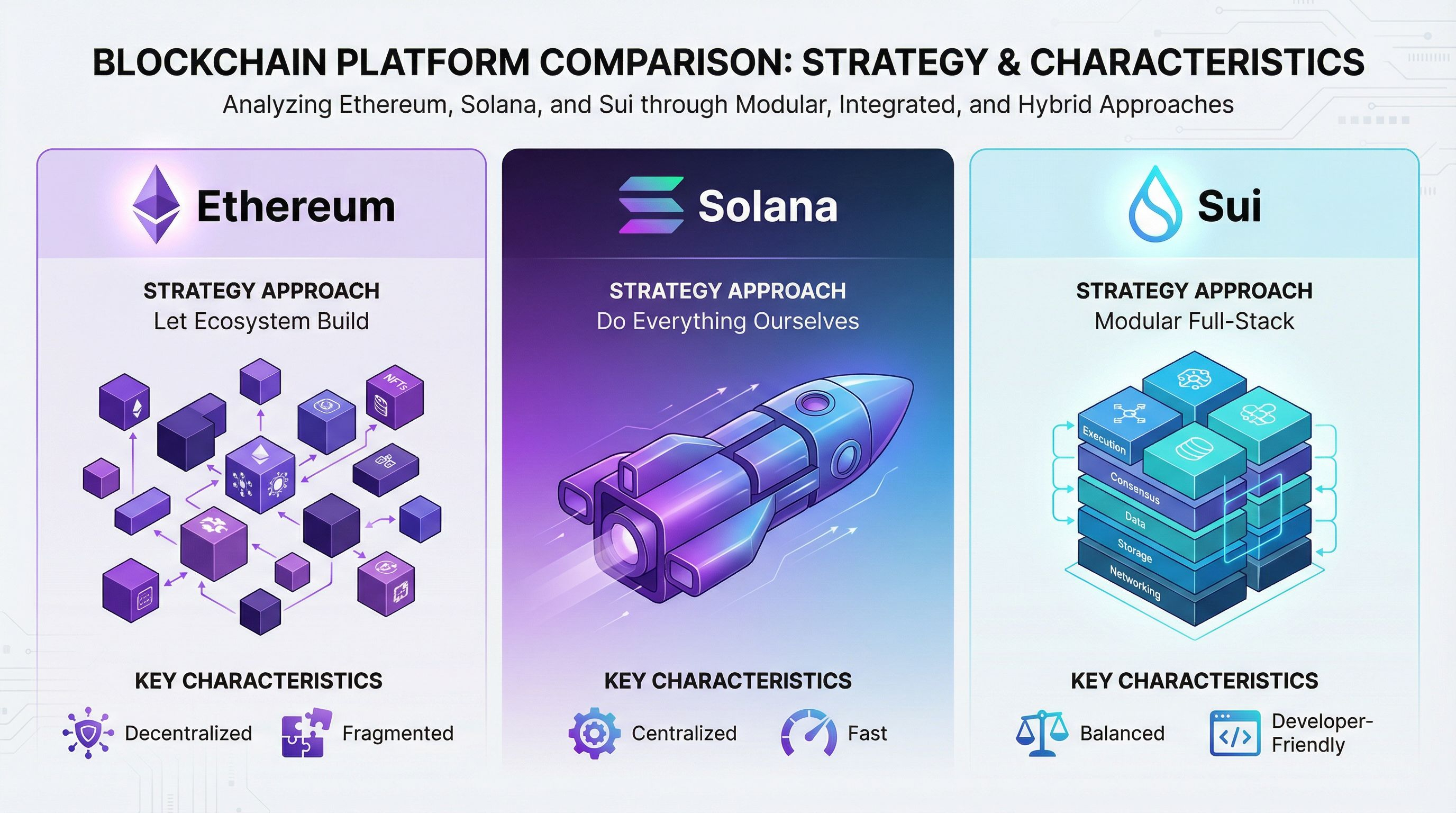
For comparison, we can compare Sui's strategy with its competitors.
Ethereum's strategy: 'Let the ecosystem do it,' doing only the core consensus and execution itself. The benefit is a thriving ecosystem, but the downside is excessive fragmentation, making the development experience like 'assembling a computer.'
Solana's strategy: 'Take it all on oneself,' a chain pursuing extreme performance. The benefits are unified experience and lightning speed, but the downside is high centralization risk, with several historical downtime crises.
Sui's strategy: 'Modular full-stack.' It provides a complete set of development tools, but is also modular, balancing development experience and decentralization.
Through comparison, it can be seen that Sui attempts to find the best balance between Ethereum's 'excessive decentralization' and Solana's 'excessive centralization.' This is a gamble, betting on whether future developers will prefer one-stop solutions.
Summary and personal opinion
In 2025, Sui made a stunning transformation, evolving from a fighter in an octagonal cage into a platform with a full armory. It answered the question 'Who am I?' with the Sui Stack, and now, it is ready to fight a hard battle about 'user experience' in 2026.
This raises the question for us investors: Is Sui worth looking forward to?
My view is: Sui's transformation shows tremendous ambition and a clear roadmap, which is a very positive signal. Compared to other public chains still telling stories, Sui has delivered tangible products.
The opportunity lies in: If Sui's platform strategy can successfully attract a large number of developers, its ecosystem will experience explosive growth, and now may be the early stage of laying out its ecological projects.
But risks also exist: The competition among public chains is extremely fierce, and whether Sui's 'full-stack' model can truly prevail will still require the test of time. Moreover, the macro environment of the entire crypto market remains the biggest uncertainty.
For investors seeking high potential, Sui is definitely worth your time to explore in depth. But if you are a conservative player, it might be wise to observe first, waiting for the signal that the ecosystem is truly taking off before making a choice.