
Recently, I saw a particularly explosive statement:
'Bitcoin reaching 1 million is not driven by retail enthusiasm, but by national-level competition.'
Many people believe that Bitcoin needs to reach 1 million for it to be 'universally adopted.'
But the truth is——there's no need at all.
Because in the entire market, the only Bitcoin that can actually circulate is 2 million coins.
Once these are drained, the price won't rise slowly but will experience a sudden cliff-like revaluation.
And just recently, a certain central bank has already sent out a shocking signal:
The topic they are studying is called——Hyperbitcoinization.

1. Why is 1 million dollars not just a pipe dream?
Someone has calculated:
Bitcoin needs a roughly 10-fold increase from now to reach 1 million.
Sounds exaggerated?
But don’t forget, Bitcoin has achieved a 17-fold increase in its history.
The difference is that this time it’s not retail speculation, but the state taking action.
Just like when the German currency collapsed in the last century, it didn’t depreciate slowly, but was 'wiped out overnight.'
This situation may likely play out again between fiat currency and Bitcoin.
2. Why is the IMF afraid?
El Salvador is one of the first countries to take the plunge. The outside world thinks they are 'compromising' under IMF pressure,
but in reality, they have retained the most core policies:
Bitcoin zero capital gains tax.
Still buying in every day.
Still fiat currency.
The only change is that merchants are no longer forced to accept Bitcoin.
This is actually a four-dimensional chess move.
The reason IMF is more afraid is simpler:
They rely on Special Drawing Rights (SDR) to print money infinitely.
But if Bitcoin becomes a settlement tool, they will immediately lose power.
So the IMF must fight to the end.
3. 2 million Bitcoins can leverage a 2 trillion dollar market.
The actual circulating Bitcoin in the entire market is only about 2 million.
These 2 million coins support the current 2 trillion dollar Bitcoin market cap.
Every country buys a bit, every institution hoards a bit, every big player holds on and doesn’t sell...
The tradable chips are becoming fewer.
This is a compressed spring effect: the tighter it is pressed, the more the price will explode in an instant.
4. Why hasn’t the price skyrocketed?
Many people ask: Since it is so scarce, why hasn’t the price soared?
It’s actually quite simple:
Early big players are cashing out (buying houses and land)
The market has panic selling.
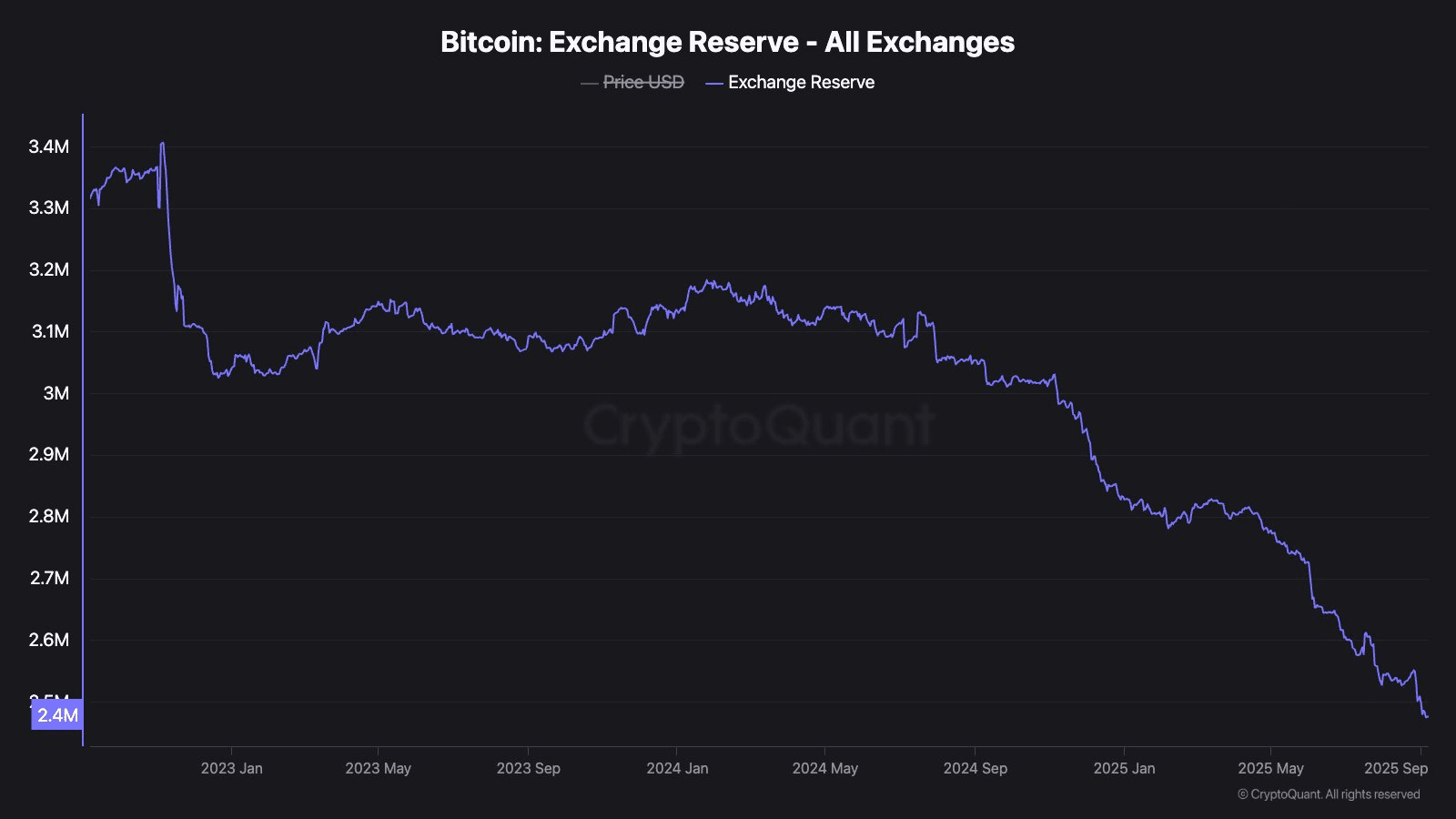
The 2 million coins on the exchange are still consuming demand continuously.
But the problem is that the Bitcoin reserves on exchanges are continuously declining.
This means the turning point is getting closer.
5. Timeline: It could come this year.
Samson Mow (Bitcoin strategy advisor for El Salvador) said in an interview:
"I don’t believe that the US dollar and Bitcoin can coexist in the long term.
When one system is 100 times stronger than another, it doesn’t replace it slowly but switches directly."
Not in 20 years.
But it might be this year.
Once these 2 million coins are drained, there is no upper limit, only price discovery.
1 million dollars is not the end, but the prologue.
6. History won’t wait for anyone.
In 1923, Germans were still fantasizing about the Mark recovering.
A few months later, buying one dollar required 42 trillion Marks.
Bitcoin rising to 1 million is not because Bitcoin 'has risen.'
But because all other fiat currencies are accelerating towards 'zero.'
At that moment, it’s not that Bitcoin becomes expensive, but money becomes worthless.