


Author: TTx0x, crypto KOL; Translation: Golden Finance Xiaozou
1. Introduction
Galaxy Digital (NASDAQ: GLXY) can be said to be an undervalued opportunity at the intersection of two of the most powerful long-term trends—cryptotechnology and artificial intelligence. The market is misjudging Galaxy, viewing it as a volatile crypto company, yet overlooking the immense value of its 'crown jewel' asset, the Helios data center. Helios is a world-class AI infrastructure platform expected to generate stable, high-margin, long-term cash flow.
The core of this investment thesis is that the market will ultimately re-rate GLXY, as it has successfully transitioned from a digital asset service company to a top AI infrastructure operator. The company's recent 15-year master lease signed with AI supercomputing service provider CoreWeave—covering the currently approved total power of 800 megawatts for Helios—validates its business model and suggests approximately $720 million in annual recurring revenue and a 90% EBITDA profit margin.
Galaxy has a clear advantage over competitors attempting to transition from 'Bitcoin mining to AI', primarily due to its fortress balance sheet with over $1.8 billion in net cash and investments, a management team with deep expertise, and a clear path to expand Helios to a potential 3.5 GW site.
2. Investment Perspective: Unlocking Top AI Infrastructure Targets
(1) Core Mispricing
Galaxy is composed of two distinctly different business segments: traditional digital asset financial services and emerging AI data center infrastructure. However, the market currently only evaluates GLXY through a single lens — that of a cryptocurrency company. The price movements of GLXY remain highly correlated with Bitcoin, indicating that investors have yet to price in the tailwinds offered by its AI data center business.
(2) Unexpected Acquisition Opportunities
At the end of 2022, Galaxy acquired the Helios data center site from Argo Blockchain for a mere $65 million through a distressed sale. At the time, Argo was facing bankruptcy and needed to liquidate assets. Galaxy obtained this world-class infrastructure asset at a price far below the current replacement cost. This transaction occurred before the explosion of AI-driven power and data center demand triggered by ChatGPT, effectively repositioning Galaxy's growth trajectory for the next decade.
(3) Strategic Asset of Helios
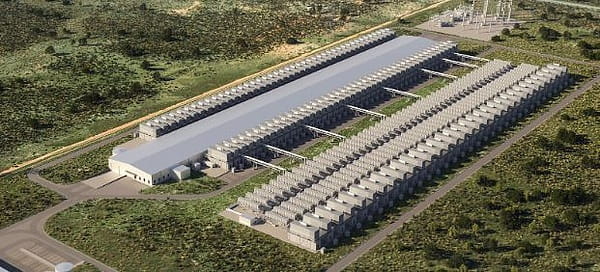
Helios is no ordinary data center; it is a first-class infrastructure asset designed to meet the demands of the AI revolution.
Power Advantage:
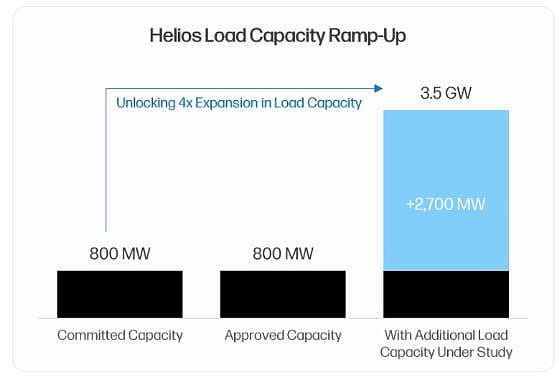
The biggest constraint facing the AI data center industry is power supply. Power contracts are the 'limiting factors' that supercomputing service providers compete to deploy GPU capabilities. Helios has secured an 800 MW approved power contract with Texas power operator ERCOT, allowing tenants to bypass the typical waiting period of over 36 months for new grid access. Furthermore, the site has a clear expansion pathway, with an additional 1.7 GW capacity currently in load study, bringing the potential capacity of the initial site to 2.5 GW. The latest announcement in the second quarter of 2025 revealed that the company has acquired adjacent land and submitted a 1 GW grid access application, raising the total potential power capacity of the site to an astonishing 3.5 GW, making it one of the largest data center sites globally.
Scale and Location Advantage:
AI supercomputing service providers prefer centralized facilities for economies of scale and performance advantages. Helios perfectly fits this model as a single scalable site. Its location in West Texas allows access to the cheapest and most reliable power resources in the U.S. Crucially, Galaxy is investing in building long-distance fiber networks to ensure 10-15 milliseconds of latency in the Dallas/Fort Worth metropolitan area. This distinguishes Helios from the growing number of pure AI training facilities — its low-latency connectivity unlocks AI inference use cases, ensuring premium pricing power.
Future-Oriented Design:
Any data center currently under construction faces the risk of obsolescence within a few years. Galaxy mitigates this risk through a phased development plan, allowing the integration of cutting-edge technology in each new construction cycle. This includes advanced cooling solutions such as direct chip liquid cooling, which is critical for the next generation of GPUs. The site's 10 million-gallon freshwater reservoir supports these critical cooling needs.
(4) CoreWeave Partnership
The partnership with CoreWeave is the most important validation of Galaxy's AI data center strategy. In the second quarter of 2025, CoreWeave committed to leasing all of Helios's currently approved 800 MW of total power.
Transaction Economics:
Its 15-year triple net lease agreement is highly attractive. The initial 600 MW of power is expected to generate approximately $720 million in annual revenue (including a 3% annual escalation clause). Due to the triple net lease structure (where tenants bear all operating expenses), this revenue is expected to convert to EBITDA with a margin of up to 90%.
Risk Mitigation and Value Validation:
This milestone agreement achieves multiple key objectives. First, it provides long-term predictable cash flow visibility, reducing Galaxy's financial risk. Second, it strongly validates Galaxy's operational capabilities, establishing the company as a reliable partner. This is crucial for attracting other hyperscale tenants — these tenants prefer partners with a proven track record.
3. Galaxy's Traditional Business: Profitable and Synergistic Cornerstone
Common bearish views on Galaxy suggest that its traditional crypto business is a negative asset that increases volatility and risk. This view is a misunderstanding. In reality, Galaxy's digital asset business is a profitable, market-leading entity that provides capital and credibility synergies for its other businesses.
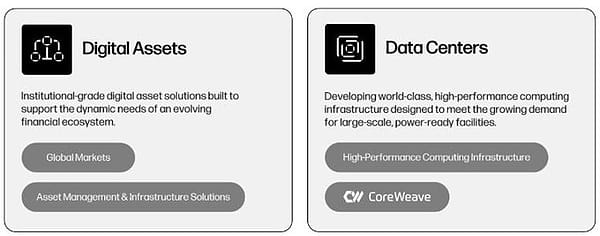
Galaxy's digital asset business primarily consists of two units: Global Markets (including institutional trading, lending, and investment banking services) and Asset Management & Infrastructure Solutions (including a series of asset management products and staking on-chain services).
Its second-quarter 2025 financial data confirms the strong profitability of this business:
The digital asset segment adjusted gross profit reached $71.4 million, a 10% quarter-over-quarter increase;
The global market outperformed the market, with institutional loan accounts growing 27% to $1.1 billion, indicating increased demand for its credit products;
The investment banking business demonstrates M&A advisory strength, serving as the exclusive financial advisor in Bitstamp's acquisition by Robinhood;
Assets under management and infrastructure solutions platform increased by 27% quarter-over-quarter to nearly $9 billion;
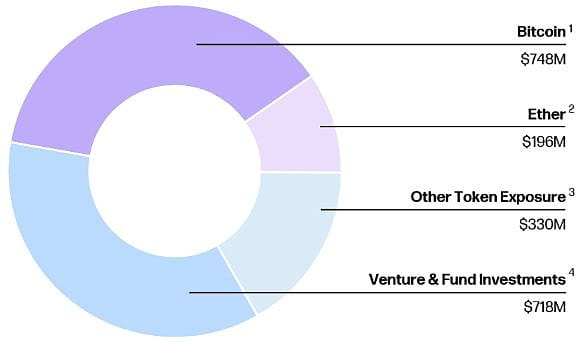
The second-quarter balance sheet shows $1.18 billion in cash and stablecoins, as well as $1.27 billion in digital assets (primarily BTC and ETH).
Galaxy's profitable digital asset business not only generates cash flow but also strengthens its balance sheet, enabling the company to self-fund the significant equity contributions required for Helios construction. Additionally, this business segment has demonstrated its capability to execute large, complex transactions — for example, recently selling over 80,000 Bitcoins (worth over $9 billion) to a single client. All these traits assure potential supercomputing clients: Galaxy is an experienced, reliable, and well-capitalized partner capable of delivering multi-billion-dollar infrastructure projects. This synergy creates a powerful self-reinforcing loop between the two business segments.
4. Competitive Landscape: AI Transformation Leader
Galaxy Digital is often confused with the group of Bitcoin miners attempting to pivot their assets towards AI computing hosting services. However, the following comparisons show that Galaxy stands out as the most attractive investment in this theme. The competitive landscape can be divided into two tiers: companies that have signed AI agreements (such as Core Scientific, TeraWulf) and companies that only claim strategic intentions (such as IREN, Hut 8, Riot). Compared to signed peers, Galaxy demonstrates significant advantages across all key dimensions.
Galaxy's leadership in key dimensions is specifically reflected in:
Agreement Attractiveness: The lease between Galaxy and CoreWeave features superior economics. Its annual rent income per MW is higher ($1.8 million vs. $1.4-1.6 million), EBITDA margins are superior (90% vs. 75-80%), and it includes a 3% annual rent escalation clause that competitors lack.
Balance Sheet Strength: Galaxy has $1.8 billion in net cash and investments. In contrast, competitors like CORZ and WULF carry significant net debt burdens — CORZ has just emerged from bankruptcy restructuring, while WULF avoided a similar fate through substantial equity dilution. These competitors' mining operations continue to consume cash flow, while Galaxy's traditional business remains profitable.
Expansion Capability: Galaxy's single Helios site has a potential capacity of 3.5 GW, dwarfing the scattered and limited power capacities of its competitors, enabling Galaxy to capture a larger share of future demand.
Strategic Focus: Galaxy has made a strategic decision to completely exit the Bitcoin mining business, dedicating 100% of its focus to AI data center opportunities. Competitors, on the other hand, attempt to adopt a hybrid model, spreading attention and capital across two distinctly different businesses.
5. Helios Valuation Analysis
The Helios data center business should be valued against other top publicly listed data center REITs (Real Estate Investment Trusts) and recent private market transactions. Public comparables such as Digital Realty and Equinix trade at multiples of approximately 25 times adjusted EBITDA. Private equity M&A transactions for data center assets also achieve similar multiples.
Baseline Scenario (only the currently approved 800 MW):
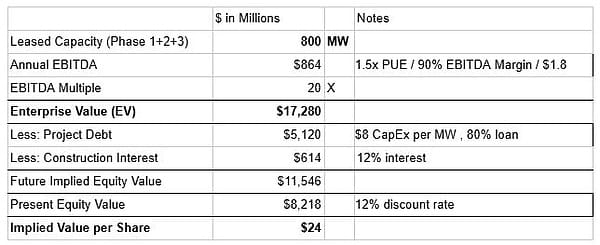
Assuming the currently approved 800 MW is leased at an average price of $1.8 million/MW. Applying a 20x EBITDA multiple yields an enterprise value of approximately $17.28 billion. After deducting about $5.73 billion in project-level debt and interest, the corresponding equity value for Helios is approximately $11.54 billion. Given that we expect this annual EBITDA to materialize by 2028, we apply a 12% discount rate, resulting in a present value equity value of $8.2 billion, or $24 per share.
Bullish Scenario (leasing 1,600 MW by the 2026 fiscal year):
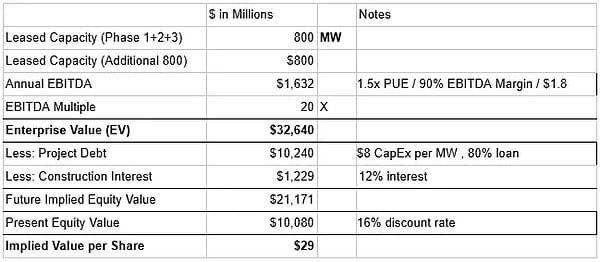
Assuming the subsequent 800 MW of power expected to be approved in the fourth quarter of 2025 is leased at an industry average of $1.6 million/MW. A total of 1,600 MW would generate approximately $1.63 billion of annualized EBITDA. Applying a 20x multiple yields an enterprise value of approximately $34.5 billion. After accounting for approximately $11.46 billion in project-level debt and interest, the corresponding future equity value for Helios is approximately $21.1 billion. Given that we expect the 1,600 MW capacity to be fully operational by 2030, we apply a higher discount rate of 16% to account for additional execution risks. This results in a current equity value of $10.01 billion, or $29 per share.
The current trading price of GLXY is approximately $24 (as of September 2, 2025). The baseline scenario for the Helios project has already reached a per-share valuation of $24. Our valuation does not yet include the traditional digital asset business profits of Galaxy. Bullish recently completed its IPO with a valuation of $5.4 billion, despite reporting a net loss in the first quarter of 2025. If the valuation of Galaxy's digital asset business approaches Bullish's IPO valuation, this alone could add about $8-10 in per-share value.
6. Key Risks and Mitigation Factors
(1) CoreWeave Tenant Concentration and Credit Risk
The most prominent bearish argument centers on the concentration risk associated with the single tenant CoreWeave, along with concerns about its debt burden and lack of investment-grade rating affecting credit reliability.
Risk Mitigation: CoreWeave's business model has high revenue visibility, with 96% of its revenue derived from long-term committed contracts. Its debt is primarily composed of delayed draw term loans specifically for financing growth capital expenditures based on signed customer contracts. This credit has been fully underwritten by established investors such as Blackstone — which has led significant financing arrangements for CoreWeave. Additionally, CoreWeave has built a durable moat through its strategic alliance with Nvidia, allowing it priority access to the latest GPUs and being the only 'Neocloud' operator capable of meeting the scale demands of top AI labs like OpenAI.
(2) Project Execution and Timeline Risks
The transformation and expansion of Helios represent a complex multi-billion-dollar infrastructure project with significant execution risks.
Risk Mitigation: The Galaxy management team, particularly Chief Investment Officer Chris Ferraro, has deep expertise in project financing and capital markets to mitigate this risk. The company's strong balance sheet (recently bolstered by approximately $500 million in financing) provides significant financial cushioning against unexpected costs or delays. A phased development strategy reduces risk by breaking projects down into manageable phases.
(3) Regulatory and Grid Risks
Future expansions beyond the currently approved capacity may face scrutiny or delays from Texas grid operator ERCOT — which is closely monitoring new large-load access requests.
Risk Mitigation: Galaxy's existing 800 MW approved access capacity is a significant de-risked asset that insulates it from the major bottlenecks faced by new projects. The approved power has been secured. Furthermore, compared to more restrictive jurisdictions, Texas regulators generally adopt a pro-business and anti-regulatory stance, providing significant benefits for future growth.
7. Conclusion
In summary, Galaxy Digital is an undervalued investment opportunity. The market continues to assess GLXY through a narrow lens of volatile cryptocurrency proxies, failing to recognize its fundamental transformation into a top AI infrastructure provider.
The core of this investment thesis lies in the Helios data center — this world-class asset mitigates risk through a milestone 15-year triple net lease signed with supercomputing giant CoreWeave. This partnership not only ensures predictable high-margin revenue streams but also validates Galaxy's position as a trusted partner in realizing its ambitious future expansion plans.
Our valuation analysis indicates that Helios's assets alone support the current stock price. Its profitable traditional digital asset business continues to distinguish it from other 'AI transformation' competitors, highlighted by its fortress balance sheet, multiple uncorrelated revenue streams, and highly focused management team. While there are risks associated with tenant concentration and project execution, Galaxy's experienced management and robust financial condition provide effective mitigation. As the company executes its clear roadmap and the market gradually absorbs the scale and stability of Helios's cash flows, we anticipate a revaluation of its stock.