One day, I was sitting with my laptop open, casually scrolling through different websites, without expecting to find anything extraordinary. It was just another routine moment — moving from one page to another, absorbing information the way we all do in this fast-paced digital age. Eventually, I opened an article focused on cryptocurrency and blockchain technology. The article explored multiple blockchain ecosystems, their architectures, their strengths, and the challenges they were trying to solve.
Naturally, as someone who follows the crypto market, I switched over to #Binance to observe the current market conditions. What I saw reflected uncertainty — volatility, hesitation, and the familiar tension that often defines emerging technological markets. Instead of rushing into conclusions, I returned to the article and continued reading more carefully, trying to understand the deeper infrastructure behind these systems rather than just their price movements.
That is when I encountered something that immediately captured my attention: Fogo.
At its core, @Fogo Official is a high-performance Layer-1 blockchain that utilizes the Solana Virtual Machine (SVM) — a powerful execution environment known for enabling parallel transaction processing, low latency, and high throughput. But what stood out was not just its technical foundation — it was the design philosophy behind it.
Unlike many blockchains that struggle with scalability, cost efficiency, or execution speed, #fogo appeared to focus on solving these fundamental limitations at the infrastructure level.
As I explored further, several key strengths became clear:
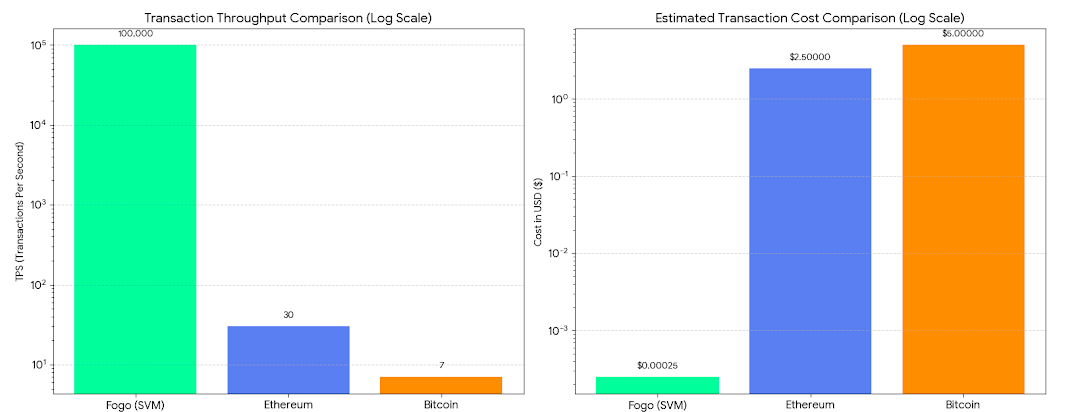
High Transaction Throughput: By leveraging the Solana Virtual Machine, Fogo can process transactions in parallel, significantly increasing execution efficiency compared to traditional sequential execution models.
Low Transaction Costs: Efficient execution and optimized infrastructure help minimize operational costs, making it accessible for both developers and users.
Fast Finality and Low Latency: Transactions are confirmed quickly, reducing waiting time and improving real-world usability.
Developer-Friendly Architecture: Since it uses the SVM environment, developers familiar with Solana-based tooling can more easily build and deploy applications on Fogo.
Infrastructure-Level Optimization: Rather than relying on temporary scaling solutions, Fogo is designed to deliver performance directly through its core protocol.
What impressed me most was that Fogo was not trying to reinvent blockchain for the sake of novelty — it was refining execution, improving efficiency, and focusing on practical performance.
After reading the article, I conducted my own research to validate these claims. I explored technical discussions, ecosystem mentions, and broader infrastructure conversations. The more I learned, the clearer it became that Fogo represents a new generation of execution-focused Layer-1 networks — designed not around hype, but around capability.
In today’s blockchain landscape, the true value of a network lies not in short-term market conditions, but in its ability to deliver reliable, scalable, and efficient infrastructure for the future of decentralized systems.
Fogo, by combining the proven execution strength of the Solana Virtual Machine with its own performance-focused architecture, positions itself as an emerging infrastructure layer capable of supporting high-demand decentralized applications.
Discovering Fogo was not just about finding another blockchain — it was about recognizing the evolution of execution itself.
And sometimes, the most important discoveries happen not when you are searching for something specific, but when you are simply willing to understand what lies beneath the surface.