


February 15, 2026.
Continuing from the previous text, yesterday it was mentioned:
"If you only have a goal but no long-term detailed plan, then the goal is just a dream."
Having a goal is just the beginning; correct execution leads to results.
For example: some people rushed to buy the dip too quickly, while the bear market lasted too long. The plan was not detailed enough, and they failed midway.
I divided the plan into three steps:
1. How to start?
2. How to execute long-term?
3. How to take profits?
Let’s talk about the first one, how to start?
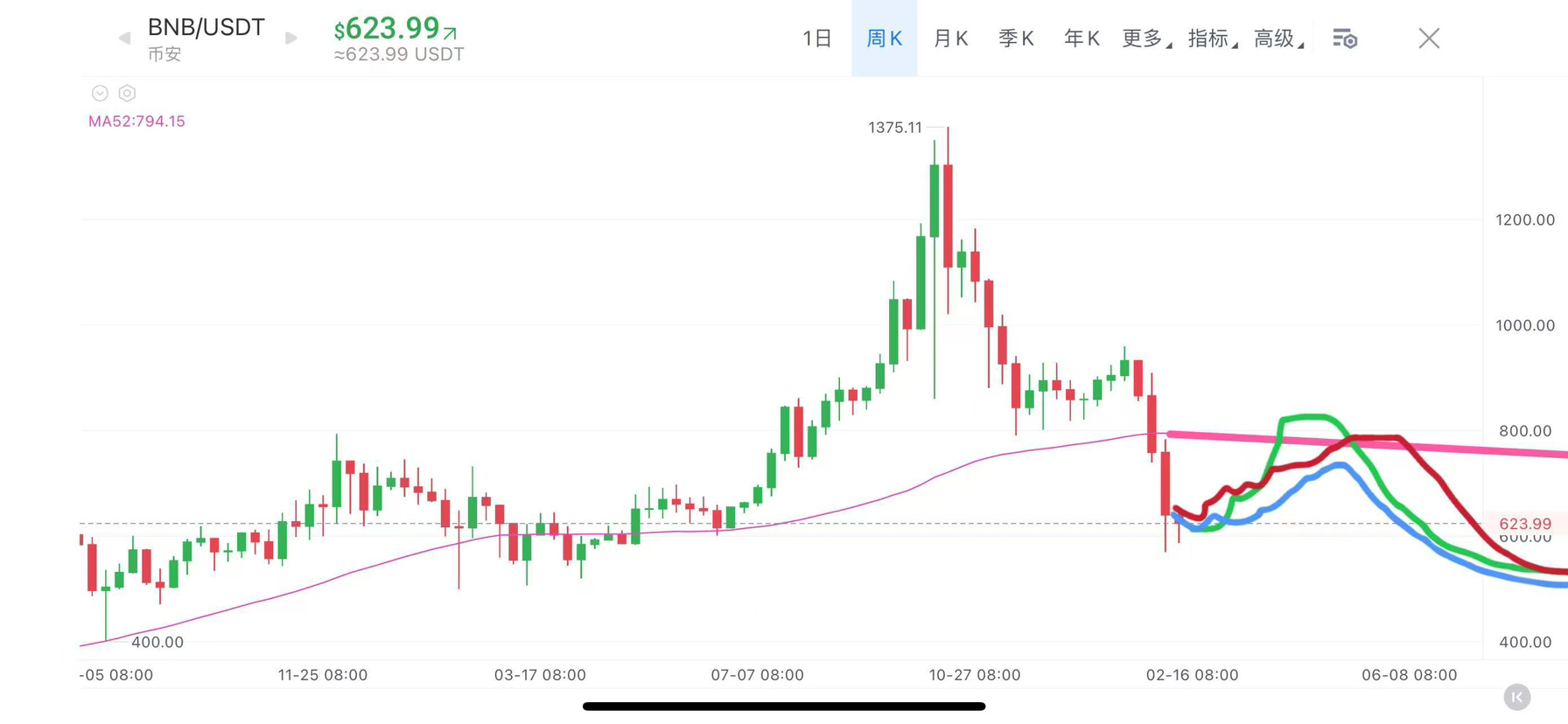
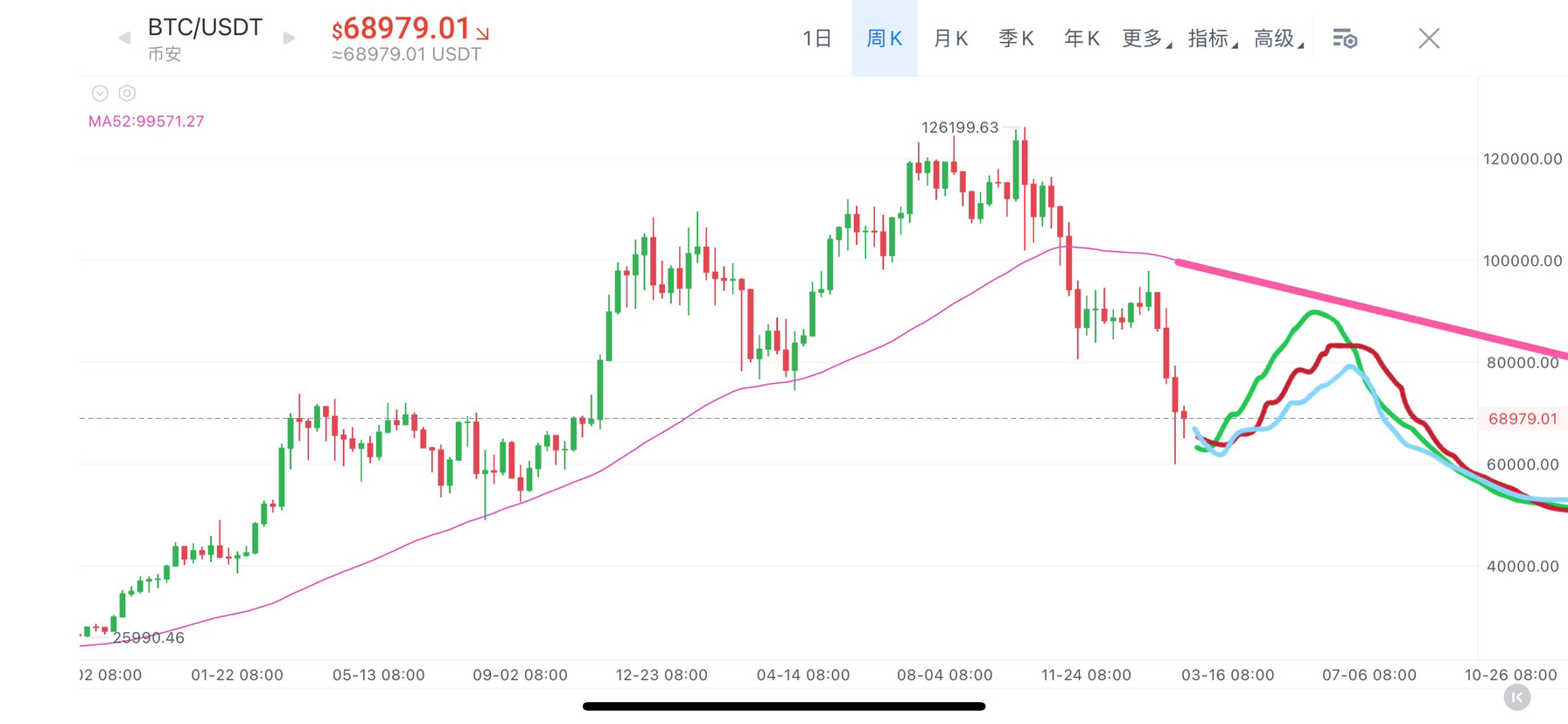
Yesterday I drew the bear market regression lines for BNB and BTC; if there is another drop, I can buy the dip in batches, close to historical extremes.
This crash could be BTC rebounding to 75,000 dollars and then dropping by 35%, or rebounding to 80,000 dollars and dropping by 40%.
Next, the second point, how to execute?
Whenever there is a crash, that’s when to execute. For instance, if April sees the second round of halving, then execute in April, and start executing in August.
If there is a crash in April, then plan for 8 months of batch investment starting from December minus four. If there's a crash in August, plan for 4 months of investment.
Concentrate funds to buy a core coin, and then redistribute profits.
For example, if you choose Bitcoin, while my first choice is BNB. Invest in batches, and don't worry about running out of bullets.
It's better to leave some funds than to go all-in at once.
Even if you haven't fully fired your bullets and the price goes up, there are other quality coins.
At that time, in the later stages of the bull market in 2025, didn't I also find OKB undervalued at over 40 dollars?
Finally, the third point, how to take profits?
When you find a quality asset with a better cost-performance ratio, you can take profits in batches and exchange them for assets with a higher profit-loss ratio.
For example, in the last bull market, the price of Bitcoin at the end of 2024 was 100,000 dollars.
While OKB's price is still over 40 dollars, I found that the future profit-loss ratio of OKB is higher, so I converted my Bitcoin into OKB.
Exchanging overvalued for undervalued is the best way to take profits.
Of course, if you can't find it, then buy quality assets at low prices and wait for them to rise to historical highs before selling in batches.
If all quality coins are overvalued, stay away from the market.
Brother Cai's personal goals and plans:
After the next round of crashes, I will prioritize buying BNB in batches.
Assuming a crash in April, I would invest over 8 months. If there is a crash in June, I would invest over 6 months. If the bullets aren't finished and there's a rebound, the remaining bullets can be directed to other coins.
If the bullets are finished and I have no money, I will look at OKB again later.
Then you will allocate some coins that have surged too much in the short term, exchanging them for OKB or other quality coins in an ant-moving-house style.
If necessary, the next round may still take 120,000 dollars of Bitcoin.
Go for higher cost-performance ratio coins rather than being greedy for the last few points of Bitcoin or pursuing so-called peak prices.

-------------
(02/14, 26) Reading notes and insights:
Greatness and short-term are incompatible.
To achieve great accomplishments, one needs long-term vision. Create a long-term executable plan to achieve your goals.
Regardless of exercising, studying, or investing, what matters is long-term persistence.
Persistently repeating small actions every day reinforces the cycle of behavior and belief, which is much more important than occasional spur-of-the-moment decisions.
We often overestimate short-term gains and underestimate long-term returns.
When you want to make an investment, don't try to do it all at once. Instead, it's better to buy in batches until you reach your target position.
Stick to long-termism, and accumulate small victories into big wins.