

In 2024, the TON blockchain became the center of attention in the crypto market – not due to a groundbreaking DeFi protocol, but because of the explosion of 'tap-to-earn' games on Telegram. Names like Hamster Kombat and Notcoin attracted millions of players in a short time, pushing the number of daily active wallets on TON to nearly 2 million by September 2024.
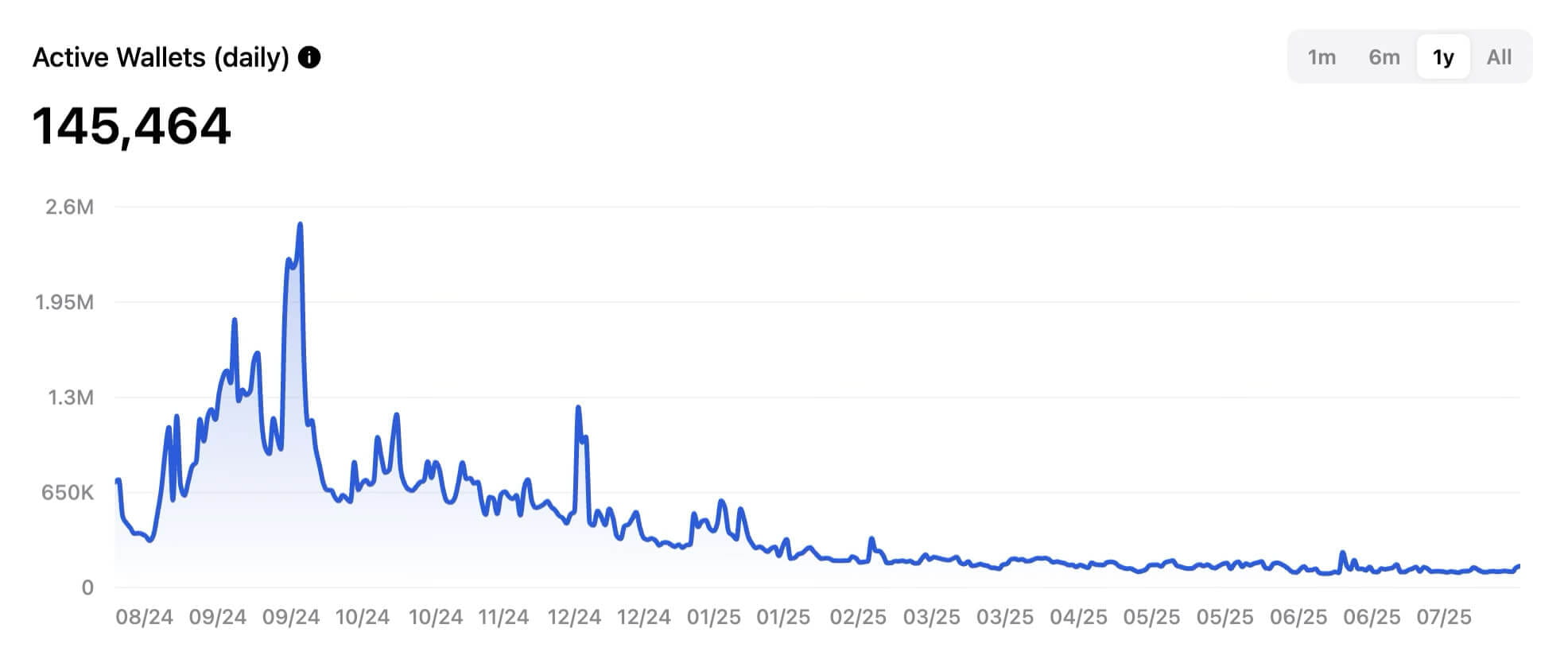
Active Daily Telegram Wallets (source: Tonstat).
This growth demonstrates TON's superior ability to attract users, but it also exposes the fragility of a model reliant on the network effect: most players participate only for quick rewards and leave when the incentives end. Speculative capital – flexible and opportunity-driven – also quickly withdraws.
The residual impact after the frenzy
The 'cooling down' after the gaming frenzy is not a collapse, but a reconstruction. In January 2024, before the gaming boom, TON only recorded an average of 26,000 active wallets per day. After the peak, this number stabilized at 100,000–200,000, several times higher than the initial baseline.
More importantly, the influx of developers and users has laid the foundation for ecosystem development. The number of DeFi protocols on TON increased from 35 to 67 in 2024, a 91% increase, indicating a shift from short-term promotions to sustainable financial infrastructure.
The DeFi landscape of TON
The DeFi ecosystem on TON currently includes token swaps, staking, and lending. In early 2024, EVAA launched as the first lending protocol. By the end of summer, AMM STON.fi raised nearly $400 million in liquidity. Currently, Tonstakers (liquid staking) and STON.fi (swap) lead in total value locked (TVL), reflecting the demand concentrated on core services with high liquidity.
At its peak, the total value locked (TVL) across the TON network reached $1.1 billion in July 2024, before dropping to $600 million at the beginning of 2025 and currently around $400 million. These figures indicate that TON's liquidity is still heavily influenced by short-term market factors.
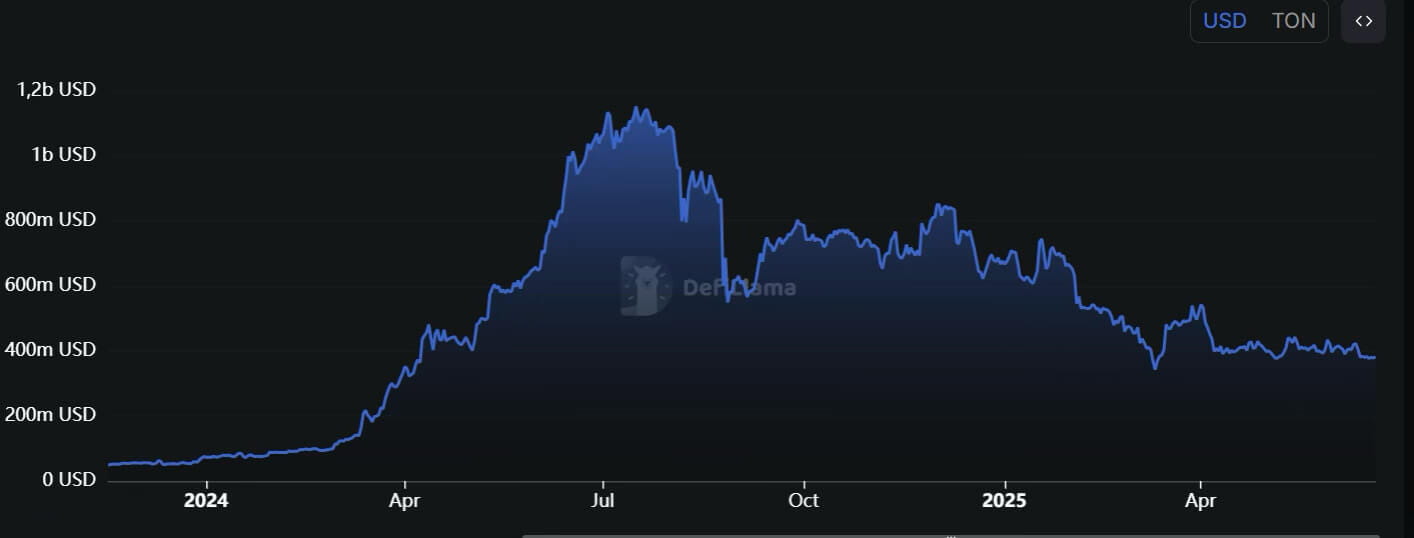
DeFi TVL (source: DefiLlama)
By the end of 2024, TON has nearly 38 million wallet addresses, but new wallets have dropped sharply from 724,000 wallets/day in the fall to just 33,000 at the beginning of 2025. In this context, staking has emerged as a safe haven, with around 790 million TON being staked, concentrating liquidity into less risky foundational infrastructure.
Why hasn't the revolution occurred?
Compared to Ethereum or Solana, the depth of liquidity and product diversity on TON is still in development. Part of the reason comes from the design: TON is built to scale massively, leading to a more complex technical structure for developers.
TON's smart contracts use low-level language, with many components needing to be developed from scratch, slowing initial DeFi progress. However, this approach may provide more effective and sustainable solutions in the long run. The core team is currently working to reduce barriers for developers, paving the way for faster growth.
Another factor is the dependence on Telegram. This integration offers a significant advantage – access to over 1 billion users – and practical utility as from 2024, Telegram channel owners can receive ad revenue in TON. But at the same time, it also creates concentration risks: any disruption from Telegram could immediately impact TON.
Currently, for many casual users, the mini-apps on Telegram are still just entertainment games and not financial tools. If it does not move beyond this framework, TON will struggle to attract institutional capital.
Unlocking DeFi potential
The way forward for TON is clear: break free from the short-term 'hype' cycle and provide mass-market financial services, seamlessly integrated into the Telegram experience.
Potential scenarios include:
Barrier-free payments: send cryptocurrency right within the Telegram chat, as simple as messaging.
Everyday utility: pay for goods, services, or restaurant bills using TON tokens.
Accessible credit: providing small loans and credit solutions in underbanked areas.
If successfully implemented, TON could move beyond the 'gaming phenomenon' image to become the main interface for global cryptocurrency adoption.
Signs of confidence from institutions
Major financial institutions have begun to acknowledge the potential of TON. In March 2024, Sequoia Capital, Draper Associates, Kingsway, CoinFund, Ribbit, and Skybridge all invested in Toncoin.
By January 2025, Zodia Custody (a subsidiary of Standard Chartered) announced support for TON's Jetton token standard, paving the way for banks and institutional investors to custody TON assets. In July 2025, The Open Platform – the entity developing the protocol and applications based on Telegram – successfully raised $28.5 million at a valuation of $1 billion from Ribbit Capital and Pantera Capital.
Conclusion: From potential to reality
The boom of 2024 proves that combining the outreach power of Telegram with blockchain technology can shake the market. However, to truly change, TON needs to evolve from a 'hype launchpad' to a solid financial ecosystem.
The necessary foundations are in place: a growing developer community, increasingly refined infrastructure, and a massive distribution channel through Telegram. If DeFi on TON can simplify user experience and provide essential services within the environment they are already familiar with, TON could not only participate in the digital finance future – but also help shape it.
This is a review by Slavik Baranov, CEO of STON.fi, a project built on the TON blockchain, so there may be some subjective elements; readers should only consider it as a reference.
https://tapchibitcoin.io/ton-tu-con-sot-game-tren-telegram-den-tham-vong-dinh-hinh-tai-chinh-so.html