


In the world of Web3, data is no longer an isolated resource but a flowing asset. Chainbase, as the world's largest super data network, integrates blockchain data into a unified ecosystem through its unique dual-chain architecture. This is not only a technological innovation but also a bold exploration of economic models. Today, we will delve into Chainbase's $C token economic model and how it drives network participants through incentive mechanisms, promoting the sustainable development of the entire Web3 ecosystem. Unlike traditional centralized data platforms, Chainbase emphasizes decentralization, transparency, and sustainability, making $C tokens not just a currency tool but also an anchor point of network value.
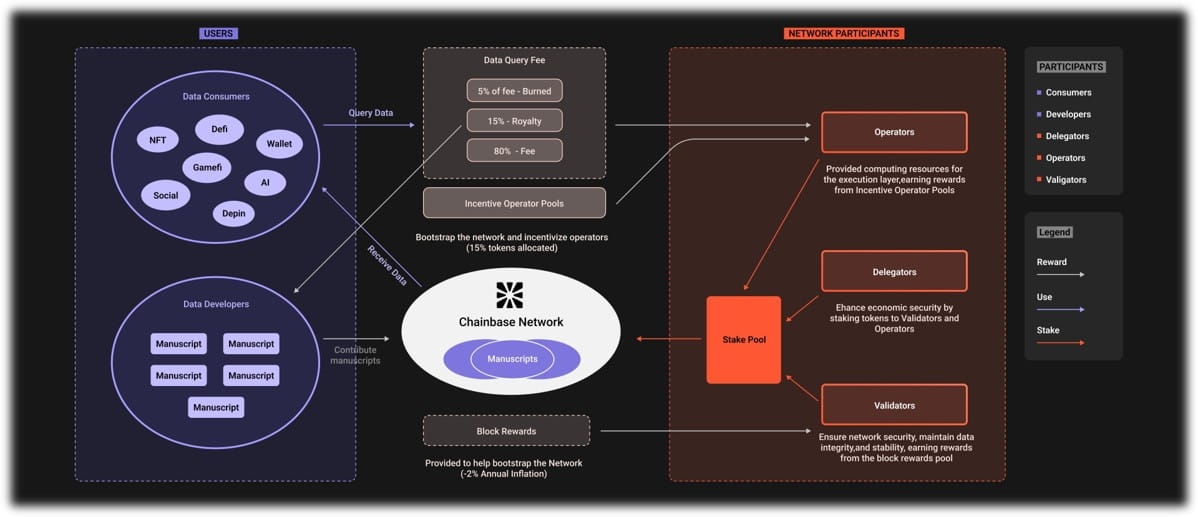
First, we need to understand the core participants of the Chainbase network and their division of roles. It is a collaborative system composed of developers, operators, validators, and delegators, each tightly connected through the circulation and staking mechanisms of $C tokens. Developers are responsible for building and publishing data sources; they are both producers and consumers of data. On one hand, they upload data sources to the network and earn rewards; on the other, while developing DApps, they query network data, becoming users. This dual identity design ensures a closed loop of data supply and demand. Operators provide computing resources, similar to a proof-of-work model, with their rewards based on the quantity and quality of tasks processed. Validators maintain consensus using a $C token-based DPoS mechanism to ensure network security. Delegators enhance economic security by staking $C tokens or ETH to earn passive income.
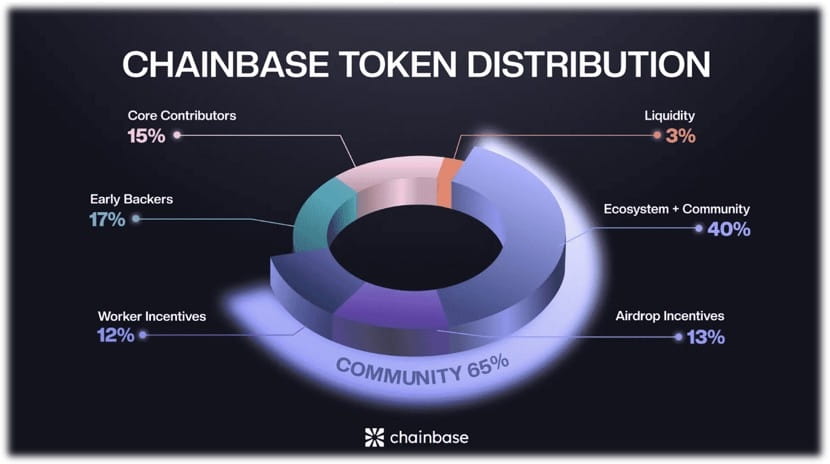
$C token's economic model is built on a dual-staking foundation, which is an innovative mechanism that combines the staking of ETH (or LST) and $C tokens. Why dual? Because single staking can easily lead to network volatility, while a dual mechanism can diversify risks and enhance overall stability. For instance, delegators can stake ETH with operators for optimized computing resources while staking $C tokens with validators to support the consensus process. This design draws from EigenLayer's smart contract framework, but Chainbase's implementation on the Holesky testnet focuses more on the real-time processing of data. According to the network's white paper, the dual-staking model can improve network security by over 30% as it introduces multi-layer incentives and avoids inflationary pressure from a single token.
On the inflation and deflation mechanisms, Chainbase's design is quite ingenious. The total supply of $C tokens is fixed within a certain range, and the circulation is controlled through a burn mechanism. Whenever a data query or indexing task is completed, a portion of the transaction fee is burned, similar to Ethereum's EIP-1559 proposal, but more targeted towards the data ecosystem. Suppose the network handles 100,000 data queries daily, with 5% of the fees being burned; this will gradually reduce the circulating supply, driving the long-term appreciation of the token's value. Meanwhile, reward distribution adopts a dynamically adjusted algorithm: developers receive rewards based on the usage frequency of their data sources, operators share rewards according to their computing contributions, while validators and delegators share network income through staking yields. This model ensures fairness and avoids resource monopolization by early participants.
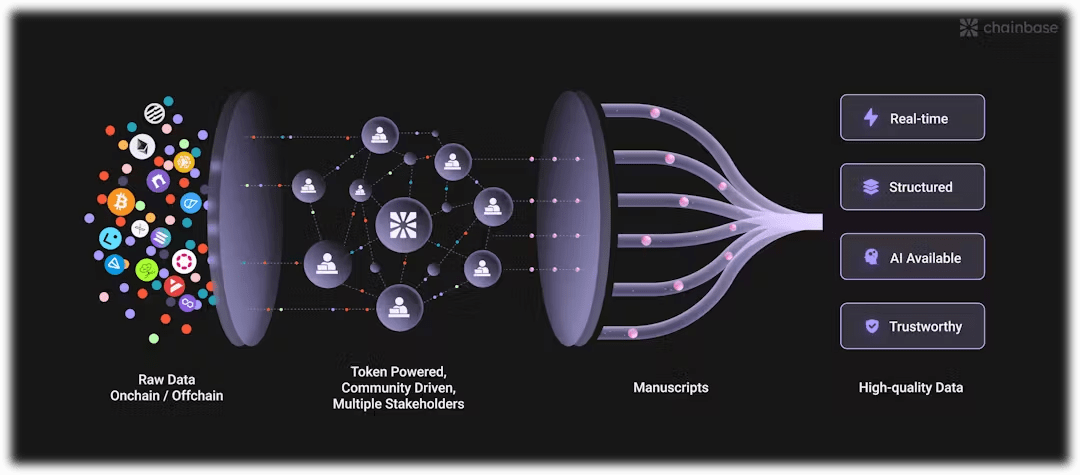
From a data support perspective, we can refer to Chainbase's roadmap. The network aims to achieve high throughput and low latency, with final determinacy achieved through the CometBFT consensus engine. In actual deployment, Chainbase has already processed over a million data indexing tasks on the testnet, with average query latency controlled at the millisecond level. This is nearly 50% faster than traditional blockchain data providers like The Graph, as Chainbase's dual-chain architecture separates the execution layer from the consensus layer. The execution layer focuses on data processing, while the consensus layer ensures security, reducing bottlenecks and improving efficiency.
Now, let's delve into the role of the $C token in the incentive mechanism. First is the developer incentives. Developers use chainbase-sdk to locally build data sources, then test them in a sandbox environment, and finally publish them to the network. This is an on-chain operation that requires a small amount of $C tokens as a registration fee. However, once the data source is indexed and queried, developers can earn continuous rewards. For example, if a data source is used for AI model training, developers may receive 20% of the query fees. This encourages the production of high-quality data sources, driving innovation in Web3 applications. For instance, in the DeFi sector, developers can create cross-chain lending data sources that allow users to seamlessly view multi-chain assets, directly enhancing liquidity and user experience.
The incentives for operators focus more on hardware investment. To become an operator, one must register their Ethereum public key in EigenLayer and then maintain the infrastructure. Rewards are based on workload: handling complex data tasks, such as real-time indexing of multi-chain data, can yield higher returns. In the network's economic model, the yield for operators is linked to network utilization. If network load is high, yields can reach annualized rates of 15%-20%. However, if operators are negligent or make mistakes, they face slashing penalties, losing the staked $C tokens. This is similar to the forfeiture mechanism in PoS, but Chainbase adds data integrity checks to ensure penalties are based on objective metrics.
The role of validators leans more towards governance. They reach consensus using the improved CometBFT, with voting power determined by the staked $C tokens. Validators need to meet hardware requirements, such as high-bandwidth servers and stable nodes. Rewards come from block production and transaction fee sharing, but more importantly, they participate in network upgrade decisions. For example, in the roadmap, Chainbase plans to introduce zero-knowledge proofs to optimize privacy data queries, and validators can influence this process through proposal voting. This makes the $C token not just an economic tool, but also a governance right.
Delegators are passive participants in the network, but their role is indispensable. Through dual staking, they can choose to support specific operators or validators and receive dividends. The yield depends on the overall performance of the network: if Chainbase successfully integrates more blockchain data, the delegator's earnings will grow accordingly. Based on simulated data, during the maturation period of the network, the annualized return for delegators may stabilize around 10%. This is more attractive than simply holding ETH, as the appreciation potential of $C tokens comes from the expansion of the data ecosystem.
From a trend forecasting perspective, Chainbase's $C token economic model will play a key role in the AI era. As artificial intelligence increasingly relies on blockchain data, Chainbase, as an open data layer, will become the preferred infrastructure. Imagine a future where AI models need cross-chain data for training, such as combining transaction histories from Ethereum and Solana to predict market trends. Chainbase's dual-chain architecture supports such interoperability, while $C token incentives ensure a sufficient supply of data. By 2026, it is expected that the Web3 data market will reach hundreds of billions of dollars, with Chainbase potentially capturing 10%-15% market share. This is based on current trends: DeFi TVL has exceeded hundreds of billions, and the rise of AI blockchain projects like Bittensor all require reliable data sources.
However, challenges cannot be ignored. While dual staking enhances security, it may increase the user threshold. New delegators need to understand the balance between ETH and $C, or else the risks may amplify. Additionally, the sustainability of the network depends on the activity of the developer community. If the quality of data sources is low, query demand will decline, leading to reduced rewards. To address this, Chainbase's roadmap includes community funds to finance developer projects. This will be distributed via $C tokens to stimulate innovation.
In terms of security, Chainbase's model employs a dual approach of economic penalties and incentives. The slashing mechanism targets malicious behaviors, such as double-signing by validators or data tampering by operators. At the same time, rewards are skewed towards long-term participants, reducing short-term speculation. In contrast, traditional PoS networks like Cosmos are more susceptible to 51% attacks, but Chainbase's dual-chain design mitigates risk: even if the consensus layer is disrupted, the execution layer's data processing can still operate independently.
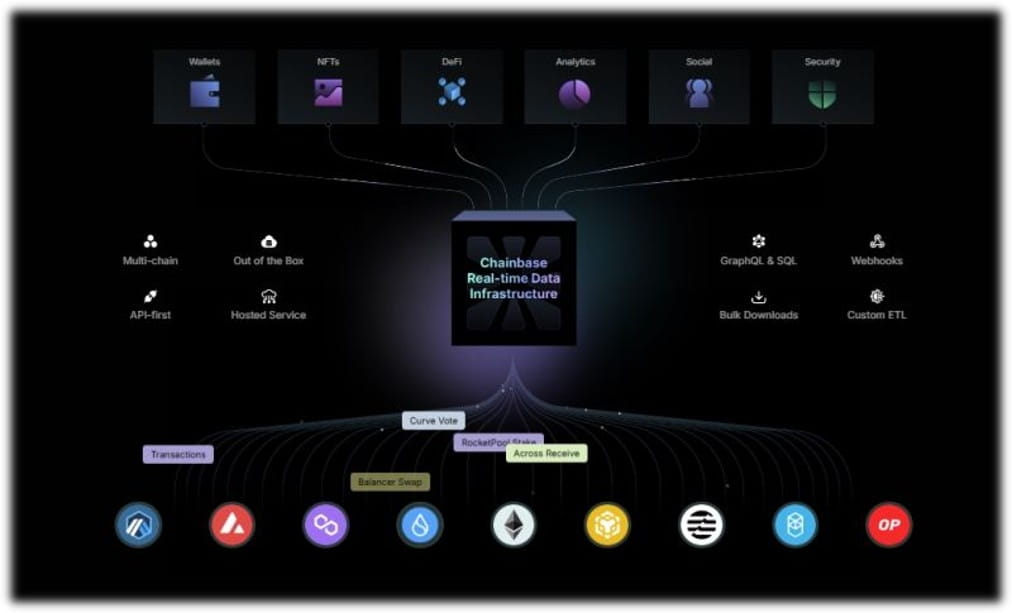
Further extending to use cases, the economic model of the $C token supports various scenarios. In wallet applications, users can query multi-chain assets by paying with $C tokens, achieving one-stop management. This reduces gas fees and enhances convenience. In security tools, the network can track attack vectors and provide alerts, while developers build data sources for such tools and earn rewards. AI integration is another highlight: deploying AI models with multi-chain data can improve accuracy, with $C tokens used to pay for computing resources, ensuring decentralization.
On social platforms, Chainbase allows cross-chain user interactions, with $C tokens incentivizing content sharing. For example, a social DApp based on Chainbase could enable seamless communication between Ethereum users and Polkadot users, with query fees settled through tokens. This promotes the decentralization of Web3 social, avoiding the monopoly of Twitter-like platforms.
On the infrastructure side, Chainbase provides cross-chain lending support for DeFi. Users can stake $C tokens as collateral to borrow multi-chain assets. This increases liquidity and reduces fragmentation risk. Looking ahead, as more Layer2 chains go live, Chainbase's interoperability will become key, and the value of $C tokens will rise accordingly.
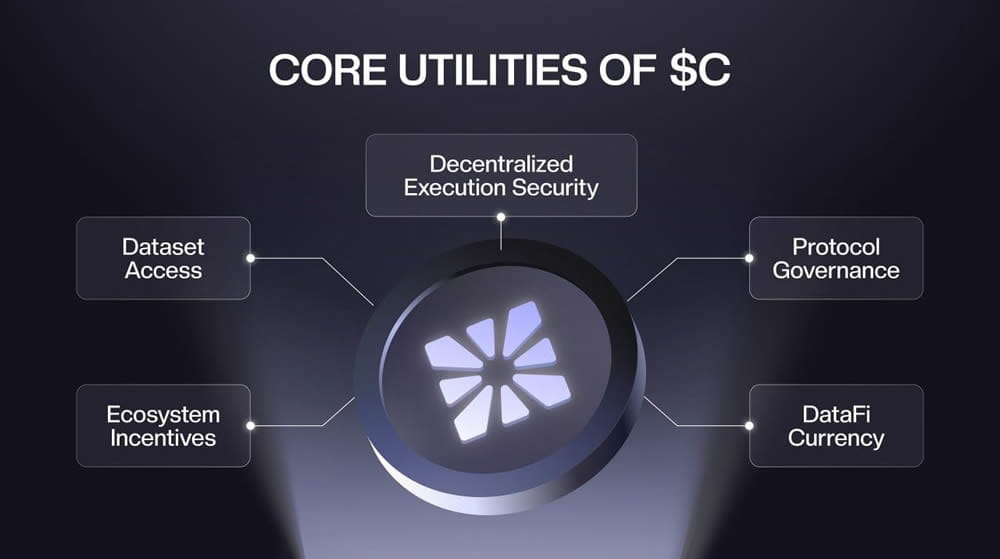
Overall, Chainbase's $C token economic model is not just an incentive tool, but the engine of the ecosystem. It ensures the long-term vitality of the network through dual staking, dynamic rewards, and burn mechanisms. Compared to other data networks like SubQuery, Chainbase places a greater emphasis on composability and supports high throughput. This will attract more developers to join, driving the transition of Web3 into the AI era. Of course, success depends on community execution, but from the current roadmap, the outlook is optimistic.
It's not just about buying tokens, but investing in the infrastructure of the future of data. Chainbase is reshaping Web3 to make data truly accessible and useful.