What is a layer?
In the blockchain field, Layer essentially refers to the division of the blockchain network's functions and positioning. The core purpose is to solve the triangular dilemma of "security, scalability, and decentralization" that a single blockchain struggles to balance through "layered collaboration." Different layers take on different responsibilities and together form an efficient blockchain ecosystem.
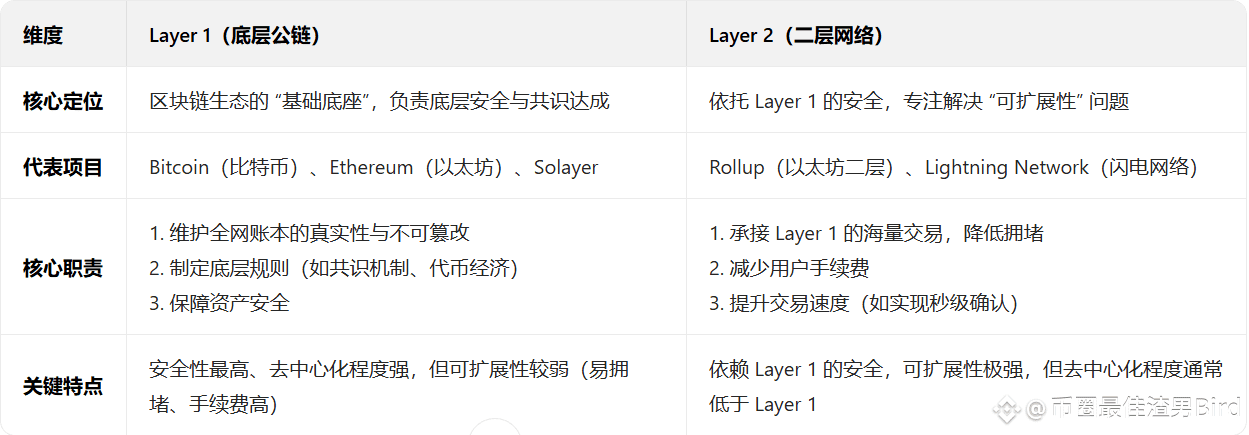
The most common are Layer 1 (base layer public chain) and Layer 2 (second layer network), which have significant differences in positioning and function. The specific distinctions can be quickly understood through the table below:
In addition to L1 and L2, there is also Layer 0 (cross-chain base protocol) (like Polkadot, Cosmos, which connects different L1 public chains to achieve cross-chain data/asset interoperability) and Layer 3 (application layer) (like DeFi applications, NFT platforms, which provide specific services directly to users and are built on top of L1 or L2). However, the most core and widely discussed collaboration model in the industry remains between Layer 1 and Layer 2.
The Solayer you mentioned earlier, $LAYER , is a typical Layer 1 public chain, whose core advantage is to directly enhance scalability (1 million + TPS) at the L1 base layer through "hardware acceleration" (such as InfiniSVM technology), breaking the traditional L1 bottleneck of "difficultly balancing security and performance."
If you need to further understand a specific type of layer (such as the technical principles of Layer 2) or want to analyze the role of layers in conjunction with certain scenarios (such as DeFi, NFT), you can provide more requirements, and I will elaborate accordingly.
#BuiltonSoloyer @Solayer $LAYER
In the blockchain field, Layer essentially refers to the division of the blockchain network's functions and positioning. The core purpose is to solve the triangular dilemma of "security, scalability, and decentralization" that a single blockchain struggles to balance through "layered collaboration." Different layers take on different responsibilities and together form an efficient blockchain ecosystem.
The most common are Layer 1 (base layer public chain) and Layer 2 (second layer network), which have significant differences in positioning and function. The specific distinctions can be quickly understood through the table below:
In addition to L1 and L2, there is also Layer 0 (cross-chain base protocol) (like Polkadot, Cosmos, which connects different L1 public chains to achieve cross-chain data/asset interoperability) and Layer 3 (application layer) (like DeFi applications, NFT platforms, which provide specific services directly to users and are built on top of L1 or L2). However, the most core and widely discussed collaboration model in the industry remains between Layer 1 and Layer 2.
The Solayer you mentioned earlier, $LAYER , is a typical Layer 1 public chain, whose core advantage is to directly enhance scalability (1 million + TPS) at the L1 base layer through "hardware acceleration" (such as InfiniSVM technology), breaking the traditional L1 bottleneck of "difficultly balancing security and performance."
If you need to further understand a specific type of layer (such as the technical principles of Layer 2) or want to analyze the role of layers in conjunction with certain scenarios (such as DeFi, NFT), you can provide more requirements, and I will elaborate accordingly.
#BuiltonSoloyer @Solayer $LAYER