
Save time and write the total score.
Conclusion: The core of profitability lies in the optimal combination of profit-loss ratio, winning rate, and loss control. Loss control affects the fluctuation range of funds (maximum retracement). There is no absolute value, only relative coordination. The overall response is the growth of the net capital value curve and the reasonable retracement.
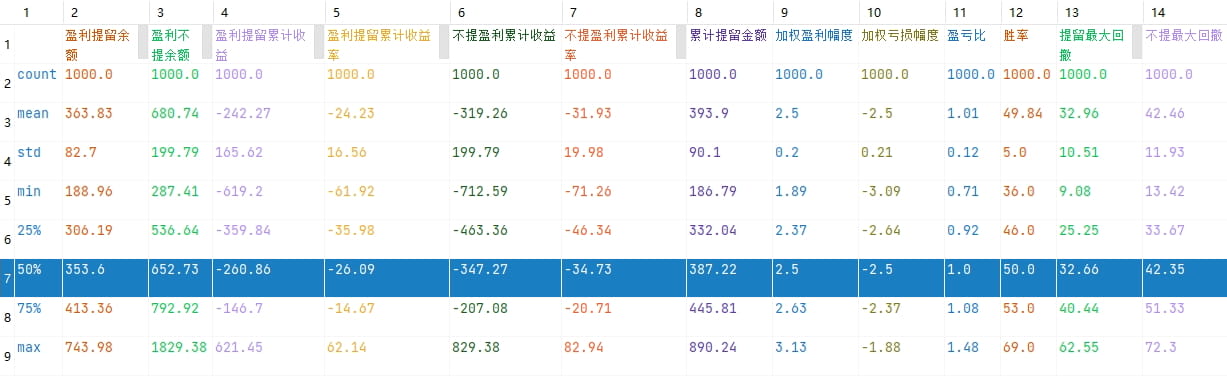
First of all, why should we study winning rate and profit-loss ratio? Because if you can't find a trading model with winning rate and profit-loss ratio that is beneficial to you. But if you enter the market randomly, the trading results will be very unfavorable to the trader. How bad is it? very scary!
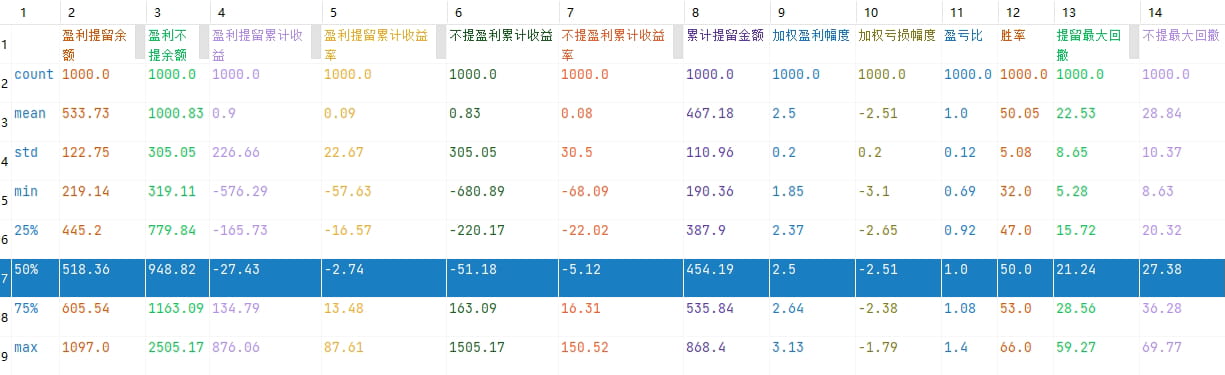
Hypothesis 1: Profit and loss ratio 1, winning rate 50%, loss control 5%, transaction costs not considered, capital situation after 100 transactions, statistics repeated 1000 times are as follows
Assumption 2: Profit and loss ratio 1, winning rate 50%, loss control 5%, considering transaction cost 0.08%, capital situation after 100 transactions, the statistics repeated 1000 times are as follows
So since the random market entry strategy is not feasible, how can traders profit from trading? The only way to think about it is to change the winning rate and profit-loss ratio so that you can gain a relative advantage in winning rate and profit-loss ratio.
There are roughly three strategies:
1. Improve the winning rate (find methods and techniques);
2. Improve the profit-loss ratio (timing, finding the best entry opportunity);
3. Improve the winning rate and profit-loss ratio at the same time;
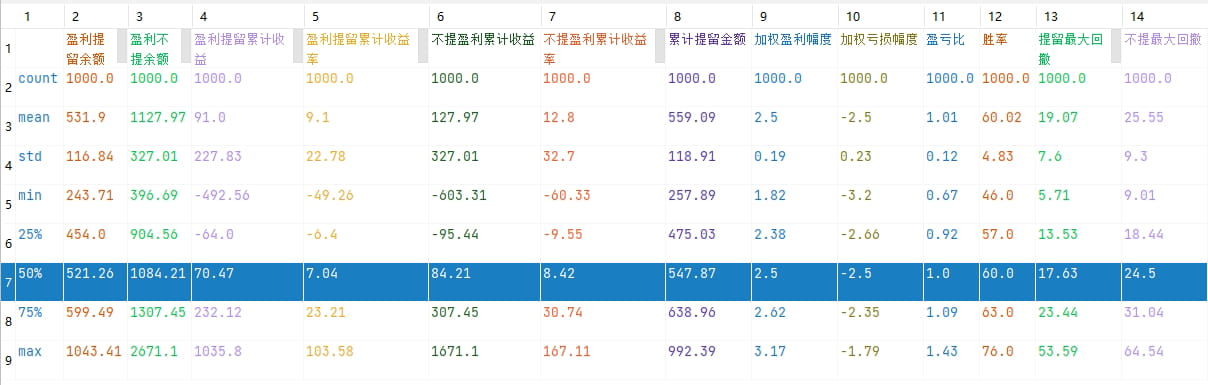
Hypothesis 3: Improve the winning rate (profit and loss ratio 1, winning rate 60%, loss control 5%, consider transaction cost 0.08%, capital situation after 100 transactions, statistics repeated 1000 times are as follows)
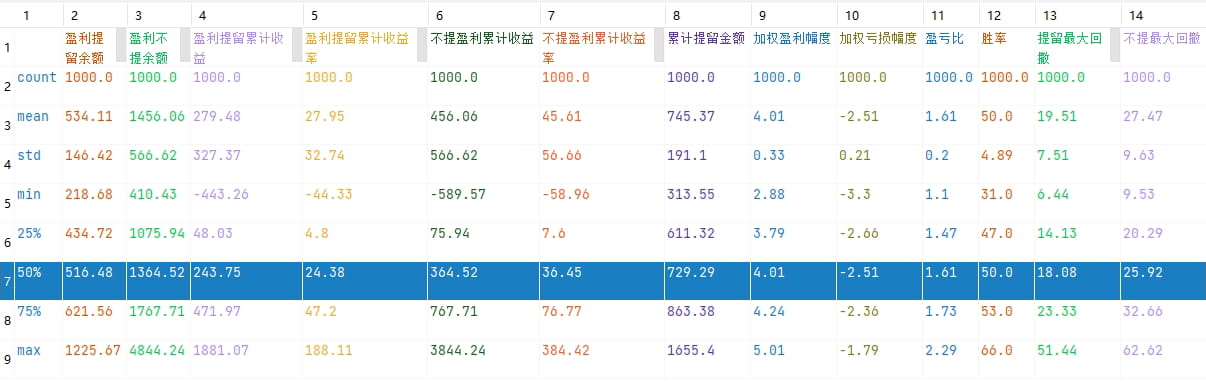
Hypothesis 4: Improve the profit-loss ratio (profit-loss ratio 1.6, winning rate 50%, loss control 5%, considering transaction cost 0.08%, capital situation after 100 transactions, statistics repeated 1000 times are as follows)
Hypothesis 5: If you increase the winning rate and profit-loss ratio at the same time, you will definitely make profits if you continue to trade for a long time (profit-loss ratio 1.6, winning rate 60%, loss control 5%, consider transaction cost 0.08%, capital situation after 100 transactions, repeat statistics 1000 times Data are as follows)
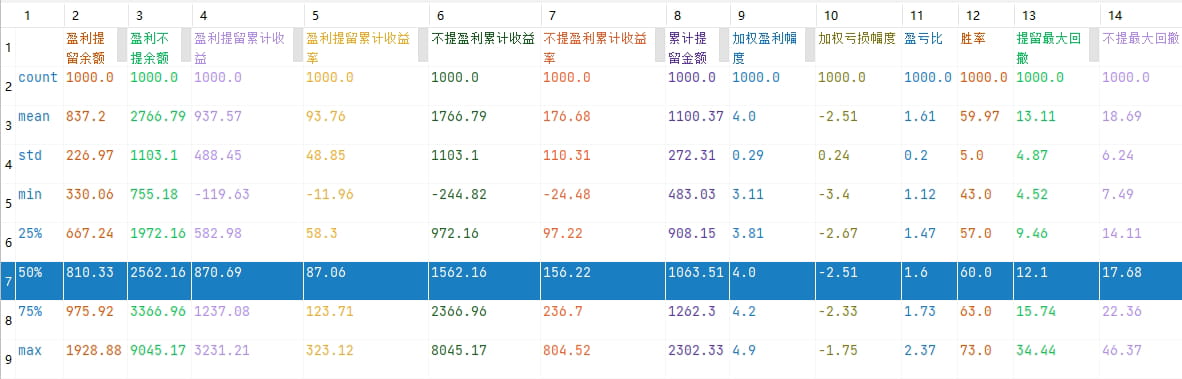
The above key points are initially integrated into the concept of expectation in mathematics, and the criterion for measuring whether a trading system makes money is also based on this. This is a very absolute measure, that is, if the expectation is positive, it will definitely make money (long-term trading).
The mathematical expected value S in trading = profit probability (i.e. winning rate) * average profit ratio - loss probability (i.e. 1 - winning rate) * average loss ratio
Assume S of 5=60%*4%-40%*2.51%=1.39%
Hypothesis 6: Same as Hypothesis 5, but the winning rate becomes lower, the profit-loss ratio is 1.6, the winning rate is 30%, the loss control is 5%, and the transaction cost is 0.08%.
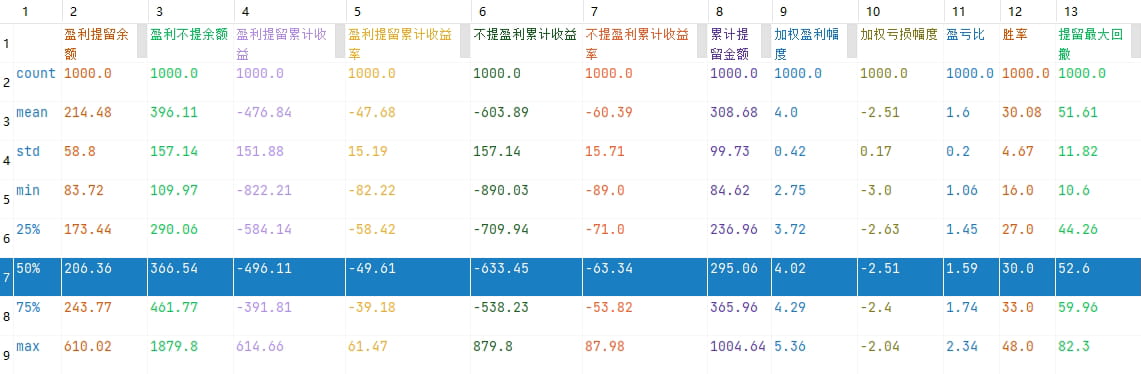
Assume 6 S=30%*4%-70%*2.51%=-0.05%
Then assuming that system 6 is used for long-term trading, it will definitely lose money.
Assumption 7: The conditions are consistent with Assumption 5, except that the number of transactions is increased to 300 times, and the statistics repeated 1000 times are as follows
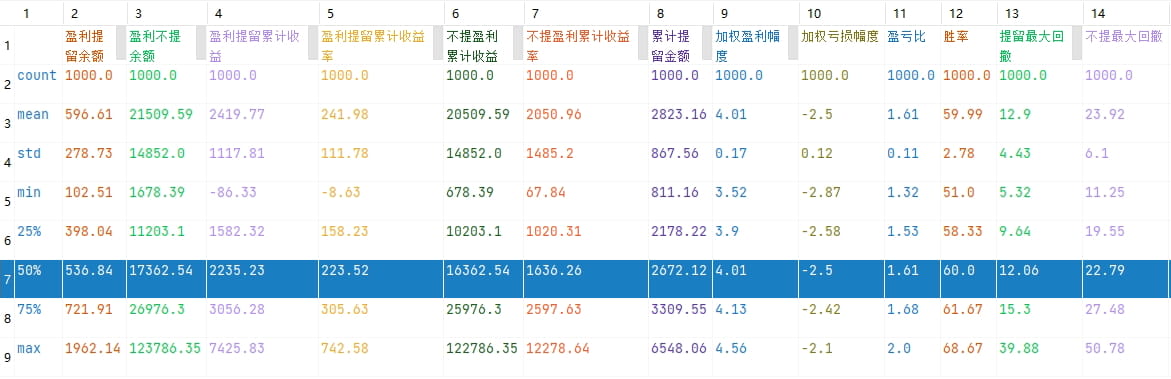
This is the effect of compound interest, not a single sudden fortune, but the result of multiple trading opportunities.
Note: Mathematical expected value is simply the average outcome of a long-term trade. Only the longer the transaction lasts and the more samples are traded, the closer the final average result will be to this result. In actual trading, the distribution of profit and loss transactions is random and uneven; profits and losses may occur at frequent intervals, or there may be multiple consecutive profits or multiple consecutive losses midway. Whether a trader can survive this period of continuous losses and stick to his or her trading system as always is often the key to the trader's ultimate success or failure. And if traders know that their trading system has a positive mathematical expectation value, that is, it will definitely be profitable in the long run. It will undoubtedly increase his confidence and determination to survive the trading loss period and help him persist until the profit turning point comes. This may be the value of a trading system with a positive mathematical expected value.
The greater the mathematical expectation, the more reliable the trading system and the higher the long-term returns. The mathematical expected value is determined by the winning rate and the profit-loss ratio. The higher the winning rate and the greater the profit-loss ratio, the greater the mathematical expected value will naturally be.
Even if it is already a difficult task to unilaterally increase the winning rate or profit-loss ratio, many people may not be able to achieve their goals despite their exhaustive efforts. The winning rate and profit-loss ratio are mutually binding, and it is even more difficult to significantly improve them at the same time. What's more, there is also the number of trading opportunities (which directly affects the income of long-term trading). This variable is also constrained by the winning rate and profit-loss ratio.
Writing here, I summarize again:
1. A successful trading system (or strategy) does not need to deliberately pursue a too high winning rate or profit-loss ratio. Because those strategies that blindly pursue high winning rates or high profit-loss ratios will significantly reduce the number of trading opportunities. In the long run, the number of trading opportunities is the most critical and core factor that determines the final level of income, because in the long run, no one depends on one or several transactions to determine the final trading result (especially for ultra-short trading, especially for ultra-short trading). in this way).
2. The single factor of winning rate or profit-loss ratio can be high or low, but when the winning rate and profit-loss ratio are combined, there must be an advantage. That is, there must be a positive mathematical expectation value.
3. This advantage does not need to be very large, that is, although the mathematical expectation value must be positive, it does not have to be very high. However, there must be enough trading opportunities to continuously accumulate this advantage step by step, and finally form huge profits.
4. These trading opportunities are qualified trading opportunities under the rules of the trading system (or strategy). Rather than impulsive, messy, and blind trading opportunities.
In fact, this is the magic of compound interest. It’s just that under normal circumstances, although everyone who trades knows the importance of compound interest, it always feels a bit abstract.