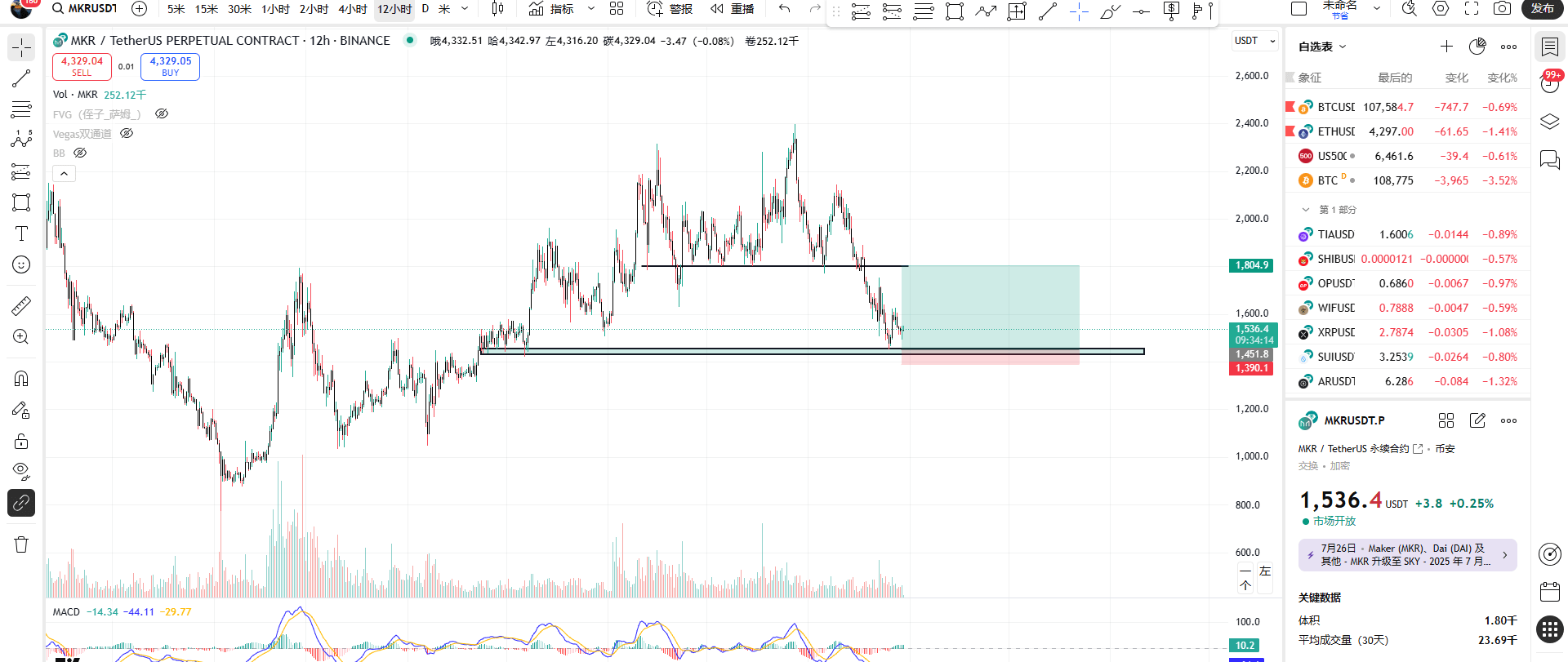
First, let's look at the cases:
Name change announcements often trigger market sentiment fluctuations. For instance, after EOS changed to Vaulta, the token price soared from $0.43 to $0.84 in a few weeks, an increase of nearly 100%. This phenomenon stems from investors' expectations of the new project narrative, especially when name changes accompany strategic transformations (such as Vaulta turning into a Web3 bank), prompting early capital positioning. Similarly, after Optimism changed to OP Mainnet, the token OP saw a maximum increase of 239%.
However, not all name changes can bring positive effects. If the market perceives a name change as 'shelling to cut leeks' (such as FFIE changing to FFAI without resolving financial crises), it may trigger a sell-off. In 2024, when FRONT changed to SLF, the token supply increased fourfold without prior notice, diluting user assets by 75% and leading to strong community backlash, causing the price to plummet.
One, core projects: MakerDAO's MKR (actual symbol MKR)
1. The cornerstone of decentralized finance: The governance hub of stablecoin Dai
Stablecoin management: MKR is the governance core of the world's first decentralized algorithmic stablecoin, Dai. Users generate Dai by collateralizing cryptocurrency assets (such as ETH, WBTC), while MKR holders vote to determine the types of collateral, risk parameters (such as liquidation thresholds), and stability fees. For example, in 2025, MakerDAO partnered with Blocktower Credit to introduce $220 million in real assets (such as real estate bonds) as collateral, a decision that must be voted on by MKR holders.
Price anchoring mechanism: When Dai deviates from $1, MKR holders can adjust stability fees (lending rates) to regulate market supply and demand. For example, if Dai appreciates to $1.05, lowering the interest rate can encourage more borrowing, increasing Dai circulation to restore the peg.
2. The last line of defense against protocol risks: debt auctions and token destruction
Debt auction mechanism: If the value of collateral plummets and the system becomes insolvent, the protocol will automatically generate new MKR tokens and auction them, with the proceeds used to repay Dai debt. This mechanism was activated during the LUNA collapse in 2022, successfully saving the system by auctioning MKR.
Deflationary design: When the system generates surplus (such as Dai lending interest), the protocol uses profits to buy back and destroy MKR. As of August 2025, the total destruction amount has accounted for 7.23% of the initial supply, forming a positive cycle of 'demand growth - supply reduction.'
3. Strategic transformation and token migration: Transitioning from MKR to SKY
Migration plan for 2025: MakerDAO will launch a brand upgrade to Sky Protocol in 2024 and plans to exchange MKR for the new token SKY at a ratio of 1:24,000. As of August 2025, exchanges such as Kucoin and Bitget have suspended MKR trading pairs, and users must complete the exchange by September 15.
Function continuity: SKY will inherit the governance rights of MKR and add support for cross-chain assets (such as Solana ecosystem assets) and real-world asset (RWA) collateral modules. After migration, MKR will exist as a historical token but will no longer have governance functions.
Two, historical projects: MARK.SPACE's MRK (no longer operating)
1. Early exploration of virtual reality platforms
Virtual space economy: Launched in 2021, MARK.SPACE is a blockchain-based VR platform where users can purchase virtual land, create 3D stores, or pay for advertising using MRK. For example, businesses can rent virtual booths with MRK to participate in online exhibitions.
Rendering power incentives: GPU miners can earn MRK rewards by providing virtual reality content rendering services for the platform, forming a closed loop of 'content production - computational support - economic cycle.'
2. Project status and limitations
Stagnation of activity: Since September 2022, MRK price data has stopped updating, with exchanges marking it as 'inactive.' Its token market cap has shrunk from $35 million at ICO to nearly zero, and the core team is suspected to have disbanded.
Technical bottlenecks: The platform relies on centralized server rendering and has not achieved true decentralization, and a lack of user base has led to ecological sustainability issues. In contrast, mainstream metaverse projects in 2025 (such as Decentraland) have turned to on-chain governance and NFT asset interoperability.
Three, common user questions and answers
1. Reasons for spelling differences
Symbol confusion: The token symbol of MakerDAO is MKR, but some wallets (such as Trust Wallet) may mistakenly label it as 'mrk' due to formatting issues. Additionally, early community discussions often featured mixed case usage (such as 'Mrk'), further exacerbating cognitive biases.
Project cold start strategy: Some new projects intentionally use similar symbols to gain attention (such as 'MRKSwap'), but these projects are often short-term speculations lacking substantive applications.
2. The actual value of MKR in 2025
The dual nature of the migration period: Currently (August 2025), MKR can still participate in governance voting but must be exchanged for SKY before September 15. Its price fluctuations reflect market expectations of migration risks, for example, on August 29, the price of MKR dropped to $1869 due to Bitget suspending trading, down 21% from the June peak.
Long-term investment logic: After inheriting the governance rights of MKR, SKY plans to expand the use cases of Dai through cross-chain integration and RWA collateral. Institutions predict that if the migration proceeds smoothly, the market capitalization of SKY could reach $2.796 billion in 2026, a 14.6% increase from the current MKR market cap of $2.438 billion.
3. The participation path for ordinary investors
Governance participation: Users holding MKR can pledge votes on proposals through voting platforms (such as Governance V2). For example, a proposal in 2025 regarding 'whether Dai should connect to the Federal Reserve's instant payment system Fedwire' needs at least 100,000 MKR pledged to take effect.
Risk hedging: Due to liquidity fragmentation risks during the migration period, it is recommended that users complete exchanges on mainstream exchanges such as Binance and Coinbase, and pay attention to SKY's deployment progress on cross-chain bridges (such as LayerZero).
Four, industry trends and risk warnings
1. The paradigm shift of governance tokens
From governance to utility: Traditional governance tokens (such as MKR) are evolving from a single voting right to multifunctionality. For example, SKY plans to introduce a 'governance as a service' model, allowing other DeFi protocols to rent its stablecoin module and pay SKY as a service fee.
Institutional challenges: Asset management giants such as BlackRock have applied for ETH futures ETFs, which have indirectly affected MKR prices since their holdings include a large amount of ETH as collateral for Dai. In June 2025, BlackRock increased its ETH holdings, causing the issuance of Dai to exceed $12 billion, subsequently increasing the price of MKR by 18%.
2. The Damocles sword of regulatory compliance
Stablecoin regulations: The EU MiCA legislation requires stablecoin issuers to hold 100% reserves, which may force MakerDAO to adjust its collateral structure (such as increasing fiat reserves). If the legislation takes effect in Q4 2025, MKR holders will need to vote on whether to accept compliance changes.
Tax disputes: The US IRS has classified governance token voting as a 'taxable event,' requiring users holding MKR worth more than $10,000 to report the 'imputed income' from voting. This policy may lead some investors to sell off.
Summary
In the cryptocurrency ecosystem of 2025, MakerDAO's MKR (actual symbol MKR) is a governance token with true strategic value, covering use cases such as stablecoin management, protocol risk control, and financial innovation. Meanwhile, MARK.SPACE's MRK has become a failed case of early industry exploration. Investors should be wary of confusion caused by symbol similarities, focusing on the technical details of the MKR to SKY migration and market reactions, while closely following global stablecoin regulatory dynamics. Personally, I believe the risk-reward ratio is decent in this range; my cost is around 1510, and I've already invested, waiting to see how it performs after the name change.