


Summary
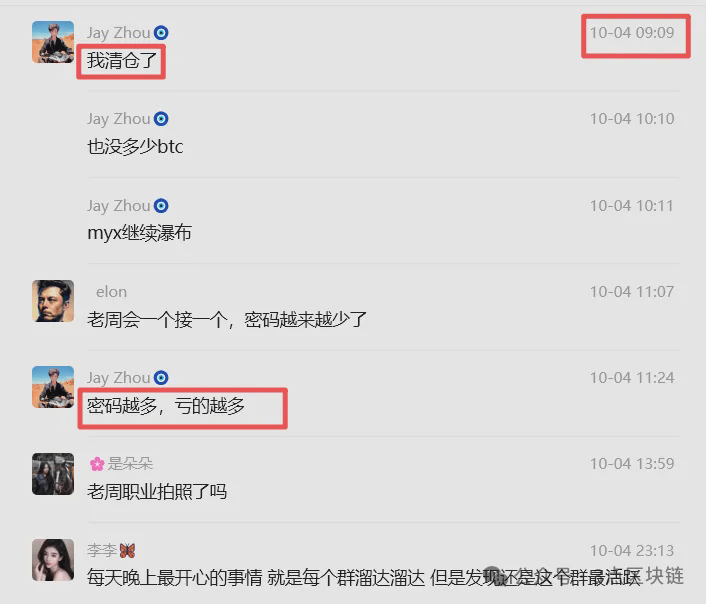
On October 4, 2025, Bitcoin reached the top area of $122,000, Ethereum broke through $4,500, and the entire cryptocurrency circle was immersed in the frenzy of 'bull market perpetuity'—social media was filled with posts about 'showing profits' and 'leveraging to a million,' interns in office buildings were discussing contract profits, and market vendors were asking how to buy Bitcoin. Even friends who never touched finance were asking me on their phones, 'Is it still worth entering the market now?' On that day, I liquidated all my cryptocurrencies, including Bitcoin and Ethereum, which I had held for two years, as well as a small amount of mainstream altcoins. At the moment I took my profits, almost everyone around me was mocking me for 'missing the boat' and 'not understanding the market.' Some said I wasted the chance to 'double overnight,' others boasted about just adding 10 times leverage, and some joked that 'I don't even know how to read K-lines, yet dare to play with coins.' They were right; I really didn't understand K-lines. I had no clue about MACD golden and dead crosses, moving average arrangements, or volume divergence; I never stared at the market until dawn, nor did I study various technical indicators, and I couldn't even distinguish the specific differences between short-term contracts and long-term holdings. But precisely this 'not understanding K-lines' allowed me to exit at the peak on October 4 of last year, avoiding the subsequent three months of continuous crashes, and escaping the increasingly severe scams in the crypto world at the beginning of 2026. Many people think that profits in the crypto world rely on luck, technology, or insider information. But in my view, the essence of the crypto world has never been 'technical games,' but rather 'human nature games'; the price fluctuations in the crypto world are never determined by K-lines, but rather by the irrational behaviors of groups, the emotional contagion of social strata, and the manipulation of capital greed. My ability to accurately escape the peak has nothing to do with luck or technology, but rather with understanding the sociological logic and social psychology behind the crypto world, seeing through the falsehood and madness behind this carnival. Now, half a year has passed, and the crypto world has changed completely. Bitcoin has fallen below $60,000, Ethereum has returned below $2,000, countless leveraged investors have been liquidated and left with nothing; even more distressing is that since early 2026, the chaos in the crypto world has intensified, with exchanges absconding with funds, virtual currency scams collapsing, and countless investors' 'wealth dreams' turning into 'bloody histories.' Looking back at this carnival and collapse, I am increasingly firm in one realization: In the crypto world, understanding human nature and the behavioral logic of social groups is far more important than understanding K-lines; maintaining rationality and rejecting conformity is the only way to exit unscathed in a chaotic market. In this article, I will combine my personal experiences and, from the perspectives of sociology and social psychology, dissect the core logic behind my decision to liquidate at the peak on October 4 last year, deeply analyzing the manifestations and roots of the current chaos in the crypto world, and how ordinary people can protect their capital and avoid pitfalls in this irrational carnival—seeking not to teach you how to profit, but to help you see the truth and stay away from being harvested.
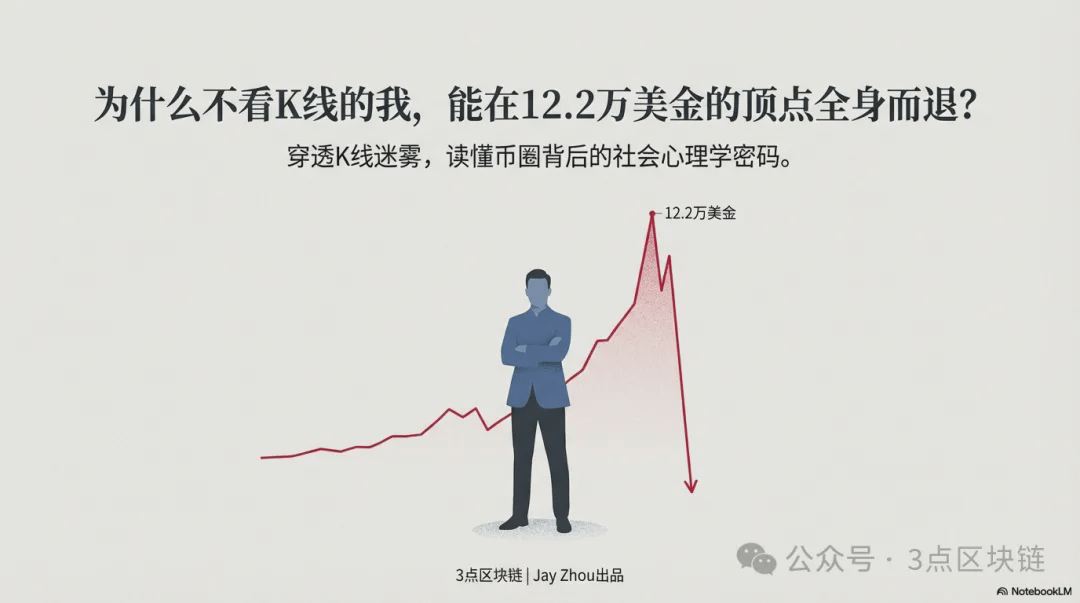
1. How do I judge that 'the peak has been reached' without looking at candlesticks?—3 social psychology signals help me understand the carnival illusion in the cryptocurrency world.
In the cryptocurrency world, the vast majority of people have fallen into a cognitive trap: they believe that as long as they understand candlesticks and master technical indicators, they can predict market trends and achieve profits. Consequently, they stay up late watching the market, researching various trading skills, and blindly following 'contract trading techniques,' while neglecting one fundamental fact: the cryptocurrency world is a market 'dominated by retail investors and driven by emotions,' with over 70% of participants lacking financial knowledge and understanding of blockchain technology. Their decisions are never based on technical analysis but are driven by emotions, conformity, and luck.
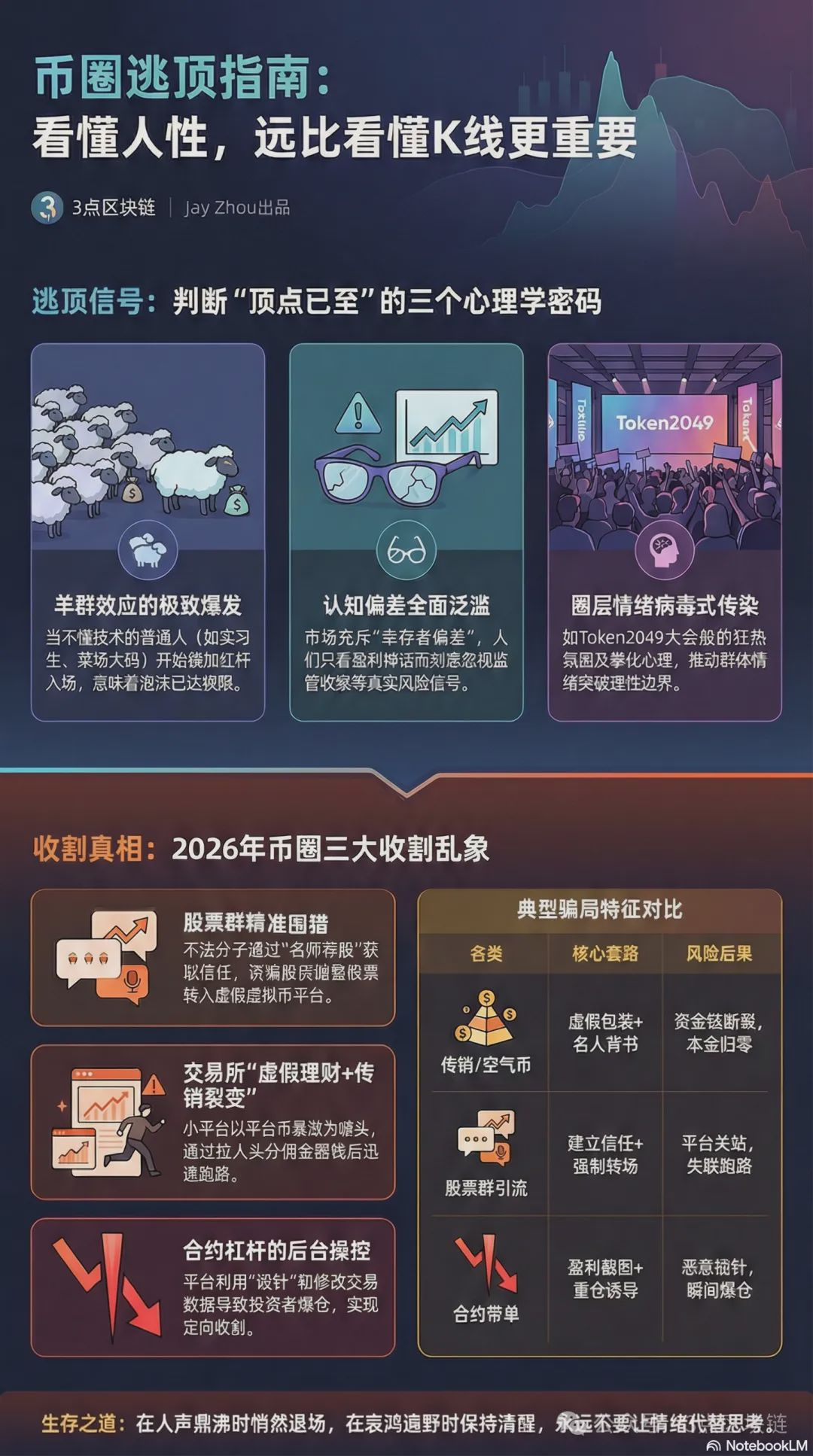
A core viewpoint in social psychology is that group behavior exhibits irrational characteristics. When individuals merge into a group, they will abandon independent judgment and be swept up by group sentiment, making decisions that contradict their own rationality. The bull market frenzy in the cryptocurrency world is essentially a feast of 'group irrationality'; and the peak of the bull market has never been signaled by candlesticks but by the moment when group sentiment reaches its peak. I do not look at candlesticks, but I always observe 'people'—observing group emotions, behaviors, and cognitive biases; these signals from social psychology are far more real and accurate than candlesticks. From late September to early October 2025, three strong signals from social psychology led me to clearly judge that the frenzy in the cryptocurrency world had come to an end and the peak was in sight.
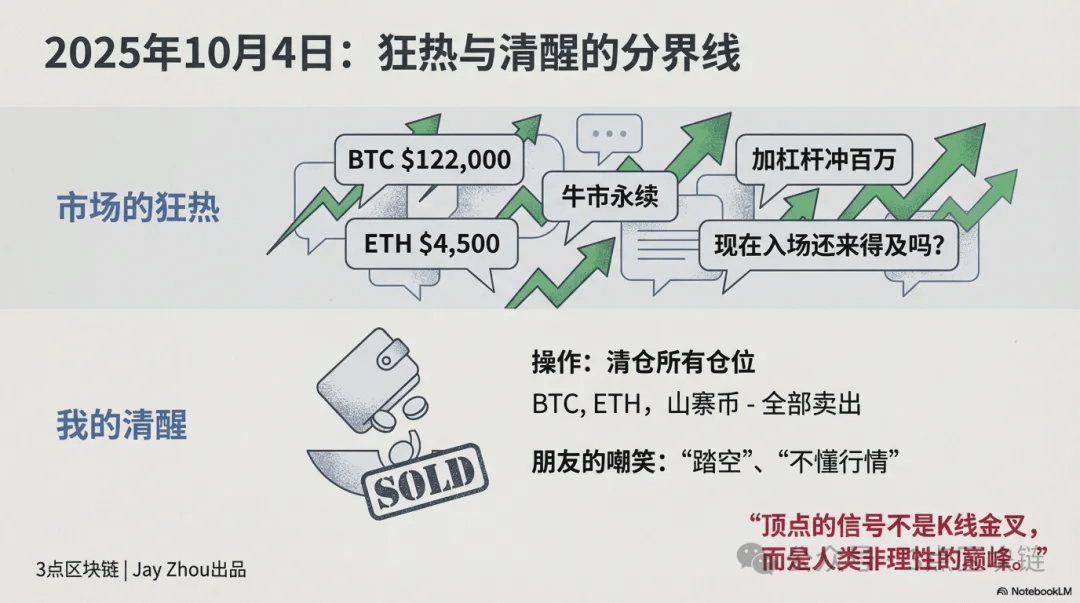
1.1 Signal one: the ultimate explosion of herd effect—'not understanding yet still being able to earn' leads everyone into a frenzy
The herd effect is the most common phenomenon of group behavior in social psychology, referring to individuals abandoning independent judgment and following the majority’s decisions when faced with information asymmetry and limited cognition, just like sheep following the lead sheep, regardless of whether what lies ahead is a pasture or a cliff. The cryptocurrency world is the 'fertile ground' for the herd effect—its decentralized, unregulated, highly volatile, and opaque nature allows the herd effect to be magnified infinitely. According to empirical research in the finance community, the intensity of herd effect in the cryptocurrency market is 2-3 times that of the stock market: when Bitcoin prices rise, 75% of retail investors will follow in buying; and when the market falls, 80% will panic sell, with many not even knowing what coins they bought, simply because 'everyone else is buying' or 'they can earn money by buying.'
Since September 2025, this herd effect has reached its peak. Almost everyone around me is caught up in the frenzy of the cryptocurrency world: a recent graduate intern, earning 5,000 yuan a month, not understanding what blockchain is, hears colleagues say 'buying Bitcoin can earn 2,000 yuan in a week,' and borrows 30,000 yuan online, investing it all in cryptocurrencies; he doesn’t even know the difference between Bitcoin and Ethereum, he just follows the coins recommended by colleagues, staring at his phone every day, hoping for a price surge, completely unaware of basic risk control. In the vegetable market below my apartment, the aunties no longer discuss prices while buying vegetables, but gather to ask 'how to register on an exchange' and 'how to buy USDT'; one of the aunties, hearing someone say 'buying DeFi staking can earn 10% a month, with zero risk,' invested her entire 100,000 yuan retirement fund, dragging along her neighboring friends into the fray, convinced 'this is a great opportunity to earn effortlessly.' On social media, the cryptocurrency world is flooded with profit screenshots: some showcase accounts with '500,000 yuan profit in a week,' others boast 'doubling with leverage, from a monthly salary of 8,000 to savings of a million,' and many influencers gain followers by claiming 'follow me to buy, no need to understand candlesticks, easily achieve financial freedom.' This content continuously reinforces the perception that 'making money in the cryptocurrency world is easy,' leading more people to fall into the 'fear of missing out' (FOMO) mentality, abandoning independent judgment and blindly following the trend to enter. Social psychology suggests that the core driving force of the herd effect is 'information cascades' and 'group pressure.' Information cascades mean that when individuals cannot obtain complete information, they infer information through observing others' behaviors—for instance, when you see ten people buying Bitcoin, you automatically assume 'they must know something I don’t,' and thus follow suit; this behavior cascades like a waterfall, ultimately forming a unanimous decision to follow the trend. Group pressure makes individuals fear becoming the minority—when everyone around is discussing cryptocurrency returns, you will feel pressured by the notion that 'not participating will lead to being eliminated' or 'fearing missing out on wealth opportunities.' When someone questions the risks in the cryptocurrency world, they are often attacked by the group as 'not understanding trends' or 'being timid and cowardly.'
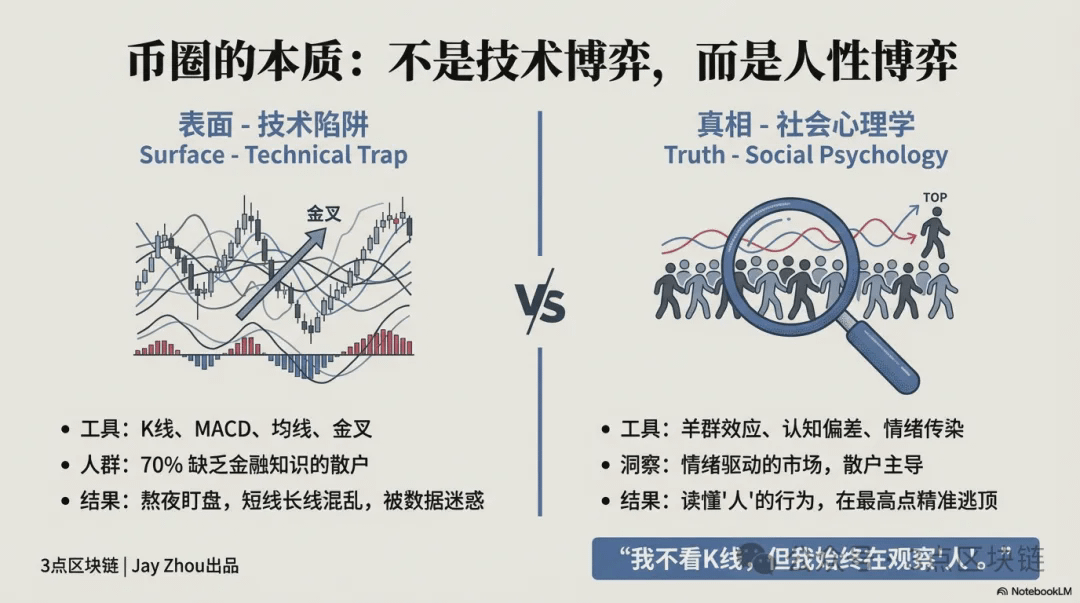
The reason I judge that the peak has been reached is precisely because this herd effect has broken through the 'rational boundary': when ordinary people who do not understand blockchain or finance start borrowing money and using leverage to speculate; when 'not understanding yet still being able to earn' becomes a consensus; when the voices questioning risks are completely drowned out, it means that group sentiment has reached its peak, and the bubble has been inflated to its maximum.
History has repeatedly proven that when everyone falls into a certain investment frenzy, it is often the beginning of a collapse—whether it was the subprime mortgage crisis in 2008 or the cryptocurrency bear market in 2021, it has always been the case.
1.2 Signal two: the rampant prevalence of cognitive biases—'survivor bias + confirmation bias' leads people to ignore risks
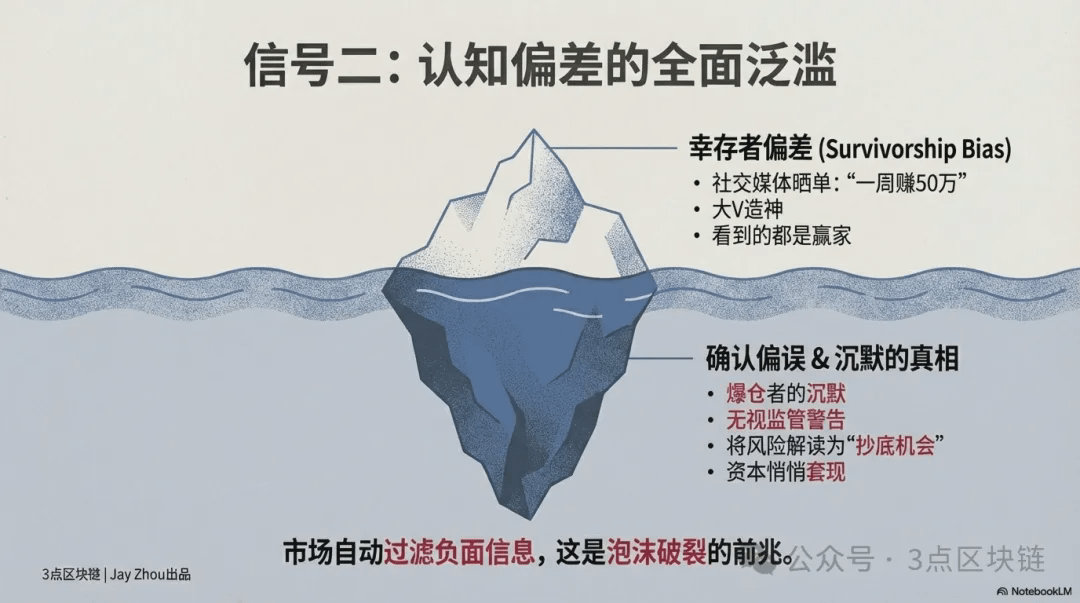
In addition to the herd effect, in early October 2025, another strong signal from social psychology emerged in the cryptocurrency world: the widespread prevalence of cognitive biases, particularly survivor bias and confirmation bias, which led the vast majority to ignore potential risks, falling into the fantasy of 'perpetual bull market.' Survivor bias refers to people focusing solely on 'successful cases' while ignoring 'failed cases,' resulting in erroneous cognition. In the cryptocurrency world, this bias is vividly evident: everyone boasts about their profits, yet no one is willing to mention those who have suffered losses, faced liquidation, or lost everything; media and influencers only report 'wealth creation myths in the cryptocurrency world,' deliberately avoiding risks and scams. I have such an example around me: a friend entered the market in August 2025 and made a profit of 20,000 yuan by luck, then boasted everywhere about his 'innate talent' and 'understanding of cryptocurrency logic,' even starting to recruit students to 'teach coin recommendation techniques;' he never mentioned that two of his three friends who entered the market with him had suffered losses of over 100,000 yuan due to leveraging, and another was scammed out of 50,000 yuan by a Ponzi coin. On social media, this survivor bias is even more pronounced. Those who are profitable actively share their account screenshots to attract attention and followers; whereas those who have lost often choose silence, quietly bearing their losses. Over time, this creates an illusion that 'everyone in the cryptocurrency world can make money' and 'as long as one enters the market, profits are guaranteed,' leading more people to lower their guard and blindly increase their investments.

Confirmation bias causes people to only believe in 'information that conforms to their expectations' while ignoring contrary signals. In the cryptocurrency world, once people fall into the fantasy of 'perpetual bull market,' they will deliberately seek evidence to support the continuation of the bull market—such as a certain influencer's coin recommendation, a piece of false good news, or a short-term rise in a particular coin, all of which will be taken as proof that 'the bull market continues'; while those signals that hint at risks or predict declines, such as tightening regulatory policies, capital quietly cashing out, or inflated valuations of coins, will be deliberately ignored, denied, or even attacked. By late September 2025, regulatory authorities had already issued warnings, clearly stating, 'The trading and speculation of virtual currencies disrupt the economic and financial order, breed illegal activities such as gambling, illegal fundraising, fraud, pyramid schemes, and money laundering, severely endangering the property safety of the public'; at the same time, there were reports that multiple mainstream exchanges were quietly reducing their holdings of Bitcoin, and capital was beginning to cash out. Yet these risk signals were drowned out by the frenzy in the cryptocurrency world—some said 'regulation is just talk, they won't really take action,' others said 'capital cashing out is to better accumulate,' and still others claimed 'these are just tactics by big players to shake off weak hands, and if you endure this period, you can double your investment.' Studies in social psychology show that when individuals fall into confirmation bias, they become extremely stubborn and refuse to accept any information that contradicts their expectations, even distorting facts to support their erroneous cognition. This cognitive bias becomes even more severe at the end of the bull market in the cryptocurrency world—people would rather believe the lie of 'perpetual bull market' than face the truth that 'the bubble is about to burst'; they would rather follow the crowd and use leverage than maintain rationality and take profits in time. I clearly remember on the night of October 3, I was chatting with a friend who had been trading cryptocurrencies for many years. I reminded him, 'The risks are too great now; you should liquidate,' but he dismissed it, saying, 'You don't understand candlesticks, nor do you understand the logic of the cryptocurrency world; it's still the middle of the bull market, and we can still double our investments.' He even showed me many 'good news items' in an attempt to persuade me to 'hold on.' But in my view, these so-called 'good news items' were merely selectively highlighted to support their confirmation bias; while the risk signals that were ignored were the most authentic warnings—when everyone falls into confirmation bias and refuses to accept risk warnings, the peak is already just around the corner.
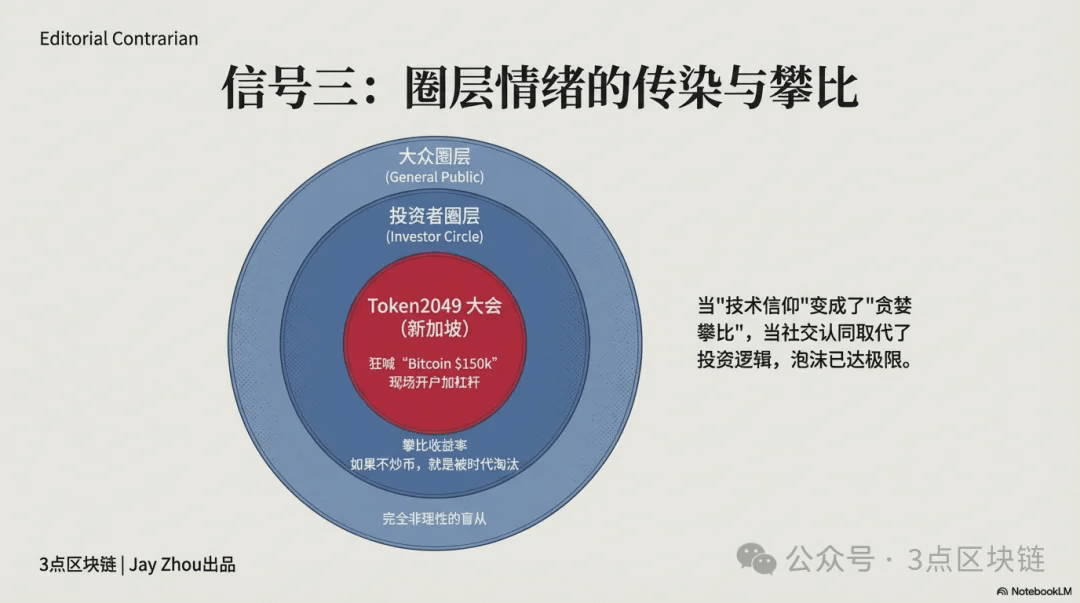
1.3 Signal three: emotional contagion in social circles—'community recognition + comparison psychology' drives bubbles to extremes. From a sociological perspective, the frenzy in the cryptocurrency world is essentially a form of 'emotional contagion within communities.' As an emerging social circle, the cryptocurrency world has its own unique language system, value recognition, and behavioral logic; the emotional contagion within the community and the comparison psychology between communities further drive the inflation of the bull market bubble, and it is this that makes me see the 'peak is near' as the third signal. The 'community culture' theory in sociology suggests that when an individual joins a community, they become assimilated by the community's values and behaviors, forming 'community recognition'—in order to fit in, individuals often mimic the behaviors of others in the community, accept the community's core cognition, and may even make decisions that contradict their rationality to maintain community recognition. The cryptocurrency world is such a community: people within the community firmly believe 'blockchain is the future,' 'digital currency can achieve financial freedom,' look down on 'ordinary people who do not understand currency,' and take pride in 'earning from trading cryptocurrencies.'
Since September 2025, the sentiment in the cryptocurrency community has completely shifted from 'rational investment' to 'frenzied comparison.' People within the community compare 'who earns more,' 'who has a higher leverage ratio,' and 'who has more funds in their accounts' every day; some even go into debt or borrow money to leverage themselves, blindly following trends to buy high-priced cryptocurrencies just to save face within the community. Others, despite not understanding blockchain, deliberately learn the jargon of the cryptocurrency world to pretend they are 'knowledgeable about the market.' Some even bind 'trading profits' to 'personal ability,' believing that 'if one cannot make money trading, it means they lack skill.' This mentality of comparison further reinforces emotional contagion. When someone in the community shares profit screenshots, others feel 'jealous' and 'anxious,' fearing exclusion from the community or missing out on further profit opportunities, leading them to increase their investments and follow the crowd; this follow-the-crowd behavior further drives up cryptocurrency prices, creating a vicious cycle of 'rise → comparison → follow the crowd → further rise,' inflating the bubble. More worryingly, this community sentiment has begun to spread outside its original boundaries. The cryptocurrency community is no longer a 'niche community,' but is starting to permeate all social strata and age groups—from white-collar workers in office buildings to students on campuses; from business owners to retired seniors, everyone is being affected by this community sentiment, joining in on trading cryptocurrencies. This cross-community emotional contagion indicates that the frenzy in the cryptocurrency world has reached a level of 'universal participation,' which is a precursor to the bubble bursting. My decision to liquidate on October 4 was precisely because I saw this irrational explosion of community sentiment: when the community's recognition shifted from 'faith in blockchain technology' to 'frenzied comparison of profits'; when emotional contagion spread from a 'niche community' to 'universal participation'; when people are willing to abandon rationality and borrow money to leverage in order to fit in and compare profits, it means the frenzy has come to an end. Furthermore, the upcoming Token2049 conference in Singapore in October 2025 serves as an 'amplifier' for this frenzy and is another important signal for me to determine that the peak has been reached. I previously wrote about how I avoided the October liquidation disaster by not attending the Singapore Token2049 conference. At that time, the conference was packed with voices, with cryptocurrency practitioners and investors from around the world flooding the venue, and everywhere you could see people holding signs saying 'bull market forever,' discussing 'how to use leverage to earn more' and 'what the next double-up cryptocurrency is,' creating an overwhelming atmosphere of excitement. Some speakers even loudly proclaimed during their speeches that 'Bitcoin will break $150,000 by the end of the year,' leading to applause from the audience. Countless people immediately took out their phones to increase their positions and open accounts, intoxicated by this false good news. But in my view, this was merely a smokescreen created by capital and the community—using exaggerated expectations and frenzied scenes to confuse ordinary investors, leading them to follow the crowd at the last moment and become the last batch of 'chives' to be harvested. This is also why I attended very few cryptocurrency conferences last year; the frenzied emotions and one-sided statements in the venues can easily interfere with judgment, leading people into a vortex of collective irrationality. Only by keeping a distance can one preserve their rationality and judgment. Looking back, I have never regretted my decisions. I don’t look at candlestick charts, not because I’m lazy, but because I understand: in the cryptocurrency world, candlestick charts only reflect past price fluctuations, while the future rise and fall are determined by group emotions, cognition, and behaviors; understanding these signals from social psychology and the logic of emotional contagion allows one to grasp the laws of cryptocurrency rises and falls, enabling one to exit at the peak.
2. The carnival has come to an end, chaos has arisen—what harvesting traps are hidden in the cryptocurrency chaos that erupted in early 2026?
After October 4, 2025, the frenzy in the cryptocurrency world came to an expected end. Bitcoin plummeted from $126,000, falling below $60,000 within three months, Ethereum fell below $2,000, and countless leveraged investors faced liquidation and losses; most ordinary people who followed the trend suffered heavy losses. Some borrowed money from online loans without the ability to repay, some lost their retirement funds, and some even fell into despair due to losses. But what is heartbreaking is that the collapse of the bull market did not bring the cryptocurrency world back to rationality; on the contrary, since early 2026, chaos in the cryptocurrency world has become increasingly severe, with various scams emerging, and the means of harvesting becoming more hidden and cruel. From the Binance exchange running away with funds to the collapse of virtual currency scams; from stock groups luring people in to harvesting them, to fake quantitative investment traps, countless investors' 'wealth dreams' have become a 'harvesting feast' for criminals. Combining recent exposed cases (Binance exchange, scams, etc.) and perspectives from sociology and social psychology, I will deeply analyze the four major chaotic phenomena in the cryptocurrency world in early 2026, uncover the harvesting logic behind these scams, help you see the truth, and steer clear of traps.
2.1 Chaos one: severe declines in certain exchange tokens have become the norm—'false investments + pyramid schemes' have harvested billions.
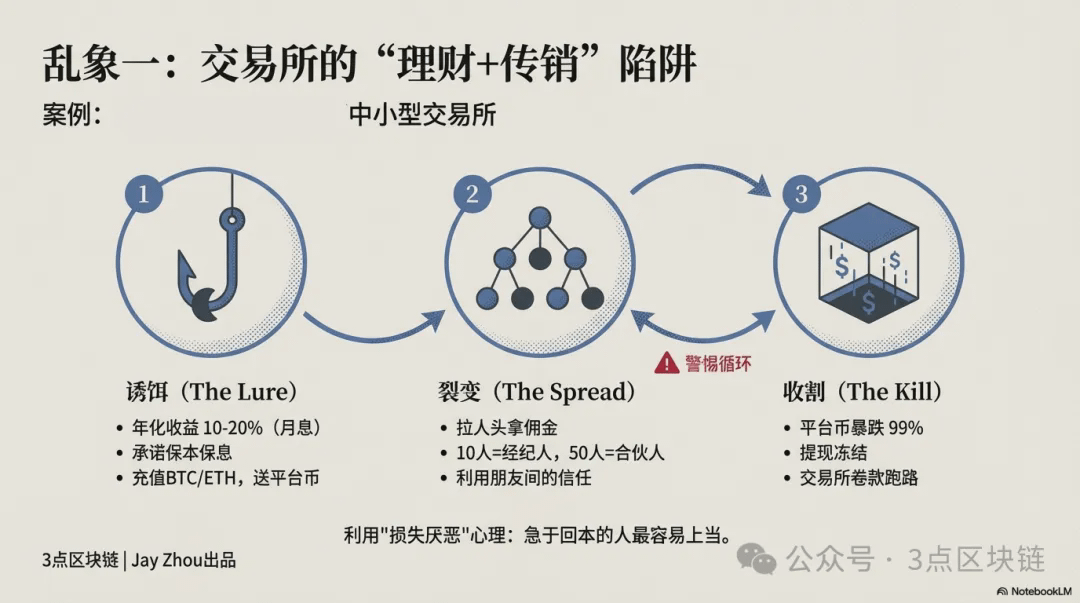
After the collapse of the bull market in October 2025, many small exchanges lacking compliance qualifications did not exit the market; instead, they precisely grasped investors' anxiety about 'wanting to recover their losses,' aggressively promoting the dual strategies of 'false investment + pyramid scheme,' leading to a normalization of sharp declines in their platform tokens. In just six months, complaints related to this have exceeded a thousand, and criminals harvested over a billion yuan through this model, becoming the most hidden and widespread chaos in the cryptocurrency world in early 2026. Its harvesting logic is highly linked to the greed psychology and herd effect in social psychology, precisely targeting ordinary investors. The core scheme of these small exchanges is 'packaging and creating momentum—pyramid recruitment—dumping and fleeing,' with each step meticulously designed to exploit information asymmetry and human weaknesses, leading investors into traps step by step. Specifically, their investment activities are highly enticing: investors deposit mainstream coins like Bitcoin and Ethereum into the exchange and can exchange them for BX tokens at a proportional rate, promising monthly returns of 10%-20%. The longer the deposit period and the larger the amount deposited, the higher the returns, even claiming 'capital preservation and interest, withdrawable at any time'; while the pyramid scheme recruitment mechanism becomes the key to rapidly expanding the capital pool—investors invite others to join the platform and deposit coins, earning tiered commissions, and upgrading to 'agents' by bringing in 10 new people, enjoying a 30% share of team profits, and becoming 'partners' by bringing in 50 new people, receiving additional token rewards, with higher levels yielding richer rewards. Essentially, this is a 'borrowing new to pay old' Ponzi scheme. Initially, they thought they could recover their investment through high-interest payouts and earn profits through recruitment, only to face the double blow of 'token crashes + withdrawal restrictions' within just 15 days. At first, the platform used backend manipulation to create the illusion of potential profits; but once the capital pool grew, the platform immediately halted support, began aggressively dumping, and the token crashed nearly to zero, while the mainstream coins deposited by investors had long been misappropriated by the platform, and the withdrawal channels were completely closed, with customer service and trading instructors also disappearing collectively. Analyzing this from a social psychology perspective, the reason these scams can repeatedly succeed lies in the two major cognitive biases and human weaknesses of investors: first is the greed and luck mentality, where investors are lured by the allure of 'high-interest capital preservation' and 'doubling in the short term,' holding onto the illusion that 'they won't be the last ones to hold the bag,' thus abandoning rational judgment and blindly investing funds; second is the herd effect, as when those around are participating and sharing 'recruitment commissions' and 'investment returns,' investors are swept up by group sentiment, fearing they might miss the opportunity to recover losses, and follow the trend, further propelling the spread of the scam. Moreover, it is worth noting that these exchanges are mostly registered overseas to evade domestic regulation, and once harvesting is complete, they will quickly deregister the platform entity and destroy transaction records, making it extremely difficult for investors to trace the flow of funds and seek redress. This type of chaos is not an isolated incident; many small exchanges have adopted similar schemes, issuing platform tokens while promoting false investments and pyramid scheme recruitment, ultimately ending in token crashes and platform shutdowns. Most of the victims are ordinary investors who lack risk awareness and do not understand blockchain technology. They originally hoped to recover their investments through legitimate investments but unexpectedly fell into deeper harvesting traps, compounding their losses. This further validates the earlier mentioned point: after the bull market in the cryptocurrency world ends, irrational greed will only become a tool for criminals to harvest.
2.2 Chaos three: air coins and Ponzi coins make a comeback—'false packaging + celebrity endorsement' harvests without bottom line
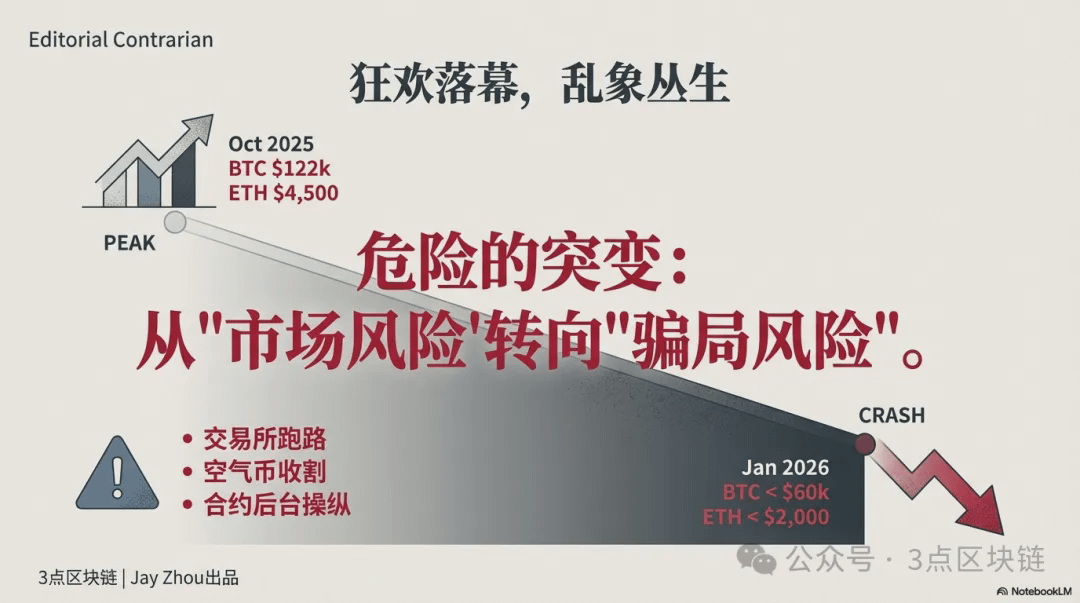
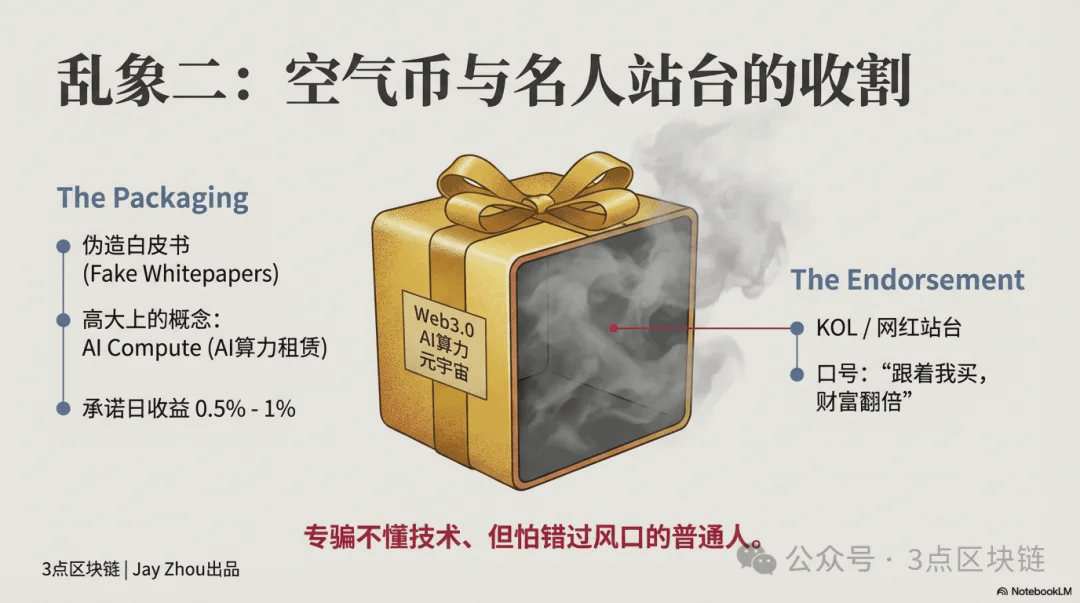
In addition to exchanges going bankrupt and stock groups luring people in, since early 2026, air coins and Ponzi coins have also made a comeback, becoming another disaster zone in the cryptocurrency chaos. These air coins and Ponzi coins lack any technical support or practical application scenarios, and even complete white papers are fabricated, yet they use 'false packaging + celebrity endorsements + high return temptations' to frantically harvest 'chives,' with methods so vile it is appalling. The core scheme of air coins and Ponzi coins is 'telling stories and creating concepts'—criminals leverage trendy terms like 'Web 3.0,' 'metaverse,' 'AI computing power,' and 'decentralized finance' to falsely package coins, forge technical white papers, smart contract codes, and even fabricate third-party audit reports to create a facade of being 'high-end, professional, and promising'; at the same time, they invite influencers, celebrities, or even washed-up stars for 'celebrity endorsements,' claiming 'this coin is the trend of the future' and 'buying it will double your investment,' attracting investors to join in. For example, some projects promote under the guise of 'AI computing power leasing,' enticing investors to use virtual currencies to invest in fictitious computing power products, promising daily returns of 0.5%-1% without real computing power backing, leading to a continuous shrinkage of the capital pool, currently on the brink of collapse. This coin has no actual computing power resources, and its white paper is full of holes, yet it has managed to attract over ten thousand investors, many of whom invested hundreds of thousands, ultimately losing everything.
Some Ponzi coins adopt a 'recruiting people and hierarchical' pyramid scheme model, combining 'mining' and 'investment' with pyramid selling, requiring investors to pay an 'entrance fee' to purchase virtual coins, and then develop downlines to earn commissions and rewards. The more levels there are, the higher the rewards. This model is essentially a Ponzi scheme, relying on 'borrowing new to pay old' to maintain payouts. Once there are no new investors entering, the funding chain will break, and the investors' funds will be taken away by criminals. From the perspective of sociology, the resurgence of air coins and Ponzi coins stems from the 'closed nature of community culture' and 'information asymmetry.' The cryptocurrency community has its own unique vocabulary and value recognition, and those within the community are often enthusiastic about 'new concepts' and 'new coins,' easily tempted by 'celebrity endorsements' and 'high returns'; while those outside the community lack understanding of virtual currencies, unable to identify the authenticity of coins, and are easily deceived by false packaging. At the same time, the anonymity of virtual currency transactions allows criminals to evade regulation and conduct fraudulent activities without restraint, further exacerbating this chaos. Even more distressing is that the targets of these air coins and Ponzi coins are mostly ordinary investors who lack financial knowledge, eager to achieve financial freedom through cryptocurrency trading, yet they do not realize they have already become 'chives' in the eyes of criminals. The funds they invest may be their savings, retirement money, or even borrowed online loans. Once the scam collapses, their lives will fall into despair.
2.3 Chaos four: frequent contract leverage chaos—'false advertising + backstage manipulation' leaves investors with nothing
In the cryptocurrency world, contract leverage trading is originally a 'high-risk, high-reward' trading method that requires investors to have extensive financial knowledge and risk control capabilities. Contract leverage chaos frequently occurs, as many exchanges and criminals exploit investors' greed through 'false advertising + backstage manipulation,' enticing them to participate in contract leverage trading, ultimately leaving them with nothing. Many small exchanges, in order to attract investors to engage in contract leverage trading, conduct false advertising, claiming 'low barriers to entry for contract leverage, high returns, zero risk, guaranteed profits,' even asserting 'newbies can easily master contracts and double their investments overnight;' they also deliberately conceal the risks of contract leverage, failing to inform investors that 'leverage trading will amplify losses and may lead to liquidation, resulting in total loss.' Even worse, some exchanges manipulate the backend, maliciously harvesting investors.
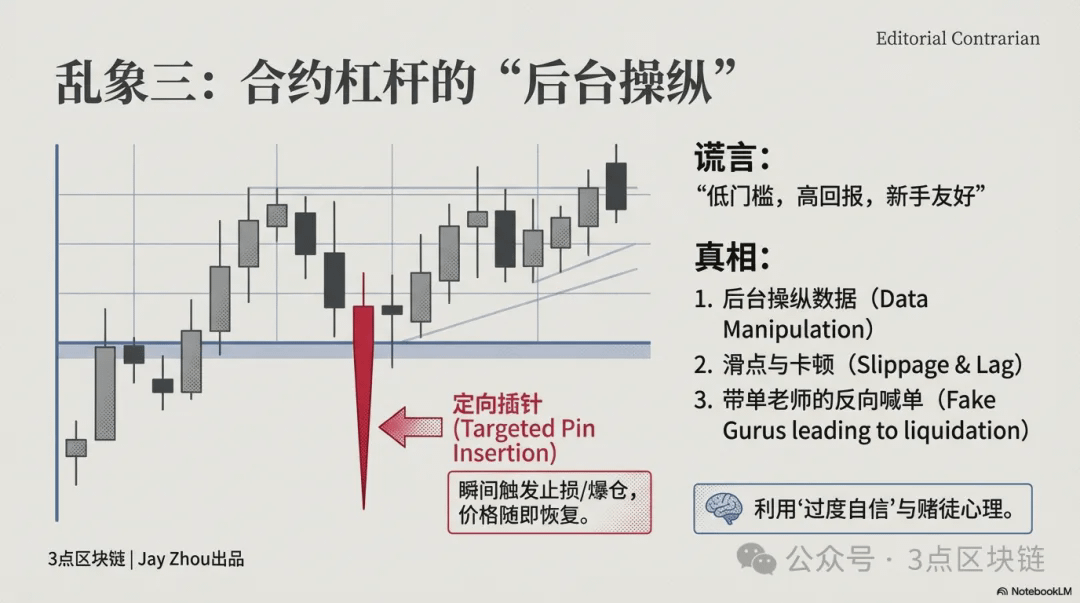
For instance, when investors are about to be liquidated, the platform may maliciously 'spike' (suddenly raise or lower the coin price), resulting in investor liquidation; or the platform may modify trading data, delaying transactions, preventing investors from timely stopping losses or taking profits, ultimately leading to heavy losses. Some investors report that when participating in contract leverage trading on a small exchange, they clearly set stop-loss lines, but the platform maliciously spiked prices, leading them to be liquidated suddenly, suffering losses of over 200,000 yuan. Additionally, many criminals promote 'contract trading services' through social media and investment communities, claiming 'following the lead trader’s operations guarantees profits,' charging high 'trading fees' and 'service fees.' Yet, in reality, most of these lead traders have no trading experience; they deceive investors with false profit screenshots; they intentionally guide investors to use leverage and make heavy trades, even leading them to trade against their interests, ultimately causing investors to incur losses while they pocket the trading fees and commissions. Analyzing from a social psychology perspective, the prevalence of contract leverage chaos arises from investors' 'greed psychology' and 'overconfidence bias.' Many investors yearn to achieve 'wealth overnight' through contract leverage, lured by 'high returns' from false advertising, ignoring the high risks of contract leverage; at the same time, they are overconfident, believing they can control the market and timely stop losses or take profits, unaware that they have already been 'controlled' by the exchanges and lead traders, ultimately becoming victims of harvesting. It is also worth noting that the high risks of contract leverage not only cause investors to lose everything but can also trigger a series of social issues—some incur huge debts due to liquidation and choose to commit suicide; some, in despair from losses, resort to illegal activities; others, having been deceived by lead traders, spark disputes that affect social stability.
3. The deep logic behind the chaos—what are the roots of chaos in the cryptocurrency world from sociological and social psychological perspectives?
The various chaotic phenomena in the cryptocurrency world in early 2026 may seem like isolated scams, but they actually have deep sociological and psychological roots. The emergence and spread of these phenomena are not coincidental but the result of the combined effects of 'human weaknesses, community culture, capital pursuit, and regulatory absence.' Analyzing the roots of these phenomena from the perspectives of sociology and social psychology will allow us to see the essence of the cryptocurrency world more clearly and avoid being harvested.
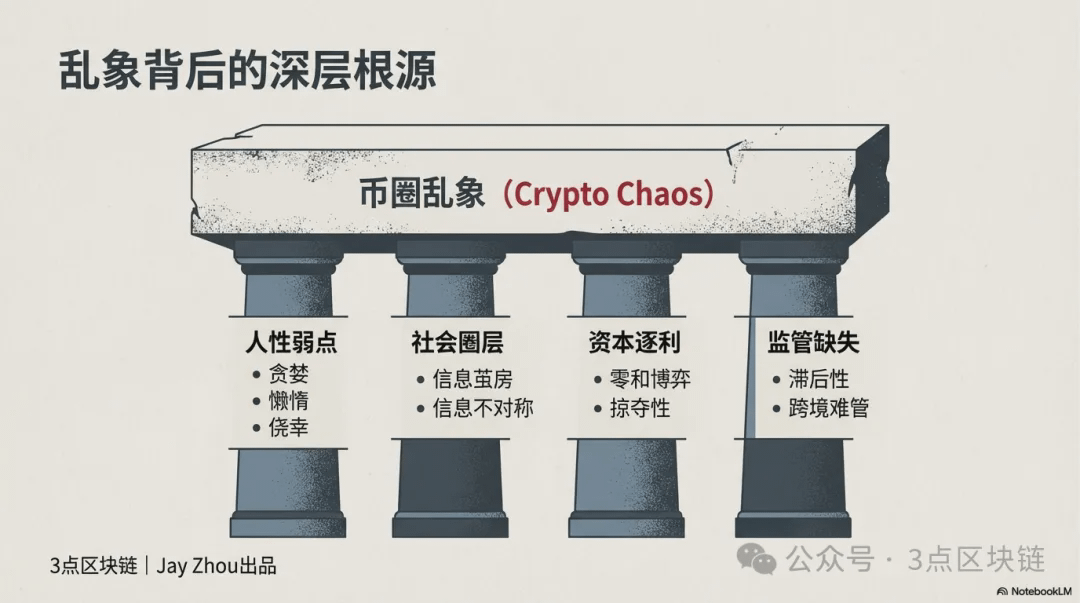
3.1 Psychological roots: human weaknesses magnified infinitely, irrational behavior dominates the market
The core social psychology root of chaos in the cryptocurrency world lies in the 'infinite magnification of human weaknesses'—greed, luck, conformity, and cognitive laziness. These inherent weaknesses of humanity have been infinitely magnified in the 'high-reward, high-risk' market of the cryptocurrency world, becoming tools for criminals to harvest and the soil for chaos to breed. Greed is the most core driving force behind chaos in the cryptocurrency world. Nearly all cryptocurrency scams exploit people's greed—high-interest bait, high premium promises, and the myth of overnight wealth, all cater to people's greed, leading them to abandon rationality and blindly invest funds. Social psychology studies show that greed is an 'infinite desire.' When people are swept away by greed, they become extremely irrational, even ignoring obvious risks and making decisions that go against their own interests. In the cryptocurrency world, many investors know full well that 'high returns are inevitably accompanied by high risks,' that 'capital preservation with high interest' is a scam, yet still cling to a 'lucky mentality,' believing 'I won't be the last one holding the bag' and ultimately become victims of harvesting. The mentality of luck is an important driver of chaos in the cryptocurrency world. Many investors, when participating in virtual currency trading, hold onto a 'lucky mentality'—they believe they are lucky enough to exit before the bubble bursts; they believe they can see through scams and make money; they even think 'the regulators won't really take action' and 'the scams won't happen to me.' This mentality of luck makes them lower their guard, unwilling to learn financial knowledge, unwilling to identify risks, blindly following trends and investing, ultimately incurring heavy losses. At the same time, many criminals exploit people's luck mentality, constantly launching new scams and innovating harvesting methods, exacerbating chaos. The tendency to conform creates a 'group effect' of irrational behavior in the cryptocurrency world. As mentioned earlier, the cryptocurrency world is a 'fertile ground' for herd effects. When those around are trading cryptocurrencies and participating in a scam, many people abandon independent judgment, thinking 'following the crowd won't be wrong.' This tendency to conform allows scams to spread rapidly and chaos to proliferate; it also causes many investors, under the influence of group sentiment, to make decisions that contradict their own rationality, ultimately becoming victims of harvesting. Cognitive laziness makes it difficult for many investors to recognize scams and fall into cognitive traps. Cognitive laziness means individuals are reluctant to think proactively, unwilling to learn actively, and accustomed to passively accepting information, lacking the ability for independent judgment. In the cryptocurrency world, many investors lack financial knowledge and do not understand blockchain technology, yet they are unwilling to learn proactively, preferring to follow trends, believe in recommendations from influencers and those around them, and accept 'false good news' without question; they do not want to spend time identifying the authenticity of coins, analyzing the legality of platforms, or assessing the level of risk, ultimately being deceived by criminals and falling into scams.
3.2 Sociological roots: closed community culture + information asymmetry provide a breeding ground for chaos
From a sociological perspective, the emergence of chaos in the cryptocurrency world stems from the 'closed nature of community culture' and 'information asymmetry'—the cryptocurrency world, as an emerging social circle, has its own unique language system, value recognition, and behavioral logic. The closed nature of the community prevents the outside world from understanding the truth within; while information asymmetry allows criminals to easily deceive investors, enabling chaos to spread. The culture of the cryptocurrency community is highly closed. Most participants are young people with shared interests and values—believing in the future of blockchain technology and yearning for financial freedom through virtual currencies. They have formed their own unique vocabulary, such as 'mining,' 'contracts,' 'DeFi,' and 'NFTs,' which are difficult for outsiders to understand; at the same time, the cryptocurrency community is highly exclusive, with people within often looking down upon 'ordinary people who do not understand currencies,' unwilling to communicate with outsiders or accept opinions and suggestions from outside the community. This closed nature allows chaos to spread quickly within the community while making it difficult for outsiders to detect; it also causes many investors to fall into irrational frenzy under the community's assimilation, unable to recognize the truth behind scams. Information asymmetry is another important sociological root of the chaos in the cryptocurrency world. In the cryptocurrency field, information dissemination mostly occurs through social media, investment communities, and influencer recommendations, which lack official vetting and oversight, making it hard to distinguish truth from falsehood; meanwhile, criminals often deliberately conceal the truth, publish false information, and create a 'false good news' illusion to deceive investors; at the same time, ordinary investors lack channels to obtain real information, unable to discern the authenticity of coins, the legality of platforms, and the movements of capital, and can only passively accept the false information released by criminals, ultimately falling into scams. Furthermore, the 'decentralized' nature of the cryptocurrency world provides a breeding ground for chaos. Decentralization, originally a core advantage of blockchain technology, means there is no central regulatory authority or human manipulation; but in the cryptocurrency world, this decentralization is exploited by criminals—they take advantage of the decentralized characteristics to evade regulation, build false trading platforms, issue air coins and Ponzi coins, and conduct fraudulent activities; and investors, in the decentralized market, once encountering a scam, find it difficult to identify responsible parties and seek redress, leaving them to accept their misfortune.
3.3 Capital and industry roots: capital pursuit + regulatory absence allow chaos to run rampant. In addition to the social psychology and sociology roots, the emergence of chaos in the cryptocurrency world also stems from 'capital pursuit' and 'regulatory absence'—the disorderly expansion of capital has turned the cryptocurrency world into a 'tool for harvesting wealth'; while the delay and absence of regulation have allowed criminals to conduct fraudulent activities without restraint, exacerbating chaos. The pursuit of profit by capital is the core driving force behind chaos in the cryptocurrency world. The essence of the cryptocurrency market is a 'zero-sum game'—when someone profits, someone else loses; the money earned by one person is lost by another. The profit-seeking nature of capital has led many investors to enter the cryptocurrency world recklessly, engaging in speculative trading, manipulating markets, and harvesting 'chives' without regard for risk or legality; they manipulate coin prices through pump and dump strategies, creating false bull and bear markets, allowing ordinary investors to be repeatedly harvested amid price fluctuations; they build fake trading platforms, issue air coins and Ponzi coins to swindle investors out of funds for 'quick riches'; some even collude with criminals to engage in insider trading, collectively harvesting 'chives.' From a sociological perspective, the disorderly expansion of capital has led the cryptocurrency world away from the original intention of blockchain technology. Blockchain technology was originally meant to achieve 'decentralization, transparency, and fairness,' to rectify the flaws of traditional finance; but under the pursuit of profit, the cryptocurrency world has become a 'tool for capital to harvest wealth,' with blockchain technology merely serving as a 'packaging tool' for criminals and capital, devoid of any practical application value. The delay and absence of regulation have allowed chaos in the cryptocurrency world to spread unrestrained. Virtual currencies, as an emerging financial product, have developed at a pace far exceeding that of regulation; currently, globally, regulation of virtual currencies is still at an 'exploratory stage,' with no comprehensive regulatory framework, no clear regulatory rules, and no professional regulatory institutions; while in our country, although virtual currency trading and speculation have been explicitly prohibited, the anonymity and cross-regional nature of virtual currency transactions make regulation extremely difficult, allowing many criminals to evade regulation by leveraging the internet to build fraudulent trading platforms; at the same time, the intensity of enforcement against virtual currency trading is still insufficient. Many criminals, even if exposed, can still evade punishment, further fostering the spread of chaos.
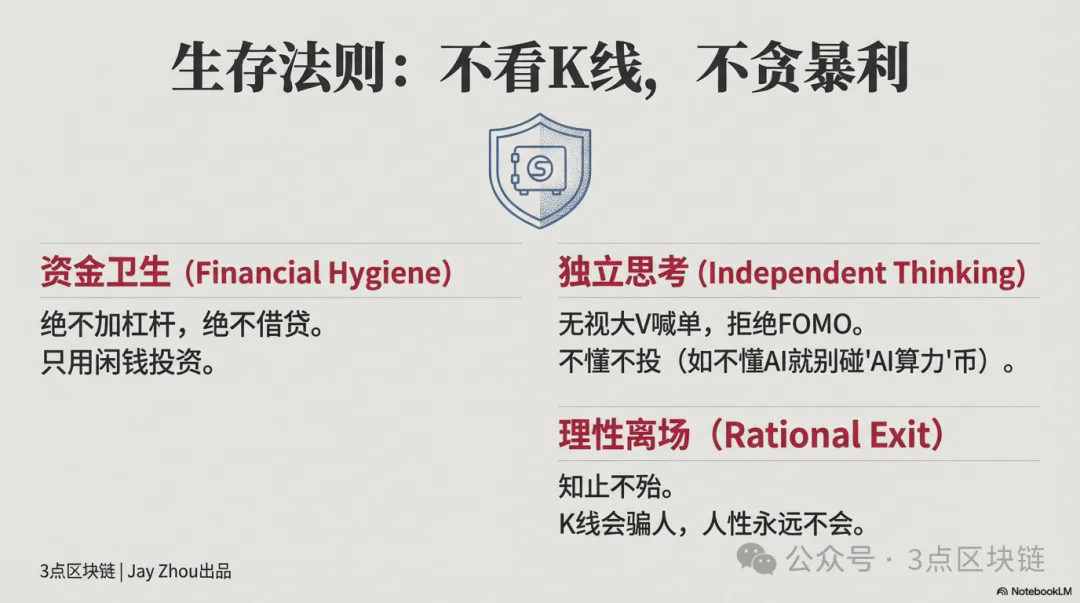
4. Conclusion: Not looking at candlesticks and not being greedy for high profits is the 'survival strategy' in the cryptocurrency world.
Looking back at the peak on October 4, 2025, I still feel grateful for my decision—not looking at candlesticks, not being greedy for high profits, maintaining rationality, and liquidating in time allowed me to avoid subsequent crashes, escape various scams in early 2026, and preserve my principal. Writing this article is not to boast about my 'accurate escape from the peak,' nor to deny blockchain technology; it is to help more people see the truth of the cryptocurrency world: the cryptocurrency world has never been a 'land of achieving financial freedom' but a 'battlefield of human nature;' the rises and falls in the cryptocurrency world have never been determined by candlesticks but by the irrational behaviors of groups, the emotional contagion of social circles, and the manipulations of capital greed; the chaos in the cryptocurrency world has never been incidental but is the result of the interplay of human weaknesses, community culture, profit-seeking capital, and regulatory absence. Too many people in the cryptocurrency world have fallen into scams because of greed; suffered heavy losses due to conformity; and lost everything due to luck. They believe that as long as they understand candlesticks, they can predict market trends; as long as they follow the crowd, they can make money; and as long as they use leverage, they can achieve financial freedom. But they do not realize that in the cryptocurrency world, understanding candlesticks is merely the 'skill' aspect; whereas understanding human nature, grasping the behavioral logic of social groups, and maintaining rationality is the 'principle' aspect—skills can be learned, principles are hard to comprehend; skills can occasionally lead to profits, while principles enable long-term survival.

The chaotic phenomena in the cryptocurrency world in early 2026 continue; countless investors' 'wealth dreams' are still being shattered. But I hope this article can awaken more people, steering them away from the irrational frenzy in the cryptocurrency world and various scams; I hope more people can understand: in the cryptocurrency world, not looking at candlestick charts is not scary, what’s scary is being swept away by greed, abandoning rationality, and blindly following the crowd; not understanding technology is not scary, what’s scary is harboring lucky thoughts, ignoring risks, and being deceived by criminals; not being able to make money is not scary, what’s scary is being willing to borrow money and leverage to make money, ultimately losing everything and ruining one’s life. For ordinary people, the best 'survival strategy' in the cryptocurrency world is to 'not participate, not follow the crowd, and not be greedy for high profits'; if participation is necessary, one must adhere to three bottom lines: first, do not borrow money or leverage, only invest their own spare money; second, do not blindly follow trends, do not believe in recommendations from influencers, and do not engage in trading air coins or Ponzi coins; third, maintain rationality, take profits and losses in a timely manner, do not be greedy, and do not cling to the battle. Lastly, I want to share a saying with all cryptocurrency participants: candlesticks can deceive, emotions can deceive, capital can deceive, but the laws of human nature cannot deceive; the logic of society cannot deceive. In the cryptocurrency world, maintaining rationality, refusing to conform, and not being greedy for high profits is the way to survive in a chaotic market; it will allow one to protect their principal and their life. May everyone be able to see the truth of the cryptocurrency world, stay away from harvesting, keep their conscience, and not betray themselves or their lives.