


\u003cm-63/\u003e\u003cc-64/\u003e \u003ct-66/\u003e\u003ct-67/\u003e
DUSK at the height of private and regulated finance on the blockchain
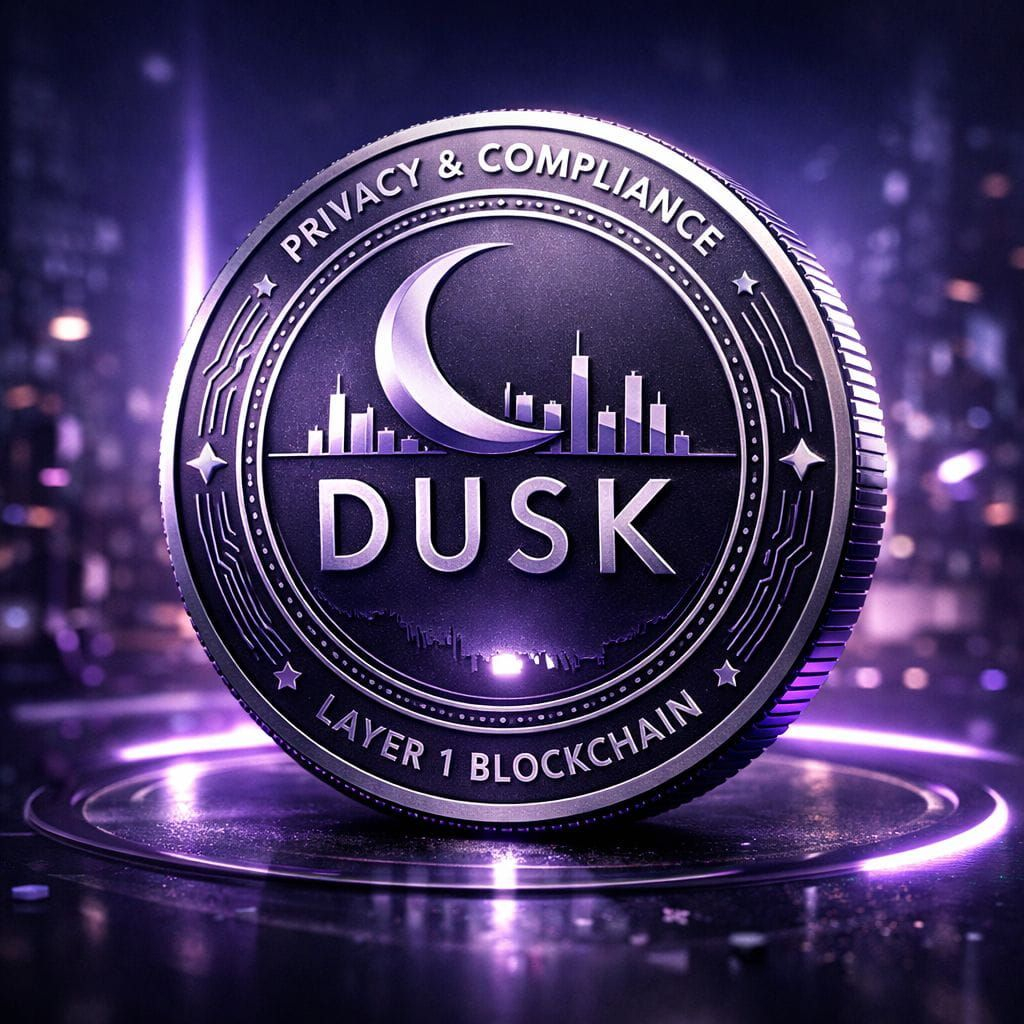
I will start from where most people feel stressed but do not always explain it clearly, because money is not just numbers, it is trust, and trust has two sides that are fighting with each other in public blockchains. One side wants transparency so that everyone can verify everything, and this early encryption has helped in feeling fairness and openness, but the other side wants privacy because real finance cannot work when every strategy, relationship, salary, trade size, and business decision is visible to strangers forever. We are witnessing the world moving towards tokenized assets and programmable finance not because banks suddenly love the culture of encryption, but because settlement is slow, settlements are costly, and many systems still rely on layers of intermediaries who pass messages back and forth as if they were in different centuries. If it becomes possible to settle faster and make ownership and rules travel with the asset, then a lot of hidden friction disappears, but only if regulation and privacy can coexist in the same room without one destroying the other, and this is exactly the space that the Dusk Foundation is trying to stand in, not in the noisy corner "everything must be public" and not in the dark corner "trust me, nothing can be verified", but in a middle ground where there is confidentiality by design and there is still a clean door for accountability.
Dusk is built around a simple feeling shared by many serious people in the market: they are not afraid of blockchains; they are afraid of public exposure and unclear compliance. Regulated finance does not hate innovation; it hates uncertainty. A chain that cannot provide controlled privacy makes regulated participation feel like walking through a glass building with no curtains, while a chain that cannot provide auditability feels like walking through a building with the lights off and hoping it does not catch fire. So Dusk's approach is to treat privacy as a first-class requirement and compliance as something that must be designed in, not merely promised. That is why its narrative keeps circling back to regulated markets, security tokens, and "market infrastructure" rather than the usual story of rapid speculation. They are trying to build something that feels less like a social experiment and more like a serious settlement layer—the kind of foundation on which institutions can issue, trade, and settle without turning all their activity into public entertainment.
To understand how it works, it helps to picture the system as two roads leading to the same courthouse. The courthouse is the base layer where settlement becomes final, and the two roads are different transaction modes that people can choose according to their needs. One road is transparent and straightforward, meaning balances and transfers are visible in the traditional accounting sense. This matters for cases that require transparency or simply prefer it because the workflow is simpler. The other road is protected and private, meaning value moves without broadcasting the details to everyone, while the chain still verifies validity without forcing disclosure. This "two roads, one courthouse" design is not just a feature; it is a philosophy. It says that privacy should be available as a normal operating mode, while transparency should remain available for the cases that require it, and the system should not split into two separate worlds that cannot talk to each other.
Step by step, private transfers in a protected model are not magic, but precise mathematics. Instead of seeing one account balance decrease and another increase, value exists as encrypted notes. When someone spends those notes, they create a proof that says, in plain human language, "I own valid value, I am not duplicating it, I am following the rules, and the result is consistent." But the proof does not reveal the amount or identity trail in the way a public ledger usually does. This is where a zero-knowledge proof system becomes the quiet engine in the background, because it lets the network verify honesty without forcing the user to reveal private details to everyone watching. Then comes the important, carefully structured step: controlled disclosure. Regulated environments often need someone to be able to prove what happened to an auditor, regulator, or compliance officer. That is where viewing rights and selective access matter, because privacy in serious finance is not about hiding forever; it is about disclosing to the right party, at the right time, for the right reason, rather than revealing everything to the whole world by default.
Beneath the marketing layer, consensus and finality choices matter more than people think, because finance depends on the feeling that "final" really means final. If a trade is "maybe final," the system still carries risk; risk becomes cost, and cost becomes hesitation. Dusk leans toward a proof-of-stake model that aims for deterministic finality through committee-based validation. That is a fancy way of saying that a selected group of validators propose, verify, and attest to blocks through an organized process, allowing the chain to reach a clear decision without endless uncertainty. They are betting that regulated markets will care more about predictable settlement behavior, stable validation economics, and clear accountability mechanisms than slogans, because institutions cannot build serious products on foundations that seem vague or unstable when things get busy.
Now, the moment you hear "regulated finance," you should also hear "smart contracts," because regulation lives in the rules, and rules need to be expressed and enforced. Dusk's stack is built modularly, meaning it tries to keep the base settlement layer focused on security, finality, and transaction validity, while execution environments above it handle application logic, trade flows, and contract behavior. This modular design matters because privacy-friendly computation and public application execution are not the same kind of work, and when you mix too much into one layer, upgrades become risky and complexity grows into a monster. Dusk's approach is to allow different execution options for different needs, including compatibility paths for developers who want familiar tools, while keeping the settlement layer aligned with privacy and regulated requirements. If it becomes possible for a chain to support both confidentiality in settlement and flexible application logic in execution, we are seeing a practical bridge between institutional reality and blockchain programmability.
The reason people in this field talk about "native issuance" with such passion is that tokenization can be superficial or profound, and superficial tokenization often keeps old problems alive. If a token is just a digital wrapper around an asset that still lives in traditional systems, then you still have settlement, you still have delays, and you still have the same middle layers—just with a nicer interface. Native issuance is a deeper promise: the instrument is created on-chain, the rules are on-chain, and recurring events can be executed with less friction. That means settlement can be faster, corporate actions can be automated, and ownership records can be cleaner, all while respecting legal obligations. This is not about replacing law with code; it is about using code to carry out what the law already requires in a clearer and more efficient way. That is why Dusk's story keeps pointing to securities-like assets, where rights and obligations are part of the instrument itself.
This is where the human side of regulated tokens comes into view, because securities are not just "transferable value"; they are ownership rights that do not evaporate when someone makes a mistake. In pure crypto culture, losing your keys is often treated as a harsh lesson. But in regulated markets, there are real obligations around continuity of ownership and investor protection. That is why Dusk's focus on security tokens emphasizes standards that can support controlled behavior, such as handling corporate actions, voting, dividend distribution logic, and redemption or administrative processes that may be required in a regulated environment. They are trying to respect a reality many blockchains avoid: sometimes an issuer has duties, sometimes an investor has rights, and the system must be able to express those duties and rights without turning everything back into a centralized database.
If you are looking at this project seriously, the metrics that matter are those that reveal real behavior, not marketing hype. On the security side, you monitor validator participation, stake concentration, and whether the network continues to finalize reliably under load, because decentralization is not just a word; it is a measurable distribution of power and a measurable ability to withstand disruption. On the privacy side, you monitor whether protected transactions are actually being used at meaningful scale, because privacy that nobody uses is just decoration, and privacy that cannot support controlled-disclosure workflows will struggle in regulated environments. On the developer side, you monitor whether application environments are achieving real usage, whether the tools are stable, whether upgrades are predictable, and whether performance remains consistent, because institutions hate surprises and markets punish instability quickly. And on the market-structure side, you monitor real progress in regulated channels, because trials and announcements are easy, but supervised operational deployment is slow and demanding. It is the only kind of adoption that truly proves the "privacy and regulation" thesis.
The risks here are real, and pretending otherwise is how people end up disappointed. The first risk is regulatory compatibility, because privacy technologies can raise suspicion if outsiders assume privacy exists only to conceal wrongdoing. So the project must continually prove that privacy and compliance can coexist through selective disclosure and clearly enforced rules. The second risk is technical complexity, because a system combining privacy-preserving settlement, modular execution, and institutional-grade reliability has a larger surface area for bugs, integration errors, and unexpected edge cases. The third risk is operational, because even a strong protocol design can be undermined by weak surrounding infrastructure such as bridges, wallets, and custody processes. Across the industry, we have seen that these components are often where incidents happen, so resilience is not just about cryptography; it is about operational discipline, monitoring, response speed, and honest communication when something goes wrong. The fourth risk is adoption timing, because regulated finance moves slowly and requires proof through audits, oversight, and years of stable operation. Even a good system can struggle if the world is not ready to move at the pace its builders hope for.
Still, the future path is not hard to imagine if you follow the logic carefully. We are seeing a world where more assets become natively digital, settlement approaches real time, and markets become more programmable. But we are also seeing that privacy and regulation will be part of that future whether people like it or not, because transparency alone cannot protect participants, and secrecy alone cannot protect markets. If Dusk continues building in the same direction, the most likely future is gradual and practical, not sudden and dramatic: specific regulated tools and markets adopt confidential settlement and compliance-aware issuance step by step, and as trust grows, the system becomes less specialized and more like a quiet part of the infrastructure. If it becomes possible for investors to hold assets without being exposed, trade under enforced rules, settle faster, and still prove legitimacy to the appropriate authorities when needed, then blockchain stops feeling like a public theater and starts feeling like a professional operating system.
I am not saying this journey is easy, because it is not, and they are not the only ones trying to solve this. But the direction itself matters. We are seeing a shift from noisy, chaotic experimentation toward a quieter kind of design where privacy is treated as a human need and regulation as a social contract. In that space, the best projects will not win by shouting; they will win by doing the work, shipping, holding up under pressure, and staying honest about both limitations and progress. And if Dusk continues to approach private, regulated finance not as a marketing phrase but as a long-term responsibility, then even small steps today could become the foundation for something that feels more stable tomorrow: a future where technology does not force people to choose between being seen and being safe, but lets them participate with dignity while the system remains accountable in the real world of blockchain.💜


\u003ct-40/\u003e\u003ct-41/\u003e\u003ct-42/\u003e\u003ct-43/\u003e