


Key points from the post:
October 10 was marked by a market flash crash, driven mainly by macroeconomic factors, market maker risk protocols, and network congestion.
The central systems of Binance remained fully operational throughout the market shock. There was no downtime or failure on the platform, and all core functions of matching, risk checks, and settlement continued without interruptions.
Binance took responsibility for two specific incidents on the platform; these two issues were not the cause of the flash crash.
On October 10, 2025, the cryptocurrency market experienced a macro shock. While some blamed Binance for a failure, the reality is that cascading liquidations were caused by macro risks from highly leveraged positions, risk controls of market makers limiting liquidity, and congestion on the Ethereum network delaying transfers. In this blog, we will share the facts to be fully transparent and acknowledge where our platform faced pressure.
Macroeconomic context
Following headlines related to the trade war, global financial markets fell sharply, with virtually all asset classes impacted. Cryptocurrencies, which had been rising for months until early October and exhibited high leverage, were particularly exposed. In the derivatives market, positions were close to record levels, with open contracts of BTC futures and options exceeding $100 billion. On-chain data showed that most Bitcoin holders had accumulated profits — ideal conditions for rapid profit-taking and forced deleveraging when a shock occurs.
The impact was not limited to cryptocurrencies: US stock markets lost about $1.5 trillion in value that day, with the S&P 500 and Nasdaq facing their largest daily declines in six months and $150 billion in systemic liquidations.
Extreme market movement triggered market makers' risk controls
As the liquidation intensified, the extreme market movement triggered algorithmic risk controls and circuit breakers of market makers, which began to automatically manage inventory and reduce exposure. This behavior, expected in times of extreme volatility, temporarily withdrew liquidity from order books.
According to the order book depth of data from Kaiko (figure 1), 'BTC liquidity was zero or close to zero at all levels' at some exchanges — except for Binance, Crypto.com, and Kraken, the major exchanges had almost no buy orders within a 4% price spread. This tightening meant that each additional forced sale moved prices more than normal. Additionally, risk management between exchanges and arbitrage was impaired.
Figure 1: Minimum BTC depth, causing significant spread widening during the crash on October 10
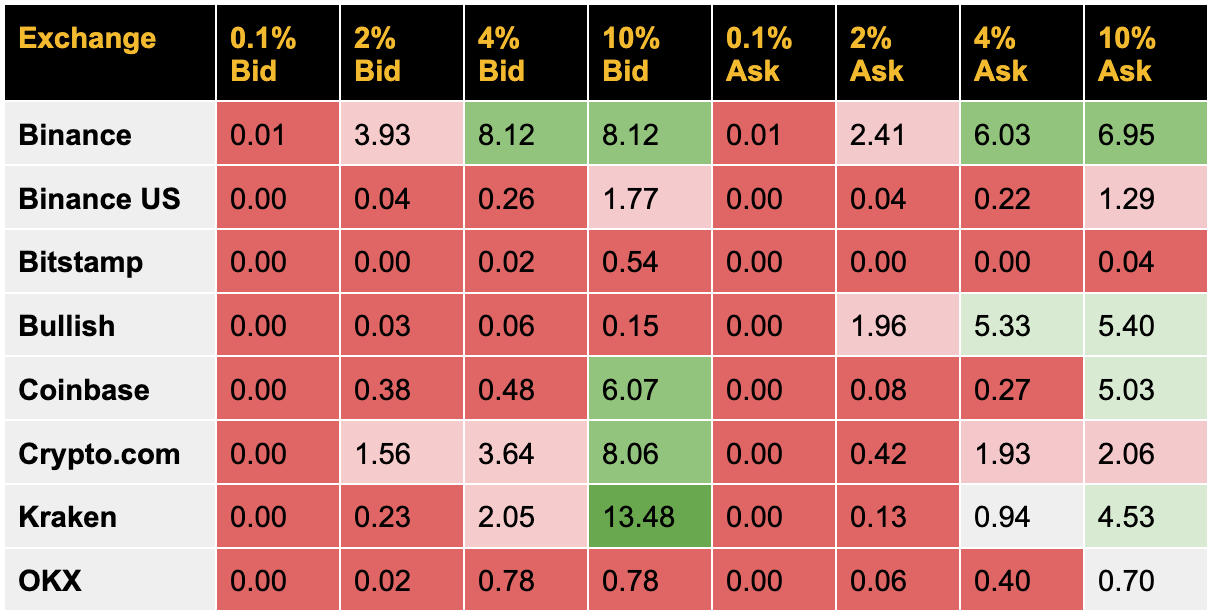
Source: Kaiko, Binance Research (Pairs: BTC-USDT, BTC-USDC, BTC-USD — based on the average per minute on 10/10/2025)
Network congestion
An additional factor in the flash crash on October 10 was the congestion of the Ethereum blockchain, which caused gas fees to spike from single digits to over 100 gwei at some points and delayed block confirmations, slowing down arbitrage and flows between platforms. In an already scarce liquidity market, this widened spreads and further complicated the rebalancing of positions, creating a brief liquidity vacuum that intensified price swings. Until selling pressure subsided and markets stabilized, it was difficult to rebalance between exchanges or allocate liquidity where it was most needed.
Market-wide implications
In tighter markets, even modest orders impact the order book, creating sharp wicks on charts. Mechanical selling and forced liquidations amplified price movements, while slowed arbitrage and transfers between venues temporarily increased price differences. Some pegged tokens or derivatives briefly decoupled from their reference values, reflecting the same pressure factors: restricted liquidity, fast flow, and delayed capital movement.
Like all exchanges, Binance faced difficulties processing high volume under extreme market conditions
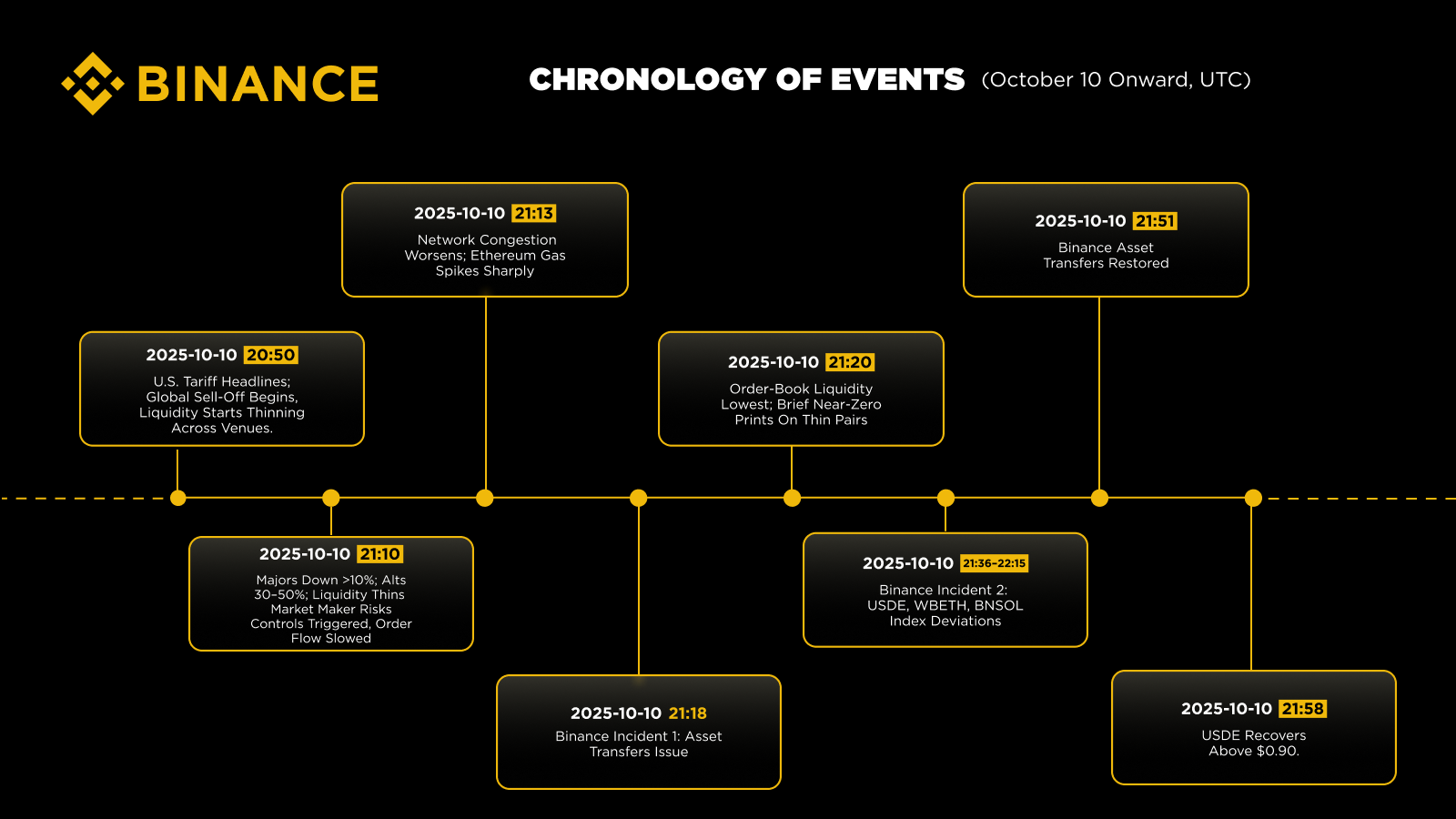
The dislocation on October 10 was a systemic risk aversion movement driven by macroeconomic factors. Still, we acknowledge that parts of the Binance platform faced temporary difficulties under extreme conditions and we have already compensated affected users, in addition to reinforcing safeguards.
Important: the specific issues of the Binance platform were not the cause of the flash crash. During the period of highest volatility, between 18:10 and 18:20 (BRT), about 75% of the day’s liquidations had already occurred before the widely reported decoupling of three tokens (USDe, BNSOL, WBETH) at 18:36 (BRT). This timeline shows that most deleveraging occurred during the initial macro shock that began at 17:50 (BRT), when forced liquidations accelerated price drops amid the weakened order book.
This confirms that the main factor was a reflexive risk aversion dynamic and liquidation across the market, not specific anomalies on the platform. Binance's core order matching engine, risk checks, and clearing systems remained fully operational throughout the period, without interruption.
Next, we detail our findings on the two incidents:
Incident 1: Degradation of the asset transfer subsystem (18:18–18:51 BRT)
During the peak of selling, our internal asset transfer subsystem slowed down for about 33 minutes. This affected the movement of some funds between Spot, Earn, and Futures. The matching core, risk checks, and clearing continued to operate normally; the disruption was limited to the transfer path and its dependents. A small number of users also viewed balances as '0' on the interface when there were failures in back-end calls; this was a contingency display issue, not a loss of funds.
Root cause: performance regression in a hot read path for the asset database that manifested under peak load. A frequently called API did not have efficient caching and read directly from the database. With traffic 5-10x higher than normal, connections saturated, thread pools became overloaded waiting for connections, and timeouts propagated. A previous version update from the cloud provider also removed an embedded behavior of query caching, reducing the safety margin of this query under stress.
Remediation: All eligible users impacted by this incident between 18:18 and 18:51 (BRT) have been fully compensated based on system logs and attempt records. To resolve the issue, we are adding cache, expanding capacity and database replicas, optimizing connections, separating critical functions, and enhancing the contingency mechanisms of the interface.
Incident 2: Deviations in the indices of USDe, WBETH, and BNSOL (18:36–19:15 BRT)
Following the depth reduction of the order book in most markets and on-chain congestion delaying rebalances between venues, the indices of USDe, WBETH, and BNSOL deviated unusually from expected values. The combination of reduced local liquidity, accelerated liquidations, and slower flow between venues caused temporary movements in our venue to significantly influence the index calculation during times of stress.
Root cause: index entries of these three tokens were overweight in our own order books and were not sufficiently anchored to the underlying reference values (especially for wrapped/staked tokens), while protections against outliers/deviations were not robust enough for a fast and narrow market.
Remediation: We enhanced parameters during stabilization and immediately initiated a methodology update for these 3 tokens. All impacted users have been fully compensated.
Kline Display: On October 12 (UTC) we announced and implemented a front-end display update, to optimize the display of price data in Kline charts. This was considered due to the $0 wick for ATOM/USDT and IOTX/USDT that occurred during an extremely low liquidity period, where, due to intense selling pressure, the system matched legacy buy orders from 2019, resulting in a single candle reflecting the artificially low price. This was a user interface adjustment and did not affect any real trading data or API information. Some misunderstood, thinking it was an attempt to alter data, and upon receiving feedback from the community, we quickly reverted the update. Binance has never altered, and will never alter, any real trading or historical data.
Putting our users first
In addition to technological advancements, by 10/22/2025, we fully compensated eligible users affected by both incidents above and credited over $328 million.
As previously announced, Binance launched the Together Initiative on 10/14, a discretionary goodwill program of $300 million, created to support users impacted by the flash crash who did not qualify for compensation, as they were not directly affected by the aforementioned Binance platform issues, and a $100 million low-interest loan fund for institutional participants severely affected by market conditions, to stabilize operations.
Binance will continue to prioritize user protection and ongoing industry development, as well as continue investing and enhancing efforts to promote the healthy and sustainable growth of the crypto ecosystem in the long term.
Additional reading
Resolution of the price decoupling of USDe, BNSOL, and WBETH and enhancements in risk control
Announcement regarding recent market volatility and update on user protection measures progress
Disclaimer and risk notice: The compensation plans and the Together Initiative described here are offered only to eligible users, on a goodwill basis and at the sole discretion of Binance, without admission of fault or liability on the part of Binance. This does not waive any rights of Binance nor create any obligation for Binance to provide compensation or restitution in similar or future circumstances, or on any other claim, issue, or matter related to or arising from the mentioned incident. Nothing in the compensation plans, the Together Initiative, or this communication constitutes financial advice or any type of guarantee. The determination of eligible users and compensation amounts will be a final decision, made and calculated by Binance. Any claims beyond, outside, or additional to the compensation plans or the Together Initiative must be submitted separately to Binance and will be evaluated on a case-by-case basis, with all rights of Binance reserved. The prices of digital assets are subject to high market risk and price volatility. The value of your investment may go down or up, and you may not recover the invested amount. You are solely responsible for your investment decisions and Binance is not liable for any loss you may incur. Past performance is not a reliable indicator of future results. Invest only in products you understand and whose risks you comprehend. Carefully consider your experience, financial situation, investment goals, and risk tolerance and consult a financial advisor before investing. To learn more about how to protect yourself, visit our responsible trading resources page. For more information, refer to our Terms of Use and Risk Notice.
Attention: Please note that there may be discrepancies between this original English content and any translated versions (these versions may be generated by AI). Please refer to the original English version for the most accurate information if discrepancies arise.