On Thursday (February 5), Strategy published its financial report for the fourth quarter of 2025 amid pressure from the digital asset market.
The quarterly net loss for Strategy reached $12.4 billion, with earnings per share at -$42.93, far below the expected $2.97. The loss is primarily due to a $17.4 billion unrealized fair value loss caused by accounting standards requiring mark-to-market valuation. This significant gap has raised questions about the company's financial health and strategic direction.
As of December 31, 2025, the company holds 713,502 bitcoins, with a total cost of $54.26 billion, averaging $76,052 per coin, maintaining its position as the world's largest holder of bitcoins. However, this also marks the first time since 2023 that the market value of its bitcoin holdings has fallen below its cumulative cost.
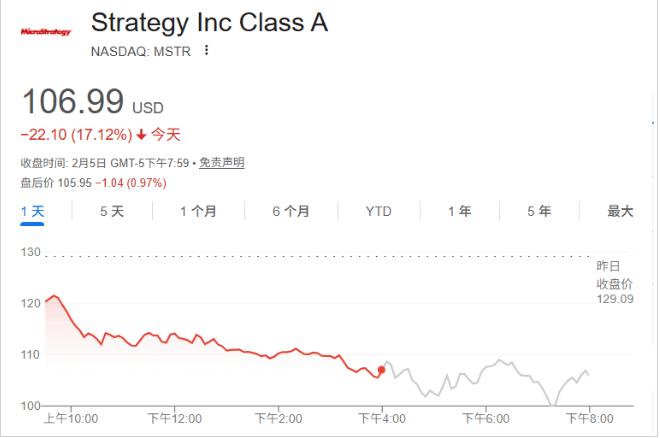
In the face of investor disappointment with the performance, Strategy's stock price plummeted 17.1% on Thursday. This not only wiped out all gains after the U.S. election but also caused the stock to drop nearly 80% from its historic high in November 2024.
However, despite the losses, Strategy still holds $2.3 billion in cash and cash equivalents by the end of 2025, a significant increase from the previous year, thanks to the dollar reserves established. In contrast, as of December 31, 2024, it only held $38.1 million.
The company's quarterly revenue also exceeded expectations, reaching $123 million, higher than the forecasted $118.81 million, exceeding by 3.53%.
As for future prospects, the company plans to double the number of Bitcoin per share over the next seven years and aims to achieve an annual Bitcoin yield of 5-14% through its digital credit strategy. Strategy also plans to continue developing its Stretch products and explore partnerships for digital currency products.
Asset-liability situation
As Bitcoin's price has currently dropped to around $63,000 (significantly below the company's average holding cost of about $76,000), Strategy's large Bitcoin asset portfolio has actually fallen into a paper loss.
Strategy carries $8.2 billion in convertible debt, although Saylor emphasized that the company has $2.25 billion in cash reserves, sufficient to cover interest and dividend payments for the next two years, and there is no margin call risk, market concerns still exist.
CEO Phong Le, when discussing the company's asset-liability situation (including convertible bonds), stated, "Our leverage is only one-third of that of high-yield companies."
He analyzed that even if the price of Bitcoin plummets by 90%, the value of Bitcoin reserves held by the company would still be enough to cover the convertible debt. However, he also admitted that if such an extreme situation arises, the company would not be able to rely solely on selling Bitcoin to repay the debt.
Phong Le pointed out, "If we cannot achieve 'debt-for-equity swaps', we will seek other debt restructuring options." This statement implies the company's desire to convert convertible bonds into preferred stock. However, this plan will incur an annual interest cost of about $900 million.
Furthermore, as a core indicator reflecting the relationship between the company's stock price and the value of Bitcoin holdings, Strategy's market net asset value (mNAV) has currently dropped to 1.09 times. Although it still maintains a slight premium, this value is far less than the high multiples seen during the Bitcoin bull cycle.
If the market net asset value further slides to 1.0 times, it will mean a loss of market enthusiasm. Currently, investors clearly believe that the stock price is difficult to exceed the intrinsic value of the Bitcoin held.
What did Saylor say?
Regarding the company's latest performance, co-founder Michael Saylor stated, "Bitcoin is digital capital. We believe in it." However, unlike his previous stance of "firmly buying and not selling," Saylor admitted during the earnings call that "selling Bitcoin is also an option."
Overall, Saylor remains optimistic during the earnings call, stating, "We have a president who supports cryptocurrency. He describes politics as a fundamental element of cryptocurrency investment". He even specifically pointed out that Kevin Warsh, the Federal Reserve chair nominee by Trump, is also a supporter of cryptocurrency.
Saylor then turned the topic to the threat of quantum computing, deliberately downplaying the risk, stating, "It will take at least ten years or longer to pose a real threat." He confidently stated, "If Bitcoin needs an upgrade, global consensus will naturally form."
Co-founder Andrew Kang added, "Our goal is to systematically increase the number of Bitcoin per share over time," emphasizing the company's strategic focus on Bitcoin growth and shareholder value.
Although the company's management tried to maintain an optimistic tone, describing profitability as a distant prospect, the current situation shows that with Bitcoin falling below cost price and financing channels narrowing, investors are facing severe reality checks.
Although Trump publicly supports and holds cryptocurrency, the price of Bitcoin still fell below the post-2024 election low on Thursday, reflecting market skepticism about Trump's commitment to pushing the federal government to purchase Bitcoin and other cryptocurrencies. U.S. Treasury Secretary Yellen made it clear to Congress on Wednesday that she has no authority to implement a rescue for Bitcoin.