


Written by: Luke, Mars Finance
Prologue: The Hunting Grounds
The darkness before dawn is always the purest hunting ground.
On August 27, 2025, at 5:50 AM. While most traders in the crypto world were still asleep, a meticulously planned 'hunt' silently unfolded on the decentralized derivatives platform Hyperliquid. The prey were those naive hedgers who believed that '1x leverage' equated to 'absolute safety'; while the hunters were two long-hidden mysterious addresses, who were about to leverage over $15 million in capital to trigger a perfect storm valued at $27.5 million.
This was not an unpredictable 'black swan' event, but an extreme utilization of the system's rules. This is a bloody lesson written with real money in the digital wilderness about trust and risk.
Chapter 1: Five-Minute Storm
The signals of the attack did not appear out of thin air. Like an experienced predator, the hunters had quietly entered this hunting ground called Hyperliquid two days prior.
The main characters are two clearly defined addresses: 0xe417..., which we call 'lurker'; and 0xb9c..., which we call 'demolition expert'.
Starting from August 24, the 'lurker' began to act. Like a patient angler, within three days, at an average price of $0.56, it quietly accumulated a long position in XPL worth $9.5 million, totaling 21.1 million tokens. Its actions were gentle and covert, aimed at not disturbing the surface of the water, laying the deepest foreshadowing for the final netting.
Meanwhile, the 'demolition expert' was preparing ammunition for the impending thunder strike. Over $15.9 million in USDC flowed through the Arbitrum network, quietly pooling into its account on Hyperliquid.
All set.
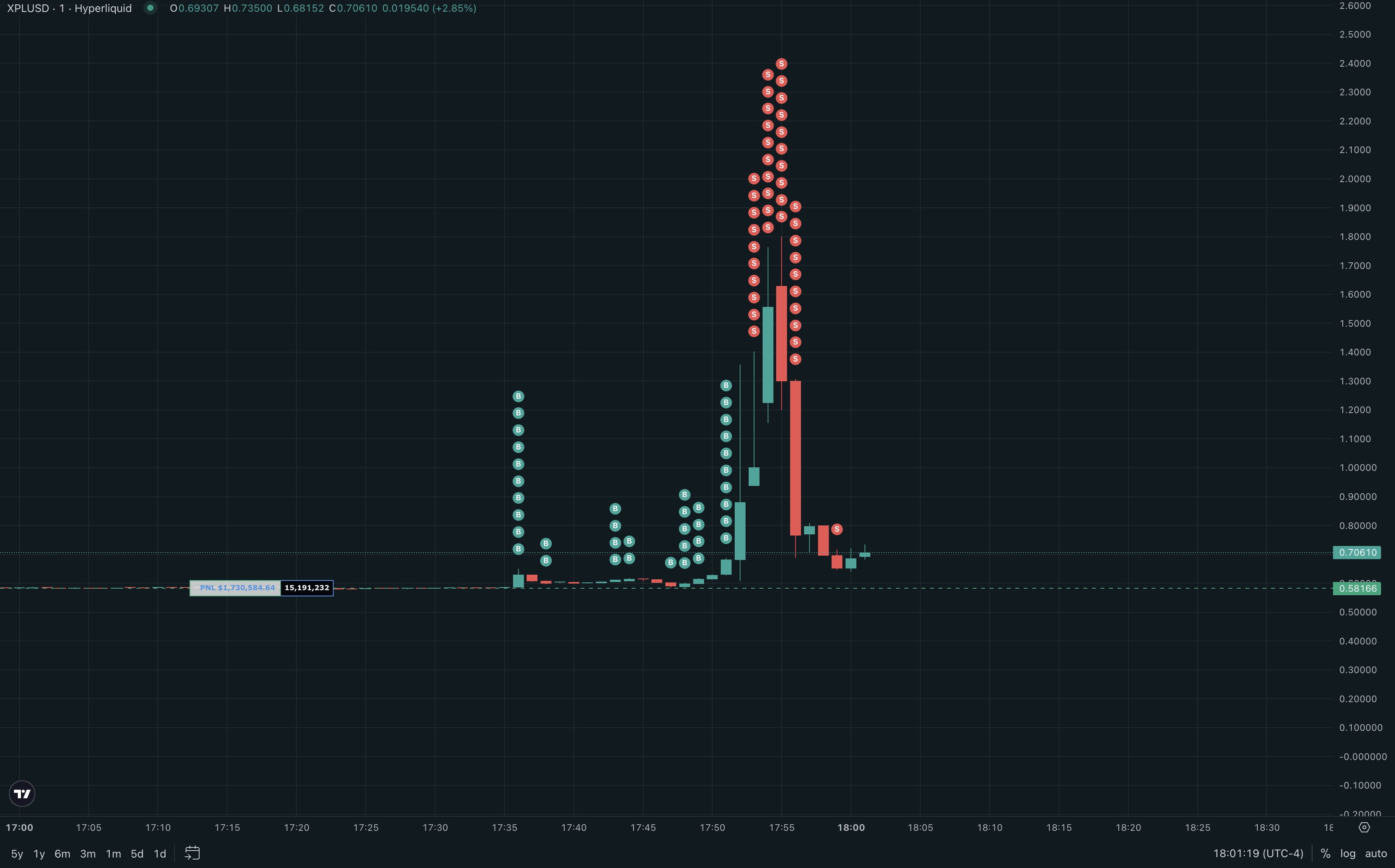
At 5:50 AM, the market was at its quietest, with liquidity at its thinnest, when the 'fuse' of the attack was ignited. The 'demolition expert' launched a full-scale assault, a series of massive market buy orders, like a heavily armored unit, instantly collapsing the weak defenses on the XPL/USD order book. On the screen, the price candlestick of XPL resembled a startled beast, breaking free from all technical indicators' constraints, tearing upwards at a bizarre vertical angle.
0.6 dollars... 0.9 dollars... 1.5 dollars... peaking at 1.8 dollars.
This is not the market's natural breathing; it is a precise, efficient, and ruthless 'precision demolition'. The price surge is merely a means; the true goal is to trigger a 'digital avalanche'. As the price breaks through one integer after another, those 1x short hedges, considered 'safe havens', have their liquidation lines breached instantaneously.
The system began to automatically execute liquidations. However, the operation of liquidating short positions involved submitting market buy orders to the market. This involuntary buying flood generated by the system was like the first boulder rolling down a hillside, triggering the roar and collapse of the entire mountain. More shorts were liquidated, more buy orders were passively generated, and prices were pushed to even crazier heights.
A deadly 'liquidation spiral' formed. In just a few minutes, short positions worth $17.67 million vanished in the flames. At the peak of the chaos, the hunters began to harvest. The buying frenzy they created became the best cover for their exit. The 'lurker's' positions were liquidated at an average price of about $1.15, yielding a profit of $12.5 million. The 'demolition expert' pocketed $16 million.
Five minutes, $27.5 million. After the attack, they left gracefully, leaving behind a battlefield that had been completely looted.
Chapter 2: Weaponized Rules
This perfect ambush did not exploit a code vulnerability (Bug), but rather took advantage of the rules themselves. The 'perfect weapon' the hunters found was the unique oracle mechanism called 'Hyperp' designed by Hyperliquid for pre-issue tokens.
In normal derivatives markets, contract prices would anchor to an external, fair spot price. But what to do when pre-issue tokens like XPL have no spot market? Hyperp's design is: its oracle price does not rely on any external data sources, but instead uses the exponentially weighted moving average (EWMA) of its own past 8-hour marked prices.
This is akin to a closed room where the thermometer's displayed 'standard temperature' is determined based on its own past 8-hour readings. This self-referential design creates a deadly positive feedback loop when faced with attackers with sufficient capital.
The logic of the attack is simple and elegant:
Impact the marked price: The 'demolition expert' violently raised the instantaneous price of the contract with massive funds.
Pollute historical data: This artificially inflated new price is input as the latest data point in the EWMA calculation formula.
Drag the oracle price: Due to the characteristics of EWMA, this internal 'oracle price' (i.e., the 8-hour average price) begins to slowly but surely move upwards.
Create price deviations and trigger liquidations: The attacker created a huge price deviation—instantaneous prices soaring far above the slowly moving oracle price. This deviation caused the value of short positions to plummet sharply, triggering the deadly liquidation avalanche.
The hunters did not deceive the system; they simply used overwhelming force to make the system 'believe' the price they wanted. This weapon was hidden in the protocol's manual, waiting for the first person to understand it and have the ability to pull the trigger.
Chapter 3: The Illusion of Safe Hedging
In this storm, the saddest characters are those '1x leverage hedgers' who were liquidated. They thought they had found a 'safety rope' to hedge risks, unaware that this rope was tied to a house of cards.
Their fundamental error lies in incorrectly applying the hedging logic of mature markets to a **'island market'. A true hedging instrument must have a strong convergence mechanism with the spot price of the asset being hedged, and this mechanism is usually arbitrage**.
However, the market for XPL on Hyperliquid is a de facto 'island'. It does not track any external spot prices, so its price does not reflect the 'fair' value of XPL but merely reflects the balance of long and short forces on the Hyperliquid platform.
Thus, shorting the XPL contract at 1x leverage is not actually hedging the future value risk of the XPL token, but rather speculatively shorting the buying pressure on the Hyperliquid platform. When an attacker with overwhelming capital decides to create buying pressure, such a 'hedging' strategy is bound to fail. The user Cbb0fe, who left indignantly after losing $2.5 million, painfully validated this point.
Chapter 4: The Silent Watchers
Most thought-provoking is that in the face of this blatant hunt, the governance of Hyperliquid—those who should maintain market order, the 'watchers'—chose complete silence.
This was not their first encounter with market manipulation. Just a few months ago, during another 'JELLYJELLY' incident, when the attacker's target was directly aimed at the platform's own liquidity vault (HLP), threatening the survival of the 'casino' itself, the 'watchers' decisively 'pulled the plug'—they paused the market, forcibly liquidated positions, and retrospectively modified the settlement prices, depriving the attacker of profits.
That time, they were hard interveners. But this time, when the victims were ordinary users on the platform, they became indifferent bystanders.
The platform's inaction during the XPL incident seemed to be perceived by the attackers as a form of tacit approval. Just about half an hour after the XPL incident occurred (6:25-6:30 UTC+8), the same short-squeeze strategy was attempted on another pre-market contract WLFI. WLFI's price soared from about $0.28 to $0.43, while the Binance pre-market saw no significant fluctuations during the same period. This clearly indicates that the attackers tried to replicate their success on another target with similar characteristics (a large number of uncirculated tokens and short hedges).
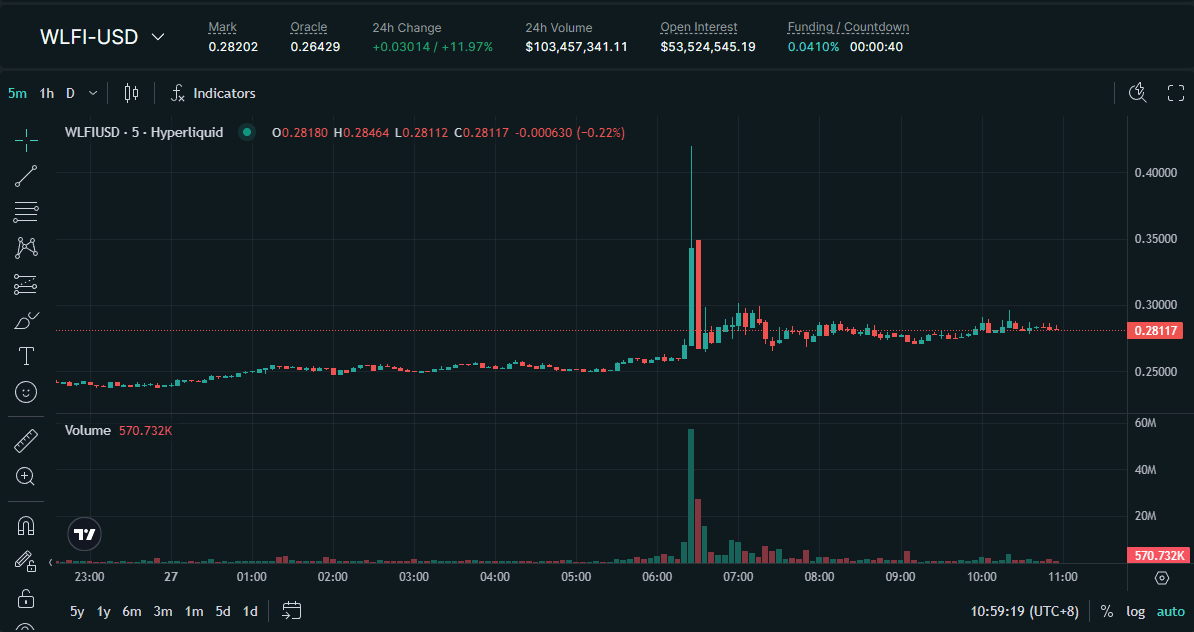
However, this attempt did not lead to a significant chain liquidation like that of XPL. Perhaps the XPL disaster made shorts in the market more vigilant, reducing their risk exposure in advance; or perhaps the liquidity structure of the WLFI market differs from that of XPL. But regardless, this unsuccessful 'copycat' attempt further confirmed the pattern of the attack and highlighted the absence of platform governance—loopholes still exist; the prey has just become more alert.
Why does the same platform respond so differently to two similarly-natured market manipulations? The answer may lie in the different identities of 'victims' in the two events. The JELLYJELLY attack threatened the survival of the protocol itself, while the losses from the XPL attack were primarily borne by the users.
This 'selective enforcement' is more chilling than the attack itself. It shatters the market's illusion of a fair and neutral platform, revealing the faint shadow of centralized power behind the so-called 'decentralization'. The platform's intervention threshold seems to be based on its own financial risk rather than universal market fairness.
Chapter 5: The Survival Rules of Investors
For ordinary investors, completely avoiding all risks is unrealistic, but they can identify and avoid such 'traps' through more prudent 'pre-investment due diligence'. The key lies in analyzing not just the asset itself but also the 'microstructure of the market' where the asset is located. Before stepping into any DeFi derivatives hunting ground, at least three reconnaissance tasks should be completed:
Identify 'island markets': Before trading a derivative, ask yourself: What is its price anchored to? XPL and WLFI on Hyperliquid are typical 'islands', with prices reflecting only the internal long-short game on the platform, without any external spot market to correct their prices through arbitrage. For such isolated markets, any so-called 'hedging' strategy is a fallacy, as you are not hedging the fair value of the asset, but rather engaging in a gamble with all the counterparty funds on the platform.
Review the oracle mechanism: This is the core of DeFi derivatives. Be wary of **'self-referential' oracles. Mechanisms like Hyperp, where prices are determined by their historical prices, are akin to defining the current standard temperature in a closed room using past temperature, which can easily be 'heated' and manipulated by large funds. A healthy oracle must rely on multiple, independent, and deep external data sources** (like Chainlink, which aggregates spot prices from multiple mainstream exchanges).
Look for the platform's 'safety net': A responsible platform will set clear risk parameters for low liquidity and high-risk assets. Investors should proactively search for and confirm:
Is there a total position limit (Open Interest Caps)? This can fundamentally limit the risk scale that a single market can accumulate.
Is there a position limit for a single account? This can prevent whales from 'controlling the market'.
Is the liquidation mechanism smooth? Is it a one-time market price crash (which easily leads to chain liquidations), or is it handled smoothly through TWAP/VWAP (time/volume weighted average price)?
If a platform does not set any of the aforementioned risk control measures on a brand new asset with no external price anchors, then for ordinary investors, it is not a fair casino but a carefully designed 'hunting ground'.
Epilogue: The Path to a Resilient Market
The Hyperliquid XPL incident should ultimately be characterized as a foreseeable exploitation of a flawed market design. It was a stress test, and the Hyperp mechanism failed completely in this test. However, the costly 'tuition' of this event must be transformed into a ladder towards more robust protocols.
The loopholes in the platform's rules could have been addressed and are technically not complex. What was exposed is not an unsolvable technical dilemma, but rather a balance issue between the platform's strategic choices for pursuing trading volume and attracting attention and risk management. The future development of DeFi needs to combine cutting-edge financial innovation with mature risk management philosophy.
Fixing the loopholes can start from the following levels:
Abandon purely internal oracles: For pre-issue tokens, hybrid oracles can be introduced, integrating prices from other platforms (like Aevo, Binance pre-market) as references, which can break the internal closed loop and provide arbitrage opportunities to correct prices. Additionally, an automated circuit breaker mechanism can be hard-coded at the protocol level, such as automatically pausing trading for 15 minutes if a contract price deviates from its 1-hour average price by more than 50% within 5 minutes, effectively preventing the formation of a 'liquidation spiral'.
Implement dynamic, on-chain risk management: This is the most core improvement. Introduce position concentration margin, where the margin requirements should increase exponentially when a certain account's position exceeds a high percentage of the overall market. This will make the cost of 'controlling' funds extremely high, thereby serving as a deterrent.
Optimize the clearing engine: Abandon blunt market price clearing, and enforce that all large clearings are executed smoothly over time using TWAP/VWAP algorithms, minimizing market impact.
These measures are standard practices in mature financial markets and some robust DeFi protocols. Hyperliquid is not unaware of this; rather, it is more likely that, in order to seize the opportunity in the high-risk, high-reward realm of 'pre-issue token trading', it selectively relaxed these safety reins.
True decentralized finance does not lie in creating more unregulated casinos, but in building a resilient market that does not require trust, where rules are paramount and a strong immune system is built-in. Only in this way can it ultimately fulfill its promise of fairness to all participants.