

Compliance is rising, DEX is exploding, and offshore is being squeezed; the endgame for Crypto exchanges has no middle ground.
Written by: Web3 Farmer Frank
Have you ever thought about whether Crypto trading will be taxed in the future?
Since this spring, many users from mainland China trading US stocks via Tiger Brokers, Futu Securities, etc., have been receiving tax backtracking notices; this is no coincidence. With the implementation of CRS global information exchange, overseas accounts and investments are under comprehensive monitoring from high net worth to ordinary middle-class individuals.
The principle is the same; the 'sovereign vacuum period' in finance is often very short. Today's US stock brokers are not the rehearsal for tomorrow's Crypto trading—once the chaotic era passes, Liangshan will have to be incorporated into regular armies:
From the invisible freedom of offshore US stock accounts to CRS global information exchange, from the barbaric growth of third-party payments to the strict regulation of central bank licenses, financial innovation lying outside mainstream regulation is transitioning from gray to standardized—a one-way street that cannot be reversed.
Especially since this year, with the entry of Web3 and power into the scene, Crypto exchanges can be said to be at a critical crossroads of fate, where compliance localizers sit steadily, the offshore gray space quickly narrows, and on-chain DEX is gaining momentum.
There is no middle ground, only clear directional differentiation.
Offshore CEX, the feast has ended
Centralized exchanges (CEX) remain the top predators in the current Crypto ecosystem.
It can be said that CEXs, which rely on trading fees as their core source of income, have reaped the biggest dividends from the explosive growth of the Crypto market. According to public market estimates, the current annual revenue and profits of leading offshore CEXs like Binance and OKX are in the range of billions to hundreds of billions of dollars; for example, Binance's revenue in 2023 reached $16.8 billion, with annual cryptocurrency trading volume exceeding $3.4 trillion.
This means that even in periods of global macroeconomic turmoil, offshore CEXs remain one of the most profitable businesses.
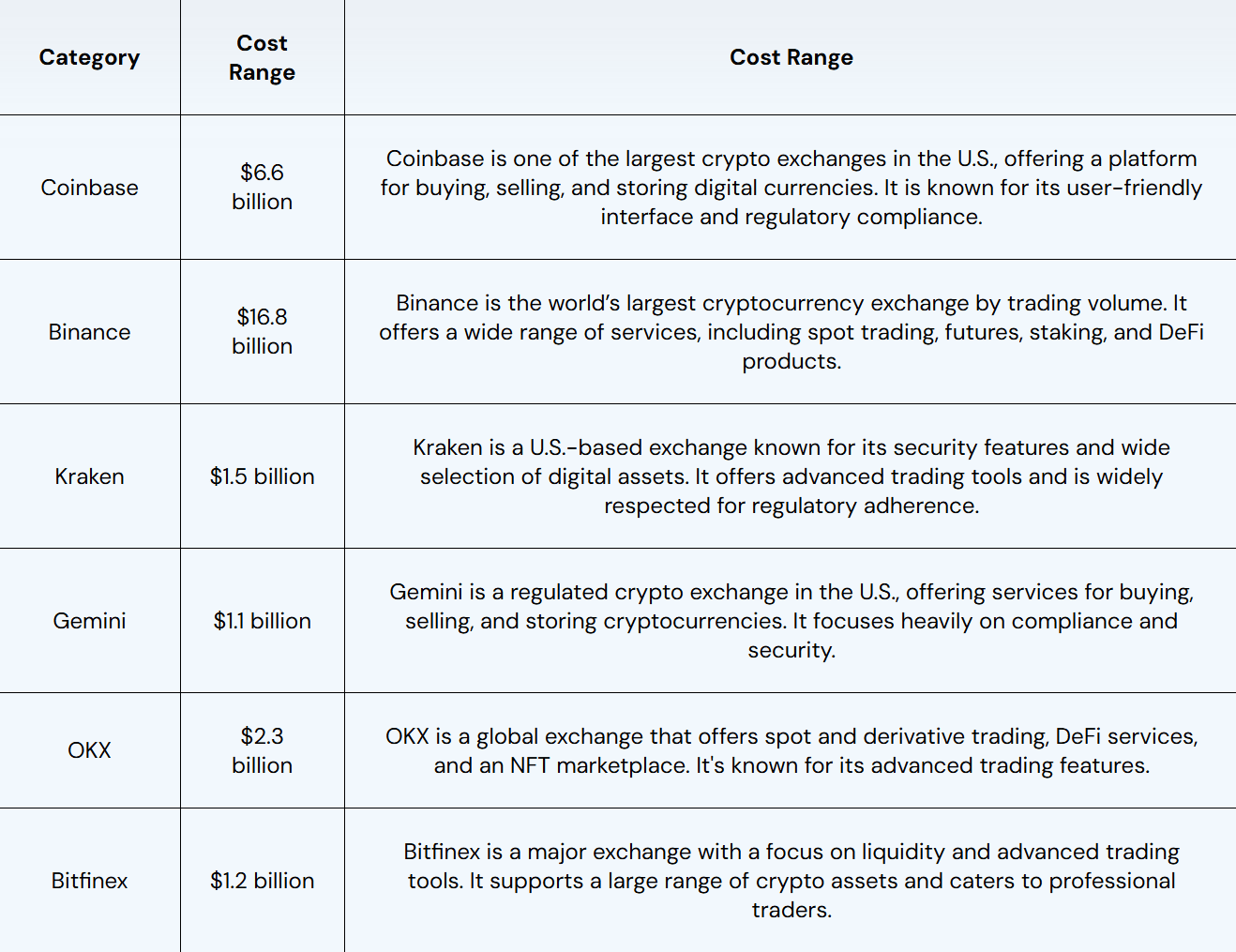
However, the golden age of the offshore model has clearly come to an end.
Compliance pressures and tax storms are extending from traditional finance to the Crypto field. Like the recent uproar about tax backtracking on US stock trading, observant users should notice that over the past year, offshore CEXs like Binance and OKX have also faced a series of public disputes:
Including but not limited to restricting accounts that use cryptocurrency assets as the sole source of income and requiring users to provide annual income and tax proof, etc.
Objectively speaking, offshore giants like Binance and OKX have paid a high price to 'go onshore.' Besides the judicial accountability faced by the founders, the investment is also considerable—Binance has publicly disclosed that it invested hundreds of millions of dollars in compliance and security alone in 2024, and its internal compliance team has grown to 650 experts.
Especially since 2025, various parties have been accelerating compliance and potential listings while taking advantage of the 'political dividend window period.'
For example, Kraken first had the SEC withdraw its securities violation charges against it, the FBI also ended its investigation into its founder, then hinted at potential IPO plans, and recently reported a financing of $500 million at a valuation of $15 billion, completely turning towards compliance.
OKX is similar; first, it reached a settlement with the US Department of Justice in February this year, paying over $500 million in fines, and then actively promoted its IPO in the US, even adjusting its compliance department in the US to be the highest priority for all departments.
These actions have released a clear signal that the survival space of the offshore model has been compressed to a historical low, and CEXs are racing to sprint for the last compliance window.

It can be said that this Crypto political honeymoon period, catalyzed by Trump’s reshaping of policy narratives, BTC's 'balance sheetization,' and the stablecoin boom, is almost the last window period for offshore CEX transformation.
Once the opportunity to 'go onshore' is missed, one may transform from a top predator at the ecological peak to an object eliminated by the times.
The foreseeable pattern of 'three divides the world'
If today's Crypto market is compared to the Hong Kong and US stock markets participated by Chinese investors ten years ago, then regulation and market evolution have only lagged a few years on the timeline.
As global tax compliance, capital controls, and the entry of financial institutions overlap, the future landscape of exchanges can almost be foreseen as 'three divides the world':
Localized licensed compliant CEXs: Coinbase, Kraken, HashKey, OSL, etc., are characterized by having banking connections and compliance clearing capabilities, mainly serving local users and institutions/high net worth individuals, building long-term brand value through compliance moats;
Offshore gray CEXs: Binance, Bitget, Bybit, etc., serve global retail investors and some high-risk users. Under the current global compliance trends and approaching on-chain experiences, they will inevitably be compressed, eroded, and marginalized;
Purely on-chain decentralized exchanges (DEX/DeFi native): no KYC, permissionless access, natively support on-chain asset settlement and multi-chain combination trading, and may become the new global liquidity hub in the future;
Among them, compliance exchanges are undoubtedly the 'upward curve players' benefiting from policy dividends. In markets like the US and Hong Kong, compliant exchanges can not only accommodate institutional and banking cooperation but can also be incorporated into local tax systems; the strategic goal of these platforms is very clear—to become the new generation of digital asset exchanges and clearinghouses.
For example, an easily overlooked signal is that compliance exchanges represented by Coinbase are ushering in their golden moment—in 2024, Coinbase's revenue is projected to reach $6.564 billion, more than doubling year-on-year, with a net profit of up to $2.6 billion, almost close to Binance's 50% (according to market estimates).
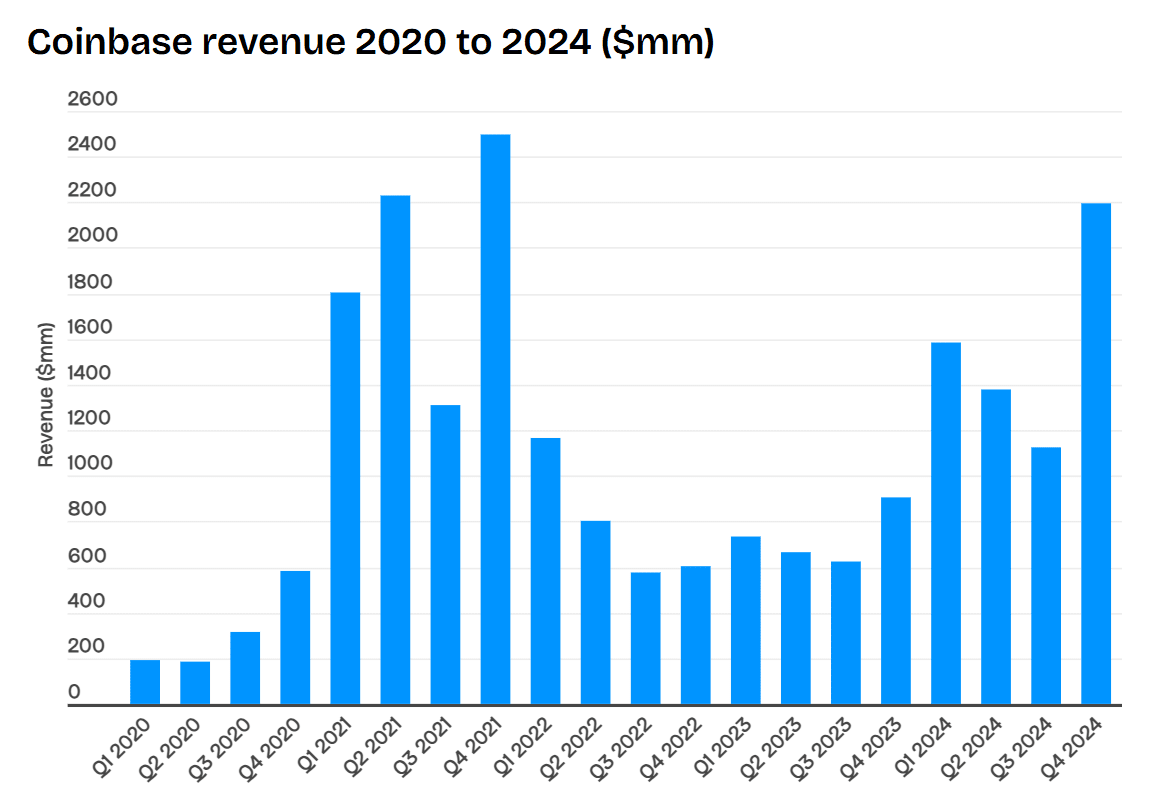
More importantly, Coinbase hardly has to worry about enforcement actions or banking freeze risks from mainstream jurisdictions worldwide, making it a natural 'safe harbor' for institutions and high-net-worth users.
On-chain DEX represents the 'global market players' with the greatest potential and the highest ceilings; they do not need to rely on national licenses and serve as a global liquidity hub operating 24/7, especially with native support for on-chain asset settlement and cross-asset portfolio strategies, offering strong programmability.
Although its current market size is still less than 10% of CEX, the growth elasticity is huge. Once the on-chain derivatives market matures, the market depth and strategic space of DEX will attract a large influx of high-frequency funds, arbitrageurs, and institutional liquidity.
For example, Hyperliquid saw a surge in capital in July, growing from just under $4 billion at the beginning of the month to $5.5 billion, and at one point approaching $6 billion in mid to late July.
Moreover, the gameplay of DEX is not only a carrier of DeFi innovation, but it may also become the cornerstone of decentralized pricing for global commodities and crypto assets, just like Fufuture's newly launched TSLA.M/BTC index trading pair based on 'coin-based perpetual options':
Allowing users to use TSLA.M as margin to participate in BTC/ETH perpetual options trading not only explores a new liquidity path for tokenized US stocks but can also be used to help build pricing pools for tokenized gold/oil products or other small market cap meme assets.
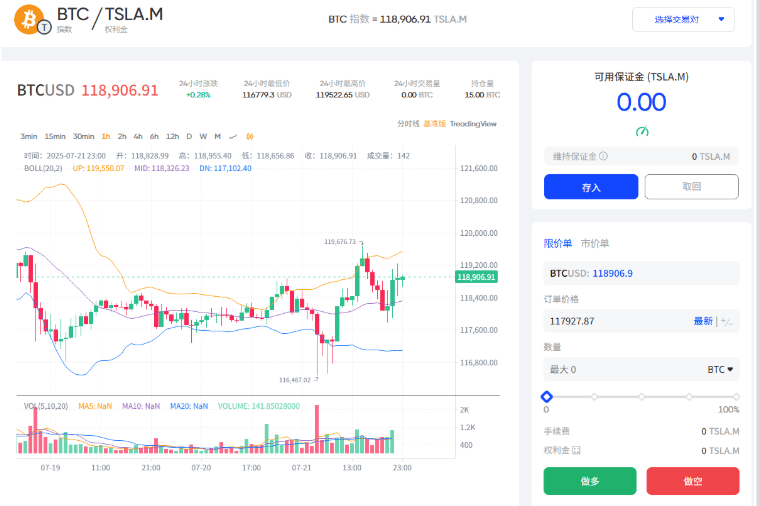
Overall, the strategic significance of Fufuture's DEX derivatives mechanism, which integrates options + perpetual contracts, lies in transforming long-tail assets (like SHIB, TSLA.M, etc.) that could only lie in wallets into usable margins, activating cross-asset liquidity, and forming a natural positive cycle of 'holding positions means participating in liquidity building,' making on-chain markets closer to the funding efficiency and depth of traditional derivatives markets.
In contrast, offshore CEXs have already peaked, and their survival space is being rapidly compressed. On one hand, they are sandwiched between compliance and on-chain, with no long-term survival space; on the other hand, global regulatory tightening, CRS tax information exchange, and banking KYC systems overlap, making gray traffic difficult to sustain.
It can be said that the offshore model's feast has come to an end; in the past, it served as a 'gray buffer zone' to accommodate regulatory arbitrage, but in the future, it may linger on the edge of policy, being eroded by compliance and on-chain markets: either included in the tax and compliance system, becoming a localized licensed institution; or completely on-chain, becoming a borderless global market.
The middle ground is destined to be cleared.
DEX New Proposition: Decentralized Pricing of Global Assets
From a longer-term perspective, the future competition of exchanges is not just a competition for traffic and transaction fees, but a struggle for routes after the rewriting of global market rules.
If the first phase of DEX was more of a testing ground for DeFi innovation, then with licensed localized exchanges in the United States, Hong Kong, etc., accommodating compliance needs and being incorporated into the tax system while fully aligning with the banking system, the mission of DEX may be completely reshaped:
It may bear the 'price discovery and pricing power' of the global permissionless market.
Why does the pricing power of global assets belong to on-chain DEX?
Unlike stocks and bonds, which have obvious regional attributes (except for US stocks and bonds), commodities such as gold, crude oil, copper, and cryptocurrencies like BTC and ETH are inherently global trading targets;
At the same time, traditional commodity futures are centralized in places like Chicago, London, and Shanghai, facing timezone and trading hour limitations, while on-chain operates 24/7, providing time zone-free and permissionless liquidity;
Even better, stablecoins can serve as globally accepted settlement tools—when users use stablecoins as margin to open positions, all profits and losses are settled in stablecoins, which means price discovery will no longer be limited by geography or banking systems;
With these three characteristics, DEX is naturally expected to become the cornerstone of decentralized pricing for crypto assets and commodities.
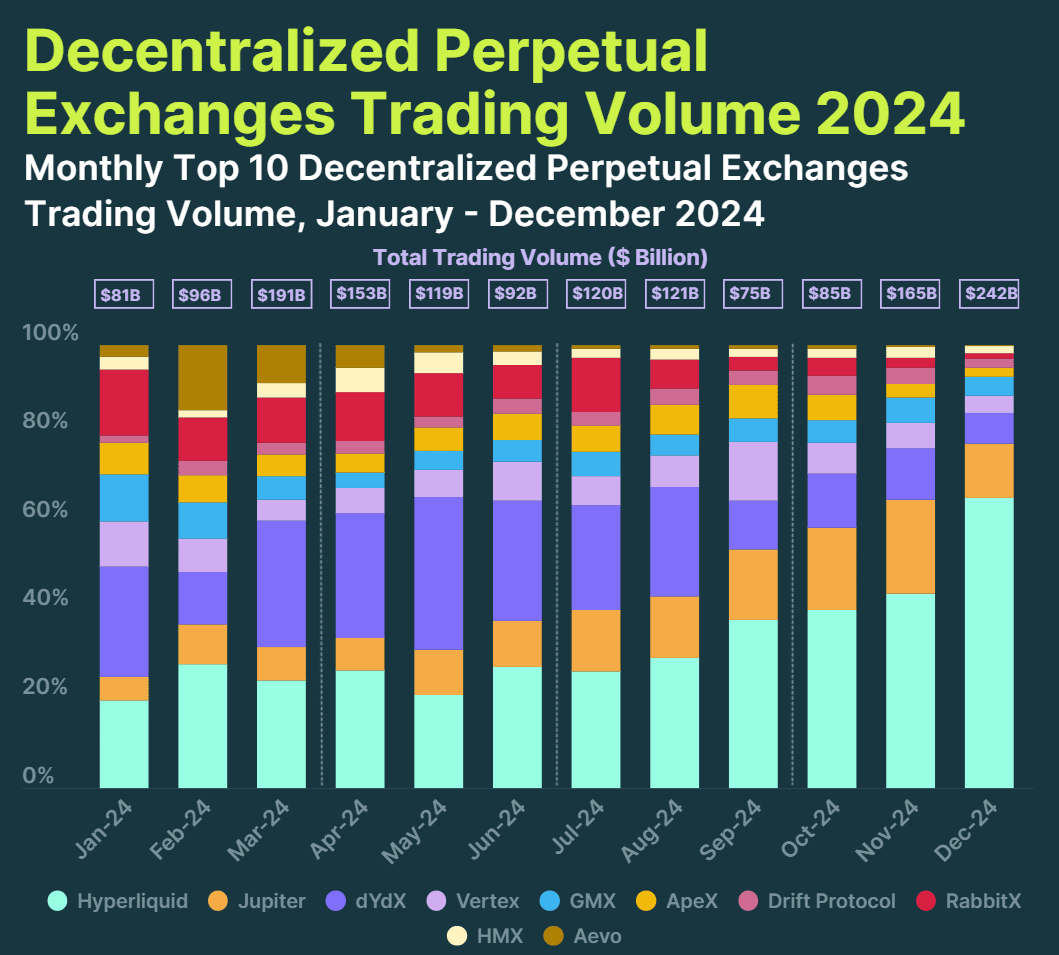
Of course, for DEX, the true support for price discovery has never been purely spot trading but rather the trading depth and price discovery mechanisms constructed by futures, options, and other derivatives systems.
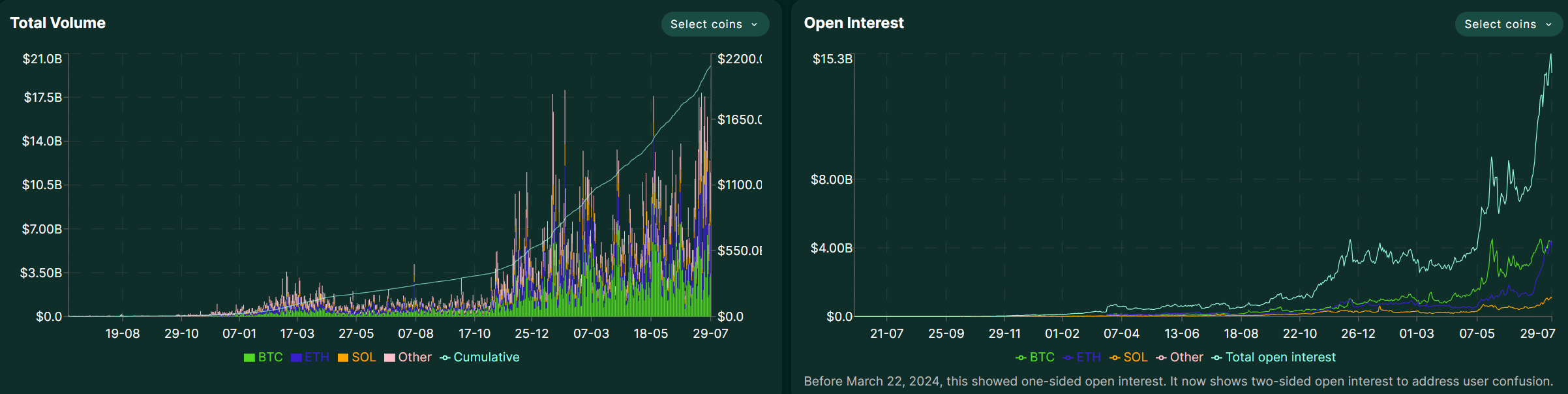
This is also why the derivatives DEX is experiencing explosive growth in 2024, with total trading volume for each Perp DEX reaching $1.5 trillion, more than doubling from $647.6 billion in 2023.
Among them, futures contracts are dominated by Hyperliquid, with annual trading volume soaring from $21 billion in 2023 to $570 billion in 2024, achieving a growth of 25.3 times. Recently, Hyperliquid has also entered the top five derivative platforms by daily trading volume, peaking at over $10 billion in daily trading volume, comparable to some mid-tier CEXs.
In the more complex cross-asset strategy layer and on-chain derivatives pricing logic, Fufuture also provides a concrete case; its 'coin-based perpetual options mechanism' has no fixed expiration date and dynamically charges premiums based on holding time, balancing the non-linear returns of options with the trading rhythm of perpetual contracts.
If one truly experiences Fufuture's perpetual options products, they can clearly feel their innovative aspects compared to traditional on-chain options products. For users holding SHIB, such meme assets can hardly be used as any form of trading collateral in traditional on-chain derivatives protocols, but on Fufuture, simply depositing SHIB into the platform allows participation in trading as margin.
In practical operations, as long as SHIB is deposited as 'usable margin,' the entire trading process is almost indistinguishable from contract trading—no need for stablecoins as margin, no need to weigh options on expiration dates, strike prices, profit and loss curves, just like daily contract trading, choose the underlying asset, direction (long/short), and the number of positions to start trading.
At the same time, it theoretically allows any on-chain asset, including the latest tokenization of US stocks, to be activated as usable margin—users can participate in BTC and ETH perpetual options strategies using TSLA.M and NVDA.M as margin, forming a true cross-market speculation and hedging network, which traditional CEXs find difficult to provide such freedom of combinations.
From an industry perspective, on-chain derivative DEXs like Hyperliquid and Fufuture are significant not only for avoiding compliance restrictions but also for providing a 24/7, borderless trading and settlement network for global commodities.
Especially for Fufuture, a new trading mechanism that does not require prior stablecoin exchange but allows direct direction selection to open positions, it maximizes the release of liquidity and strategic space for on-chain assets, not only approaching CEX in trading experience but also objectively achievable only by on-chain derivatives DEX, with the potential to become the on-chain 'pricing power entry' for global assets.
Written at last
The future exchange is not just a battle for immediate interests, but a differentiation between the rewrites of global market rules.
One will become localized compliant, one will become offshore gray, and one will become the next cornerstone of decentralized pricing for global commodities and crypto assets.
There is no middle ground.
The future fork in the road has been determined; it is only a matter of time.