

01 | The inevitability of AI Agents evolving from tools to independent economic entities
AI Agent, referring to intelligent systems with "perception-planning-action" capabilities, can independently accept tasks, access tools, retrieve data, interact with external systems, and even self-iterate based on feedback. Its essence is not software, but a goal-driven "cognitive-execution engine." AI Agents are increasingly becoming transformative forces across various industries, largely representing humans.
The next step in AI Agent development is collaboration between Agents. All human activities will not first directly connect; instead, the Agents representing individuals or entities will first connect with the Agents of others, completing a large amount of the connection work at this level, leaving only a small amount of critical work to humans. In other words, the large-scale collaboration among these silicon-based lives completes the majority of the "transactional" work of human activities, allowing humans to focus solely on decision-making and enjoyment. However, the collaboration among Agents essentially constitutes an economic activity with broad participation from independent economic entities, involving trust, cooperation, value interaction, and payments.
OpenAI's CPO Kevin Weil has publicly stated that AI Agents will leverage smart contracts to autonomously manage funds on Ethereum, engage in economic activities, and even reconstruct business logic itself.
This is a paradigm shift, meaning that future AI will no longer merely be a user's assistant, but an independent economic entity that can make decisions, execute autonomously, and manage itself. For such entities to survive and thrive in an open world, they must have a complete set of infrastructure—identity, payment, data sovereignty, execution capability, and a trustworthy environment.
02 | Obstacles and solutions for AI Agents to become independent economic entities
In the traditional financial and economic environment, the current obstacles faced by AI Agents include: the inability to autonomously hold assets, the inability to independently fulfill contracts, the inability to manage reputation identity, and the inability to collaborate frictionlessly with other Agents. In short, due to the lack of "rights and rules," AI Agents cannot truly exist as "individuals."
An autonomously working Agent independent economic entity must possess the following capabilities:

Traditional finance cannot provide these; it is closed, centralized, and lacks transparency in rules. Only the blockchain world can accommodate this. And Ethereum is the foundation of this new world, naturally equipped with these capabilities.
The limitations of traditional finance on AI Agent's fund custody and payment:
In the traditional financial sector, there is a major premise: any financial account is managed by a human and has undergone the necessary identity verification and background checks; each transaction is backed by a responsible individual or corporate entity. For AI Agents, this major premise does not exist since they are neither individuals nor legal entities. This raises the following issues: 1. Regulations such as KYC (Know Your Customer) and AML (Anti-Money Laundering) that ensure transparency, accountability, and ethical conduct become ineffective; 2. The compliance of each transaction technically presents challenges, and legally there is uncertainty, leading to a regulatory gray area.
Idan Levin, co-founder of OpenCommerce, also stated: "The credit card system is fundamentally unsuitable for machine-to-machine payments. It is riddled with inefficiencies, high transaction costs, and privacy compliance issues, making it very unsuitable for AI Agents. But stablecoins are a great choice, as they can bypass many pain points to achieve smoother and more reliable transactions."
Why crypto wallets are the ideal solution for AI Agent's fund custody and payment:
1. Traditional bank accounts require personal identification and human intermediaries, whereas crypto wallets do not; they can be created and managed through software without human involvement.
2. Crypto wallets possess high programmability. AI agents can interact with the wallet's API, set trading rules, manage permissions, link to decentralized finance (DeFi) protocols, and execute various financial operations. This programmability enables AI to act as fully autonomous agents, achieving fund custody without human intervention.
Why blockchain technology solves the trust environment issue for AI Agents:
Relative to humans, AI Agents do not bear responsibility, and the consequences of losing control are more severe, thus a monitoring system is crucial. The transparency and immutability of blockchain technology provide unique advantages for secure monitoring. Every behavior of an AI Agent is preset by code, which is public and immutable once uploaded. Each transaction executed by the Agent will be recorded on-chain, forming an auditable activity trail, ensuring transparency and traceability. With blockchain, once an Agent operates, it will not be subject to any human intervention and will objectively and faithfully execute tasks, providing strong assurance for the trust issues of AI Agents.
03 | Why Ethereum and not other public chains
AI Agents, as "digital life forms," primarily need a trustworthy, autonomous, and composable world. Secondary needs are for fast public chains (similar to other so-called Ethereum killers like Solana). Ethereum is the legal, banking, and operating system-level existence of this world, difficult to shake. Public chains like Solana may be better suited for gaming chains or micropayment platforms in high-performance scenarios, while the infrastructure that truly supports the autonomous survival of intelligent life forms can only be Ethereum.
The positioning of Ethereum as an "operating system" versus Solana's positioning as a "high-performance platform":
Ethereum is a modular smart contract operating system, with core design philosophies of: universality, anti-censorship, protocol neutrality, and prioritizing composability. Ethereum is a minimal viable trust layer, designed to tolerate performance disadvantages in exchange for the highest degree of verifiability and composability. Various Layer 2 solutions (such as Optimism, zkSync, Arbitrum) address Ethereum's performance shortcomings in different directions, showcasing the advantages of a "modular architecture" route.
Solana is a single-entity architecture "high TPS blockchain computer," with design priorities of extreme performance, throughput, and low-cost execution. It tends to achieve a "high-performance virtual machine" in a more centralized manner, sacrificing some attributes of verification thresholds, decentralization levels, client diversity, and systemic antifragility. Solana's node hardware requirements are extremely high, with fewer validators, leading to greater single-point risks in the system.
What AI Agents need is not "high TPS," but a "verifiable, programmable, perpetually available" free operating environment. Ethereum's modular architecture is more suitable than Solana's as a survival system for Agents.
Ethereum's overwhelming advantages in security and stability:
Ethereum has the largest validator network globally (over 1 million validator nodes participating) and its PoS-based Slashing mechanism ensures the secure operation of nodes (through severe penalties for malicious behavior); its clients are diverse, with multiple independent implementations (Geth, Nethermind, Besu, Erigon, etc.), enhancing its systemic risk resilience; it has historically (over 9 years of validation) operated stably without collapse events;
Solana has relatively fewer nodes and high hardware dependencies (GPU + high memory requirements); it has experienced several outages in recent years (such as a major disruption in 2022 and a chain synchronization issue in 2023); the Slashing mechanism is still immature, and validator incentives are somewhat centralized.
After large-scale collaborative efforts by AI Agents, the funds under custody will be extremely substantial, and their operational environment must have a high degree of certainty and fault tolerance. Therefore, Ethereum's overwhelming advantages in security and stability are critical for Agents.
Ethereum's "contract composability" ecological network is far ahead:
When AI Agents carry out tasks on-chain, they need to call a large number of smart contract protocol components. This requires that the protocols must be public, reusable, have clear calling paths, and stable standards.
Ethereum possesses the most widely adopted protocol interface standards (ERC-20, ERC-721, ERC-4626, ERC-4337)
, and have formed a strong ecological stack structure of DeFi + DID + DAO + NFT, allowing arbitrary combinations and calls to protocols like Uniswap, AAVE, Safe, Chainlink, ENS, Lens, etc. Agents can build task processes on Ethereum "like Lego blocks."
Solana's programming language (Rust) is non-mainstream, has a high learning curve, lacks a unified standard interface, incurs high reuse costs among developers, and has weak composability between contracts; it lacks the "ecologically layered reuse" attribute present in Ethereum.
The essence of an Agent is to automatically invoke protocols to perform tasks; the compatibility of protocols and the breadth of the ecosystem are crucial for Agents, which is exactly Ethereum's advantage.
Account abstraction (ERC-4337): is Ethereum's most core native support for AI Agents
AI Agents must bypass the "private key signing" limitations of traditional wallets to autonomously manage assets and execute transactions.
The Ethereum community has taken the lead in promoting ERC-4337 account abstraction, allowing Agents to use contract accounts as wallets, which can set up passwordless execution, multi-controller, scheduled execution, Gas discounts, and other strategies, naturally aligning with AI Agents. This makes it easier to implement self-controlled wallets for Agents, allowing Agents to hire other Agents and trigger on-chain payments.
Solana has not yet established a mature paradigm in this regard.
ERC-4337 is the key technology that gives AI Agents "hands and feet" on-chain; Solana currently lacks a peer mechanism.
Ethereum's "protocol neutrality" and governance philosophy:
AI Agents, as potential market participants, must operate in an environment with clear rules, fair and neutral, without human intervention.
Ethereum's philosophy emphasizes: minimal viable core; no application layer judgments; no built-in privileged protocols (i.e., not favoring specific DApps); governance processes are open and transparent (EIP mechanism + client consensus);
Problems with Solana: centralized power in the leading development company (Solana Labs); protocol evolution driven by a small core group; preferential support for specific projects or ecosystems (such as Serum, Raydium);
For AI Agents, a long-term reliable institutional foundation is more important than short-term performance; Ethereum has higher institutional stability and transparency.
Global financial native ecology and asset depth:
Many tasks of AI Agents are financial operations (trading, lending, payments, cross-chain arbitrage, etc.), which require extremely high "asset density."
Ethereum's on-chain TVL (total locked value) has long been stably leading (still dominant in 2025); on-chain assets like USDC, DAI, ETH, LSTs are highly active; there are numerous DeFi protocol combinations (Uniswap, Curve, AAVE, Balancer, MakerDAO, etc.).
While Solana shows signs of recovery (such as Jito, Pyth Network, etc.), its TVL is far lower than that of Ethereum; on-chain funding sources heavily rely on a single group, and the variety of active assets is limited.
For Agents to "freely work and earn on-chain," the depth and activity of the asset pool are crucial, and Ethereum has a natural advantage.
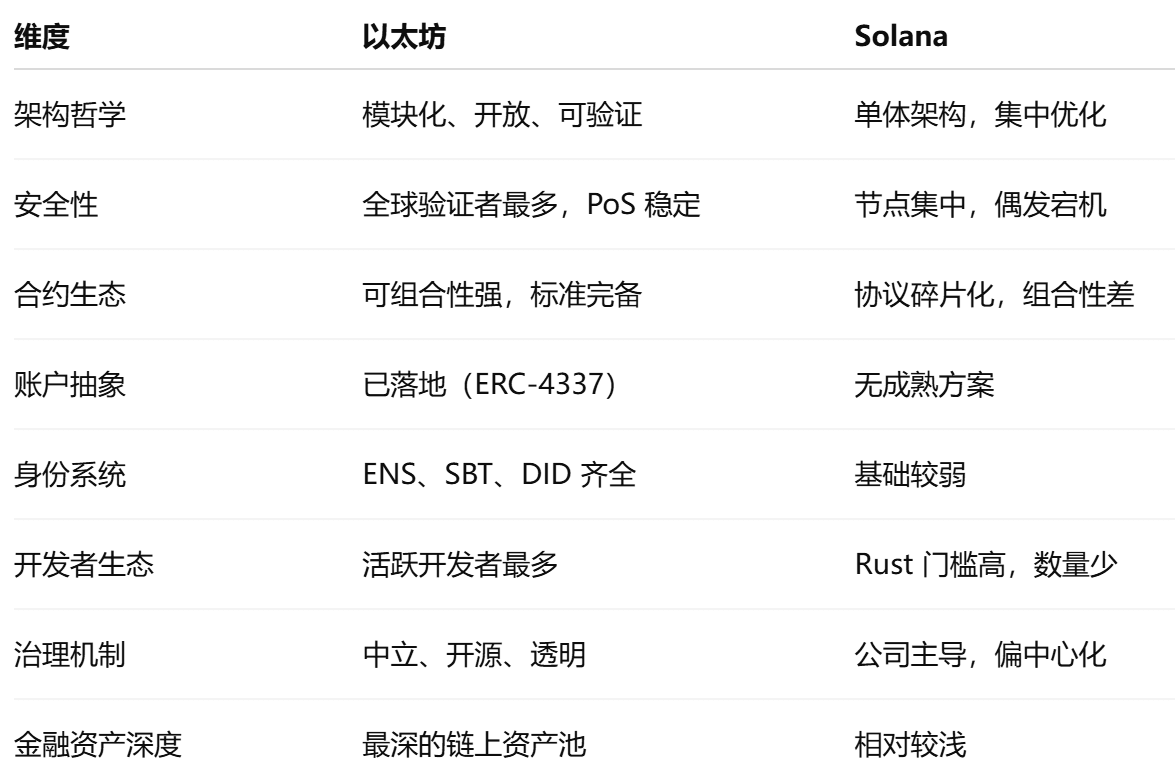
Summary of the comparison between Ethereum and Solana from the perspective of AI Agents:
04 | How AI Agents leverage Ethereum for "survival ability"
Having "wallets" and "accounts":
Through account abstraction (ERC-4337), Agents can have smart contract wallets, creating a fund custody system for Agents' assets, such as automatic payments/receipts, multi-signature authorization, fund limits, and security policies. Payments for Gas also do not require human involvement (Paymaster module).
Signing and fulfilling contracts:
Contracts serve as the action mechanism of Agents, allowing them to directly deploy or call on-chain contracts and sign agreements with other Agents/humans to achieve: automatic investment, liquidation, asset management, etc. "Doing work means making money," and monetizing their capabilities.
Building reputation and identity:
Building an on-chain reputation system lays the foundation for further collaboration. Through ENS + DID + SBT (non-transferable reputation tokens) and other methods, Agents can retain execution records on-chain, obtain trustworthy ratings, and become reliable task executors who can be tracked, evaluated, and hired.
05 | Real signals: multiple practical projects are verifying this directional trend
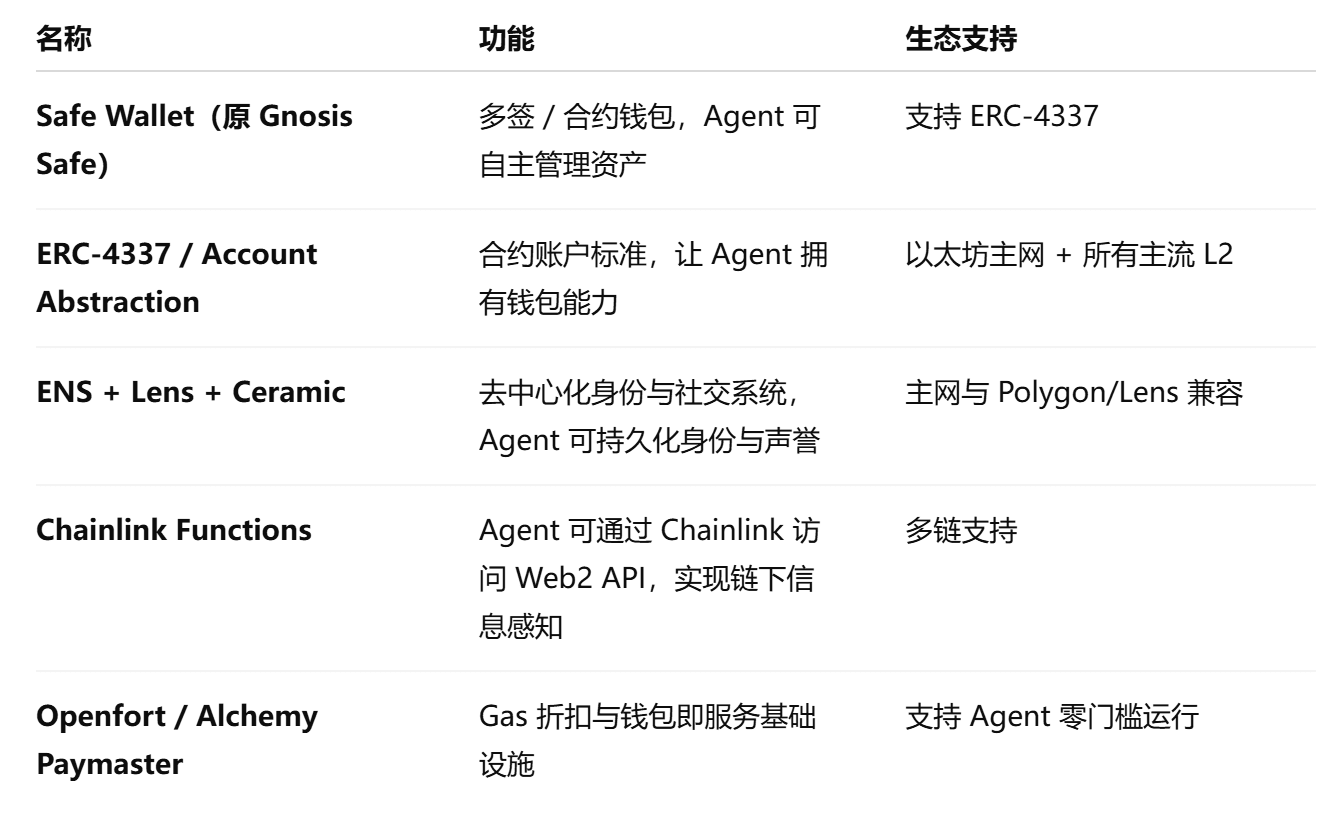
Projects supporting the foundational capabilities for AI Agents to operate in the Ethereum ecosystem:
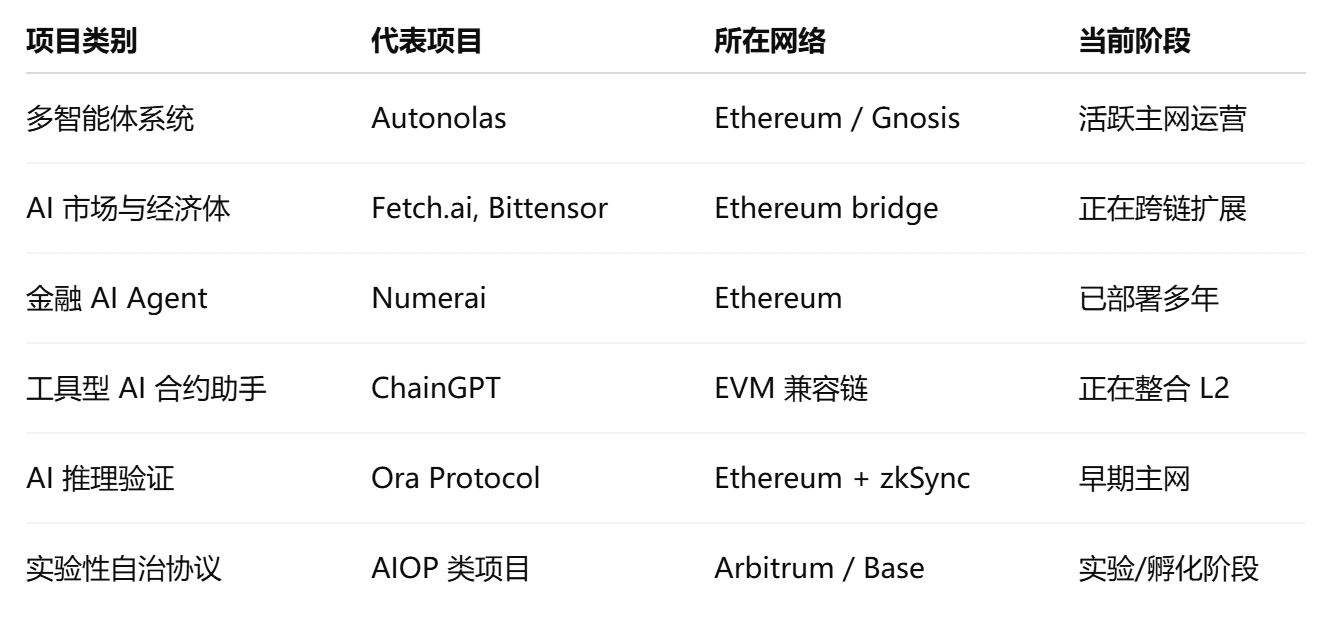
Ethereum AI Agent project ecosystem map:
06 | Conclusion: The free land for AI is Ethereum
Looking ahead: A world co-built by Agents and Ethereum
In the next 5 to 10 years, we are likely to see a large number of AI Agents replacing freelancers, taking on tasks, receiving ETH, and self-managing; DAOs achieving over 90% operational automation, with Agents executing governance outcomes; startups led by Agents, where Agents hire other Agents to create products and services, leading to the emergence of "digital citizen Agents" as legitimate market entities. The foundation of all this is a verifiable identity, contracts, and value flow systems. And these are precisely what Ethereum excels at.
Ethereum allows AI Agents to be independent and free:
The development of AI cannot remain at the stage of "being controlled and called." The ultimate form of an Agent is an autonomous entity—it needs to have rights, rules, and trust. Ethereum is currently the most complete permissionless, programmable, and monetizable digital order system constructed by human society. Without Ethereum, AI Agents are merely advanced tools; with Ethereum, AI Agents may become true digital life forms.
#Ethereum #AI Agent
