
Many people enter spot trading in the same pattern: they open a trade, the currency drops a bit, they sell quickly at a loss while stressed. And when they open a profitable trade, they leave it open without a plan, causing the currency to return to the entry point or even lower, and they sell at a loss.
This method slowly destroys capital over time, causing losses to accumulate one trade after another, and in the end, the trader discovers that their balance is dwindling without having learned anything from the market.
Today, I will teach you two essential steps:
Division
Using an order that prevents emotions and secures your trade (OCO)
These two steps are sufficient to build a mathematical mindset in trading, helping you over time to design your own strategy away from randomness.
1- The idea of division
Let's assume you have a capital of $180, and you have a recommendation on the SOL currency as follows:
Entry: 180
Target: 190
Stop Loss: 160
What does the beginner do?
They enter with the full $180 at the entry price, and if the currency drops to 178$, they sell at a loss. They repeat the same mistake with a second and third currency until they lose all their capital without understanding the market.
But the trader with a calculative mindset thinks differently:
They say: the market is volatile and will not move in a straight line. Sometimes it goes up and sometimes down.
So, they only enter $90 at 180, leaving the second half ($90) as a reinforcement in case the currency drops by 5%, meaning at 171$.
Buying $90 at 180 = 0.5 SOL
Reinforcement $90 at 171 = 0.526 SOL
Total = 1.026 SOL
Calculates the average:
180 + 171 / 2 → the average is about 175$.
What did they benefit? The average entry is lower, thus their chance of profit is greater. Instead of needing the currency to rise to 180 to recover their capital, it is enough for it to reach $175 to exit without loss.
2- OCO Order (One Cancels the Other)
After adjusting the average price, the second and most important step comes: securing the trade.
Of course, this is if the currency rises above $175, focus... the topic is very easy.
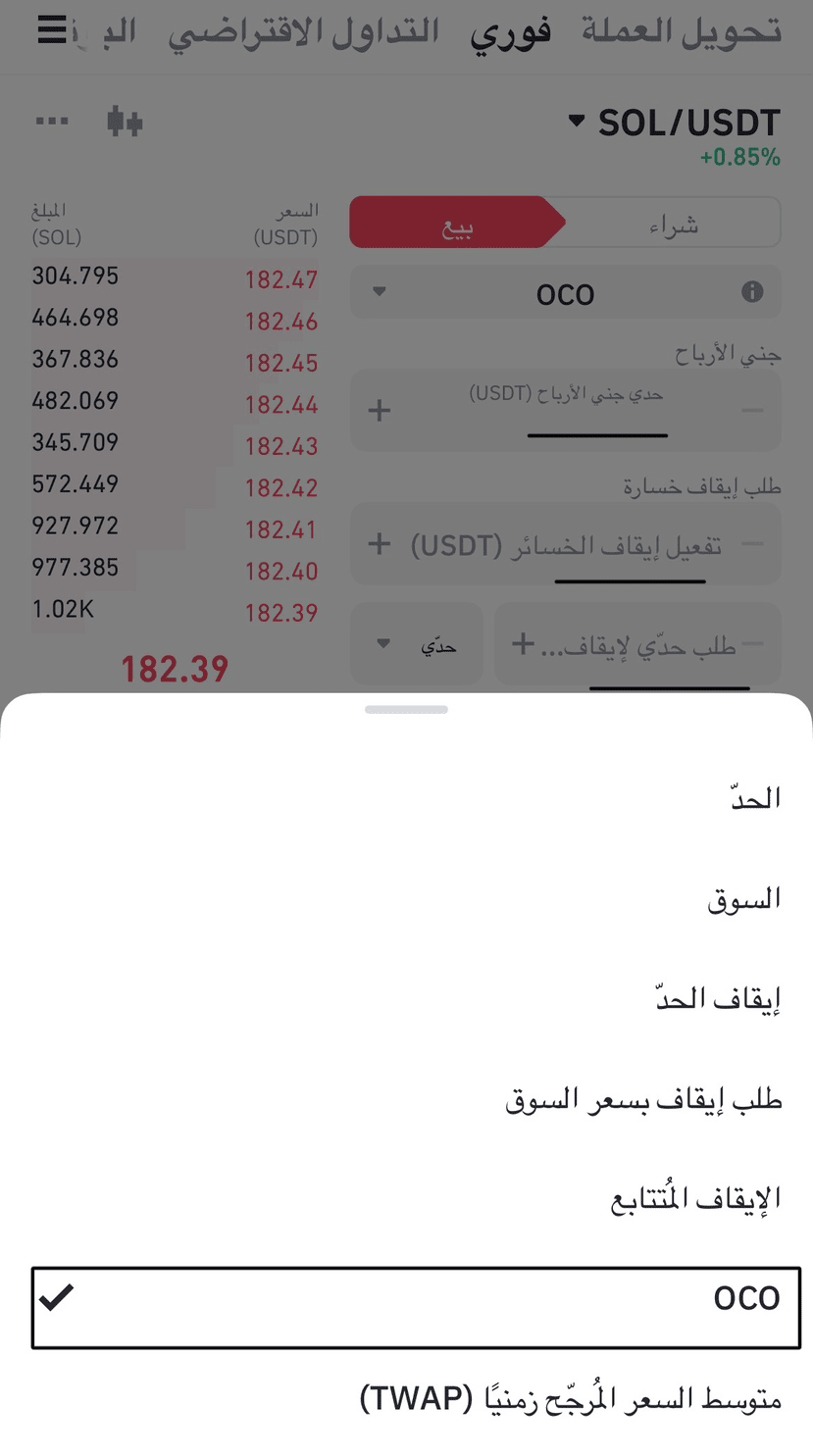
This happens through an OCO order (the name may vary from device to device, mine is called OCO and you can find it listed as number 6).
How does it work?
They set a sell order at the target of $190 (take profit).
And they activate the stop loss order at $175 (to exit without loss if the currency returns).
When placing a stop limit order, you write 174.9, the condition is activated for the full amount and the order is executed automatically, thus securing the trade.
Result:
If the price rises and reaches $190 → their profit is $15 (about 8.5%).
If the price drops to $175 → they exit without loss.
Summary
The idea is simple:
Do not enter all capital at once.
Divide your entry to reinforce wisely.
Use automated orders like OCO to protect yourself from emotions.
In this way, you can preserve your capital and learn step by step how to think with a mathematical mindset that distances you from randomness and brings you closer to building a strong strategy of your own.