

After much anticipation, last night Boundless @boundless_xyz released specific Tokenomics. The third horse of the ZK series is about to gather, and today I will provide a detailed analysis and share my judgment.
For research and analysis on Boundless, you can check my tweet below.
https://x.com/0xcryptoHowe/status/1936752023246184790
Table of Contents
1. Token Utility
2. Tokenomics Distribution Interpretation
3. Project Subsequent Trend View
𝞝 Token Utility
Unlike the conventional utility of past utility tokens (staking/service fees/governance, etc.), Boundless has incorporated some deflationary designs in this part.
➣ Ticket for Prover Participation: Provers wishing to participate in the Boundless proof process must first stake at least 10 times the proof fee in $ZK tokens. If they default, 50% will be directly burned, and 50% will be rewarded to other normally functioning provers.
This part is crucial; first, it reduces the potential selling pressure on tokens through lowered fee thresholds, and second, it further reduces token circulation through internal deflationary mechanisms, collectively achieving strong control.
➣ Staking Rewards: Staking tokens as a prover to participate in proof activities to earn rewards or through participating in protocol governance. Stakers can receive 25% of the rewards for each Boundless proof.
➣ Node Mining Rewards: Rewards for provers participating in Boundless network activities can receive 75% of the rewards for each Boundless proof.
𝞝 Tokenomics Distribution Interpretation
The specific token distribution rules are as follows
➣ Ecosystem Growth: A total of 49% is allocated, of which 31% is used to establish an ecosystem fund, with 25% directly released after a 1-year lock-up, and the remaining 75% released linearly over two years; additionally, 18% is designated as a strategic growth fund, unlocking linearly within 1 year.
➣ Core Team and Early Contributors: A total of 23.5% is allocated, of which 3.5% goes to Boundless's parent company RISC Zero. This part of the tokens will be locked for 1 year, with 25% released directly after that, and the remaining 75% released linearly over two years.
➣ Investors: A total of 21.5% is allocated, with 25% released directly after a 1-year lock-up and the remaining 75% released linearly over two years.
➣ Community Round Pre-sale and Airdrop: A total of 6% is allocated, with airdrops fully released on TGE day, and 50% of the community round released on TGE day, with the remaining 50% locked for 6 months.
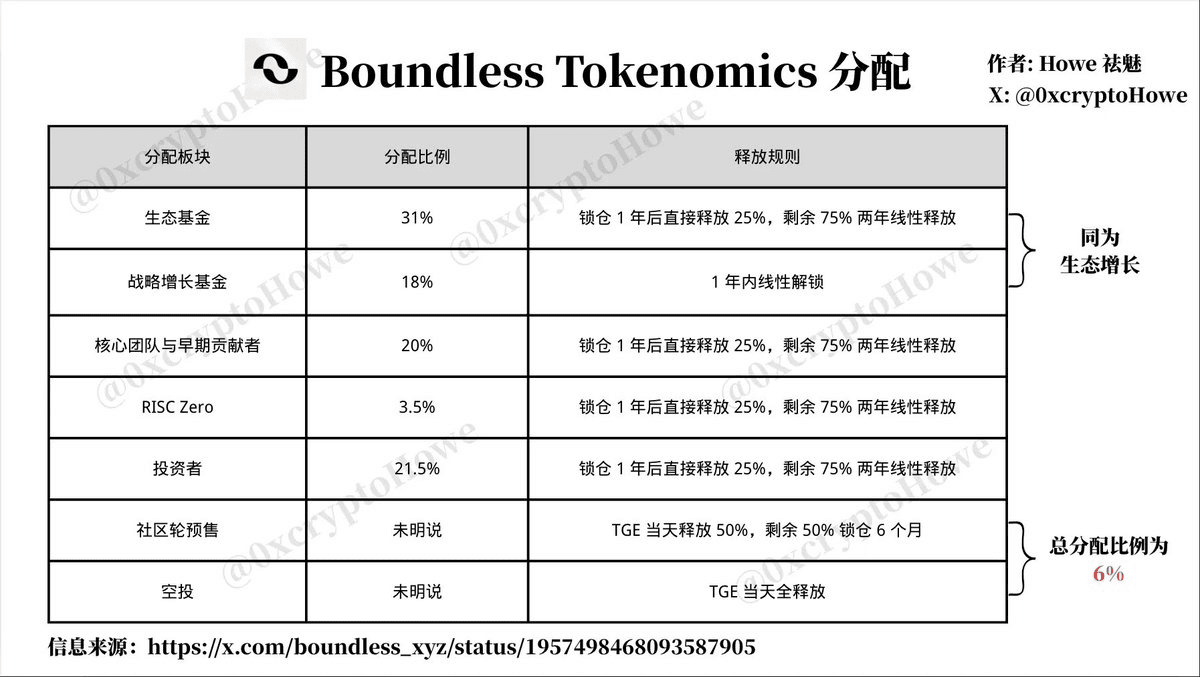
The design of Tokenomics is relatively detailed. As the official community round pre-sale ratio has not been announced yet, we will tentatively calculate it based on a ratio range of 1%-5%, with a circulation range of 5%-7% on TGE day.
However, looking at the token release chart released by the official side (if we focus on the details), the community round pre-sale ratio is likely to be 1%, corresponding to a circulation volume of 7% on TGE day.
However, I personally feel that the data ratio in this chart is not quite right; a 7% circulation volume corresponds to 7k tokens, but the data in the chart is already close to 250 million.
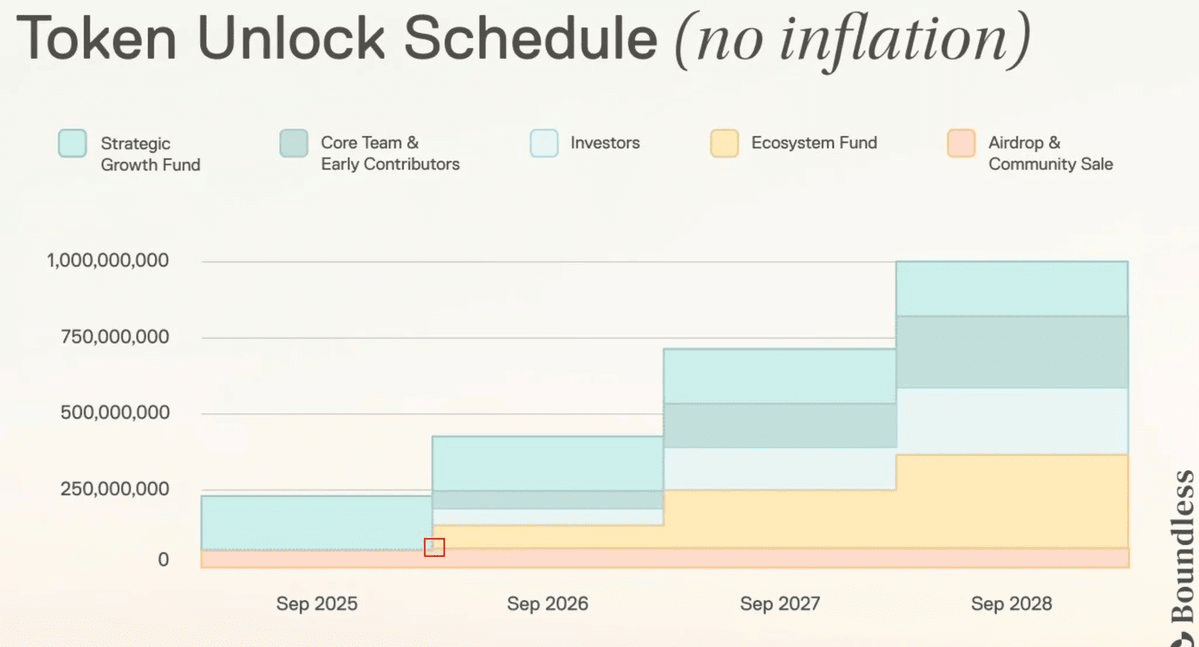
It is important to note that $ZK has inflation and is not a fixed total supply. The current setting is to gradually decrease from a 7% inflation rate to a stable 3% over the first 8 years. For example, a 7% inflation rate in the first year means an additional issuance of 70 million $ZK on the initial base of 1 billion tokens, which is one of the reasons why Boundless designed a deflationary model.
𝞝 Project Subsequent Trend View
Currently, Boundless's overall data and market popularity are doing quite well, not much different from the situation before Succinct TGE.
Given the current situation, it should not be difficult for the subsequent token valuation to remain above 1B, similar to $PROVE.
$PROVE's grand slam, apart from the ZK infrastructural narrative, is most importantly that it is a project fully operated by Paradigm. Although Boundless also has a solid financing lineup, it may lack a cohesive driving force, which I feel will mainly affect the overall process's advancement speed, with little impact on the upper limit.
As for the community pre-sale round, a reasonable pricing should be around 500-600 million USD; any higher would require considering unlocking terms and time costs (to break even at launch, it must double).