
After the Spring Festival, the biggest source of hot spots in the Web3 industry is not the strong rise of L2 new star Arbitrum, nor the open and secret struggles between the two new ace public chains Aptos and Sui. Instead, it is BTC from the living fossil of Web3. Since the launch of the Ordinals protocol on December 14 last year, as of March 6, more than 300,000 NFTs have been minted, and the first 10K set Bitcoin Punks minted for free using Ordinals was sold out in less than a day. This was almost unimaginable in the past, as BTC has always been synonymous with slowness and high costs.
Apart from the price trend of Bitcoin, people don’t pay much attention to it. So much so that Bitcoin has been jokingly described as “a classic car made of pure gold, whose greatest value is to be exhibited in a museum.”
But now, BTC has undoubtedly ushered in a second spring. According to Dune, Bitcoin NFT reached its peak in February this year: https://dune.com/dgtl_assets/bitcoin-ordinals-analysis
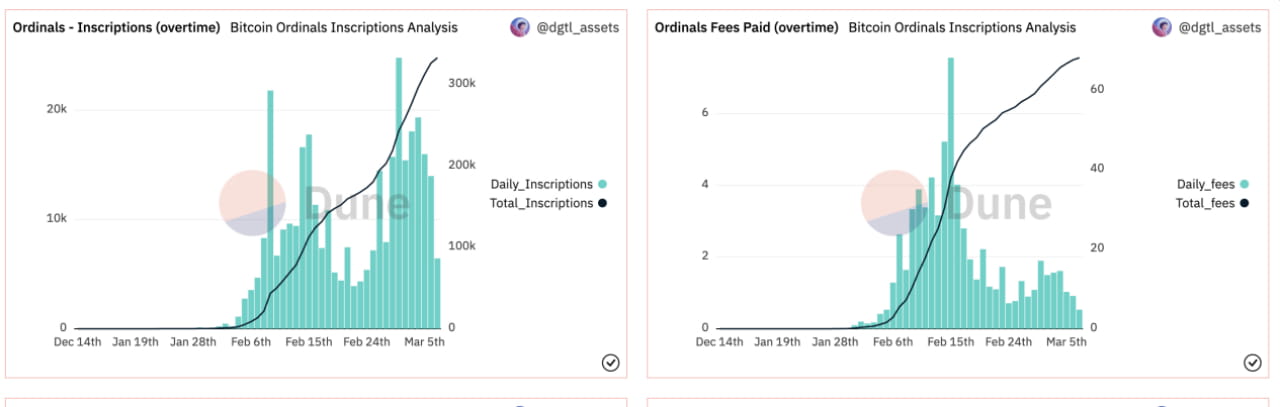
Maybe many people are still confused about the concepts of "Bitcoin ecosystem prosperity" and "Bitcoin NFT". Next, we will explain them one by one:
What is BTC NFT
To describe it in one sentence: BTC NFT is an NFT product released based on the BTC ecosystem. It sounds like it is no different from ETH NFT Polygon NFT.
But in fact, the issuance of NFTs on the BTC chain is defined based on Sats (Satoshi), the smallest unit of measurement on the BTC network. First of all, we need to understand what Sats is: the name of the eighth decimal place of Bitcoin, with a ratio of 100 million to BTC, named Sats in memory of Satoshi's great creation. So how do Sats issue NFTs on the BTC network? Here we have to mention a protocol: Ordinals. Official website address: https://ordinals.com/
Ordinals is an NFT protocol based on the BTC network that aims to assign a unique identity to each satoshis (sat). Using the Ord software, the protocol adds data to these sats and allows software users to track them based on an ordinal numbers system. In other words, the Ordinal protocol presents the smallest unit of Bitcoin, sats, in the form of NFTs and gives sats a well-reasoned trading value and collection value. When the smallest unit becomes a new hype target, to some extent, it can be regarded as an expansion of Bitcoin.
Since the birth of the Ordinals protocol, users can engrave information on the Bitcoin chain, including text/pictures/audio/video, thereby creating NFTs on the Bitcoin chain.
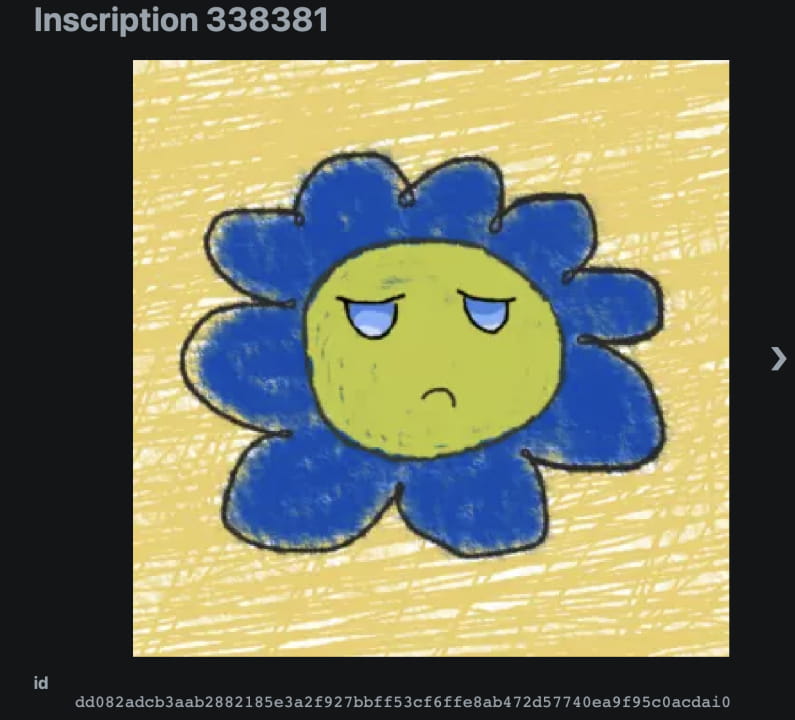
It is like engraving your name and picture on a dime, so that this dime becomes a non-fungible token. For example, the number dd082adcb3aab2882185e3a2f927bbff53cf6ffe8ab472d57740ea9f95c0acdai0 has the following features: the time when this Sats was mined, percentile, name, the block where it was mined, and scarcity, etc. At the same time, this Satoshi is also engraved with a visual jepg. Based on these features, you can easily find it. This Sats is also called Inscription 338381, which means it is the 338381st inscription.
How is it different compared to smart contracts?
Through the above, we understand the origin of BTC NFT, so how is it different from the conventional ETH NFT on the market? First of all, we need to clarify the definition of smart contract NFT.
Smart Contract NFT Definition:
Smart Contract NFT: How to achieve uniqueness and indivisibility: The Token ID composed of an integer is mapped to the URL containing the NFT metadata (name, description, image address), and the contract is used as the collection boundary. Therefore, a specific NFT can be retrieved layer by layer through the contract address → TokenID → metadata.
Collection: Use 721 or 1155 protocol contracts to issue and transfer NFT Collection.
Metadata: Usually stored in IFPS or centralized servers. There is a metadata attribute in the Collection smart contract. Set metadata to point to a URL storage address.
Transaction: Through the Marketplace transaction contract, the NFT transfer authority is authorized to the transaction contract
In other words, an NFT should have at least four elements: uniqueness, indivisibility, transferability, and describability. Let's see how BTC NFT is achieved?
BTC NFT:
Uniqueness: Ordinals Theory: Ordinals are numbered starting from 0 according to the order in which Satoshi are mined. The first Satoshi in the first block has an ordinal number of 0, the second Satoshi has an ordinal number of 1, and the last Satoshi has an ordinal number of 4999999999, so that each Satoshi has an ID attribute.
Indivisibility: As mentioned above, Sats is the smallest unit of BTC and cannot be divided any further.
Transferability: The satoshis in the transaction input are transferred to the output sats in a first-in, first-out order, thus achieving directional transfer. However, in the current transaction process, since there is no smart contract, a centralized platform is required to act as an arbitrator.
Describability: It is stored on the BTC chain, so there is a size limit. Because the inscription is on the chain, it cannot refer to the off-chain content, so it cannot be modified, unlike Ethereum NFT, which is indexed through IPFS or AWS off-chain. However, due to the lack of smart contracts and other issues, the inscription cannot support on-chain royalties.
How to get BTC NFT?
Hardware requirements
The computer has a solid-state drive of more than 1TB. Generally, everyone will use their own personal computer to install a full Bitcoin node. In addition to the space used by themselves, at least 600GB of space is required to store Bitcoin blocks.
In a normal network environment, synchronization takes a long time, about 10 hours. Domestic users may need to use a VPN, or it may take even longer.
process
You need to download Bitcoin Core and synchronize the full node, 500Gb+ space;
You need to download Ordinal and create an Ordinal wallet;
Use the ord protocol's instructions to depict Satoshi;
Transfer BTC to your wallet.
Set up a casting robot: to facilitate casting and receiving orders.
Minting NFT: You can simply upload pictures/audio/videos and let the robot help you mint them into NFTs. The larger the file size, the more gas it will cost to mint, and the more expensive it will be.
Minting Sats domain name: Buy a domain name on Bitcoin once and it will be free forever, without the need for annual renewal.
https://docs.sats.id/sats-names/about
Set the inscription. The inscription of Bitcoin can be a picture or a txt document. Below, we take the txt document as an example to mint a sats domain name.
Open the built-in software "Text Editor" and enter the content required by sats official
Format - Make it plain text, then save it as a txt file and copy the path where the file is saved.
In the ordinals command window, enter ./ord wallet inscribe ‘file path’ - - fee -rate < current fee rate >. You can view the current priority fee rate here. Please note that you must set the fee rate manually, because the default fee rate is 1. If you do not set it, you will be stuck and unable to confirm the transaction.
https://hub.cryptocell.guru/ordinalsturbo/
Wait for the block to be confirmed, and run ./ord wallet inscriptions to view the inscription information. Or you can go to the ordinals official website to see the latest information.
The above process is the BTC NFT minting method built with a full node. The premise of this is that users need to synchronize the BTC full node on their computers. Although it is troublesome, it can reduce the loss of transaction fees during the minting process and is also conducive to in-depth participation in the subsequent BTC NFT ecosystem.
If users think that building a full node is too troublesome, in fact, there are already many third-party nodes in the industry to replace minting. For example: ordinarysbot, Gamma, unisat_wallet, etc. The advantage of these third parties is that users can simplify the minting process, but it also means that they need to pay more handling fees and product service fees. The description of these products is explained below.
Interpretation of BTC NFT ecosystem:
Yuga Labs:https://yuga.com/
Yuga Labs, the strongest IP creator in the NFT field, has officially announced a plan to launch the NFT series TwelveFold on the Bitcoin blockchain based on the Ordinal protocol. TwelveFold is based on a 12 x 12 grid, a visual allegory of Bitcoin blockchain data mapping. In addition, unlike PFP series such as BAYC, the works that make up the TwelveFold series are produced in-house by Yuga Labs' art team using 3D modeling, algorithmic construction, and high-end rendering tools to pay tribute to the serialized inscriptions that are currently done by hand.
DeGodsNFT:https://degods.com/
Solana ecosystem NFT project DeGods has destroyed its 535 NFTs on the Solana chain and cast them as "inscriptions" in a separate block on the Bitcoin chain using the Ordinals protocol.
Crypto Punks:https://bitcoinpunks.com/
Crypto Punks is the first project to issue NFTs on the Bitcoin network, and BAYC is currently considering issuing NFTs on Bitcoin.
Gamma.io: https://gamma.io/
The Gamma platform aims to bring together collectors, creators, and investors in the Bitcoin ecosystem. The platform consists of three core products: NFT Marketplace, Launchpad, and Social Interaction. Users can mint NFTs using the tools provided by the Gamma robot, solving the pain points of creating NFTs on the Bitcoin network, which is technically difficult, complex, and time-consuming.
Ordinals Bot: https://ordinalsbot.com/
Ordinals Bot is also a tool for minting Bitcoin NFTs on the Ordinals protocol. This tool can save users the trouble of running Bitcoin nodes when minting Bitcoin NFTs. Players can upload the NFT file you need to mint, fill in the NFT address you need to receive (the address is recommended to start with bc1), and click "Submit & Pay Invoice" to pop up the payment address and payment QR code, and then pay. What is more friendly about this is that payment supports the Lightning Network and the Bitcoin mainnet. Because the Bitcoin network is slow, it may take 10 to 60 minutes after the payment is officially confirmed by the network.
Stacks:https://www.stacks.co/
Stacks is an open source project initiated by Bitcoin builders. It is a Bitcoin Layer 2 that can use smart contracts. Strictly speaking, anything that can be built on Ethereum and Solana can be built on Stacks L2s. Currently, the contracts on Stacks L2 have locked $250 million and have issued 2,200 Bitcoins to users as rewards. The next version of Stacks, which will be launched this year, will add a decentralized BTC anchor, which can easily transfer BTC in or out of Stacks L2.
getAlby:https://getalby.com/
Support Bitcoin Lightning Network payments
Xverse:https://www.xverse.app/
Support BTC NFT storage
At present, there are many projects based on the concept of BTC NFT. This article summarizes several representative benchmark projects. veDAO Research Institute will release a more detailed summary of the BTC NFT ecosystem in the future, so stay tuned.
Summarize
Although the BTC NFT ecosystem is very prosperous, the current financing situation of the Bitcoin sector is not optimistic. As of February 22, according to data from The Block, the Bitcoin ecosystem has only raised $500 million in the past year. Compared with the total financing of nearly $30 billion in the entire industry, Bitcoin is not in line with its status as the blockchain hegemon. In addition to the financing problem, the current BTC NFT also has many criticisms:
First of all, the threshold is very high:
High memory requirements;
The operation process is complicated;
Gas is expensive and consumes a lot of funds, making it difficult for small players to afford it.
Second, it is resisted by BTC fundamentalists:
As mentioned above, giving Sats value and meaning is, to some extent, an act of expanding the volume of BTC, which will make many BTC fundamentalists believe that it affects the scarcity of BTC.
In addition, giving Bitcoin the function of NFT is also seen by BTC fundamentalists as violating the spiritual core advocated by the Bitcoin white paper.
But no matter what, Ordinals' NFT innovation is, to a certain extent, a novel attempt at the future development path of the ancient Bitcoin. In addition, the BTB ecosystem itself has a huge amount of funds. As the Bitcoin ecosystem is gradually valued, the potential accumulated within Bitcoin will be further released.
references
@Jason_chen998
@CH_909