


The Solv Protocol was established in 2020 with the aim of lowering the barriers to creating and using on-chain financial tools, bringing diverse asset classes and yield opportunities to the crypto space. The project focuses on minting and trading NFTs related to financial ownership certificates. With the ongoing development of the BTCFi track in 2024, the Solv Protocol has shifted its focus to BTCFi, creating a full-chain yield Bitcoin asset called SolvBTC, providing new opportunities for Bitcoin holders while creating an efficient BTCFi ecosystem. Recently, the Solv Protocol launched the Staking Abstraction Layer (SAL), simplifying and standardizing the cross-chain Bitcoin staking process, abstracting the complexities of Bitcoin staking scenarios to allow users and developers to adopt it quickly.
Core Team Ryan Chow: Co-founder. Graduated from Beijing Foreign Studies University, previously served as co-founder of Beijing Youzan Technology, dedicated to applying blockchain technology to automotive industry databases. Additionally, he worked as a financial analyst at Singularity Financial, researching blockchain technology integration and financial regulation. Will Wang: Co-founder. Creator of "ERC-3525: Semi-Homogeneous Token Standard", he has worked in the financial IT field for 20 years, overseeing the design and development of the world's largest banking accounting systems based on open platforms and distributed technologies, and is a recipient of the "Zhongguancun 20th Anniversary Outstanding Contribution Award". Meng Yan: Co-founder. Former Vice President of CSDN, also an active KOL in the crypto industry.
Financing Situation The Solv Protocol has raised approximately $29 million through three rounds of financing.
Angel Round On November 10, 2020, it was announced that $6 million was raised in an angel round, led jointly by Laser Digital, UOB Venture, Mirana Ventures, ApolloCrypto, Hash CIB, GeekCartel, ByteTrade, Matrix Partners, BincVentures, and Emirates Consortium.
Seed Round On May 8, 2021, it was announced that $2 million was raised in a seed round, with investment from Binance Labs. On August 30, 2021, it was announced that $4 million was raised in the seed round, led jointly by Blockchain Capital, Sfermion, and Gumi Cryptos Capital, with participation from DeFi Alliance, Axia 8 Ventures, TheLao, CMSholdings, Apollo Capital, Shima Capital, SNZ Holding, Spartan Group, and others.
On August 1, 2023, it was announced that $6 million was raised in the seed round, with investments from major Japanese banks such as Nomura Securities, Laser Digital, UOB Venture Management, Mirana Ventures, Emirates Consortium, Matrix Partners China, Bing ventures, Apollo Capital, HashCIB, Geek Cartel, ByteTrade labs, and others. Strategic Round On October 14, 2024, it was announced that $11 million was raised in a strategic financing round, with participation from companies like Laser Digital, Blockchain Capital, and OKX Ventures. Throughout the three rounds of financing, Solv Protocol raised a total of $29 million, with substantial investments from well-known investment institutions such as Binance Labs, Blockchain Capital, Laser Digital, Matrix Partners China, and OKX Ventures, indicating strong confidence in the future development of Solv Protocol in the capital field.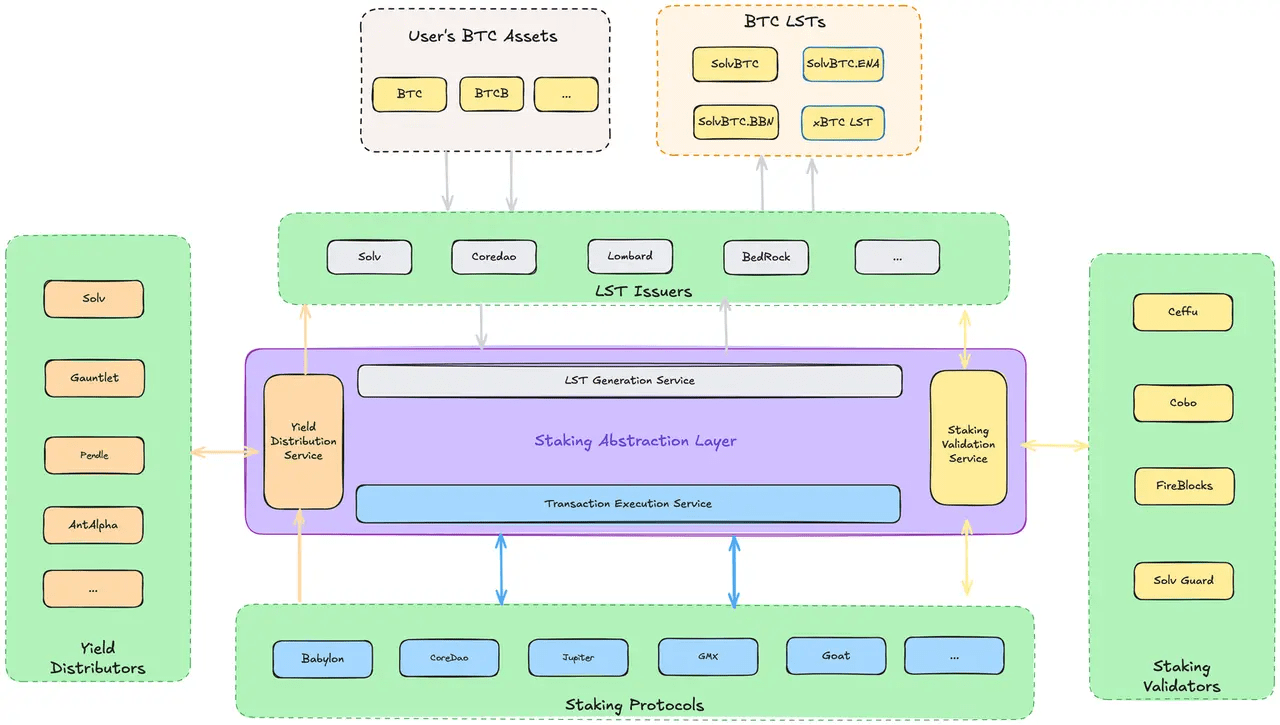
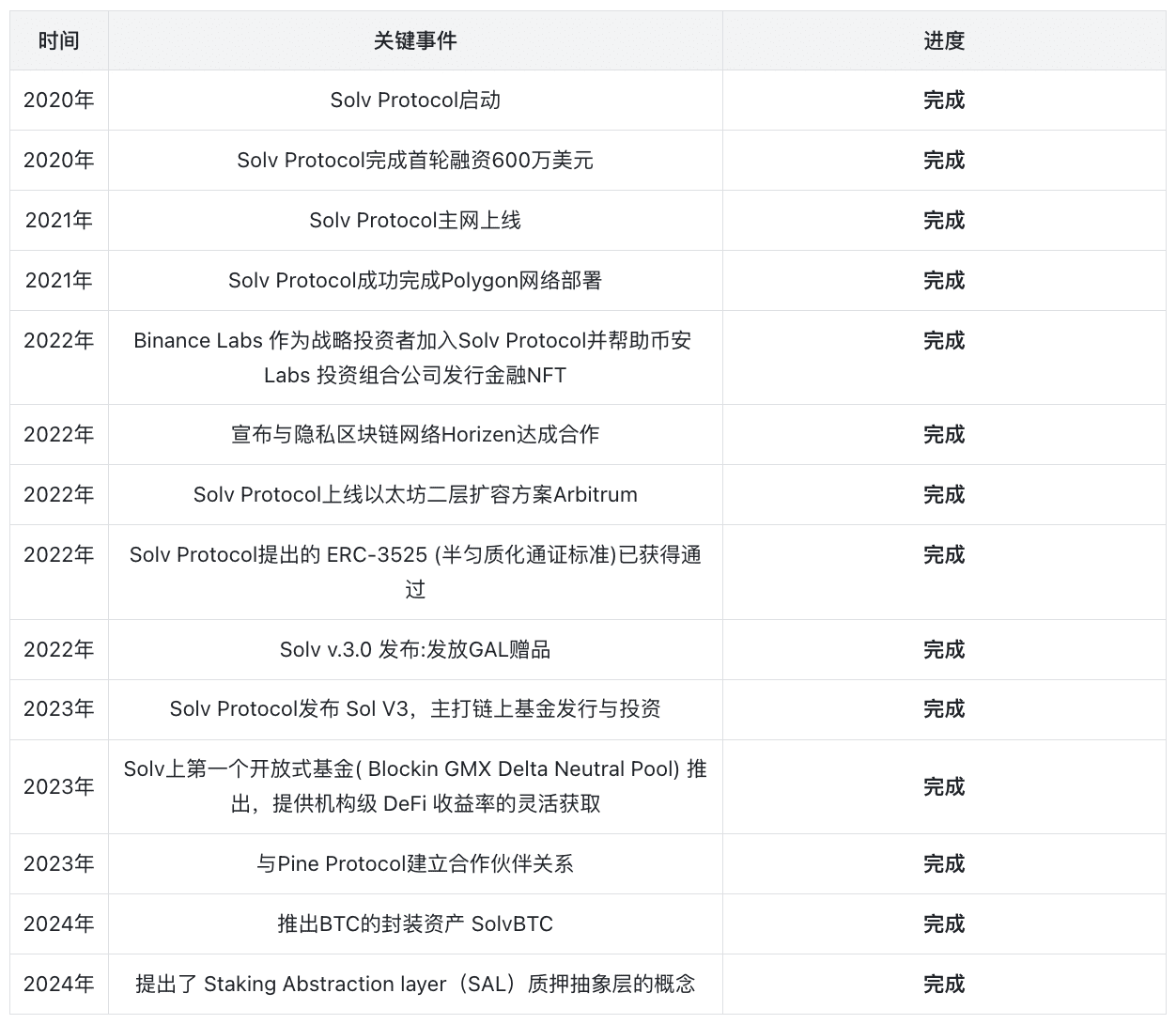
From the perspective of key events in the project development of Solv Protocol, it has consistently worked to lower the barriers to creating and using on-chain financial tools, enabling it to quickly issue the wrapped Bitcoin asset SolvBTC after the rise of the BTCFi track and rapidly capture the LST market based on BTC. In terms of achieving various key technical milestones, the Solv Protocol has completed project technical development on schedule, indicating the robustness of the Solv Protocol technical team's capabilities. Operating Model As the largest asset in the crypto industry, BTC has a market value of over $1.3 trillion, but for a long time, BTC holders have simply held BTC without unlocking its potential value like ETH. Therefore, the Solv Protocol advocates unlocking the $1.3 trillion BTC asset potential through BTC staking. In 2024, Solv Protocol shifted its focus to BTCFi, launching the full-chain yield BTC asset SolvBTC, capable of releasing the staking liquidity of BTC, and recently introduced the concept of the Staking Abstraction Layer (SAL), marking the beginning of Solv Protocol's aggregation of BTC liquidity.
In summary, SAL, as a Staking Abstraction Layer, is characterized by the integration of multiple staking participants (including Bitcoin staking providers, yield acquisition, and DeFi scenario unlocking), abstracting and encapsulating these complex processes into standardized modules. This allows developers to quickly integrate Bitcoin staking functionality into their applications and enables users to initiate staking in a comprehensive manner. SAL is simplifying the implementation of staking to promote the adoption of more dApps. DeFi applications or wallet applications only need to integrate SAL to provide a range of staking options for their user base. However, since Bitcoin itself does not support staking, all third-party staking may pose certain security risks, and SAL is no exception. As SAL integrates staking-related solutions, the technical complexity and compatibility behind the integration may also pose new security risks. Therefore, SAL needs to continuously address challenges related to operational robustness and security.
Security The Solv Protocol ensures the security of staking transactions by integrating Active Verification Services (AVS). The AVS system comprehensively monitors all aspects of staking transactions, including target addresses, script hashes, staking periods, etc., to ensure the validity and security of transactions, thereby avoiding errors or malicious actions. This comprehensive monitoring and verification mechanism provides reliable assurance for users' staking transactions. Process Optimization The Solv Protocol not only integrates BTC liquidity but also optimizes the project's staking process, allowing users to perform staking operations more conveniently. Users only need to deposit Bitcoin into the platform without doing other on-chain operations, which ensures user safety while improving staking efficiency and generating returns. Full-chain Yield Aggregation Platform The Solv Protocol is a full-chain yield aggregation platform that adopts a CeDeFi model, combining CeFi and DeFi, and providing transparent contract management services. By implementing refined permissions and conditional execution through Gnosis Safe's multi-signature contract address and Solv Vault Guardian, the security of assets and efficient operation of the system are ensured. Industry Standardization After launching SAL, the Solv Protocol aims not only to integrate BTC liquidity but also to promote the industry standardization of BTC-based LSTs. As a standardized staking process that regulates BTC staking processes and parameter systems, establishing industry standards can facilitate cooperation and communication among various parties in the industry, promote healthy industry development, and provide users with more stable and reliable staking services.
Unified Liquidity As a unified liquidity entry point in the BTCFi industry, Solv Protocol integrates various liquidity resources and investment opportunities into one through the launch of SAL.