



Leading global cryptocurrency exchanges are facing increasing legal risks in the Philippines after being accused of illegally targeting users and violating new stringent digital asset compliance rules.

The SEC of the Philippines warns that major cryptocurrency exchanges are operating illegally in this country
The Securities and Exchange Commission of the Philippines (SEC) issued an advisory on August 4, warning investors about unregistered foreign cryptocurrency platforms that continue to serve Philippine users. The regulatory agency warned that some digital asset service providers are operating in the Philippines without valid licenses. The SEC of the Philippines stated that these platforms are providing cryptocurrency trading services, violating newly implemented compliance requirements. The advisory emphasized:
These rules apply to any individual or organization providing, promoting, or facilitating access to trading venues for cryptocurrency assets or intermediary services such as buying, selling, and trading derivatives of cryptocurrency assets.
The advisory has identified 10 exchanges that are currently violating domestic securities regulations: OKX, Bybit, Mexc, Kucoin, Bitget, Phemex, Coinex, Bitmart, Poloniex, and Kraken. All are actively promoting services or still allowing users in the Philippines full access despite lacking any licenses issued by the SEC under Memorandum Circulars No. 4 and No. 5, effective from July 2025.
The regulatory agency also noted that other cryptocurrency exchanges may also be in violation, stating: "This list is not exhaustive. Other platforms providing similar services to the public in the Philippines without registration or SEC approval are also considered to be operating in violation of Philippine securities laws."
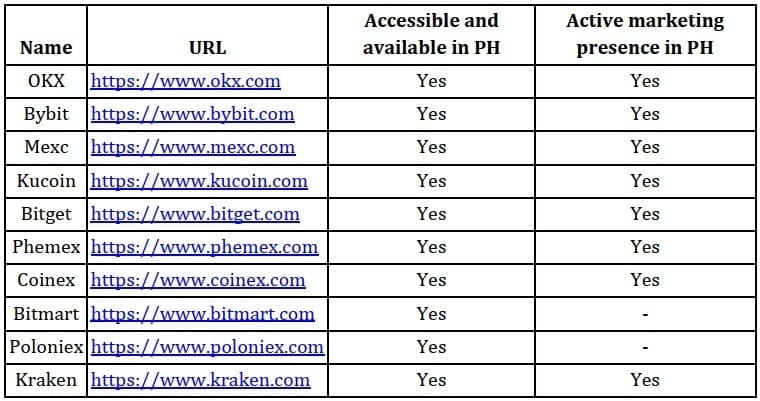
List of unlicensed cryptocurrency exchanges flagged by the SEC of the Philippines. Source: SEC Philippines
After the previous geo-blocking order against Binance, the SEC of the Philippines revealed that several other platforms remain accessible and are engaging in unlawful marketing activities targeting Philippine residents. This regulatory agency emphasized:
They continue to provide or market cryptocurrency asset services to the public in the Philippines without the required licenses or registrations.
In addition to concerns about investor protection, the Securities and Exchange Commission of the Philippines (SEC) also highlighted broader national risks posed by unregulated cryptocurrency activities. As these organizations operate outside the scope of the Anti-Money Laundering Act (AMLA), they are not subject to compliance control measures such as customer due diligence, record-keeping, or reporting suspicious transactions. The SEC warns that this lack of oversight could facilitate cross-border financial crime activities and increase the risk of being placed on the gray list. Enforcement measures may include cease and desist orders, criminal prosecutions, and coordination with tech companies to mitigate risks. In response, some cryptocurrency advocates have called for regulators to adopt a more collaborative compliance approach to encourage innovation and safer participation in the digital asset space.