


1.
What is a cryptocurrency trading bot?
Using artificial intelligence and programming code, cryptocurrency trading bots act as automated trading systems, executing trades with minimal errors and little to no human intervention.
Since cryptocurrency trading takes place around the clock, 7 days a week, crypto trading bots have become a practical tool for professional retail traders and institutional investors to track and profit from every move in the cryptocurrency market.
A cryptocurrency trading bot is a software program that automates trading tasks such as selecting, buying, and selling cryptocurrencies based on specific parameters set by the bot's programmer or creator.
Employing artificial intelligence (AI) principles such as safety, objectivity, and trust, cryptocurrency trading bots can be configured to execute different cryptocurrency trading strategies, such as buying undervalued cryptocurrency tokens, adding new cryptocurrencies that have entered the market, or even Trade a basket of cryptocurrencies at a specific price to benefit from price fluctuations.
Since cryptocurrency trading bots work according to predefined rules and conditions, they prevent investors from falling prey to emotions and provide a more efficient way to trade in the volatile cryptocurrency market.
Whether a crypto trading bot is configured to send trading signals or perform the last mile and execute trades, investors can greatly benefit from the logic-based approach and AI-driven automation on offer.
2.
How do cryptocurrency trading bots work?
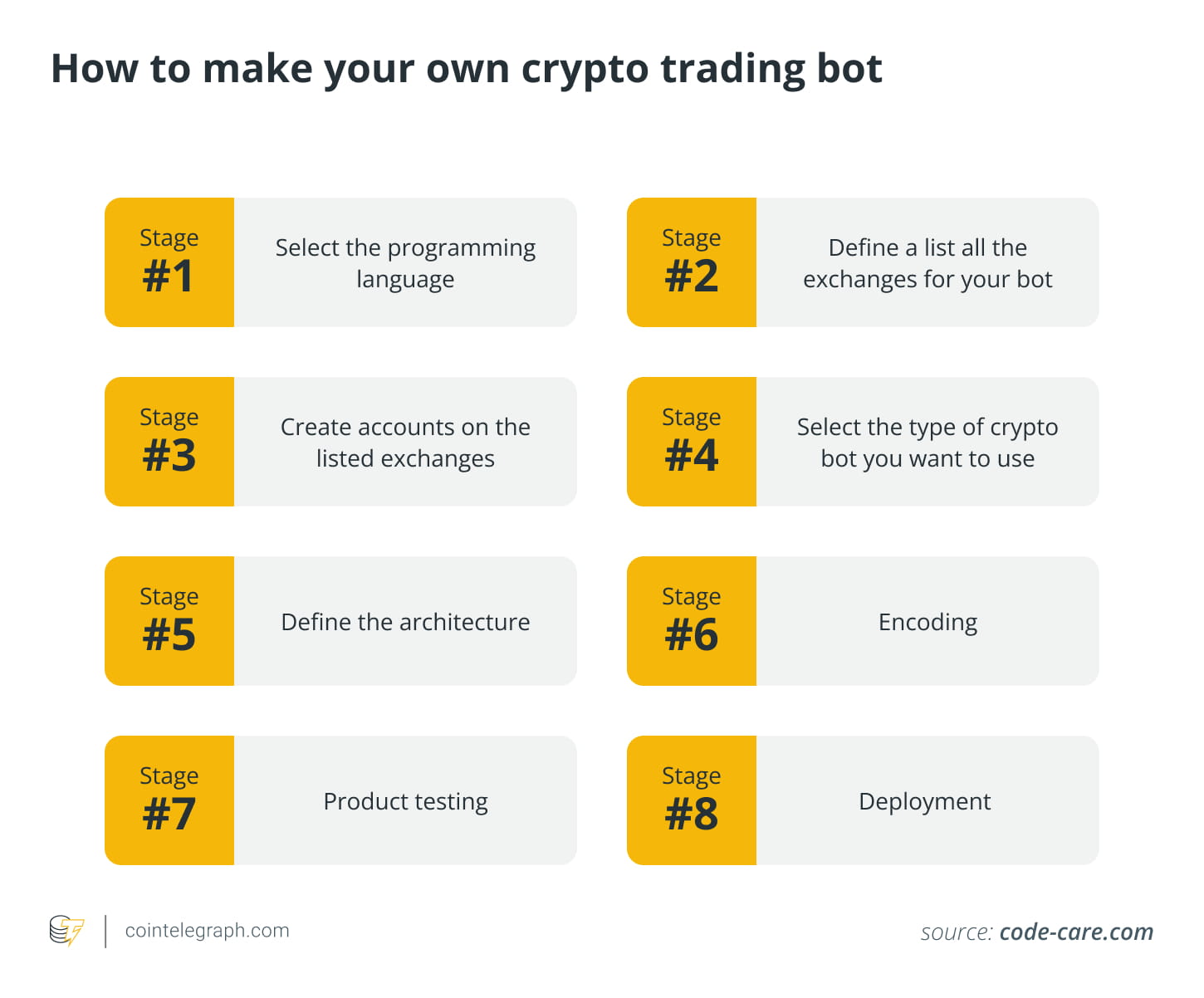
Cryptocurrency trading bots are developed using programming scripts such as Python, Java, C or C# and use APIs to interact with different cryptocurrency exchanges and perform trades on them.
Cryptocurrency trading bots need to collect data from exchanges, generate trading signals from it, calculate the risks involved, and then execute the trades. This applies to buy and sell transactions and is repeated in every instance where the crypto trading bot interacts with a crypto exchange.
Using an application programming interface (API) key to access a trader's account, the crypto trading bot first uses machine learning algorithms to analyze the data and identify potential trades that meet its preset criteria.
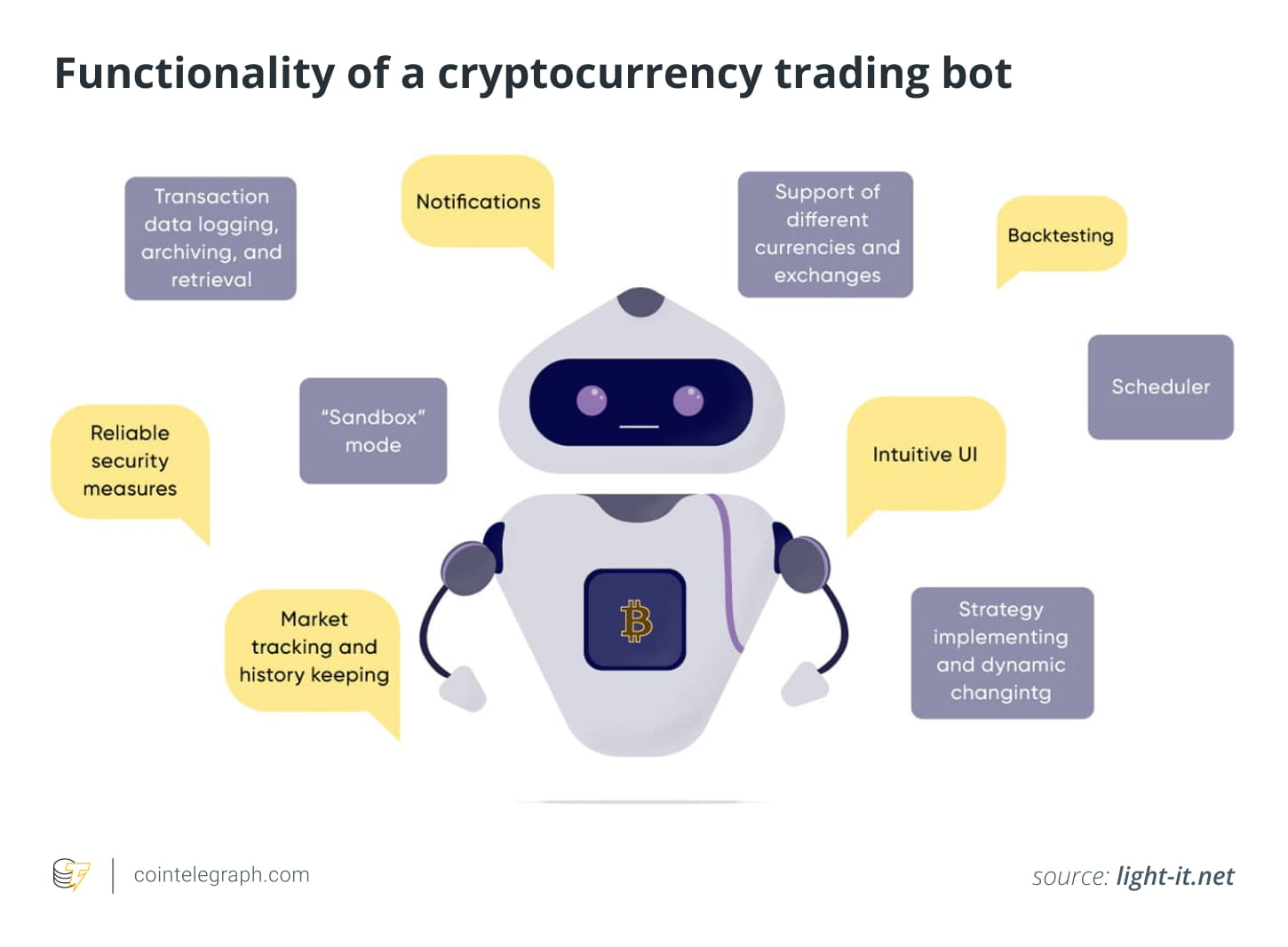
It then allocates funds proportionally based on trader-defined risk and executes trades by sending buy or sell orders to cryptocurrency exchanges using its API. The length of code used in a crypto trading bot depends on the number of trading strategies it can deploy. At the same time, the programming language used is based on the comfort level of the bot creator.
That said, most of the advanced cryptocurrency trading bots in use today rely on Python, mainly because it is well-suited for creating algorithmic trading software and has high-level libraries that developers can use.
3.
How successful are cryptocurrency trading bots?
Whether paid or free, a cryptocurrency trading bot should be chosen based on data on historical performance, the trustworthiness of the bot’s creator, and reviews from peers who have used it before.
It’s no secret that much of Wall Street’s trading activity is dominated by algorithmic trading, which has been accelerating over the past decade. Now, the same is reflected in the cryptocurrency market as trading activity by institutional investors continues to gain momentum and far exceed the volume contributed by retail investors.
Therefore, the use of trading robots is increasing. An increasing number of private investors are using one or more AI cryptocurrency trading bots to improve their chances of making consistent profits in the cryptocurrency market.
However, while there are many free and paid cryptocurrency trading bots available, it is important to understand how these bots perform the tasks promised by their advocates. For a cryptocurrency trading bot to deliver positive returns on a net basis, it must execute trades at lightning speed and have zero or negligible errors in its code.
Risk diversification strategies are used to determine profit consistency, as even a single unhedged trade can jeopardize days and weeks of trading profits. Therefore, it is crucial for traders to run multiple trading robots and select only those that have a proven track record of generating impressive returns.
4.
Are cryptocurrency trading bots legal and safe?
While crypto trading bots are legal and widely used by institutional investors, many fake or poorly coded bots are being sold to unassuming investors by anonymous bot creators.
Although there are many reservations about the legal status of cryptocurrency trading bots, the fact remains that these bots are used worldwide and are considered legal. The scope of automated trading in traditional financial markets has been expanding, and there is no reason to believe that the cryptocurrency market will perform differently.
However, legal does not equate to safe. This is especially true for traders who are used to trading large volumes and want to make substantial profits from marginal price changes in the underlying cryptocurrency.
While cryptocurrency trading bots will undoubtedly help execute large trades in milliseconds, if the trading strategy is not adequately backtested, the chances of incurring huge losses are very high. A key component in developing a successful trading system, backtesting involves using historical data and resulting statistics to recreate results to measure the success of a trading strategy.
Furthermore, the functioning of the cryptocurrency market is not solely based on technical analysis, requiring traders to be aware of fundamental changes or updates to the underlying protocol of a particular cryptocurrency. This is not possible with crypto trading bots as they rely on mathematical calculations based on pricing behavior to discover and execute trades. Therefore, traders must use crypto trading bots with fundamentally sound cryptocurrencies and perfect their trading strategies to generate stable profits.
5.
How much do cryptocurrency trading bots cost and are they worth it?
While most popular cryptocurrency trading bots are available for free, they do come with associated costs such as trading commissions and withdrawal fees that need to be evaluated before proceeding.
When choosing a crypto trading bot, investors need to weigh the pros and cons of a “free” crypto trading bot versus one that charges a fixed monthly or annual subscription fee. The most popular cryptocurrency trading bots like Naga, Pionex, eToroX, etc. do not charge users viewing fees, but trade commissions are as low as 0.05% for each trade executed through their platform.
This is especially important for those whose daily trading volume regularly exceeds tens of thousands of dollars. Fees for transactions longer than one month can far exceed the subscription fees charged by other competitors.
For example, cloud-based trading bots like CoinRule and CryptoHopper offer free trials, after which users can pay from as low as $19/month to as high as $450/month, depending on the plan and range of services chosen. These trading bots make more sense for investors who trade a lot and want to enjoy these services from anywhere in the world.
That said, investors or traders looking to buy or rent a cryptocurrency trading bot will need to verify that their cryptocurrency exchange supports the bot. CoinBase, for example, does not allow trading bots to interact with its platform, offering this utility through its CoinBase Pro platform.
However, with Coinbase announcing that the CoinBase Pro platform will cease to exist by the end of 2022, all advanced trading features, including the use of trading bots, will be available to all its users in early 2023. Exchanges like Binance, on the other hand, support a range of cryptocurrency trading bots and are better suited for those looking to indulge in high-speed trading powered by these bots.