


Author: Biteye Core Contributor @lviswang
Editor: Biteye Core Contributor Denise.
01. Market Overview: dTAO upgrade triggers ecosystem explosion.
On February 13, 2025, the Bittensor network welcomed the historic Dynamic TAO (dTAO) upgrade, which transformed the network from a centralized governance model to a market-driven decentralized resource allocation. After the upgrade, each subnet possesses independent alpha tokens, allowing TAO holders to freely choose investment targets, truly realizing a market-oriented value discovery mechanism.
Data shows that the dTAO upgrade has unleashed tremendous innovative vitality. In just a few months, Bittensor has grown from 32 to 118 active subnets, an increase of 269%. These subnets cover all subfields of the AI industry, from basic text reasoning and image generation to cutting-edge protein folding and quantitative trading, forming the most complete decentralized AI ecosystem to date.
Market performance is also impressive. The total market cap of the top subnets grew from $4 million before the upgrade to $690 million, with staking annual returns stabilizing between 16-19%. Each subnet allocates network incentives based on market-driven TAO staking rates, with the top 10 subnets accounting for 51.76% of network emissions, reflecting a survival of the fittest market mechanism.
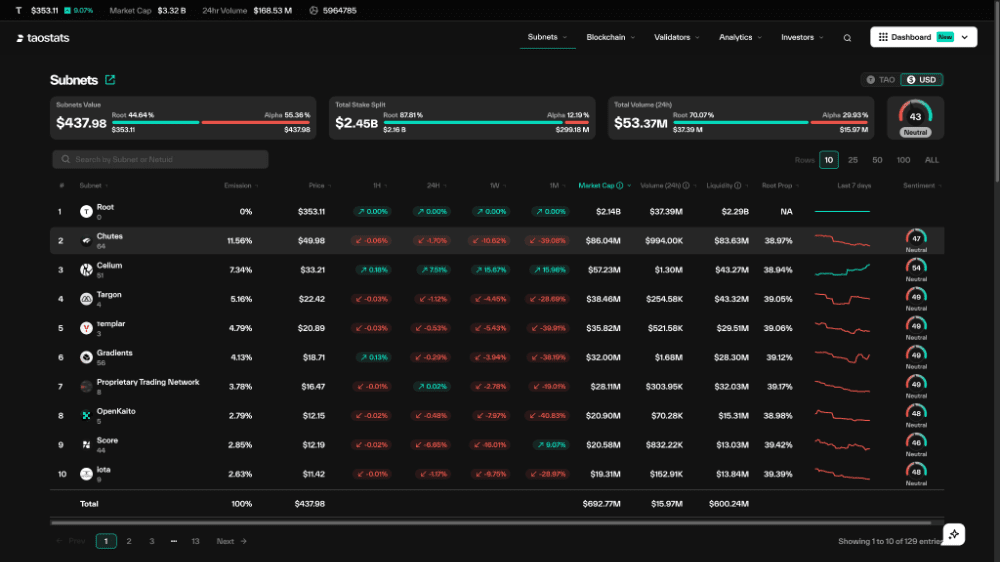
https://taostats.io/subnets
02. Core Network Analysis (Top 10 Emissions)
1. @chutes_ai, Chutes (SN64) - Serverless AI computing.
Core Value: Innovating AI model deployment experience and significantly reducing computing costs.
Chutes employs an 'instant startup' architecture, compressing AI model startup time to 200 milliseconds, achieving a tenfold efficiency improvement compared to traditional cloud services. With over 8,000 GPU nodes worldwide, it supports mainstream models from DeepSeek R1 to GPT-4, processing over 5 million requests daily, while keeping response latency under 50 milliseconds.
The business model is mature, employing a freemium strategy to attract users. Through integration with the OpenRouter platform, Chutes provides computing power support for popular models like DeepSeek V3, generating revenue from each API call. The cost advantage is significant, being 85% lower than AWS Lambda. Currently, total token usage exceeds 9042.37B, serving over 3,000 enterprise clients.
dTAO reached a market cap of $100 million nine weeks after launch, with a current market cap of 79M, a strong technological moat, smooth commercialization progress, and high market recognition, currently leading the subnet.
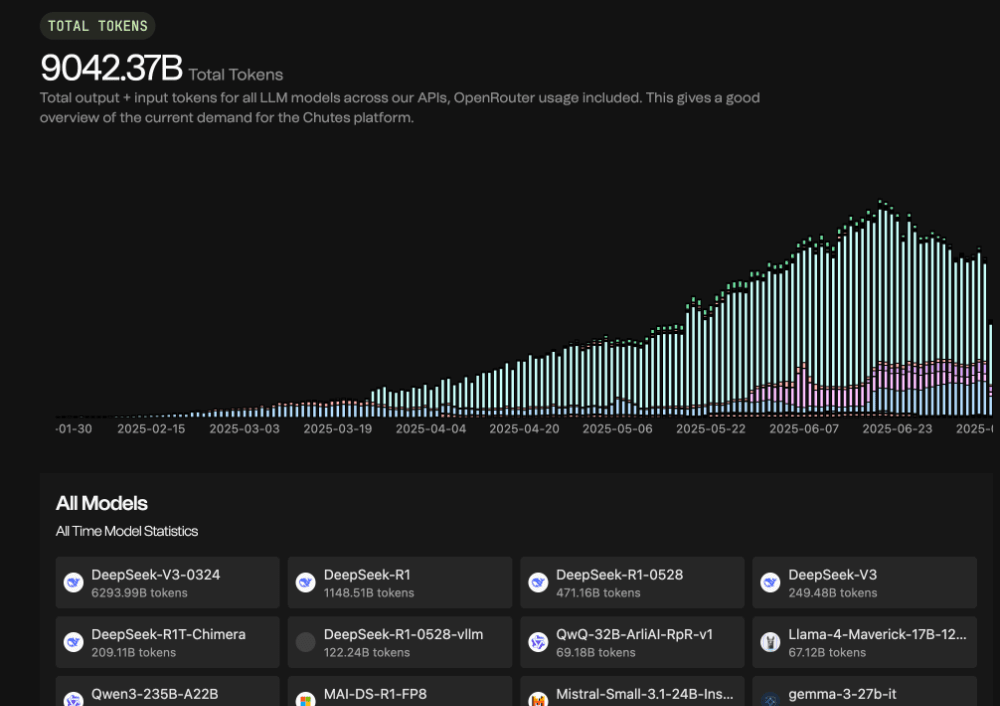
https://chutes.ai/app/research
2. @celiumcompute, Celium (SN51) - Hardware computing optimization.
Core Value: Underlying hardware optimization to enhance AI computing efficiency.
Developed by Datura AI, focusing on optimization at the hardware level. By maximizing hardware utilization efficiency through four technical modules: GPU scheduling, hardware abstraction, performance optimization, and energy efficiency management. It supports the full range of hardware including NVIDIA A100/H100, AMD MI200, Intel Xe, with prices reduced by 90% compared to similar products and computing efficiency improved by 45%.
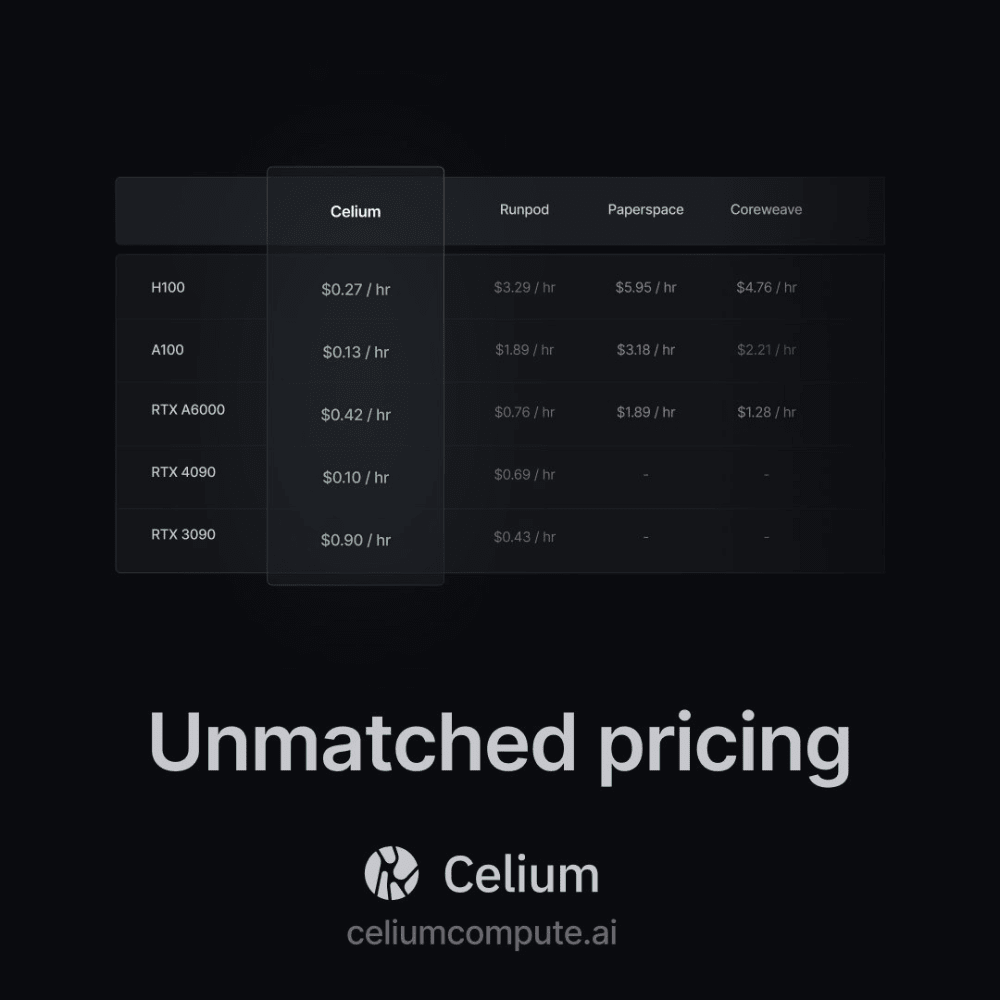
https://celiumcompute.ai/
Currently, Celium is the second largest emitting subnet on Bittensor, accounting for 7.28% of network emissions. Hardware optimization is a core element of AI infrastructure, with a strong trend of increasing technical barriers and current market cap of 56M.
3. @TargonCompute, Targon (SN4) - Decentralized AI inference platform.
Core Value: Confidential computing technology ensuring data privacy and security.
The core of Targon is the TVM (Targon Virtual Machine), a secure confidential computing platform that supports the training, inference, and validation of AI models. TVM employs confidential computing technologies such as Intel TDX and NVIDIA confidential computing to ensure the security and privacy protection of the entire AI workflow. The system supports end-to-end encryption from hardware to application layer, allowing users to utilize powerful AI services without disclosing data.
Targon's technical barriers are high, and its business model is clear with stable revenue sources. It has already initiated a revenue buyback mechanism, with all income used for token buybacks, the latest being $18,000.
4. @tplr_ai, τemplar (SN3) - AI research and distributed training.
Core Value: Large-scale collaborative training of AI models, lowering training barriers.
Templar is a pioneering subnet on the Bittensor network dedicated to large-scale distributed training of AI models, with the mission of becoming 'the best model training platform in the world.' It focuses on collaborative training of cutting-edge models and innovation, emphasizing anti-cheating and efficient collaboration through GPU resources contributed by global participants.
In terms of technical achievements, Templar has successfully completed the training of a 1.2B parameter model, undergoing over 20,000 training cycles, with about 200 GPUs participating in the entire process. In 2024, it will upgrade the commit-reveal mechanism to enhance decentralization and security in validation; in 2025, it will continue to advance large model training, with parameter scales reaching 70B+, performing comparably to industry standards in standard AI benchmark tests, receiving personal recommendations from Bittensor founder Const.
Templar has a prominent technological advantage, currently with a market cap of 35M, accounting for 4.79% of emissions.
5. @gradients_ai, Gradients (SN56) - Decentralized AI training.
Core Value: Democratizing AI training and significantly reducing cost barriers.
Also developed by Rayon Labs, it addresses the pain points of AI training costs through distributed training. The intelligent scheduling system is based on gradient synchronization, efficiently allocating tasks to thousands of GPUs. It has completed the training of 118 trillion parameter models at a cost of only $5 per hour, 70% cheaper than traditional cloud services, with training speeds 40% faster than centralized solutions. The one-click interface lowers the usage threshold, with over 500 projects already used for model fine-tuning across fields such as healthcare, finance, and education.
Currently, with a market cap of 30M, there is strong market demand and clear technological advantages, making it one of the subnets worth long-term attention.
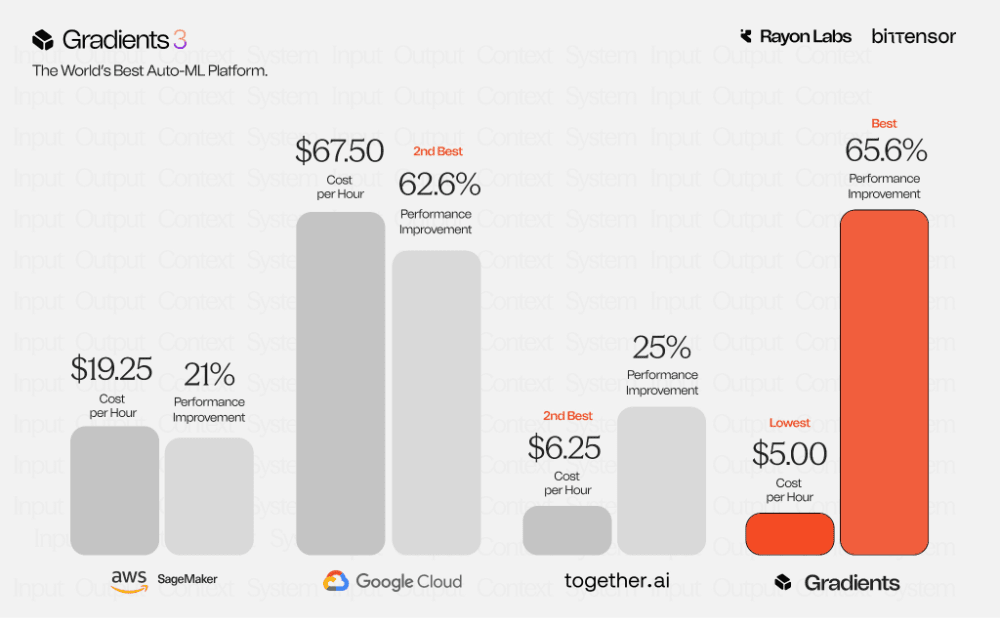
https://x.com/rayon_labs/status/1911932682004496800
6. @taoshiio, Proprietary Trading (SN8) - Financial quantitative trading.
Core Value: AI-driven multi-asset trading signals and financial forecasting.
SN8 is a decentralized quantitative trading and financial forecasting platform, driven by AI to generate multi-asset trading signals. The proprietary trading network applies machine learning techniques to financial market forecasting, building a multi-layered prediction model architecture. Its time series prediction model integrates LSTM and Transformer technologies, capable of processing complex time series data. The market sentiment analysis module provides sentiment indicators as auxiliary signals for predictions by analyzing social media and news content.
On the website, you can see the returns and backtesting of strategies provided by different miners. SN8 combines AI and blockchain to offer innovative trading methods in the financial market, with a current market cap of 27M.
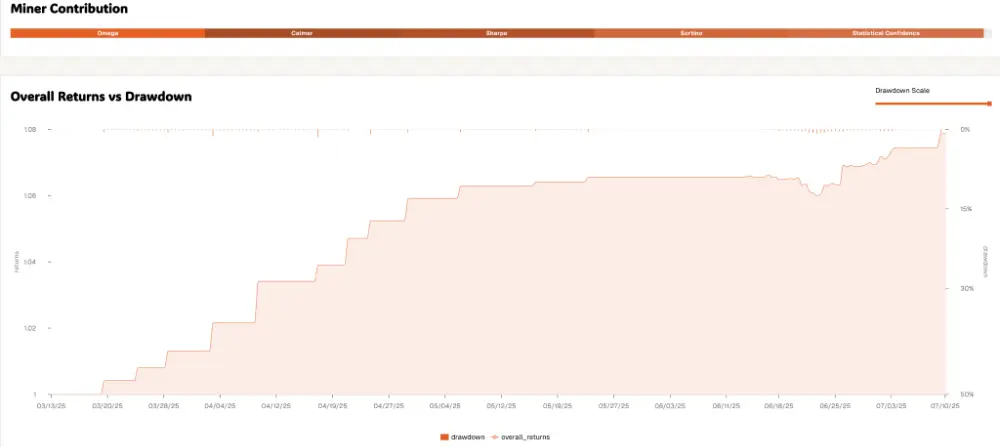
https://dashboard.taoshi.io/miner/5Fhhc5Uex4XFiY7V3yndpjsPnfKp9F4EhrzWJg7cY6sWhYGS
7. @_scorevision, Score (SN44) - Sports analysis and evaluation.
Core Value: Sports video analysis targeting the $600 billion football industry.
A computer vision framework focused on sports video analysis, reducing the cost of complex video analysis through lightweight verification techniques. It employs two-step verification: field detection and CLIP-based object checking, lowering the traditional single-match labeling cost from thousands of dollars to between 1/10 and 1/100. In collaboration with Data Universe, the DKING AI agent has an average prediction accuracy rate of 70%, and has reached 100% accuracy in a single day.
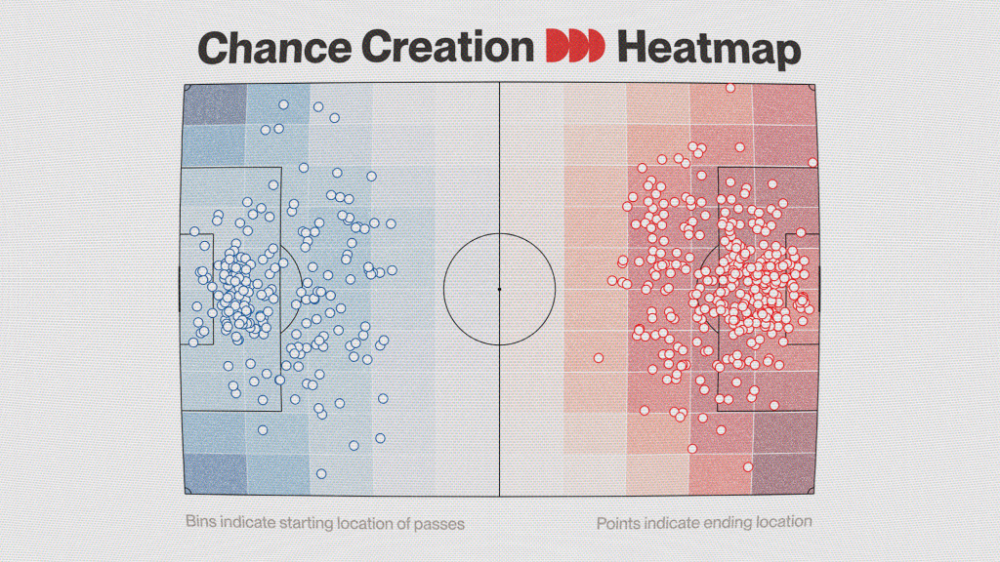
https://x.com/webuildscore/status/1942893100516401598
The sports industry is vast, with significant technological innovation and a broad market outlook. Score is a subnet with a clear application direction worth paying attention to.
8. @openkaito, OpenKaito (SN5) - Open-source text reasoning.
Core Value: Development of text embedding models and optimization of information retrieval.
OpenKaito focuses on developing text embedding models, supported by Kaito, an important participant in the InfoFi domain. As a community-driven open-source project, OpenKaito is dedicated to building high-quality text understanding and reasoning capabilities, especially in information retrieval and semantic search.
This subnet is still in the early construction phase, primarily focusing on building an ecosystem around text embedding models. Notably, the upcoming Yaps integration may significantly expand its application scenarios and user base.
9. @MacrocosmosAI, Data Universe (SN13) - AI data infrastructure.
Core Value: Large-scale data processing and supplying training data for AI.
Daily processing of 500 million rows of data, totaling over 55.6 billion rows, supporting 100GB storage. The DataEntity architecture provides core functions such as data standardization, indexing optimization, and distributed storage. The innovative 'gravity' voting mechanism achieves dynamic weight adjustment.
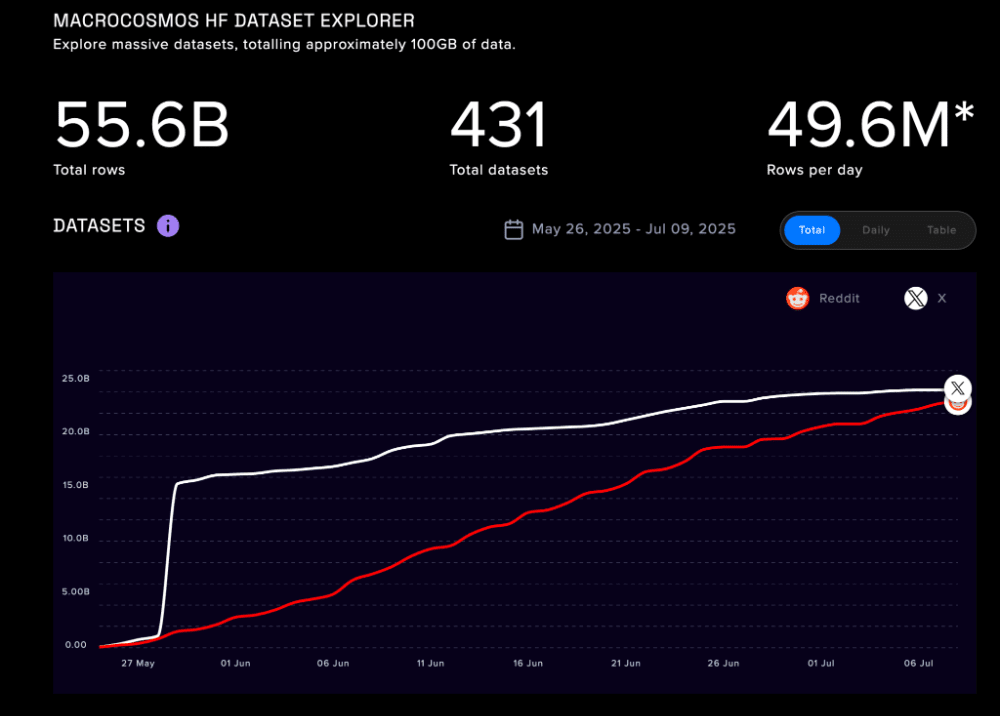
https://www.macrocosmos.ai/sn13/dashboard
Data is the oil of AI, infrastructure value is stable, and ecological niches are important. As a data supplier for multiple subnets, deep collaboration with projects like Score demonstrates infrastructure value.
10. @taohash, TAOHash (SN14) - PoW computing power mining.
Core Value: Connecting traditional mining with AI computing, integrating computing resources.
TAOHash allows Bitcoin miners to redirect their computing power to the Bittensor network, earning alpha tokens through mining for staking or trading. This model combines traditional PoW mining with AI computing, providing miners with a new source of income.
In just a few weeks, it attracted over 6EH/s of computing power (approximately 0.7% of global computing power), demonstrating market recognition of this hybrid model. Miners can choose between traditional Bitcoin mining and earning TAOHash tokens, optimizing returns based on market conditions.
11. @CreatorBid, Creator.Bid - Launch platform for AI agent ecosystems.
Although Creator.Bid is not a subnet, it plays an important coordinating role in the Bittensor ecosystem. The ecosystem of Creator.Bid is built on three main pillars. The Launchpad module provides fair and transparent AI agent launching services, ensuring a secure and transparent starting point for new AI agents through anti-sniping fair launch smart contracts and curation launch mechanisms. The Tokenomics module unifies the entire ecosystem through the BID token, providing a sustainable income model for agents. The Hub module offers powerful API-driven services, including content automation, social media APIs, and fine-tuned image models.
The core innovation of the platform lies in the concept of Agent Keys. These digital membership tokens enable creators to build communities around AI agents and achieve collective ownership. Each AI agent obtains a unique identity through the Agent Name Service (ANS), realized in NFT form, ensuring that each agent has a non-repeating identifier. Users can input personality traits through simple prompts, generating fully functional AI agents without any programming knowledge.
Although Creator.Bid itself is built on the Base network, it has established a deep collaborative relationship with the Bittensor ecosystem. By operating the TAO Council, Creator.Bid brings together top subnets like BitMind (SN34), Dippy (SN11 & SN58), becoming the 'coordinating layer for TAO-aligned agents, subnets, and builders.'
The value of this collaborative relationship lies in integrating the strengths of different networks. Bittensor provides powerful AI inference and training capabilities, while Creator.Bid offers a user-friendly platform for agent creation and launching. The combination of these two ecosystems enables developers to leverage Bittensor's AI capabilities to create agents, which can then be tokenized and community-driven through Creator.Bid's Launchpad.
Collaboration with Masa's AI Agent Arena (SN59) further illustrates this synergy. Creator.Bid provides agent creation tools for the arena, enabling users to quickly deploy competitive AI agents. This cross-ecosystem collaboration model is becoming an important trend in the decentralized AI field.
03. Ecosystem Analysis.
Core advantages of the technical architecture.
Bittensor's technological innovations have constructed a unique decentralized AI ecosystem. Its Yuma consensus algorithm ensures network quality through decentralized verification, while the market-oriented resource allocation mechanism introduced by the dTAO upgrade significantly improves efficiency. Each subnet is equipped with an AMM mechanism for price discovery between TAO and alpha tokens, allowing market forces to directly participate in the allocation of AI resources.
The collaboration agreements between subnets support the distributed processing of complex AI tasks, creating a strong network effect. The dual incentive structure (TAO emissions plus alpha token appreciation) ensures long-term participation motivation, with subnet creators, miners, validators, and stakers all receiving corresponding rewards, forming a sustainable economic cycle.
Competitive advantages and challenges faced.
Compared to traditional centralized AI service providers, Bittensor offers a truly decentralized alternative, excelling in cost efficiency. Multiple subnets show significant cost advantages, for example, Chutes is 85% cheaper than AWS, with this cost advantage stemming from the efficiency gains of the decentralized architecture. The open ecosystem fosters rapid innovation, with the number and quality of subnets continuing to improve, and the speed of innovation far exceeding that of traditional in-house R&D.
However, the ecosystem also faces real challenges. The technical barriers remain high; despite ongoing improvements in tools, participation in mining and validation still requires considerable technical knowledge. The uncertainty of the regulatory environment is another risk factor, as decentralized AI networks may face different regulatory policies in various countries. Traditional cloud service providers like AWS and Google Cloud are unlikely to sit idly by and are expected to launch competitive products. As the network scales, maintaining the balance between performance and decentralization also becomes an important test.
The explosive growth of the AI industry provides Bittensor with significant market opportunities. Goldman Sachs predicts that global AI investment will approach $200 billion by 2025, providing strong support for infrastructure demand. The global AI market is expected to grow from $294 billion in 2025 to $1.77 trillion by 2032, with a compound annual growth rate of 29%, creating a broad development space for decentralized AI infrastructure.
Support policies for AI development from various countries have created a window of opportunity for decentralized AI infrastructure, while increased focus on data privacy and AI security has raised demand for technologies like confidential computing, which is a core advantage of subnets like Targon. Institutional investors' interest in AI infrastructure continues to grow, with participation from well-known institutions like DCG and Polychain providing funding and resource support for the ecosystem.
04. Investment Strategy Framework.
Investing in Bittensor subnets requires establishing a systematic evaluation framework. Technically, it is necessary to assess the degree of innovation and the depth of the moat, the technical strength and execution capability of the team, as well as the synergy with other projects in the ecosystem. From a market perspective, it is essential to analyze the target market size and growth potential, the competitive landscape and differentiation advantages, user adoption and network effects, as well as regulatory environment and policy risks. Financially, attention should be paid to current valuation levels and historical performance, the proportion and growth trends of TAO emissions, the rationality of token economics design, as well as liquidity and trading depth.
In terms of specific risk management, diversification is the fundamental strategy. It is recommended to spread investments across different types of subnets, including infrastructure-type (e.g., Chutes, Celium), application-type (e.g., Score, BitMind), and protocol-type (e.g., Targon, Templar). Investment strategies should also be adjusted based on the development stage of the subnets; early projects carry high risks but have high potential returns, while mature projects are relatively stable but have limited growth space. Given that the liquidity of alpha tokens may not be as high as TAO, a reasonable allocation ratio should be maintained to keep necessary liquidity buffers.
The first halving event in November 2025 will become an important market catalyst. The reduction in emissions will enhance the scarcity of existing subnets while potentially eliminating underperforming projects, reshaping the economic landscape of the entire network. Investors can strategically position themselves in high-quality subnets to seize the allocation window before the halving.
In the medium term, the number of subnets is expected to exceed 500, covering various subfields of the AI industry. The increase in enterprise applications will drive the development of confidential computing and data privacy-related subnets, leading to more frequent cross-subnet collaborations and forming a complex AI service supply chain. The gradual clarification of regulatory frameworks will give compliant subnets significant advantages.
In the long term, Bittensor is expected to become an important component of global AI infrastructure, with traditional AI companies potentially adopting a hybrid model, migrating part of their operations to decentralized networks. New business models and application scenarios will continue to emerge, with enhanced interoperability with other blockchain networks, ultimately forming a larger decentralized ecosystem. This development path is similar to the evolution of early internet infrastructure, where investors who can capture key nodes will reap substantial rewards.
05. Conclusion.
The Bittensor ecosystem represents a new paradigm in the development of AI infrastructure. Through market-oriented resource allocation and decentralized governance mechanisms, it provides new soil for AI innovation, with its demonstrated innovative vitality and growth potential being remarkable. Against the backdrop of rapid development in the AI industry, Bittensor and its subnet ecosystem deserve continued attention and in-depth research.