
Mastering the King of Crypto with a Step-by-Step Strategy Based on Smart Trading Rules
✅ Step 1: Understand Bitcoin’s Nature
Volatility: BTC can swing 5–15% in a week.
Whale Influence: Large wallets often drive sudden reversals.
Macro Sentiment: BTC reacts to global events, Fed policies, and ETF news.
Cycle Driven: Halving cycles (~every 4 years) heavily affect price trends.
🔹 Step 2: Set the Ground Rules
No borrowed capital.
Do not full-time trade BTC unless experienced.
Only invest what you can afford to hold for months if needed.
🔹 Step 3: Identify Ideal Entry Points
📌 Rule 1: 9-Day Dip at High Levels
If BTC drops steadily for 9 days after a strong run, accumulate during low-volume panic.
Entry confirmed with rising buy volume or a bullish engulfing candle.
📌 Rule 2: MA Signals for Timing
3-Day MA Up = Short-Term Entry.
30-Day MA Up = Medium-Term Entry.
80-Day MA Up = Main Trend Confirmation.
120-Day MA Up = Long-Term Buy Zone.
📌 Rule 3: Post-Consolidation Breakouts
Enter when BTC breaks consolidation with rising volume near support levels (e.g., 200D MA).
🔹 Step 4: Trade Management – When to Book Profits
📌 Rule 1: Two Green Days in a Row?
Sell a portion (20–30%) of your holdings.
BTC often cools down after 2-day rallies.
📌 Rule 2: Single Day 7%+ Surge
Pause. Avoid buying.
Next day often sees a pullback. Wait for retest.
📌 Rule 3: Volume Spike Without Breakout
If volume rises and BTC fails to break a resistance (like $70K), exit partially or fully.
📌 Rule 4: Price Doesn’t Reclaim Previous Day’s Close
Weakness. Exit or reduce position immediately.
🔹 Step 5: Recognize Stagnation
📌 BTC Flat for 3 Days?
Observe for 3 more days.
No move = rotate funds into altcoins or stablecoins.
🔹 Step 6: Use Gainers List Psychology
If BTC is in top 3 gainers today, it may lead momentum for 2–4 days.
Enter after dips on day 3, and target profit booking on day 5.
🔹 Step 7: Market Cycles
Best Time to Buy: 6–12 months before halving.
Best Time to Exit: 12–18 months after halving.
Post Bull Run: Wait for 30–50% retracement before re-entering.
🔹 Step 8: Emotions and Discipline
Avoid emotional decisions tied to news or tweets.
Stick to pre-set rules: entry, stop-loss, exit.
Log every trade in a journal.
🔹 Step 9: Long-Term vs. Short-Term Allocation
Hold 60% in long-term wallet if 30D/80D/120D MAs are all positive.
Use 40% for swing trades around high-volume breakouts or 3-day MA pullbacks.
🔹 Step 10: Portfolio Safety
Use hardware wallets for long-term BTC.
Split funds: exchanges (20–30%), cold storage (70–80%).
Avoid overexposure—BTC is volatile even though it’s the most stable crypto.
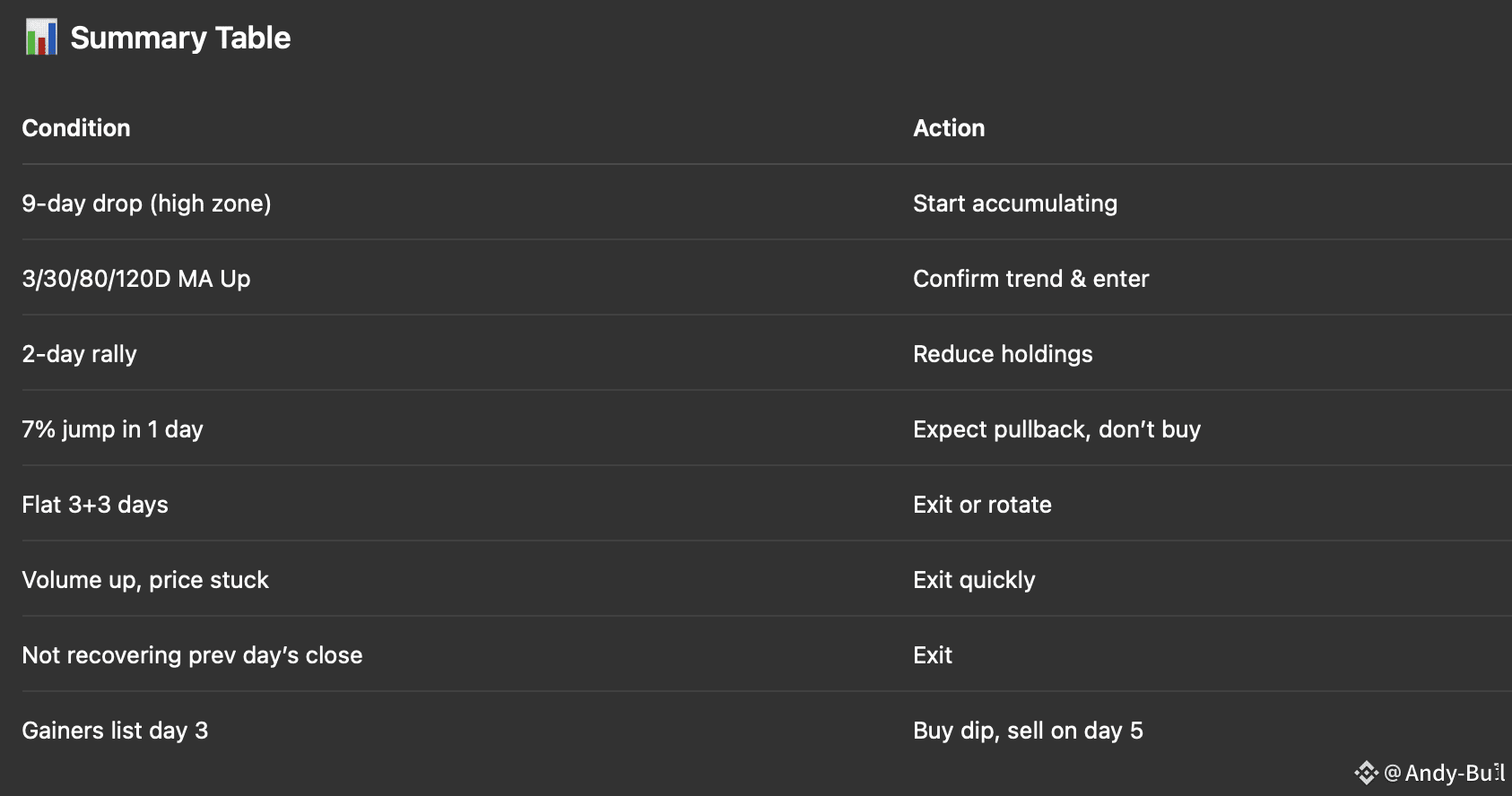
📊 Summary Table