


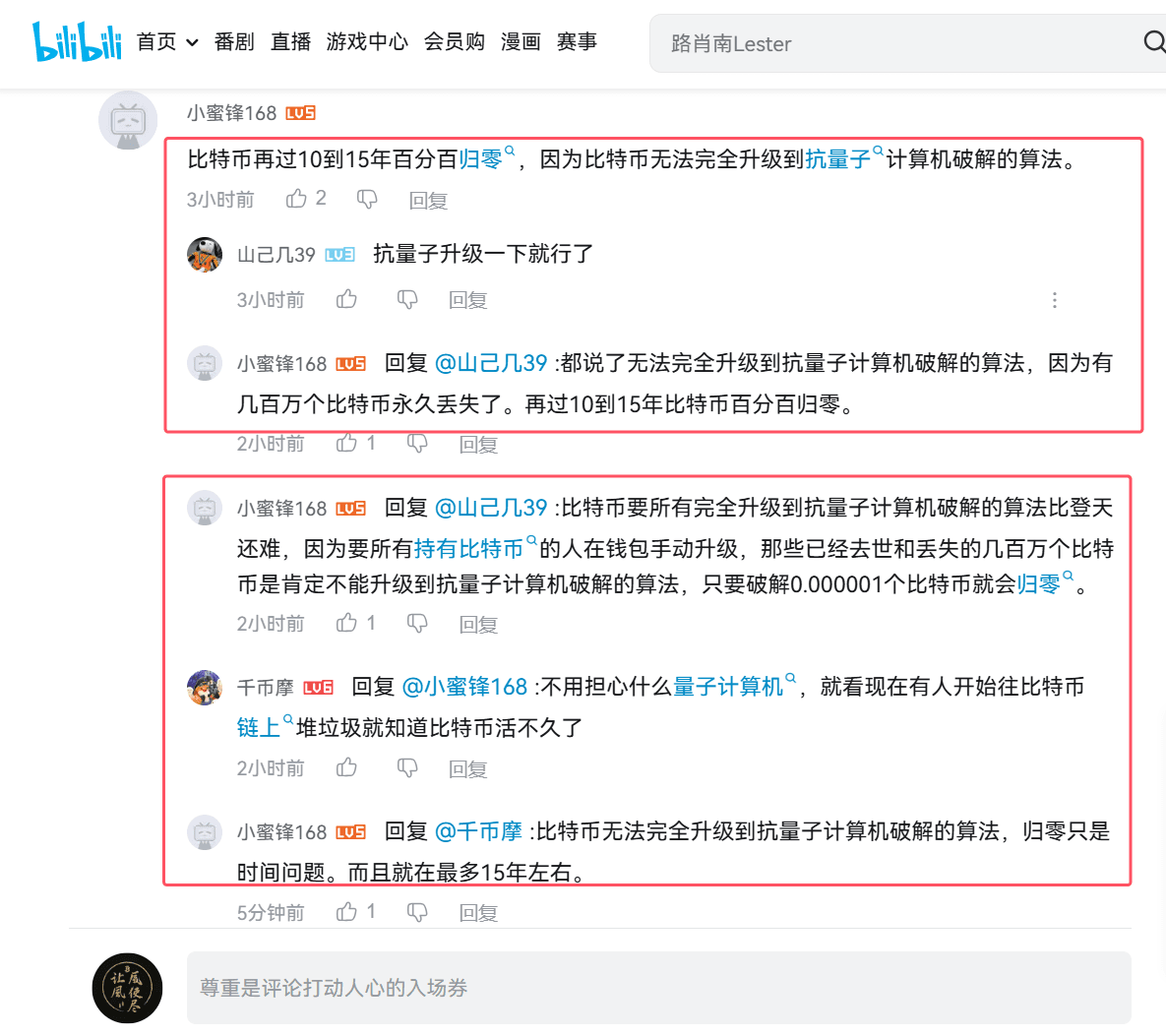
Recently, I released a video about Bitcoin prices still being very cheap, and many netizens commented below, saying that in the future, quantum computing technology will be powerful enough to bring Bitcoin to zero. Some even assert that as long as a quantum computer can crack one or two private keys, Bitcoin will inevitably 'go to zero across the network.' Others incite emotions, claiming that millions of 'dormant coins' that cannot be upgraded due to lost private keys will become the entry point for quantum attacks. This rhetoric of deriving 'total destruction' from 'individual extremes' may seem shocking, but is actually riddled with flaws. Below, I will share my views from four aspects: technical reality, upgrade mechanisms, community governance, and future opportunities.
Quantum attacks are not the 'instant kill' weapon of today.
First, it is important to clarify: the elliptic curve digital signature algorithm (ECDSA) and SHA-256 hash currently used by Bitcoin are at a 'great divide' level when faced with classical computers; and the Shor algorithm, which is best at factoring large numbers and discrete logarithms, indeed accelerates these processes, but to be realized in a real-world environment, it requires tens of thousands of metastable qubits and nearly perfect error correction capabilities. Based on the current scale of quantum processors published by laboratories like IBM and Google, it will be ten or even twenty years before there is a true threat to the key lengths of the Bitcoin network.
More importantly, quantum attacks are not a zero-sum game—cracking one private key can only affect that one address; and Bitcoin addresses number in the hundreds of millions, with every transaction needing to be broadcast and validated by all nodes in the network, which can instantaneously detect and roll back abnormal transactions. The logic of 'if one is compromised, the whole network goes to zero' is fundamentally flawed.
Post-quantum cryptography: Already on the way.
In the face of quantum threats, the cryptography community has not been idle. Since 2016, the National Institute of Standards and Technology (NIST) in the United States has initiated the standardization of post-quantum cryptographic algorithms, and by 2022, a series of quantum-resistant algorithms such as lattice-based encryption (CRYSTALS-KYBER) and lattice-based signatures (CRYSTALS-Dilithium) have been established. Google in TLS, Cloudflare in DNSSEC, and the OpenSSH community are actively testing these solutions, with the internet backbone protocols moving towards a 'quantum-safe' era.
In contrast, Bitcoin, as an open-source protocol, has inherent upgradability—by introducing new script versions through soft forks, it can adopt post-quantum signature algorithms without requiring a hard split across the entire network, while remaining compatible with old nodes. Wallet providers, mining pools, block explorers, and node software can seamlessly switch private key generation and verification logic as long as they publish new versions in sync. As for those long-lost 'dormant coins' private keys, they have long been unrelated to the current protocol's security; they are merely numbers on paper and will not hinder network upgrades and security.
Consensus and governance: Tests that are more important than 'technology'.
To truly allow Bitcoin to collectively enter the post-quantum era, the core issue is not 'creating a quantum machine', but how to reach a consensus within the global community and smoothly complete the upgrade process. Looking back, upgrades like SegWit and Taproot have sparked intense discussions among developers, miners, and nodes, even leading to conspiracy theories like 'hash power threats' and 'chain split risks'. However, in the end, through open voting, balancing hash power signals, and economic interests, the entire network successfully transitioned. The upgrades in the quantum era will face similar tests of 'soft fork governance', rather than insurmountable technological divides.
Economic incentives will continue to play a role: once quantum-resistant upgrades become the industry consensus, global exchanges, large custodians, DeFi platforms, and payment channels will respond in coordination, as it pertains to the security of hundreds of billions or even trillions of dollars in assets. It is this community of interests that ensures Bitcoin can proceed steadily amid technological changes.
Protection and evolution paths in practice.
Before completing a full network upgrade at the formal protocol level, enterprises and large holders can take the lead in adopting techniques such as multi-signature (Multisig), hardware security modules (HSM), and offline cold wallets to raise the barrier against quantum cracking of private keys; layer two networks like the Lightning Network and RSK side chains can also deploy post-quantum signature solutions ahead of time to isolate risks. Meanwhile, the developer community has synchronized the hosting of source code on platforms like GitHub, GitLab, and various country mirror sites, and has set up quantum threat monitoring projects to track global quantum hardware progress in real-time, ensuring that once breakthroughs occur, security patches can be released in the shortest time possible.
In the era of quantum computing, Bitcoin has even greater opportunities.
Some are concerned that quantum computing is the 'doomsday weapon' for Bitcoin, but the opposite is true: the quantum threat will compel the entire ecosystem to upgrade rapidly, promoting the implementation of more secure and efficient cryptography and network architecture. In the long run, whoever can complete the quantum-resistant upgrade first will gain an advantage in the new round of digital asset security competition. Bitcoin, with its open source, decentralized nature, and strong economic incentives, has more evolutionary potential than any closed-source currency or consortium chain.
In summary, the arrival of quantum computing is not 'Judgment Day,' but rather a catalyst for Bitcoin to embrace the next stage of development. As long as the community still has even a shred of vitality, developers are willing to contribute, miners are willing to upgrade, and nodes are willing to operate, Bitcoin can continue to move steadily forward in the quantum era, and may even achieve greater value and security through technological iterations and application implementations. In the next 10 to 15 years, Bitcoin is not only unlikely to go to zero, but is also expected to consolidate its dominant position in the 'value internet' through its quantum-resistant evolution.