
In the six years since 2016, Cosmos has completed the construction of a series of infrastructure and ecosystems such as Tendermint, CosmosSDK, and IBC. All of this is inseparable from the neutrality and self-sacrifice of the Cosmos Hub. Now that we have seen the thriving growth of the IBC network, maybe it’s time to pay attention to $ATOM
1. Inspiration and Integration
In the summer of 2016, Jaekwon and Buchmanster envisioned the future of blockchain Internet, thus starting a six-year "inspiration" journey.
During this period, a series of blockchain Internet infrastructures (Tendermint, CosmosSDK, IBC) were released, and a decentralized and innovative diverse community (Osmosis, Evmos...) was gradually built. Obviously, this is inseparable from the support of the Hub.
During this period, $ATOM has been doing nothing and has almost no "value capture". It protects the network at the cost of high inflation, provides neutral resources for developers, and provides a user entrance for IBC. Now, we can see that more and more chains are joining IBC. With the prosperity of the ecosystem and the establishment of the community, perhaps Cosmos will move from "inspiration" to "integration".
In ATOM2.0, Cosmos Hub will become the provider of inter-chain basic services and the entrance to the Cosmos ecosystem. It will expand with the growth of the multi-chain ecosystem. We divide the upgrade of Atom2.0 into 3 parts:
Interchain secure expansion (ICS and liquid staking)
Interchain Reserve Currency (Release and Fees)
Interchain economic engine (interchain scheduling and interchain allocation)
Finally, we will talk about the governance of the Hub.
2. Secure expansion between chains
Cosmos’ secure expansion includes:
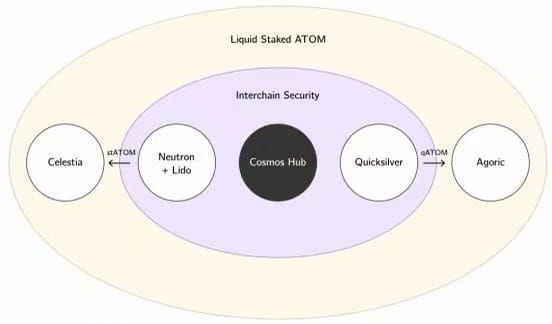
Interchain Security: The Cosmos Hub is the most secure backbone between chains. Through interchain security, the Hub will protect the security of consumer chains (liquidity staking providers).
Liquid Staking: Liquid $qATOM / $stATOM can be circulated by IBC to other chains to become reserve assets.
2.1 Interchain Security
Interchain security allows supplier chains (such as @cosmoshub) to share their security with consumer chains (such as @stride_zone) and gain benefits. In addition, the platform provided by interchain security also allows third parties to build the following possibilities using Hub as infrastructure:
1) Rollup Settlement Layer: In the modular blockchain proposed by Celestia, Hub can serve as the settlement layer of RollApp.
2) IBC routing: Aggregate IBC repeaters to provide better IBC services
3) Multiverse: An application deployment tool used to start a consumer chain in the CosmWasm environment, as easy as deploying a contract.
4) CNS: Chain domain name service, providing secure identification and authentication for the IBC chain. In addition, the Hub can integrate new functions into the Hub’s consumer chain (@Neutron_org|@CrescentHub) to maintain simplicity.
2.2 Liquid Pledge
At present, the two major liquidity pledge chains @quicksilverzone and @stride_zone will join the Hub consumption chain and be protected by the Hub. Liquid pledge can release the liquidity of the pledged $ATOM, and the $stATOM and $qATOM generated by the pledge can be used for inter-chain activities such as trading and staking...
This solves a traditional problem: Should I stake or use? It protects network security while improving liquidity.
3. Interchain Reserve Currency
ATOM2.0 will deeply integrate $ATOM into the Cosmos ecosystem and become the mother of Cosmos. Therefore, it involves the modification of the economic model. Including: issuance and fees
3.1 Release
In order to maintain the network staking rate, ATOM1.0 adopted hyperinflation to protect the network. With the launch of inter-chain security and liquid staking, the staking rate can be guaranteed in other ways, so the issuance of $ATOM has changed: The new monetary policy is divided into two phases: 1) Transition period 2) Stabilization period
Transition period: The first 36 months after the new policy is launched is a transition period. In the first month, 10 million $ATOM will be issued per month, and then the issuance will decrease by about 12% per month. During this period, the issuance of $ATOM includes security subsidies and treasury.
 The security subsidy is the original staking reward, which will remain consistent with the original policy at the beginning of the first month and then decrease by 10% per month.
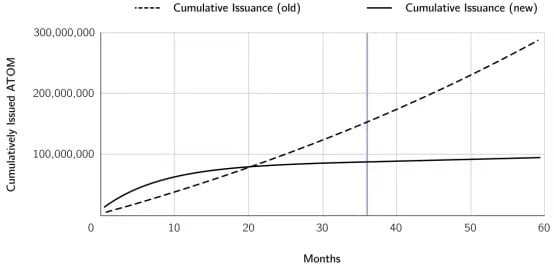
 For example, at the beginning of the new policy, the monthly staking reward is 5 million $ATOM, and the first month's 10 million ATOM issuance is allocated to 5 million security subsidies + 5 million treasury. In this way, the new monetary policy will have a larger issuance volume than before in the first 9 months, and much less than the original policy afterwards. (However, if the staking rate does not meet the network standard, the 1.0 monetary policy will be restarted to protect the network)
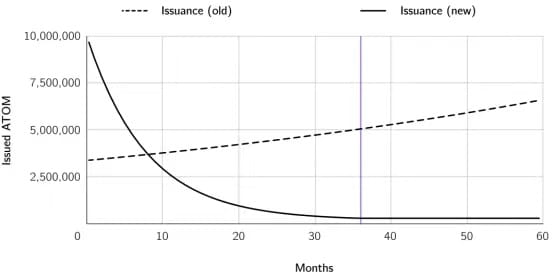
Stabilization period: After 36 months, the stabilization period begins, security subsidies are stopped, and the original staking income is completely provided by ICS and other income. The total monthly issuance is 30w $ATOM (treasury) to fund new projects and facilities. From then on, the annual inflation of $ATOM is close to 1% (a total of about 100 million new coins were added during the new policy period). The new monetary policy has greatly increased the share of the treasury, and the economic model of high inflation in the early stage and ultra-low inflation in the later stage has reduced long-term inflationary pressure.
3.2 Fees
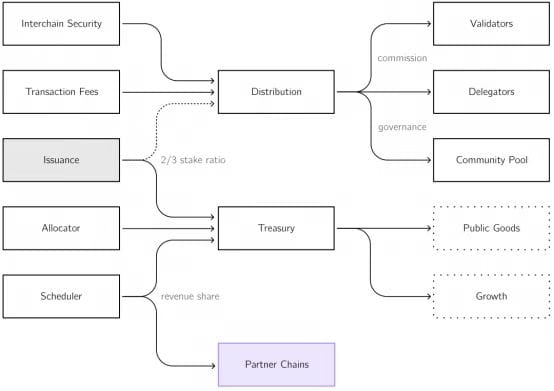
After stabilization, part of the transaction fees and issuance generated by the consumer chain will be allocated to the Hub and redistributed to stakers, nodes, and community pools. The $ATOM issuance, inter-chain scheduler, and inter-chain distributor will distribute the proceeds to the treasury to support ecological growth and the development of $ATOM public assets.
 4. Interchain Economic Engine
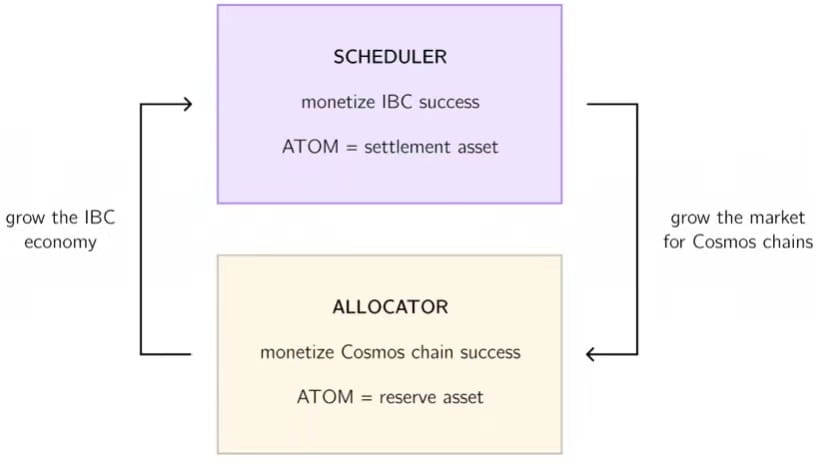
The Cosmos hub will drive the growth of IBC and $ATOM through two mutually reinforcing systems: 1) Interchain Scheduler: a secure interchain block space market (capturing multi-chain MEV) 2) Interchain Allocator: a platform for interchain economic coordination and alliance. Together, they form a Cosmos Hub flywheel:
4.1 Inter-chain Scheduler
The largest part of the profit included in MEV (Miner Extractable Value) is the miner's transaction front-running profit. The inter-chain scheduler allows: user K to initiate a transaction in block A1 of chain A, and chain B sells its adjacent block B1 (scheduled by Cosmos Hub) to record the transaction for K, and returns the message to write it into the next block A2 of chain A. In this way, K can pay a little more gas and avoid being squeezed!
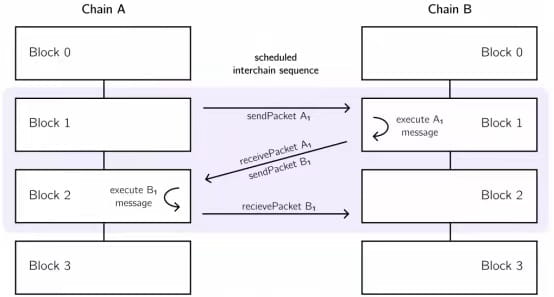
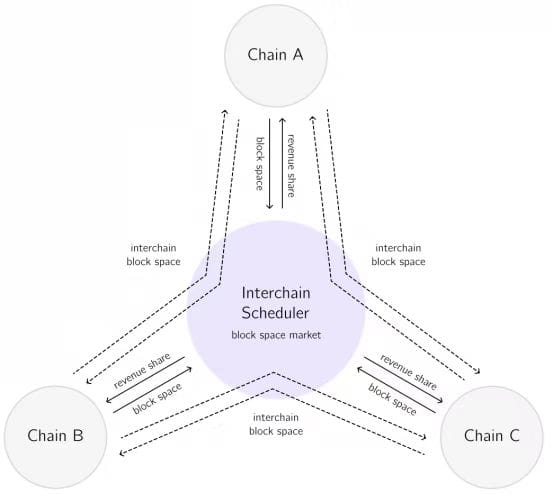
The extra gas paid by K is shared between the Hub and the B chain. In this way, the right to sort transactions for a specified block in the future is tokenized, and the inter-chain MEV is not taken away by miners like ETH (about 100 million US dollars per year), but is shared with the Cosmos Hub and the chains involved in the scheduling. This brings value capture between chains and IBC to the Hub.
 4.2 Inter-chain Allocator
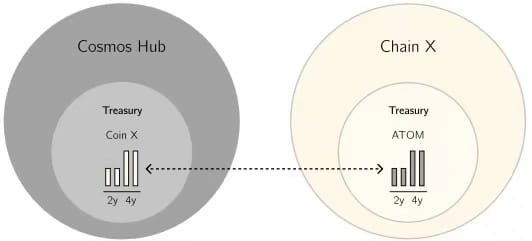
Interchain allocation is to provide a more efficient way for new Cosmos projects to acquire users, liquidity and ecological alliances. In interchain allocation, the more X-chain tokens held by Cosmos Hub, the more $ATOM held by X-chain.
In the above text, we can see that a large proportion of $ATOM is allocated to the treasury, and the Cosmos Hub hopes to allocate the treasury and fund the inter-chain ecosystem by establishing multiple "incentive alliance" DAOs, and inter-chain allocation is the tool of DAO.
It does this through two tools: 1) Contracts 2) Rebalancing
 contract
DAOs composed of $ATOM stakers can sign agreements with other chains through contracts (token swaps, etc.). In the long run, there may be multiple DAOs in the Hub, and the voting rights of the DAO are related to the number of stakes and lock-up time of the DAO. This actually turns the Cosmos Hub into a fund managed by multiple DAOs, the Hub as a fund.
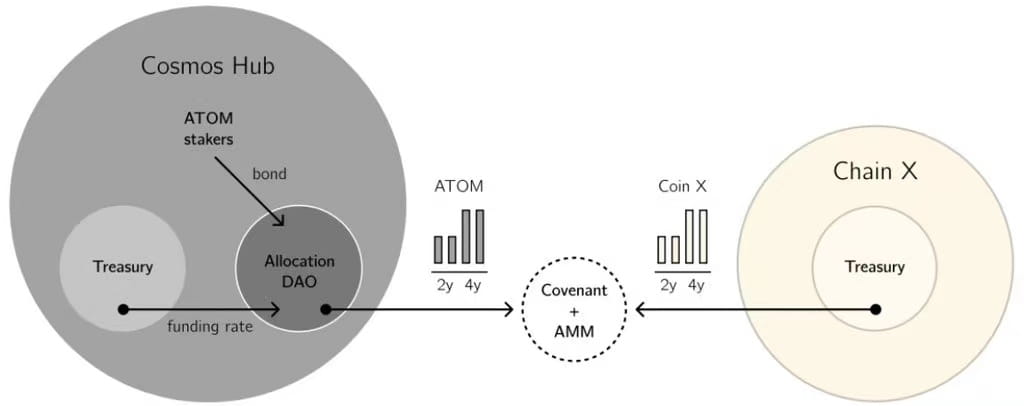 Rebalancing
The rebalancing system can reduce slippage in DAO investments and move towards the target portfolio in a gradual manner (fixed investment, Dutch auction). In fact, through these two tools, Cosmos Hub will become the largest DAO organization and DAO-managed fund, increasing the utility and number of consumer chains of $ATOM on a larger scale.
5. Hub Governance
Cosmos is highly decentralized, and Atom 2.0 will turn Hub into the largest DAO, so governance is naturally crucial.
Cosmos Governance Stack
The Atom 2.0 white paper also provides a governance stack to facilitate accountability and alliances, as well as coordinated management. But I personally think that the real DAO will be perfected in practice.
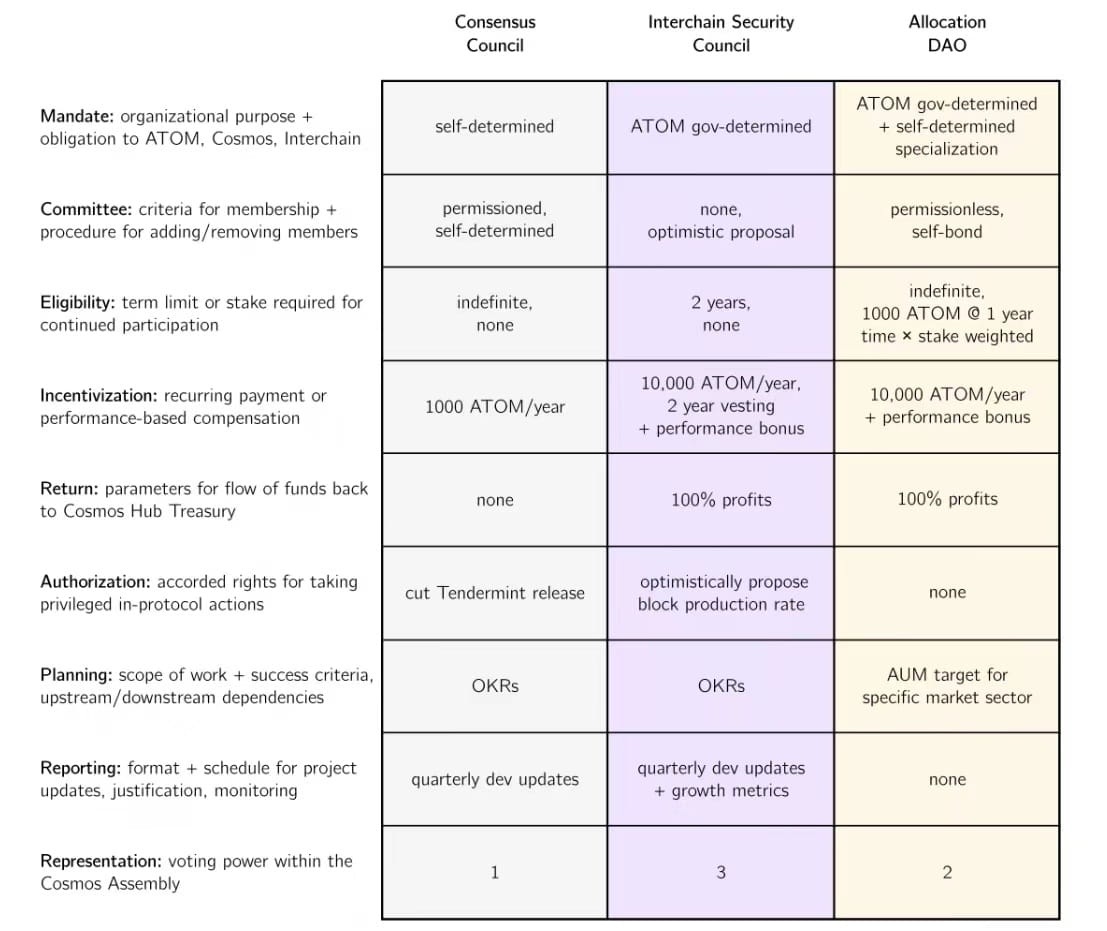 Cosmos Council
After ATOM2.0, Cosmos Hub has high requirements for DAO governance, so the concept of Cosmos Council is proposed: The Council is elected by each DAO, it will formulate an annual budget and goal setting, and it is directly responsible to $ATOM holders, who have the final say on decision-making.
VI. Conclusion
In my opinion, ATOM2.0 is a big gamble:
1) Betting that the ecosystem will develop faster than the production reduction from staking.
2) Betting that DAOs will vote for the right projects and not be bribed.
If the bet is successful, we will see $ATOM deeply integrated with the inter-chain ecosystem in three directions:
1) Public assets: Liquid pledge/inter-chain allocation
2) Inter-chain value capture: ICS/inter-chain scheduling
3) Interchain Fund: Hub becomes the largest DAO fund in the Cosmos ecosystem
The change in monetary policy can be seen as a fundraiser for the treasury to raise money for future DAOs.
In short, ATOM2.0 deeply binds $ATOM and Cosmos. Only under the governance of DAO, can an excellent consumption chain be created and the inter-chain flywheel can be truly turned. The road ahead is long and arduous, and ATOM2.0 is another new six-year journey.