

Written by: Ponyo
Compiled by: Sui Network
Key Points Summary
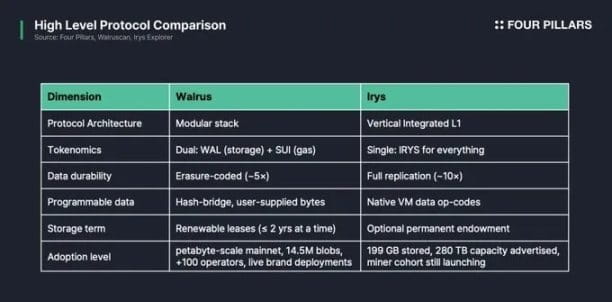
🔧 Architecture: Irys is a fully functional integrated Layer 1 'Data Chain' providing native blob access for contracts, but requires a brand new set of validating nodes. Walrus is a data storage layer built on Sui, easier to integrate but requiring cross-layer coordination.
💰 Economic Model: Irys uses a single token, IRYS, to unify payment of fees and rewards, providing a simple user experience but with higher price volatility risk. Walrus, on the other hand, separates functions into two tokens: WAL (for storage) and SUI (for gas), effectively isolating costs but requiring maintenance of two incentive systems.
📦 Persistence and Computing Power: Irys maintains 10 complete copies and streams data directly into its virtual machine; Walrus uses approximately 5 times redundancy with erasure coding and hash verification, resulting in lower storage costs per GB, but a more complex protocol implementation.
💾 Adaptability: Irys offers a 'one-time payment, permanent storage' donation model, which is very suitable for preserving immutable data, but the upfront cost is high. Walrus, on the other hand, employs a 'pay-as-you-go, automatic renewal' leasing mechanism, which is convenient for cost control and can quickly integrate with Sui.
📈 Adoption: Although Walrus is still in the early stages, it is developing rapidly, already has PB-level storage, 100+ node operators, and has been adopted by multiple NFT and game brands. In contrast, Irys is still in the pre-expansion phase, with data volume not reaching PB level, and the node network is also still growing.
Walrus and Irys both aim to solve the same problem: providing reliable, incentivized on-chain data storage. However, their design philosophies are entirely different: Irys is a Layer 1 blockchain specifically built for data storage, integrating storage, execution, and consensus into a vertically integrated architecture; while Walrus is a modular storage network relying on Sui for coordination and settlement while running an independent off-chain storage layer.
Although the Irys team initially portrayed it as a superior 'built-in' solution compared to defining Walrus as a limited 'external' system, in reality, both have their advantages and disadvantages, with different trade-offs. This article objectively compares Walrus and Irys across six dimensions from a technical perspective, rebutting one-sided assertions and providing developers with a clear selection guide to help them decide on the most suitable path based on cost, complexity, and development experience.
1. Protocol Architecture
1.1 Irys: Vertically Integrated L1
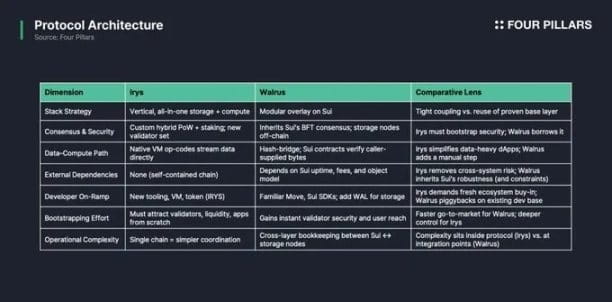
Irys embodies the classic 'self-sufficiency' concept. It comes with its own consensus mechanism, staking model, and execution virtual machine (IrysVM), all tightly integrated with its storage subsystem.
Validation nodes simultaneously assume three roles:
Store user data in the form of complete copies;
Execute smart contract logic in IrysVM;
Protect network security through a PoW + staking hybrid mechanism.
Since these functions coexist within the same protocol, every layer from the block header to data retrieval rules can be optimized for large-volume data processing. Smart contracts can directly reference on-chain files, and storage proofs will follow the consensus path of ordinary transactions. Its advantage lies in the high consistency of architecture: developers only face a single trust boundary, a single fee asset (IRYS), and the experience of reading data in contract code is akin to native support.
However, the cost is a higher startup cost. A brand new layer-1 network must start from scratch to recruit hardware operators, build indexers, launch block explorers, secure clients, and develop developer tools. In the early stages, when validating nodes have not yet grown, block time assurance and economic security lag behind established chains. Thus, Irys's architecture chose deeper data integration at the expense of ecological startup speed.
1.2 Walrus: Modular Stacking Layer
Walrus takes a distinctly different path. Its storage nodes operate off-chain, while Sui's high-throughput L1 is responsible for handling ordering, payment, and metadata through Move smart contracts. When a user uploads a blob (data block), Walrus shards it and distributes storage across nodes, then records an on-chain object on Sui, containing content hash, shard allocation, and lease terms. Renewals, penalties, and rewards are executed as ordinary Sui transactions, paying gas with SUI but using the WAL token as the unit of storage economic settlement.
Based on Sui, Walrus immediately gains the following advantages:
Verified Byzantine Fault Tolerance consensus mechanism;
Comprehensive development infrastructure;
Strong programmability;
Liquidity-based foundational token economics;
Many existing Move developers can integrate directly without protocol migration.
But the cost is the need for cross-layer coordination. Each lifecycle event (upload, renewal, deletion) must be coordinated between the two semi-independent networks. Storage nodes must trust the finality of Sui while still maintaining performance during Sui congestion; meanwhile, Sui validating nodes do not verify whether the actual disk stores the data, thus they must rely on Walrus's cryptographic proof system to ensure accountability. Compared to an all-in-one design, this architecture inevitably incurs higher latency, and part of the transaction fee (SUI gas) will flow to roles that do not actually store data.
1.3 Design Summary
Irys adopts a vertically integrated monolithic architecture, while Walrus is a horizontally layered modular solution. Irys enjoys greater architectural freedom and a unified trust boundary but must overcome the ecological construction challenges brought by cold starts. Walrus, leveraging Sui's mature consensus system, significantly lowers the entry threshold for developers in existing ecosystems but must manage the coordination complexity of two economic domains and operator systems. Neither model is absolutely superior; they simply optimize for different directions: one pursues coherence, while the other seeks composability.
When the choice of protocol depends on developers' familiarity, ecological attractiveness, or speed of launch, Walrus's layered model may be more realistic. However, when the bottleneck lies in deep data and computation coupling or custom consensus logic requirements, Irys, a chain designed specifically for data, has sufficient rationale to bear a heavier architectural burden.
2. Token Economics and Incentive Mechanisms
2.1 Irys: A Single Token Drives the Entire Protocol Stack
The native token of Irys, IRYS, encompasses the economic model of the entire platform:
Storage costs: users prepay IRYS to store data;
Execution gas: all smart contract calls are also priced in IRYS;
Miner rewards: block subsidies, storage proofs, and transaction fees are all paid in IRYS.
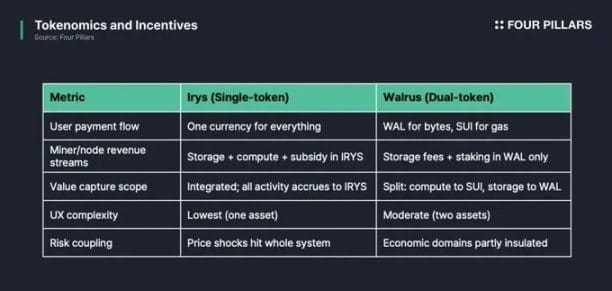
Because miners are responsible for both data storage and contract execution, computation revenue can compensate for the shortfall in storage income. Theoretically, when DeFi activity on Irys is robust, computation income will subsidize data storage, achieving near-cost services; if contract traffic is low, the subsidy mechanism adjusts inversely. This cross-subsidy mechanism helps balance miner earnings and aligns incentives among the roles within the protocol. For developers, a unified asset means fewer custody processes and a simplified user experience, especially suitable for scenarios where users should not interact with multiple tokens.
However, the downside is the risk linkage of single assets: once the price of IRYS drops, the rewards for computation and storage will decrease simultaneously, putting miners under dual pressure. The economic security of the protocol is therefore tied to the same price volatility curve as data persistence.
2.2 Walrus: Dual-Token Economic Model
Walrus separates functional responsibilities into two tokens:
$WAL: The economic unit of the storage layer. Users pay for leasing space using WAL, and node operators earn WAL rewards through staking and storing data fragments, with rewards also linked to their delegated staking weight.
$SUI: The gas token for on-chain coordination transactions. Any transaction on Sui, such as uploads, renewals, penalties, etc., requires consuming SUI and rewards Sui validating nodes, rather than Walrus storage nodes.
This separation keeps the storage economy clear: the value of WAL is only influenced by data storage demand and lease duration, unaffected by DEX trading or NFT frenzy on Sui. Meanwhile, Walrus can inherit Sui's liquidity, cross-chain bridges, and fiat gateways—most Sui builders already hold SUI, so the marginal cost of introducing WAL is low.
However, the dual-token model also faces the incentive disconnection issue. Walrus nodes cannot participate in SUI's fee income, so the price of WAL must be sufficient to independently support hardware, bandwidth, and return expectations. If WAL's price stagnates while SUI gas surges, user costs will rise, but storage providers will have no direct income. Conversely, a DeFi explosion on Sui boosts validating node earnings but is unrelated to Walrus nodes. Therefore, to maintain long-term balance, proactive optimization of the economic model is necessary: storage prices need to flexibly fluctuate based on hardware costs, demand cycles, and WAL market depth.
2.3 Design Summary
In short, Irys offers a unified and streamlined user experience but bears concentrated risks; Walrus delineates boundaries at the token level, providing finer economic accounting but needing to manage two market systems and fee diversion issues. Builders should weigh their preference for seamless experience against a preference for separate management of economic risks to match their product planning and funding strategies.
3. Data Persistence and Redundancy Strategies
3.1 Walrus: Lightweight High-Reliability via Erasure Coding
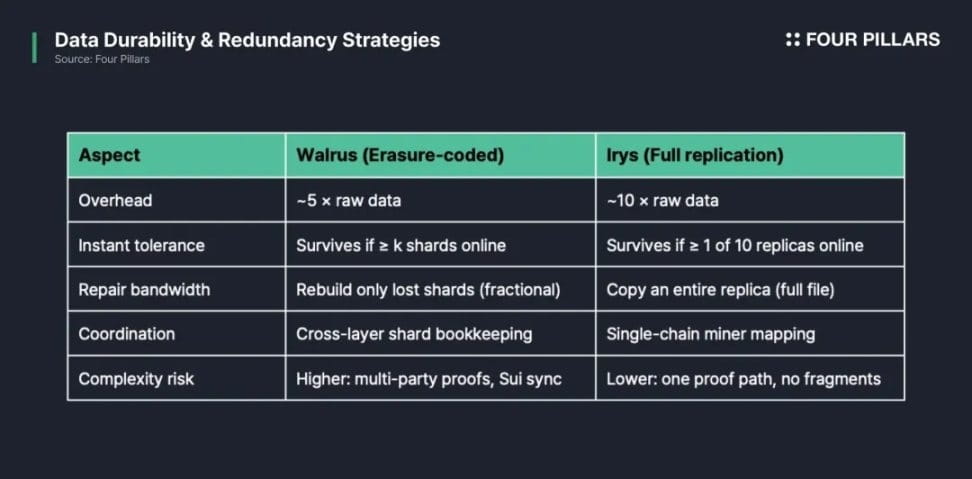
Walrus splits each data block (blob) into k data shards and adds m redundant parity shards (using the RedStuff encoding algorithm). This technology is similar to RAID or Reed-Solomon coding but optimized for decentralized and highly dynamic node environments. You only need to select k from k + m shards to reconstruct the original file, providing two advantages:
High space efficiency: under typical parameters (approximately 5 times expansion), required storage space is halved compared to traditional 10x copy replication schemes. In simple terms, storing 1GB of data on Walrus requires about 5GB of overall network capacity (dispersed across multiple nodes), while a traditional full-copy system might need 10GB to achieve similar security.
Strong on-demand repair capability: Walrus's coding method not only saves space but also bandwidth. When a node goes offline, the network only reconstructs the missing shards rather than the entire file, significantly reducing bandwidth overhead. This self-healing mechanism only requires downloading data roughly equal to the size of the lost shard (i.e., O(blob_size/shard_count)), while traditional copy systems usually require O(blob_size) of data.
The allocation of each shard and node will exist as objects on Sui. Walrus rotates the staking committee each epoch, challenges node availability through cryptographic proof, and automatically re-encodes when node loss exceeds a safety threshold. Although this mechanism is complex (involving two networks, multiple shards, and frequent verification), it achieves the highest persistence with minimal capacity.
3.2 Irys: Conservative but Robust Multi-Copy Mechanism
Irys intentionally chose a more primitive and direct durability method: every 16TB data partition is fully stored by 10 staking miners, each keeping a complete copy. The protocol prevents duplicate entries on the same hard drive by introducing a 'salt' from specific miners (Matrix Packing technique). The system continuously reads and verifies the nodes' hard drives through 'proof-of-useful-work' to ensure each byte exists; otherwise, miners will be penalized and have their staked assets deducted.
In practice, data availability depends on: does at least one of the 10 miners respond to the query? If a miner fails verification, the system will immediately initiate re-copying to maintain the standard of 10 copies. The cost of this strategy can be up to 10 times data storage redundancy, but the logic is simple and clear, with all states centralized on a single chain.
3.3 Design Summary
Walrus focuses on addressing the frequent turnover of nodes through efficient coding strategies and Sui's object model, thereby ensuring data persistence without increasing costs. Irys believes that as hardware costs decrease rapidly, a more direct, heavier multi-copy mechanism is actually more reliable and hassle-free in practical engineering.
If you need to store PB-level archival data and can accept higher protocol complexity, Walrus's erasure coding has an advantage in per-byte economics. If you value operational simplicity (one chain, one proof, ample redundancy) and consider hardware expenditure negligible compared to product delivery speed, Irys's 10-copy mechanism can provide durability assurance with minimal thought.
4. Programmable Data and On-chain Computation
4.1 Irys: Natively Supports Data Smart Contracts
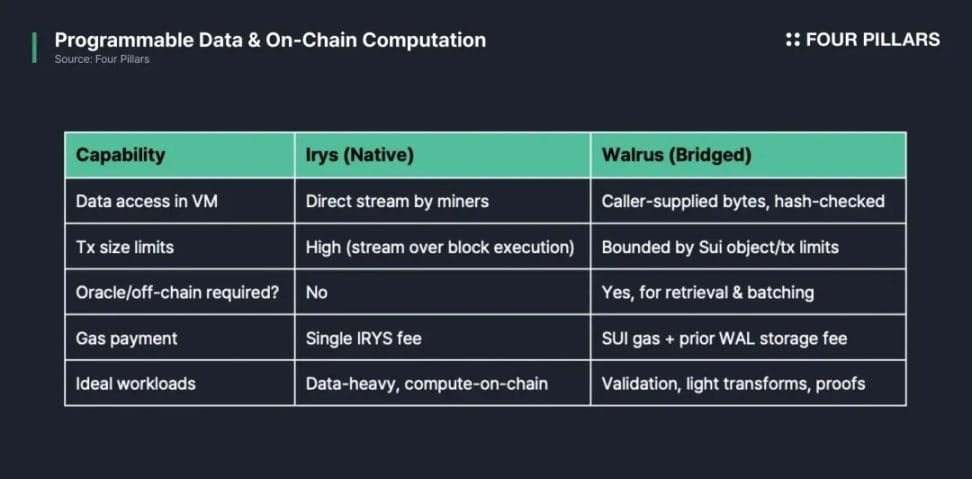
Since storage, consensus mechanisms, and Irys virtual machine (IrysVM) share the same ledger, contracts can easily call the read_blob(id, offset, length) method as if reading their own state. During block execution, miners stream the requested data fragments directly into the virtual machine, perform deterministic checks, and continue processing the results in the same transaction. No oracles, no user parameters, and no off-chain intermediaries are required.
This programmable data structure can achieve the following use cases:
Media NFTs: On-chain all metadata, high-resolution images, and royalty logic, enforcing at the byte level.
On-chain AI: Directly executing inference tasks on model weights stored in partitions.
Big Data Analytics: Contracts can scan logs, gene files, and other large datasets without external bridging.
Although gas costs will increase with the number of bytes read, the user experience remains a transaction priced in IRYS.
4.2 Walrus: 'Verify Before Compute' Mode
Since Walrus cannot directly stream large files into the Move virtual machine, it employs a 'hash commitment + witness' design pattern:
When users store blobs, Walrus records their content hash on Sui;
Subsequently, any caller can submit the corresponding data fragments and a lightweight proof that verifies the correctness of those fragments (such as Merkle paths or complete hashes);
Sui contracts will recompute the hash and compare it with Walrus metadata. If verification is successful, trust the data and execute subsequent logic.
Advantages:
Ready to use immediately, with no modifications needed for the L1 protocol;
Sui validating nodes do not need to be aware of GB-level large data contents.
Limitations:
Manual data retrieval required: the caller must pull data from the Walrus gateway or nodes and package limited-length data fragments in transactions (restricted by the transaction size of Sui);
Shard processing overhead: for large data processing tasks, multiple micro-transactions or off-chain preprocessing + on-chain verification are needed;
Dual gas costs: users must pay SUI gas (for transaction verification) and WAL (to indirectly pay for underlying storage costs).
4.3 Design Summary
If your application requires contracts to process several MB of data per block (such as on-chain AI, immersive media dApps, or verifiable scientific computation processes), the embedded data API provided by Irys is more attractive.
If your scenario emphasizes data integrity proof, small media display, or computations that happen off-chain with on-chain verification of results, Walrus can already handle it.
So, the choice is not about 'right or wrong,' but rather where you wish to place the complexity: at the protocol layer (Irys) or the middleware application layer (Walrus)?
5. Storage Duration and Permanence
5.1 Walrus: Pay-As-You-Go Leasing Model
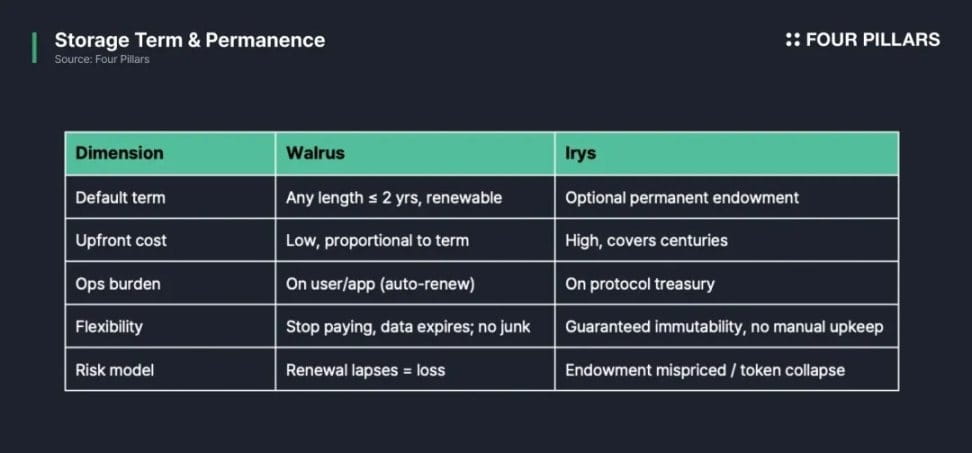
Walrus adopts a fixed-cycle leasing model. When uploading data, users pay for a fixed storage period using $WAL (billed at 14 days per epoch, with a maximum one-time purchase of about 2 years). After the lease period expires, if not renewed, nodes can choose to delete that data. Applications can write automatic renewal scripts through Sui smart contracts, turning 'leasing' into de facto 'permanent storage,' but the responsibility for renewal always rests with the uploader.
Its advantage is that users do not have to prepay for potentially abandoned capacity, and pricing can track real-time hardware costs. Furthermore, by setting expiration times for data leases, the network can perform garbage collection on data that is no longer paid for, preventing the accumulation of 'permanent garbage.' However, the downside is that missing a renewal or exhausting funds can result in data loss; long-running dApps must run their own 'keep-alive' bots.
5.2 Irys: Protocol-Level Guaranteed Permanent Storage
Irys provides a 'permanent storage' option similar to Arweave. Users only need to make a one-time payment of $IRYS to fund miners' storage services for hundreds of years in the form of an on-chain fund (assuming storage costs continue to decline, this can cover about 200 years). After this transaction is completed, the responsibility for storage renewals shifts to the protocol itself, relieving users from further management.
The result is a user experience of 'store once, available permanently,' ideal for: NFTs, digital archives, and datasets requiring immutability (such as AI models). However, its downside is the high initial cost, and this model heavily depends on the price health of $IRYS over the coming decades, making it unsuitable for frequently updated data or temporary files.
5.3 Design Summary
If you want to control the data lifecycle and pay based on actual usage, choose Walrus; if you need unshakeable long-term data persistence and are willing to pay a premium for it, choose Irys.
6. Network Maturity and Usage
6.1 Walrus: Achieving Production-Level Scale
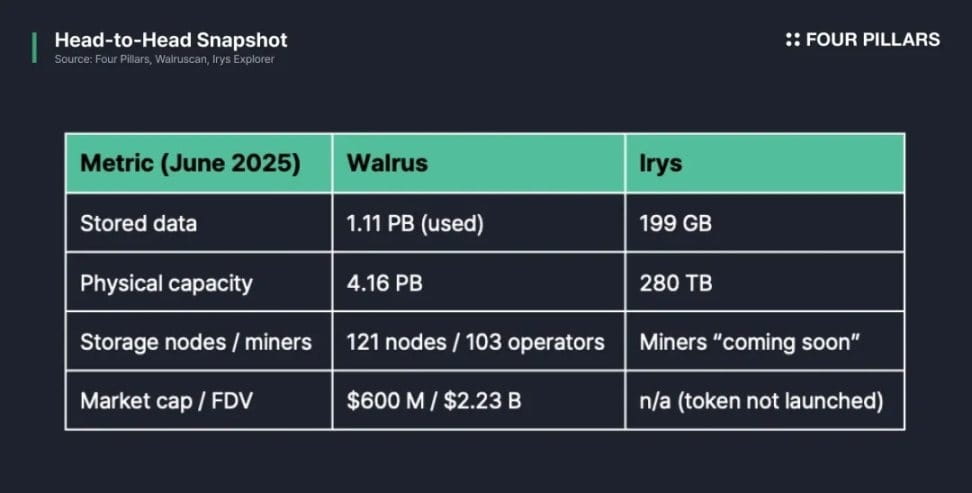
The Walrus mainnet has been online for only 7 epochs but is already running 103 storage operators, 121 storage nodes, and has staked a total of 1.01 billion WAL. The network has currently stored 14.5 million blobs, triggering 31.5 million blob events, with an average object size of 2.16MB, totaling a stored data volume of 1.11PB (approximately 26% of its 4.16PB physical capacity). The upload throughput rate is approximately 1.75KB/s, with a shard coverage of 1,000 parallel shards.
The economic aspect also shows strong momentum:
Market capitalization of approximately $600 million, FDV (fully diluted valuation) reaching $2.23 billion;
Storage price: approximately 55K Frost per MB (equivalent to about 0.055 WAL);
Writing price: approximately 20K Frost per MB
Current subsidy ratio up to 80% to accelerate early growth
Many high-traffic brands have adopted Walrus, including Pudgy Penguins, Unchained, and Claynosaurs, all of which have built asset pipelines or data archiving backends on it. The network currently has 105,000 accounts, with 67 projects integrating, supporting PB-level data transmission for real-world scenarios involving NFTs and games.
6.2 Irys: Still in the Early Stages
According to Irys's public data dashboard (as of June 2025):
Contract execution TPS ≈ 13.9, storage TPS ≈ 0
Total storage data volume ≈ 199GB (officially claiming 280TB space)
Number of data transactions: 53.7 million (with June accounting for 13 million transactions)
Number of active addresses: 1.64 million
Storage cost: $2.50 / TB / month (temporary storage), or $2.50 / GB (permanent storage)
Miner system 'coming soon' (uPoW mining mechanism not yet enabled)
Programmable data call costs $0.02 per chunk (data block), but since the permanent storage fund is not yet in place, the actual data write volume remains very limited. Currently, contract execution throughput performs well, but batch storage capacity is still nearly zero, reflecting its current focus on virtual machine functionality and developer tools, rather than data carrying capacity.
6.3 The Significance of Digital Representation
Walrus has reached a scale of PB, capable of generating revenue and has undergone rigorous testing by consumer NFT brands. In contrast, Irys is still in the early guidance phase, rich in features but requiring miners to join and meet data volume requirements.
For clients assessing production readiness, Walrus's current performance is as follows:
Higher real usage: over 14 million blobs uploaded, PB-level data storage;
Wider operational scale: over 100 operators, 1,000 shards, over $100 million staked;
Stronger ecological appeal: leading Web3 projects have integrated and are using it;
A clearer pricing system: WAL/Frost fees are clear and transparent, on-chain subsidy mechanisms are visible.
Although Irys's integrated vision may play advantages in the future (such as miner onboarding, permanent storage fund implementation, and improved TPS), based on current quantifiable throughput, capacity, and customer usage, Walrus has a more practical leading advantage.
7. Looking to the Future
Walrus and Irys represent the two ends of the spectrum of on-chain storage design:
Irys consolidates storage, execution, and economic models into a single IRYS token and a dedicated L1 blockchain born for data, providing developers with a frictionless on-chain big data access experience and an embedded protocol-level commitment to 'permanent storage.' Accordingly, development teams need to migrate to a still-immature ecosystem and accept higher hardware resource consumption.
Walrus builds a data storage layer through erasure coding on top of Sui, reusing mature consensus mechanisms, liquidity infrastructure, and development toolchains to achieve highly cost-effective per-byte storage costs. However, its modular architecture also brings additional coordination complexity, a dual-token experience, and a continuous focus on 'lease renewals.'
Choosing which one is not a question of 'right or wrong,' but depends on your most pressing bottleneck:
If you need deep data and computation combination capabilities, or a protocol-level 'permanent save' commitment, then Irys's integrated design will be more suitable.
If you value capital efficiency, rapid deployment on Sui, or highly customized control over the data lifecycle, Walrus's modular solution is a more pragmatic choice.
In the future, it is likely that both will coexist in parallel during the ongoing expansion of the on-chain data economy, serving different types of developers and application scenarios.