



1.
What is an inflationary cryptocurrency?
Some cryptocurrencies are inflationary because the supply of coins increases over time. Inflationary cryptocurrencies use a predetermined inflation rate, supply limits, and a mechanism for allocating tokens to maintain supply and incentivize participation in the network.
Looking at their monetary systems, cryptocurrencies have multiple coin creation and supply mechanisms. Inflationary cryptocurrencies have resulted in a steady increase in the supply of tokens entering the cryptocurrency market. Typically, there is a predetermined set of inflation rates that specify the percentage by which the total money supply increases over time. Additionally, the maximum supply of inflation tokens is usually fixed or variable, setting the total number of tokens that can be created. Once the maximum supply is reached, no more coins can be minted.
Still, different cryptocurrencies have different token economics that may adjust over time. For example, Dogecoin ( DOGE ) once had a hard cap of 100 billion tokens before the supply cap was lifted in 2014. Following this decision, DOGE now has an unlimited supply of the token.
How does an inflationary cryptocurrency work? Inflationary cryptocurrencies use specialized consensus mechanisms such as Proof of Work (PoW) and Proof of Stake (PoS) to distribute newly minted coins to network participants, through which new coins can be mined (Bitcoin ( BTC )) or Distributed to network validators (Ethereum (ETH)).
Through Bitcoin’s PoW consensus mechanism, miners validate transactions and receive rewards based on who solves the puzzle first. In PoS, when a block of transactions is ready to be processed, the PoS protocol selects a validator node to review the block. Validators check whether the transactions in the block are accurate. If so, the validator adds the block to the blockchain and is rewarded in ETH for their contribution, usually proportional to the validator's stake.
In some cryptocurrencies, the distribution of new tokens may be affected by governance decisions. For example, a decentralized autonomous organization (DAO) might vote to release treasury funds, change staking rewards, and set vesting periods, ultimately affecting the currency’s inflation rate and the distribution of new tokens.
2.
What is a deflationary cryptocurrency?
A deflationary cryptocurrency shrinks over time due to a decrease in supply. Deflationary tokens use various mechanisms to reduce their supply, and tokens are typically destroyed through transaction fees and token burning.
Deflationary cryptocurrencies have a predetermined deflation rate encoded in the protocol. This ratio determines the percentage by which the total money supply decreases over time. For example, a cryptocurrency has an annual deflation rate of 2.5%, which means that the total supply of the currency will decrease by 2.5% per year.
Like many inflationary cryptocurrencies, deflationary cryptocurrencies can have a fixed or variable maximum supply to limit the total number of tokens created. Typically, once the supply limit is reached, no more units can be minted, but this is not always the case.
It is worth noting that the economics of deflationary cryptocurrencies are affected by the incentives of stakeholders, including miners, developers, and users, who have different motivations and goals that influence cryptocurrency supply and demand. Miners mine new coins and tend to hold newly mined coins during bull markets rather than selling them on the market. Likewise, supply caps can be lifted, as was the case with DOGE, leaving some cryptocurrencies vulnerable to manipulation.
How do deflationary cryptocurrencies work? Deflationary cryptocurrencies may have direct or indirect mechanisms to destroy circulating coins. Some deflationary currencies may use transaction fees to promote burns to reduce the total number of coins in circulation. Token burning may also involve sending a specific number of tokens to an inaccessible address, directly removing them from circulation. Binance Coin (BNB) uses two burn mechanisms that reduce its supply by 50% over time. The first is to burn a portion of BNB as gas fees on the BNB chain, and the second is the quarterly BNB burning event.
Deflationary cryptocurrencies also use other tools to reduce the token supply, including "halvings." Approximately every four years, the halving event cuts the ming rewards that BTC miners receive for their work, directly affecting BTC’s scarcity.
3.
What is the difference between inflationary and deflationary cryptocurrencies?
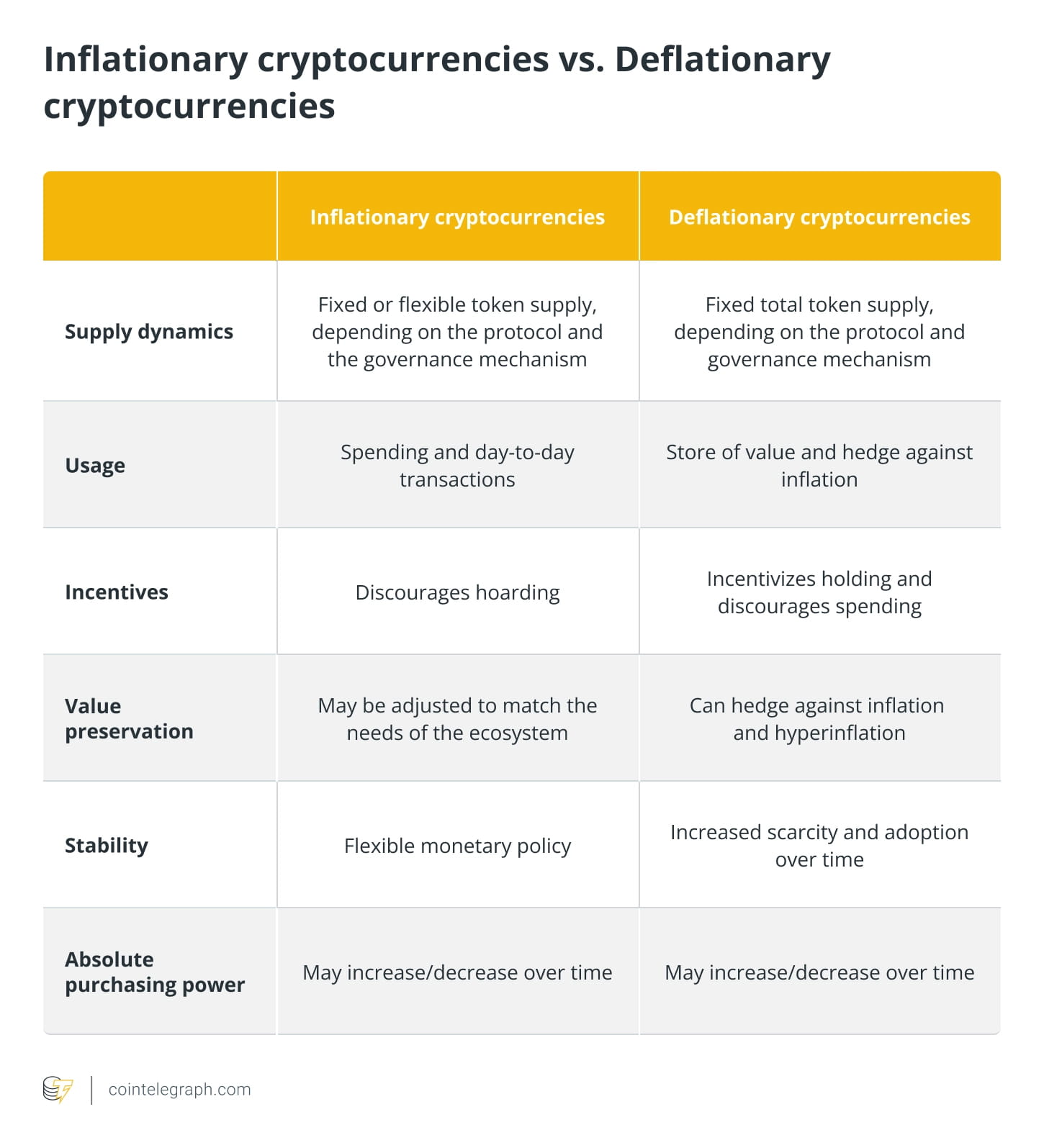
The monetary mechanisms and supply dynamics of inflationary and deflationary cryptocurrencies differ. These distinctions have a significant impact on the use and value of each cryptocurrency.
Both deflationary and inflationary cryptocurrencies can have unique token economics that affect their value and usage. Deflationary cryptocurrencies typically have a fixed limit on the total supply of coins, which causes purchasing power to increase over time. Inflationary cryptocurrencies typically have flexible coin creation rates that arguably reduce purchasing power over time.
Inflationary cryptocurrencies have some advantages over deflationary cryptocurrencies. They encourage consumption and discourage hoarding. Depending on the use case, they may increase liquidity and rapid adoption due to their utility or functionality as a medium of exchange.
Additionally, they arguably offer more flexible monetary policy than deflationary cryptocurrencies and some fiat currencies. Token inflation can be adjusted to meet ecosystem needs, such as fund development, incentivizing participation, or offsetting inflationary pressure on fiat legacy systems.
A deflationary cryptocurrency incentivizes holding and discourages spending, increasing scarcity and the adoption of currency as a store of value.
Additionally, deflationary cryptocurrencies can provide a hedge against inflation, hyperinflation, and stagflation, retaining their value over time. A reduction in the token supply can offset inflationary pressures caused by external factors, including government policies or economic events.
4.
Is Bitcoin inflationary or deflationary?
Classifying Bitcoin ( BTC ) as inflationary or deflationary depends on a variety of factors. BTC is inflationary because new coins are constantly being mined and entering the supply. However, anti-inflationary measures such as halving will reduce inflation over time.
The argument for BTC deflation is based on the fact that the supply of BTC is limited and inherently contains a deflationary measure called halving. The halving event reduces miner rewards, affecting BTC’s scarcity and reducing inflation over time. As mining rewards continue to decrease over time, mining BTC becomes increasingly difficult and expensive.
The 21 million supply cap means that once all coins have been mined, no more will be added to the market. Once BTC's hard cap is reached around 2140, inflation will stop as no new coins will be added to circulation. Finally, as adoption and demand for BTC continues to increase due to increased external demand and its internal deflationary mechanisms, its price will likely continue to rise. BTC can hedge against inflation due to its internal mechanism, gradually reducing its inflation rate.
5.
Is Ethereum inflationary or deflationary?
Classifying Ether as inflationary or deflationary is a controversial topic. Proponents of the inflation argument might point out that there is no hard cap on the supply of ether. However, the programmatic decline in token creation rates, the implementation of PoS, and its increasing utility in the decentralized finance (DeFi) ecosystem indicate a deflationary trend for ETH.
Ethereum’s ecosystem facilitates the development of decentralized applications (DApps). Its native currency, Ethereum, is used for transactions and as a reward for validators who process transactions. There is no fixed limit on the total supply of ETH, but the creation rate of new coins decreases over time.
Before the merger, the annual issuance rate of ETH used to be around 5%, meaning the circulating supply of ETH increased by that amount every year. However, the move to PoS resulted in a reduction in the issuance of ETH by rewarding validators, arguably causing ETH to become a deflationary asset. Importantly, since the Ethereum ecosystem now uses PoS, validators must put up their ETH as collateral. As more ETH is locked up in the network, the supply of ETH available for transactions decreases, which can cause its price to increase over time.
Additionally, those who subscribe to the notion that Ethereum is deflationary may point to its increasing utility and adoption. As more developers build DApps, demand for ETH is likely to increase, raising its price. Furthermore, as the Ethereum platform continues to be used for DeFi applications, payment and staking demand for ETH may also increase, which may lead to further price increases.