


1. Introduction to Kaito Background
Kaito is a Web3 information platform dedicated to solving the problem of fragmented information in the crypto world. It collects and organizes data from various sources such as social media, research forums, and podcasts in real-time through the AI-driven Kaito Pro search engine and Kaito Connect InfoFi network. The platform utilizes large language models (LLM) and semantic understanding techniques to transform unstructured information into instant insights, including sentiment analysis, keyword tracking, and narrative context mining. Additionally, Kaito Yaps tokenizes the attention of users' content posted on X, quantifying real influence and incentivizing the community to create and share high-quality information, promoting a fair and transparent information finance ecosystem. The project was founded in 2022 and completed two rounds of financing totaling $10.8 million in June and August 2023, with investors including Dragonfly, Sequoia China, and Jane Street.
2. Kaito Connect and Yaps Points System
To incentivize community participation and reward valuable information contributions, Kaito launched the Kaito Connect network and Yaps points system. The Yaps program is Kaito's core incentive mechanism, encouraging users to post high-quality crypto-related content on the social platform X. The system uses AI to assess post quality, interaction depth, and content relevance, rewarding authentic high-quality contributions. Participants are called 'Yappers,' and the points they earn (Yap Points) can be used for:
Participate in weekly sKAITO reward distribution
Gain eligibility for future airdrops
Improve ranking in the Yapper leaderboard
Unlock more rights in the Kaito ecosystem
Yapper Leaderboard and Launchpad
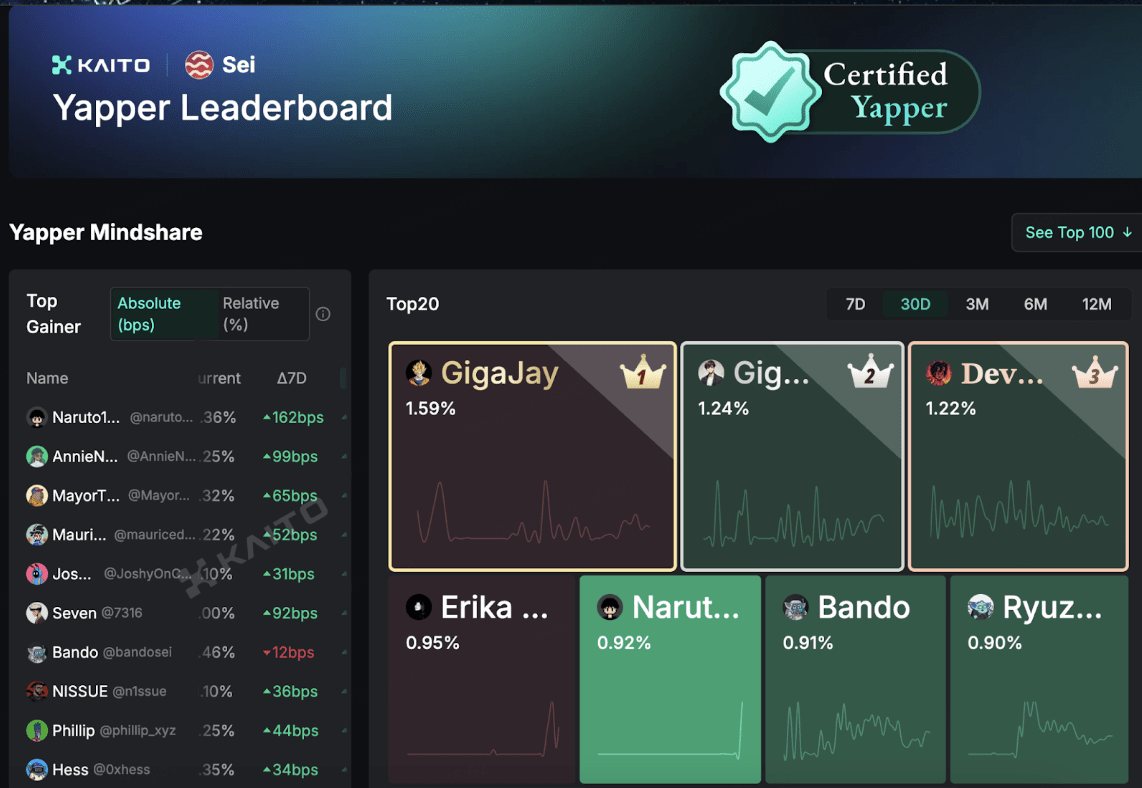
Kaito has built a content incentive and project screening mechanism through the Yapper leaderboard and Launchpad. Users can gain rankings by posting high-quality crypto content, and the leaderboard includes comprehensive rankings, AI topic rankings, and specific project rankings. In addition, each specific crypto project has a separate project leaderboard divided into two phases: before and after TGE, including popular projects like Berachain, Monad, and Initia. The project leaderboard is used to identify and reward core opinion leaders and supporters, allowing users to see who is vying for influence and what content they have posted. The community can vote through the Launchpad to decide which new projects get listed, and holding Yap points or Smart Followers allows participation, with new projects selected for the leaderboard weekly. Voting methods include Yapper voting (based on points and followers) and Holder voting (Genesis NFT + staked KAITO users). Through the Launchpad, users can participate in project support while creating opportunities to compete for their Yap points.
Kaito Connect
Kaito Connect is an AI-based InfoFi information network that promotes information sharing and transparency through interconnected products and frameworks. Any user (regardless of influence) can participate and share crypto-related information to gain corresponding value shares. All rewards are recorded on-chain and publicly verifiable, and the leaderboard mechanism ensures transparent disclosure of sponsored content. This network includes four types of participants: creators, ordinary users, brands, and platforms, and aims to distribute rewards fairly among these four parties.
3. Mechanism for Acquiring Yaps
1. Yap Points Calculation Rules
Kaito's Yaps system is not solely based on traditional 'likes' or 'views'; the official FAQ clearly states that the focus is on post quality > quantity. The algorithm filters out junk content and rewards insightful posts by using large language models to comprehend content in various languages. It comprehensively considers the following factors:
Posting Frequency: Encourage continuous output, but quality is more important than quantity.
Interaction Performance: The more retweets, comments, and other interactions a post receives, the higher the score.
Content Semantics: Whether the content has analytical depth, originality, informativeness, and relevance to cryptocurrency
Originality Assurance: Using LLM and plagiarism detection tools to combat junk content and plagiarism
2. Ways to Acquire Yaps Points
Points are highly dependent on interaction signals from the Inner Circle (i.e., highly influential Crypto Twitter accounts), especially high-quality social behaviors such as comments and quotes, to validate content value and prevent spam and ineffective interactions from inflating scores.
Method 1: Deep Interaction Strategy
Actively comment on high-impact Twitter accounts' tweets to express your views. You can increase the likelihood of a response by supplementing with data or insights. Additionally, reply to tweets related to currently popular projects in the market (like Kaito leaderboard projects) to enhance interaction value. Attracting attention from high-impact accounts (smart followers) can also earn corresponding Yap points.
Method 2: Write In-Depth Content
Focus on writing in-depth content (technical analysis, valuation models, airdrop strategies, etc.) related to the projects on the Kaito leaderboard that week, and then @ the project parties and Kaito to potentially earn Yaps + rewards from the project parties. For instance, considering a user ranked in the top fifty of Sei this month: they posted about 20 tweets related to the project in the past thirty days, each with their own insights and original graphics, and additionally replied to more than 500 tweets related to Sei this month (most of which were meaningless content). Despite having only 9 smart followers and fewer than 1000 fans, they were still able to reach the top fifty on the leaderboard. This indicates that ordinary users can also gain entry into the Kaito leaderboard and earn corresponding rewards by posting high-quality tweets and insights. Smaller accounts can succeed because Kaito's algorithm does not only favor users with large follower counts; some users with fewer followers can surpass KOLs in rankings through high-quality tweets.
3. Kaito Voting Mechanism
Kaito's voting mechanism revolves around the Yapper Launchpad, focusing on distributing influence through holding and participation behaviors. Voting is divided into Yapper voting (based on Yap points and number of Smart Followers) and Holder voting (based on staked KAITO to obtain sKAITO and Genesis NFT). Holder voting accounts for 75%, while Yapper community votes account for 25%. Genesis NFT acts as a 'voting multiplier' to enhance sKAITO voting effectiveness, helping long-term holders gain higher weight.
The voting power of sKAITO is calculated based on four dimensions: the number of holdings, holding time, continuous voting time, and system dynamic multiplier. The system encourages long-term locking and stable support through time weighting and 'holding scores.' The influence of sKAITO voting accumulates gradually over time and will not be immediately apparent; Genesis NFT can enhance its final effect.
4. Popular Activities
1. INFINEX (top-ranked by popularity)
INFINEX's activities are conducted seasonally, with a total prize pool of approximately $6 million worth of uPatrons: Season 0 rewards are about $600,000, and the first season is currently underway with rewards around $900,000. Users participate in point competitions through content creation and invitation mechanisms to earn uPatrons rewards. The distribution of points and reward amounts increases progressively each season: the top three participants in Season 0 each receive rewards ranging from $10,000 to $35,000; the top 10 receive rewards over $7,000; and the top 138 all receive over $1,000. Starting from Season 1, 150 MuPatrons (approximately $900,000) will be distributed, with more rewards allocated in subsequent seasons. Additionally, 20% of uPatrons will belong to Genesis NFT holders and staked users, with some distributed through Infinex airdrops.
Participation methods include:
Post high-quality insights related to Infinex on Twitter, and the system will evaluate rankings based on posts weekly.
Recommend real users to use the platform, increasing points (only sponsors and the top 500 users from Season 0 can generate referral links).
Become an Infinex sponsor, with points and earnings multipliers, to gain higher rankings and rewards.
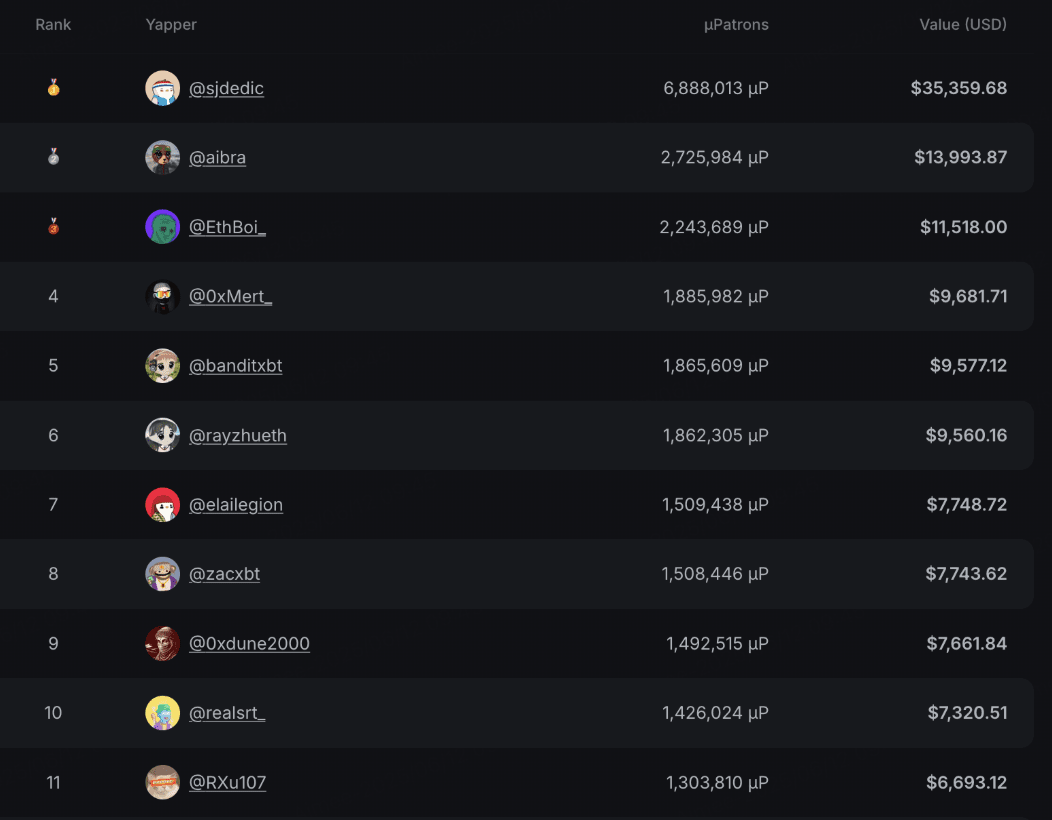
Note: The image shows the earnings of the top 10 users in Season 0
2. Huma Finance
Huma's activities are divided into three seasons, with a total prize pool of approximately 0.5% of the total supply of Huma, worth about $2.3 million. The first season is currently underway, and participants only need to output high-quality, in-depth, and valuable Huma-related content on Twitter to share substantial HUMA token rewards, with the first season reward period from May 26 to June 26. Additionally, users in the Kaito ecosystem will share another 10 million HUMA tokens, and the eligibility for this part of the reward requires users to remain active in the fields of Solana, DeFi, PayFi, and RWA, as well as hold over 100 Skaito / YT Kaito in their SOL wallet on Yaps.
3. Newton
The total prize pool for Newton's activities is approximately 0.75% of the total supply of NEWT, of which 0.5% is allocated to quality Yapple and successful referrals, and a maximum of 0.25% will be distributed to the Kaito community based on community milestone achievements. Users can earn rewards through content creation, recommending Agent usage, and community interaction mechanisms, and introduce community milestone incentives and identity weighting, with the overall growth of the community leading to richer benefits.
Participation methods include:
Post in-depth original content about Magic Newton on Twitter, and the system will evaluate rankings based on depth of speech, interaction quality, and other data.
Recommend other users to register and use the Recurring Buy Agent (intelligent investment agent), where both the referrer and the referred can earn reward points.
Participating in social media follows, joining Discord, and other tasks, as well as platform interactive mini-games, can also earn points. The platform's mini-games include dice rolling and minesweeping.
Community milestone incentive mechanism, mainly referring to the total number of activated Agents in the community reaching the following nodes, increasing the token proportion in the community reward pool, meaning the more participation in the community, the higher the total reward pool:
1K Agent Activation: +0.05%
5K Agent Activation: +0.10%
15K Agent Activation: +0.15%
25K Agent Activation: +0.20%
50K Agent Activation: +0.25%
4. LOUD (ended)
At the end of May, LOUD tokens became the market's focus in the Pre-TGE section of the Kaito platform with nearly 60% attention share, sparking a lot of discussions on X. The design inspiration for LOUD comes from Kaito's concept of attention (Mindshare), where its operating mechanism involves users posting LOUD-related content on X to earn attention value. The Kaito system generates a leaderboard based on this, and the official distributes 72% of token trading fee revenue to the top 25 users weekly according to their ranking; additionally, 18% is allocated to users staking KAITO, and 10% goes to creators, forming a revenue model based on content influence. LOUD's ability to gain significant attention in a short time is also related to its low initial financing threshold. The project raised approximately $70,000 and sold 45% of its tokens in two tranche packages.
Top 1000 users on the leaderboard can subscribe at a price of 0.2 SOL;
Users with more than 10 Smart Followers can also subscribe; if oversubscribed, it will be reduced to 0.05 SOL per address.
After launch, LOUD's price once surged to a market value of approximately $36 million, bringing more than 100 times returns to early investors. However, due to the initial concentrated release of unlocked tokens, combined with a lack of ongoing narrative support, the price subsequently retraced sharply, and its current market value has fallen to about $1.31 million. This indicates that although LOUD successfully attracted widespread attention under Kaito's Mindshare model, due to excessive sell pressure and the lack of follow-up development planning, the project's lifecycle has been relatively short.
5. Conclusion
Overall, Kaito has built an innovative information ecosystem through the Kaito Connect and Yaps points system, allowing KOLs to amplify their influence and earn rewards, while project parties can more accurately identify key creators, design interaction mechanisms, and achieve effective linkage between community content and project value. Although ordinary users also have opportunities to earn points through content creation and interaction, the overall operational threshold is relatively high, requiring continuous time investment to manage accounts (such as posting original content and interacting with quality accounts, similar to operations in Sei activities). Compared to past methods of participating in a single project testnet or brushing transactions to obtain airdrops, the Kaito model has higher costs and participation difficulty for retail investors, incentivizing long-term content creators more.