


Author: Onkar Singh, Cointelegraph; Translated by: Song Xue, Golden Finance
1. The role of random numbers in blockchain
A nonce is a special number assigned to a block during the blockchain mining process and is an important component of the Proof of Work (PoW) consensus mechanism.
As a cryptographic puzzle, the nonce is a variable that miners manipulate to generate a hash value that meets certain requirements. Miners keep changing the nonce until they find a hash value with the necessary properties, usually a certain number of leading zeros. This iterative process is called mining and ensures the security of the blockchain.
Correct random numbers are essential for verifying the legitimacy of blocks and play a key role in block creation. Random numbers prevent the possibility of malicious actors tampering with data by making the computational work required to tamper with the data extremely large.
The mining process is further complicated by the trial-and-error method involved in determining the correct nonce. If a miner discovers the correct nonce, the block is considered legitimate, highlighting the critical role of nonce in maintaining the consensus, security, and integrity of the blockchain.
2. The Importance of Random Numbers in Blockchain Security
The diverse capabilities of random numbers make them extremely important in supporting blockchain security.
It is essential to prevent double spending, which could compromise the integrity of the cryptocurrency. Blockchains reduce the possibility of fraudulent manipulation by requiring miners to perform a computationally demanding process to discover a specific random number. This ensures that every transaction is uniquely confirmed.
Additionally, random numbers enhance defenses against Sybil attacks by imposing a computational cost on attackers who attempt to take over a large portion of the network. This strategy prevents malicious actors from injecting false identities into the system.
In addition, random numbers play an important role in maintaining the immutability of blocks. Any effort to change the contents of a block requires recalculating the random number, which is an impractical task but can enhance the integrity and tamper-resistance of the blockchain.
3. How are random numbers used in the Bitcoin blockchain network?
Miners use Bitcoin random numbers in a trial-and-error process to find a specific hash value that meets the network's difficulty criteria, thereby validating and adding new blocks to the blockchain.
The following step-by-step process explains how random numbers are calculated and used in Bitcoin mining:
Block setup: Miners assemble a new block with pending transactions.
Nonce inclusion: A unique random number is added to the block header.
Hash Attempt: Miners hash blocks using SHA-256.
Difficulty Check: Compares the hashrate to the network’s difficulty target.
Iterative process: Miners adjust the random number until they find a hash value that satisfies the difficulty, verifying that the block is added to the blockchain.
The difficulty of finding a valid nonce in the Bitcoin blockchain is dynamically adjusted to maintain a steady rate of block creation. To ensure that miners competing to find the correct nonce for a valid block hash face a challenge proportional to the network’s hashing power, this adaptive difficulty adjusts to changes in the network’s computing power.
The difficulty increases as the network capacity increases, requiring more processing power to find the right random number. On the other hand, when the network's processing power decreases, the difficulty decreases, making block creation easier.
4. What are the different types of random numbers?
Random numbers, whether cryptographic, related to hash functions, or programmatic, serve different purposes aimed at ensuring data integrity in a variety of computing applications.
While the concept is widely used in blockchain technology, there are various types of random numbers used in different applications. One popular type is cryptographic random numbers, which are employed in security protocols to prevent replay attacks by generating unique values for each session or transaction.
Another type of random number includes cryptographic hash function random numbers, which are used in hashing algorithms to change the input random number to change the output hash. In programming, a random number can refer to a value generated to ensure uniqueness of data or to avoid collisions.
Understanding the specific context and goals is critical because random numbers come in many forms, each designed to meet specific security or functional needs in the broader fields of computer science and cryptography.
5. What is the difference between hash value and random number?
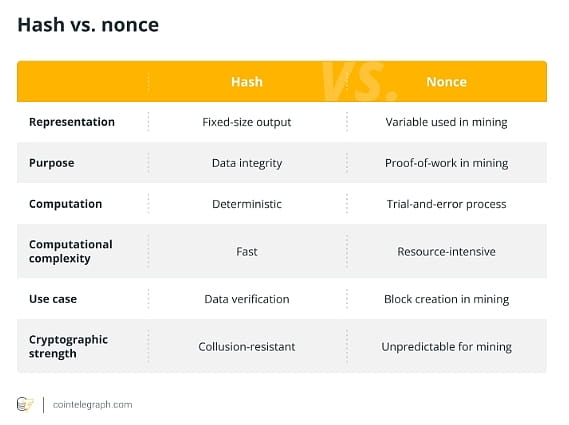
A hash is like a fingerprint of data, while a nonce is a special number used in a security puzzle to create digital currency.
In the context of blockchain, a nonce is a variable used by miners to generate a hash value that meets specific requirements, while a hash value is a fixed-size output generated from input data. The following table lists the differences between a hash value and a nonce.
6. Randomness-related attacks in cryptocurrencies and how to prevent them
In the field of cryptography, attacks involving random numbers mainly focus on exploiting flaws in the creation or management of random numbers, especially flaws in cryptographic protocols.
One notable example is the "random number reuse" attack, where a malicious party is able to reuse random numbers in the cryptographic process, increasing the likelihood that security properties will be compromised. This is particularly important for systems that rely on random numbers to remain unique, such as digital signatures and encryption.
"Predictable random number" attacks are another common attack where an adversary can predict and manipulate cryptographic operations because the random numbers exhibit predictable patterns. Additionally, "stale random number" attacks involve using outdated or previously valid random numbers to trick the system.
Cryptographic protocols must ensure the uniqueness and unpredictability of random numbers to prevent random number-related attacks. It is critical to correctly implement random number generation to ensure that random numbers have a low probability of duplication. In addition, the protocol should also contain mechanisms to identify and reject reused random numbers. Reusing random numbers in asymmetric encryption can have dangerous effects, such as leaking keys or compromising the privacy of encrypted communications.
In addition, continuously upgrading cryptographic libraries and protocols, as well as continuously observing unusual trends in random number usage, can help protect against evolving attack vectors. Reducing vulnerabilities related to random numbers requires the use of security best practices, such as regularly evaluating cryptographic implementations and strictly adhering to standardized cryptographic algorithms.