


Source: IOSG Ventures
Author: Yiping, IOSG Ventures
This article is original content of IOSG and is only for industry learning and communication purposes. It does not constitute any investment reference. If you need to quote, please indicate the source. If you want to reprint, please contact the IOSG team to obtain authorization and reprint instructions. All projects mentioned in this article do not constitute recommendations or investment advice.
TL,DR;
ZK technology is mainly used to improve the scalability, privacy and credibility of various projects such as Starkware, zkSync, Scroll, Mina, Risc0, Giza and EZKL.
ZK technology requires a lot of computing power, resulting in 10^4 to 10^6 computing overhead, posing a challenge to infrastructure teams.
The main methods for generating ZK proofs are Proof Markets and Proof Networks. Proof Markets operate as an open market for trading ZK proofs, while Proof Networks have internal servers that provide a cloud-like experience for generating proofs.
The Proof Market approach allows for flexibility and cost-effectiveness as it facilitates an open market for ZK proof transactions without the need for high-end server management.
The Proof Network approach provides a smooth and developer-friendly experience and provides a solution to generate proofs quickly and reliably without paying too much attention to market mechanisms. In theory, it can generate proofs quickly because it also takes time to match orders in the proof market.
Challenges include difficulties in testing and debugging, emergence of new security issues, possible vendor lock-in, higher fees in certain usage models, and loss of token utility.
Leading players are likely to be those with the most in-house ZK proof demand, as they can leverage existing infrastructure and dedicated teams to maximize hardware utilization.
Emerging applications include ZK Coprocessors, ZK Attestation, ZKML, and ZK Bridges, which all create a greater need for generating ZK proofs.
Decentralized proof networks in the ZK space are driven by the blockchain industry’s preference for security, censorship resistance, and privacy, although the inherent security of ZK means that these advantages do not require decentralization as a prerequisite. For Zk, performance is the primary focus.
introduction
Growing Demand for ZK
After years of research in the zk space and huge improvements in performance, zk is finally being used in real-world applications. Talented engineers are applying ZK to:
Scalability
privacy
Data Credit
There are many interesting projects relying on zk, such as Starkware, zkSync, Scroll, Mina, Risc0, =nil;Foundation, EZKL, Giza, Polygon, and Manta. These projects are steadily and continuously generating zk proofs every day. The most popular zk use case right now is zkRU for solving Ethereum's scalability issues. In the past month, zk proofs have spent millions of dollars on Ethereum/Ethereum L2s.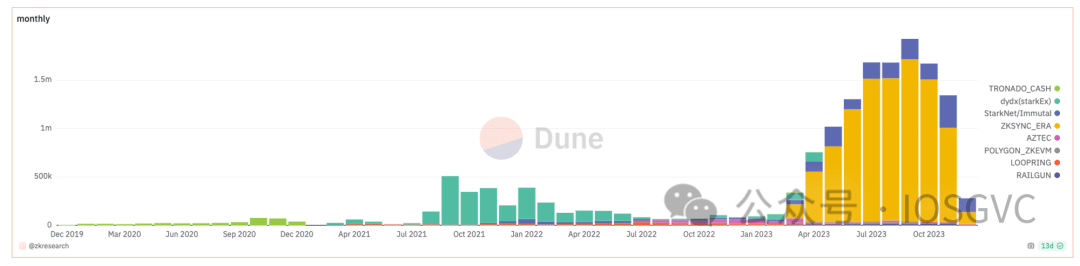 Source: https://dune.com/nebra/zkp-verify-spending A strong increase in ZK verification cost over last year.
This chart by the Near team shows the gas consumption of zkSN(T)ARK on Ethereum and L2s. It includes popular ZK projects like zkSync, Polygon, Aztec, Tornado Cash, Loopring, Worldcoin, Tailgun, Sismo, StarkNet, ImmutableX, and dydx. Compared to zkStark, zkSnark accounts for 80% of the total cost in terms of verification. Among all these projects, Worldcoin has the highest verification cost, followed by zkSync. The verification cost per worldcoin is about $2. The verification cost per zkSync is about $30.
Proving the burden of infrastructure
ZK solves the scalability problem, but it comes at a cost. It requires a lot of computing power. ZK introduces a lot of computational overhead, and the Rollup team needs to deal with this. @_weidai estimates that there will be 10^4 to 10^6 computational overhead using today's ZK technology. In theory, we can achieve 10 times the computational overhead with dedicated circuits. If you add the abstraction layer of virtual machines, there will be 100 times the computational overhead. The figure below depicts a graph of computing power based on yearly growth based on Kummer's law. Chip efficiency has increased by 10 times every decade since 2000. If we compare computing power with 2000 as a baseline, it will reach 784 times in 2025. This also shows that current ZK computing is still not on the same order of magnitude as in 2000.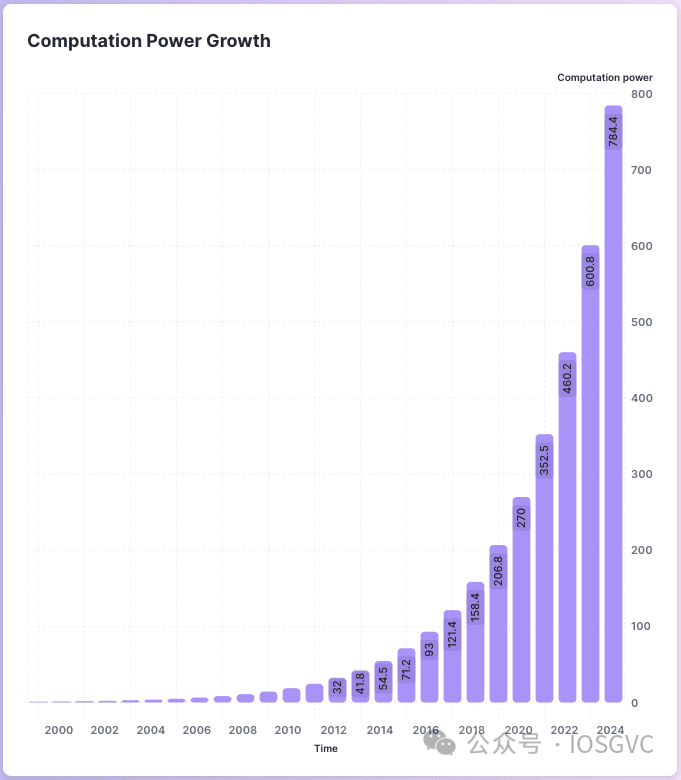 Source:https://visualize.graphy.app/view/04f82b27-3654-47eb-83e8-3981f6e258be
Think about this for a second. We are trying to bring 10x to 100x the volume of transactions to ZKRU. With the increased volume of transactions, we are also facing 10^4 to 10^6 computational overhead. These numbers put a huge strain on the ZKRU infrastructure team. Leading ZKRU teams are using high-end machines with at least 200 GB of memory and have talented operations staff to handle these infrastructure complexities. So what does this mean for a small team if they want to launch a ZKRU or build a third layer solution with the ZK stack? If an independent developer wants to build a ZK Dapp, how can they buy these high-end servers and operate them properly? Now, it is not difficult to launch a ZKRU. You can use the ZK Stack and deploy a new ZKRU by following the instructions in the documentation. The hardest part is getting the high-end infrastructure to work. Managing a bunch of servers is much harder than maintaining our personal laptops on a daily basis. In addition, hardware acceleration is not plug-and-play; each team needs to set up different configurations for their servers depending on the zero-knowledge proof system they use. Ensuring high availability is also a tricky topic. What if a bunch of users start minting Ordinals on your ZKRU and you suddenly have 1000x the throughput? Even experienced teams like Arbitrum experienced hours of downtime due to a surge in Ordinals transactions. Generating a large number of zero-knowledge proofs requires high-end server support. For small and medium-sized teams, setting up and maintaining a fleet of high-end servers would be a heavy burden. In order to better help groups adopt zero-knowledge technology simply and quickly, the Rise project attempts to help these groups handle all the computational infrastructure complexities.
Proven Market
Source: IOSG Ventues
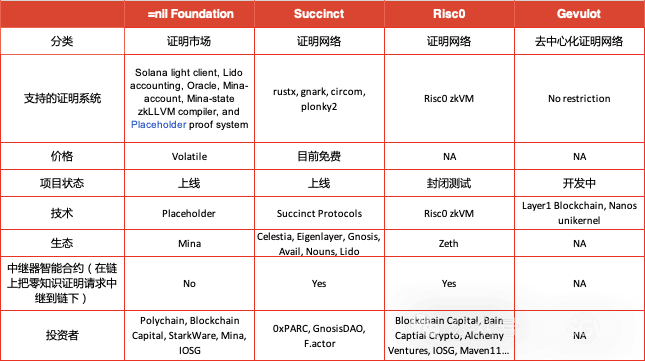
Proof Market and Proof Network are two main approaches. Proof Market is like an open market. To generate a proof, users need to find a party willing to sell proofs for a certain price. Proof Network is like a traditional cloud service, developers submit their circuits and inputs, and a centralized load balancer assigns internal servers within the proof network to generate proofs for users. Proof Market is a popular approach in ZK proof infrastructure. Proof Market is an open market where buyers and sellers trade ZK proofs. The ZK Proof Market team does not need to care about ZK proof hardware or have high-end servers, they focus on ZK proof trading and verification mechanisms to absorb third-party hardware vendors. Proof Market is a more open approach. It welcomes third-party hardware vendors. Buyers can buy ZK proofs at a USD price as long as there are sellers of such proofs. When verifying proofs, everyone in the market does not need to reach a consensus, only the market operator bears the responsibility of verification. In Proof Market, zkDapp developers submit a ZK proof order, including price, generation time, timeout, and public inputs. Then the third-party hardware vendor will accept the order and generate the proof. The economic structure of Proof Market is simple. Proof generators need to stake. If they generate the wrong proof or do not provide a proof by the deadline, they will be fined. Proof generators with more stake will be able to generate multiple proofs at the same time. The main players in the proof market industry are =nil and Marlin.
=nil Foundation
The proof market has sellers and buyers. Buyers are dApp developers. They pay sellers to generate proofs. There are many factors that affect the price of proofs. The main factors include circuit size, proof system, generation time, and input size. Here is the workflow of the =nil proof market:
The proof requester sends a request to the market with an expected price of c_r .
Proof that the marketplace locks the cr_r tokens in the buyer’s account.
The proof producer sends a proposal to the market at price c_p <= c_r.
The proof market matches requests with proposals from proof producers.
Proof Producers generate proofs and send them to the market.
The proof market verifies the proof and pays the producer in c_r - fee tokens.
The proof requester obtains their proof and uses it.
The market is designed to provide a trading-like experience. The price of proof generation changes in real time. Below is a screenshot of the product of the =nil proof market.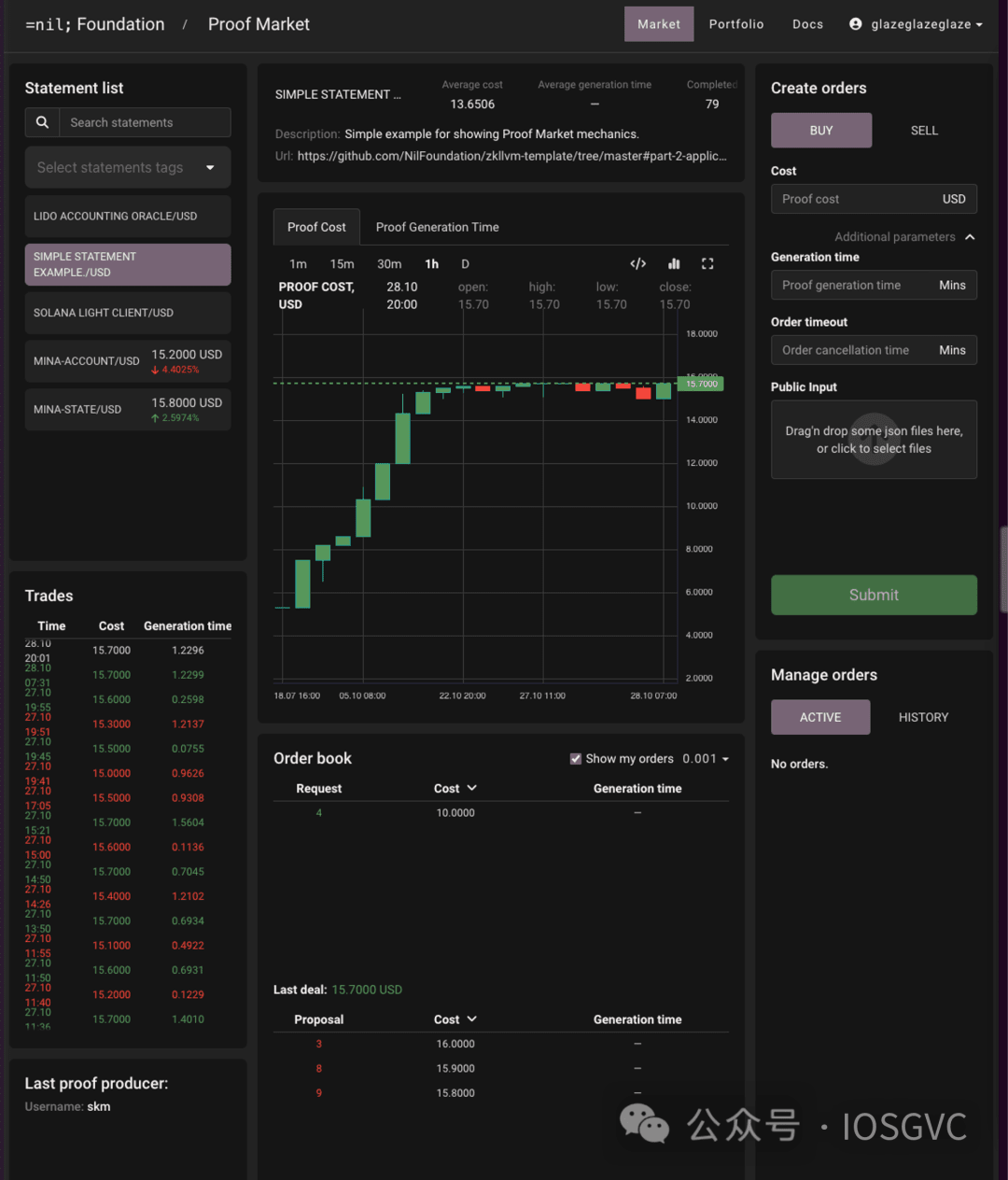 Source:https://nil.foundation/Currently, Proof Market supports a limited number of claims, of which Mina claim proofs are the most active. Specifically, Proof Market accepts circuits based on their zkLLVM compiler and Placeholder proof system.
Gevulot
Gevulot is committed to bringing decentralization to the proof market. Gevulot is an open and programmable first-layer blockchain designed specifically for the proof market. The first-layer blockchain is responsible for handling the distribution, verification, and reward distribution of proof requests. The prover network utilizes lightweight unikernels to achieve high performance. Gevulot uses a verifiable random function (VRF) to distribute the proof work to a small group of provers, ensuring the reliability of the system.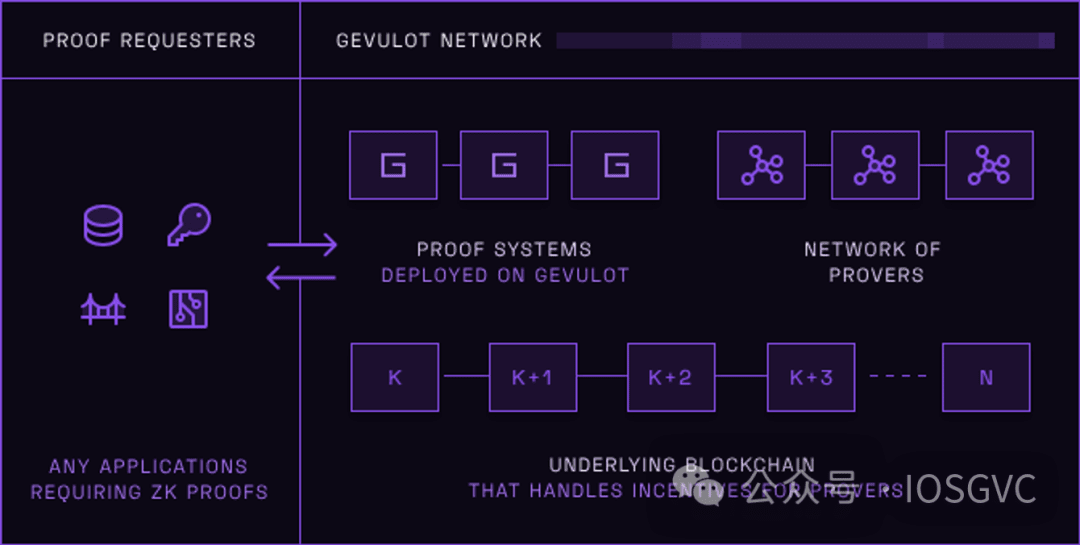 Source: https://www.gevulot.com/Users can deploy programs seamlessly with predictable fees, and users can set a maximum fee based on the number of cycles required for program execution. Provers are rewarded through the Gevulot network and user fees, incentivizing them to generate efficient and competitive proofs. The fastest provers will receive the most network rewards. User fees will be shared equally with all nodes that complete the proof. Gevulot supports program deployment in multiple programming languages, including C, C++, Go, Java, Node.js, Python, Rust, Ruby, PHP, etc., because Gevulot's underlying VM Nanos supports x86_64 Linux ELF binaries. Gevulot is a general computing platform that supports different languages and proof systems. Gevulot relies on the Nanos single kernel to ensure that provers can easily run on different machines. All provers need to be compiled into a single single kernel image.
Proof Network
Proof Network provides a more developer-friendly approach. It works similarly to Web2 cloud service providers. Developers send payload data through the REST API, and the proof network then returns the proof to the developer. Developers do not need to worry about price fluctuations and which party will generate the proof.
Heating0
Risc Zero launched Bonsai using their zkVM. With the power of zkVM, users can have Bonsai generate various claims. For example, based on Bonsai and Risc0 VM, Zeth generates proofs for Ethereum blocks.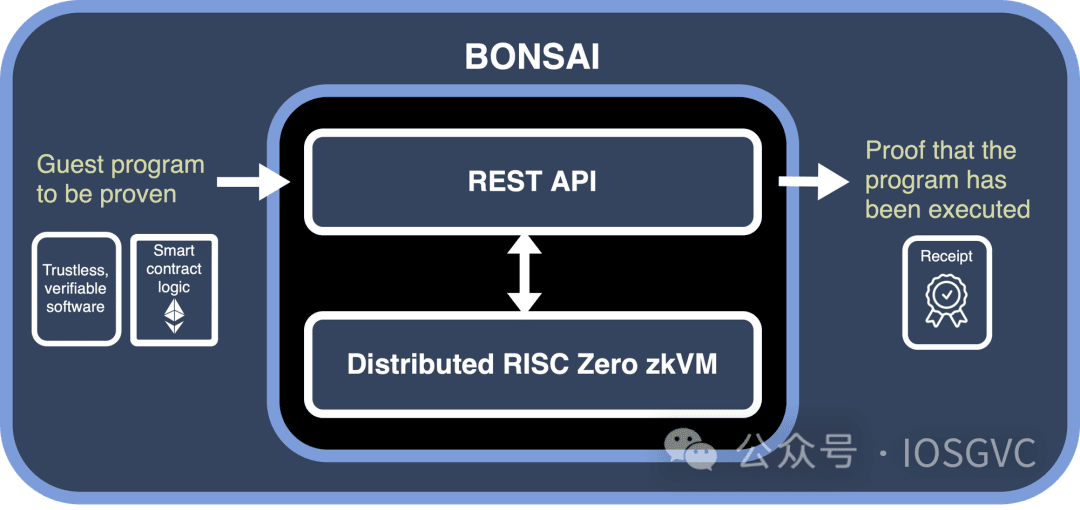 Source:https://www.risczero.com/
Succinct
Recently, Succinct also launched their new product. Instead of providing a REST API circuit, Succinct provides an approach more similar to cloud functions. The following is the user workflow:
Connect to your GitHub account and deploy your circuit
Call the API via REST or smart contract and pass in the circuit input
Query results via REST API or smart contract
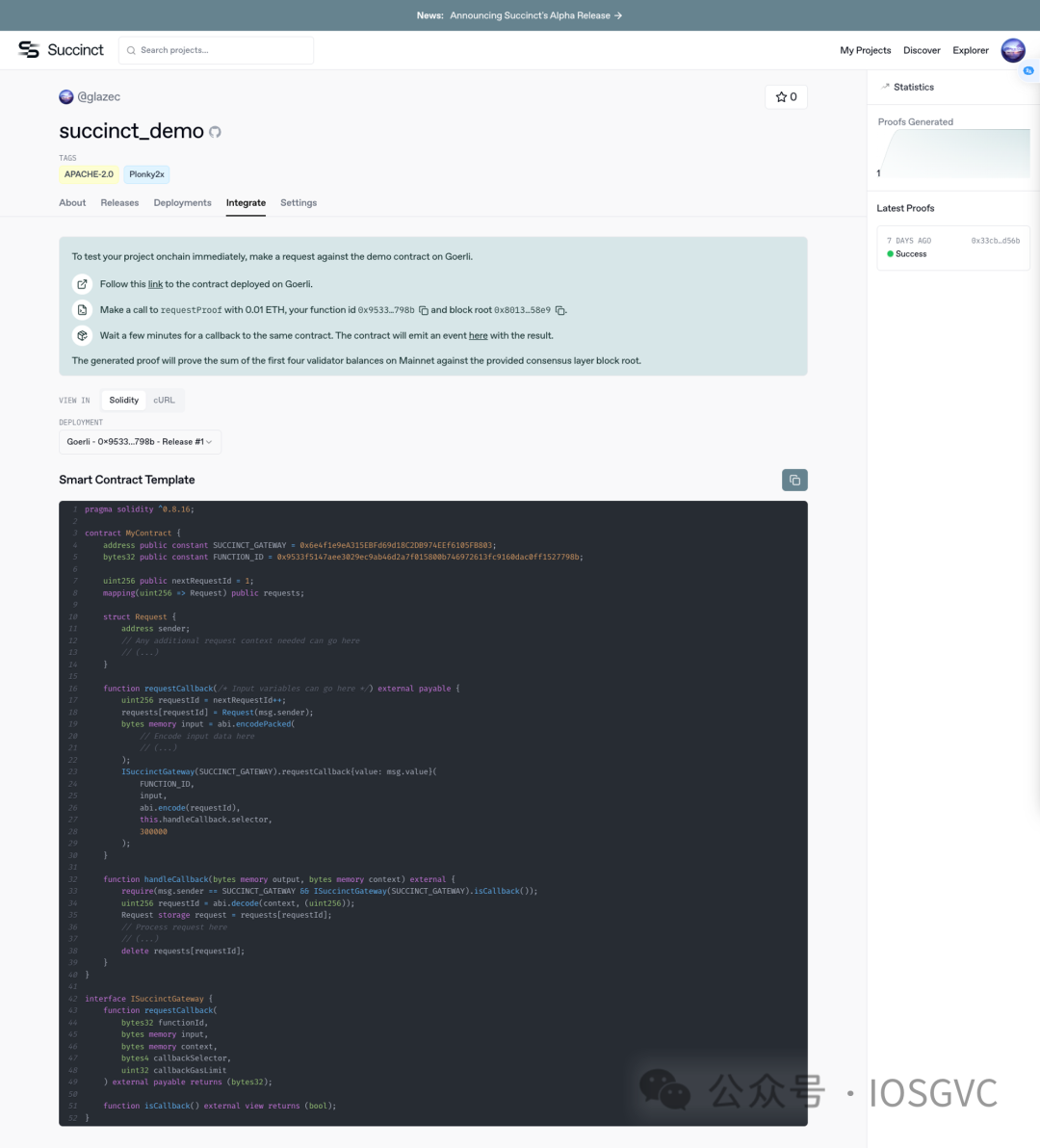 Source: https://succinct.xyz/ Compared with BONSAI, Succinct has the following advantages in developer experience:
Easier management of circuit code base
No secondary transmission circuit required
One-click deployment of smart contracts for on-chain proof generation and verification
Explore popular ZK proofs
View the certificate generation status on the dashboard
Support rustx, gnark, circom, plonky2
Source: https://succinct.xyz/
Prove the network or prove the market
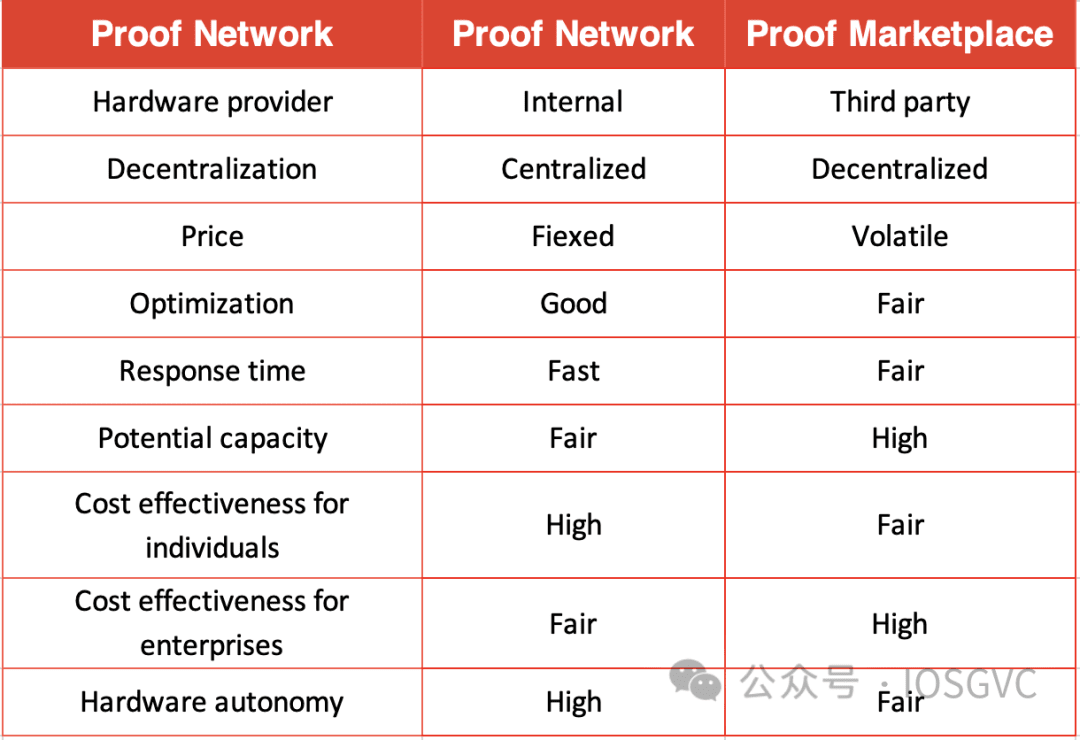
The Proof Market provides greater pricing flexibility for buyers and sellers of proofs. It invites all hardware providers to participate, which helps reduce costs for buyers. But it is worth noting that the amount of savings may vary between individuals and businesses. Typically, centralized services such as the Proof Network may provide free services to individuals while charging businesses a high fee but providing access to VIP customer support. For example, if a business plans to launch a new event or feature, the business can reserve some computing power on the Proof Network in advance. A decentralized market may present more balanced and competitive pricing. In today's market, products based on the Proof Network seem to provide a smoother experience for developers. It handles all the proof generation work and supports major proof systems without introducing any new complex concepts. It provides a consistent user experience. In theory, since order matching in the Proof Market also takes time, it provides fast proof generation. If you are familiar with cloud computing, the Proof Network is more like a stateless cloud function. We have =nil Foundation and Gevulot working on the Proof Market. Succinct and Risc0 are on the Proof Network. Hardware companies like Ulvetanna and Cystic have also contributed greatly to improving ZK proof performance on GPUs and developing next-generation specialized ZK chips. Proof markets are relatively easy to launch. For ZK infrastructure projects, the proof market design can bring more hardware providers online. With its decentralized design, they can easily scale the network to meet future computational needs. In the future, we foresee a combination of proof network and proof market designs. The goal is to provide a seamless experience for developers while integrating the proof market as a backend to facilitate the addition of additional computational resources. This is a direction Succinct plans to pursue in the near future. We are also seeing similar shifts in other markets, such as Infura. Infura has its own servers, but it also plans to bootstrap permissioned parties to provide infrastructure.
Source: IOSG Ventures
Who really needs cloud-based ZK infrastructure?
We believe that developers who want to reduce time to market and build lightweight, flexible applications that can be quickly scaled or updated will benefit greatly from these cloud ZK infrastructures. For applications with large differences in peak and trough usage, cloud ZK infrastructure will reduce costs.
For such applications, it is expensive to purchase a set of servers that are always running and available at peak times. This will result in a large waste of resources during the trough of usage. Cloud infrastructure can be expanded at any time to improve performance. The excess computing power can be automatically released during non-peak hours.
Who will be the leader?
From our understanding of the Web2 cloud industry, we have found that those companies with the largest demand for computing tend to have leading cloud infrastructure businesses. They can take advantage of scalability, cost, team, and innovative products. The same applies to cloud ZK infrastructure. We believe that projects with the largest demand for generating verification have the potential to have one of the most successful ZK cloud infrastructure businesses. For projects that generate a large number of ZK proofs in-house, they already have a large amount of infrastructure, optimizers, and professional teams. They can also maximize hardware utilization by sharing proof resources across applications; when an application does not need to generate proofs immediately, the prover can be reused for other purposes. These large projects have their own proof systems to some extent. Third-party proof infrastructure often has difficulty optimizing the various proof systems used by different large projects. By providing fast and easy-to-use cloud provers, large projects can effectively expand their proof system ecosystem. For ZKRU, cloud ZK infrastructure can increase the usage of its forks. It is not difficult to start a new layer 2 or layer 3 on these ZKRUs, but maintaining the ZK infrastructure will be costly. Providing an out-of-the-box and flexible cloud prover can help attract more developers. Currently, most developers usually use OPRU SDK to build new layer 2 or layer 3 because the corresponding infrastructure is easy to manage. Without building their own ZK infrastructure, these large ZK projects need to pay high fees to third-party computing providers. They are also limited in their development speed because they cannot always customize their own infrastructure to further improve performance and reduce proof costs.
Who has the greatest need for zero-knowledge proofs?
In addition to ZKRU and layer 1 networks, we have recently seen more emerging applications for zero-knowledge proofs. They all have a huge need for proof generation. Zero-knowledge coprocessors enable smart contract developers to access past blockchain states without trust. A zero-knowledge coprocessor generates zero-knowledge proofs for these past blockchain states. This may be a more secure and less trustless alternative to graphs. Zero-knowledge authentication helps users bring off-chain data or identity information onto the blockchain. After the authenticator verifies this data off-chain, a zero-knowledge proof is generated for it and placed on the blockchain. Zero-knowledge machine learning makes on-chain reasoning possible. The computation provider performs the ML computation off-chain, generates a zero-knowledge proof for it, and then publishes the proof to the blockchain. Zero-knowledge bridge is a more secure version of cross-chain bridge. It generates a proof of storage or even a proof of consensus for the source chain and places it on the target chain. This may replace the current cross-chain bridge.
What’s so special about decentralized proof-of-stake networks?
Decentralization is the most popular narrative within the blockchain industry. Decentralization brings many benefits:
safety
Censorship resistance
Privacy
Zero-knowledge proofs are different from other general computations. ZK is inherently secure. Anyone can easily and quickly verify the proof to ensure the prover’s honesty. In the ZK space, decentralization is not a prerequisite for security. Zero-knowledge proofs focus on complex low-level details, built into circuits. While the content within these circuits is extremely difficult to censor, censorship can still be effectively implemented by targeting the ZK proof generation requester. Privacy may become an issue for the proof network because users send private inputs to the proof network. The ideal solution is to generate proofs locally to prevent any data leakage. This will pose challenges for local performance. Other solutions may be a new zero-knowledge multi-party computation protocol or generate proofs in a trusted execution environment. A decentralized proof network cannot bring more privacy. Apart from narrative, censorship resistance may be the main reason to build a decentralized proof network. Zero-knowledge proof technology is still in its infancy and we have not observed any form of censorship in this space so far. However, the main challenge hindering the development of zero-knowledge proofs is performance. Introducing a decentralized proof network may lead to an increase in the computational requirements for generating proofs.
in conclusion
Zero-knowledge proof applications are growing rapidly and are used in a wide range of areas. We expect to see zero-knowledge proofs integrated into different technology stacks. We have already seen ZK layer1, ZK layer 2 network, ZKML, ZKVM, ZK-Email. Developers are also building ZK oracles, ZK data sources, and ZK databases. We are on the path of "ZKing everything". The computational overhead brought by ZK forces developers to deploy their circuits on high-end servers. Therefore, we expect the demand for cloud ZK proof infrastructure to increase to help developers get rid of the complexity of operating these infrastructures.
Our insights in this area include:
Proof Marketplaces and Proof Networks are two main approaches that can help shield ZK dApp developers from infrastructure complexity.
We anticipate a hybrid approach that combines both proof-of-stake and proof-of-stake market mechanisms.
Not all ZK dApp developers are suitable for using cloud ZK infrastructure. Medium-sized projects with stable traffic can self-host servers to reduce costs.
The leaders in cloud ZK infrastructure will be projects that have demand for generating large volumes of ZK proofs, such as the leading ZKRU. They have the economic incentive to do this business.
Decentralization is the main narrative in crypto because it brings privacy, censorship resistance, and security. ZK proofs already have some of these properties. Currently, the selling point of the decentralized proof market is censorship resistance.
The popularity of cloud ZK proof infrastructure is closely related to the number of ZK dApps currently on the market. While some projects initially highlight their cloud ZK proof infrastructure as a key feature, many eventually shift focus to other new narratives.