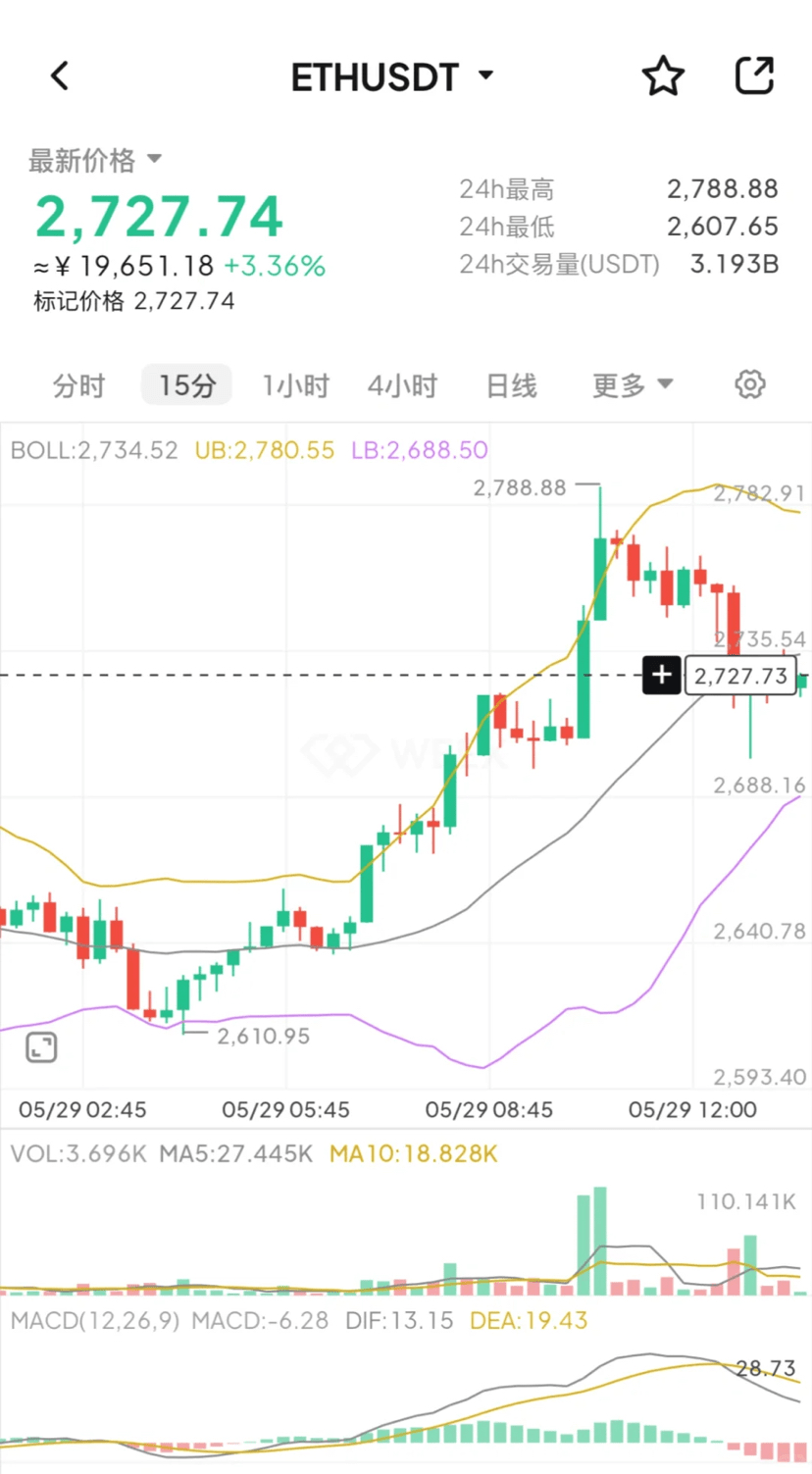
I. Identify Trend Signals (Key of the Key)
Fundamentals First
Pay attention to industry cycles (e.g., Bitcoin halving), policy trends (regulatory easing/tightening), and technical breakthroughs (new narrative hot spots).
On-Chain Data: Capital flow direction in exchanges, whale address movements, stablecoin inflow and outflow.
Technical Confirmation
Trend Direction: Weekly/Daily MA200 to determine long-term trend; price above the moving average indicates an upward trend.
Key Signals: Breaking through long-term resistance levels (e.g., upper boundary of a range), bullish arrangement of moving averages (MA50 golden cross MA200), MACD golden cross above the zero line.
Volume-Price Coordination: A trend requires increased volume to start, and a decrease in volume during corrections is a healthy signal.
II. Three-Stage Strategy for Trend Trading
1. Early Stage of the Trend: Trial and Error Entry
Left Side (Prediction): Gradually build a position in batches during market panic, use small positions for trial and error, and set stop-loss when breaking previous lows.
Right Side (Confirmation): Enter after breaking resistance levels; if the price stabilizes above MA200 and volume increases, the win rate is higher.
2. Mid Stage of the Trend: Primarily Hold
Position Management: Gradually increase the position to 30%-50% after confirming the trend, using 'pyramid scaling' (decrease position incrementally after breaking resistance).
Dynamic Profit Taking: Trailing Stop Loss: Hold along MA5/MA10, liquidate part of the position when breaking down.
Partial Profit Taking: Take 30% profits every time there is a 50% increase, keep the base position to aim for higher targets.
Taboo: Do not exit due to short-term corrections (10%-20% fluctuations), do not short against the trend.
3. Late Stage of the Trend: Decisively Exit
Top Signal: Technical: Divergence (new price highs but indicators do not reach new highs), long bearish candle at high levels, breaking the upward trend line.
Market Sentiment: Retail investors entering frantically, media hype, Fear and Greed Index > 90.
Operations: Take partial profits when reversal signals appear, and liquidate when breaking critical support levels (e.g., previous lows).
III. Risk Control Iron Rules (Life-Saving Bottom Line)
Stop Loss Must Be Set: Set a 5%-10% stop loss for each trade (mainstream coins can be relaxed to 15%); exit unconditionally when breaking critical support levels.
Position Management: Primarily spot trading, futures leverage ≤ 5 times, single currency position ≤ 20%.
Diversified Allocation: 70% mainstream coins (BTC/ETH) + 30% potential coins (be wary of altcoin zero-risk).
Reject Emotional Trading: Do not chase highs or sell in panic; execute according to preset plans (entry price/target price/stop-loss price) to avoid FOMO and panic selling.
IV. Core Mindset: Make money from trends, relying on patience rather than skills.
Accept Imperfection: Not buying at the lowest point or selling at the highest point; capturing 80% of profits in the middle of the trend is success.
Reduce Watching: Overly focusing on short-term fluctuations can lead to mistakes; check the market at fixed times daily (e.g., morning and evening).
Review Optimization: Summarize the correctness after each round of trends, such as whether to take profits too early or set stop losses too strictly, and iterate strategies.
Note: The crypto market is highly volatile and risky; any strategy must be adjusted according to real-time market conditions. Beginners are advised to start by tracking the major trends of BTC/ETH.#Strategy增持比特币 #币安Alpha上新 $BTC $ETH