


Author: Moonshot
AI has been hot for almost three years.
Major technology giants are rushing to enter the game, but in this craze, Apple, which is closest to our lives, seems to be the furthest from AI.
The biggest giant seems to be invisible in front of the hottest trend.
At WWDC last June, Apple slowly released Apple Intelligence, but now that almost a year has passed, for most users, Apple Intelligence is still only heard of, not seen.
The whole world sees that Apple's AI is not doing well, but no one knows what exactly happened.
Renowned Apple analyst Mark Gurman just published a lengthy article on foreign media titled (Why Apple Still Hasn't Cracked AI), revealing Apple's internal wavering attitude towards AI, internal struggles, and insurmountable technical bottlenecks.
It is worth noting that Gurman used "Still hasn't", which has already set the tone for Apple's current situation.
This article will reorganize the original text to present Apple's history, current situation, root causes, and future challenges in the field of AI, and analyze why Apple is struggling in the AI race, making AI its Achilles' heel.
01 Siri 14 years ago, the concept was already a large model
On October 4, 2011, the day before Jobs died, Siri, the legacy he left to Apple, was born.
At that time, Siri was like a product of science fiction coming true. It could understand users' voice commands, book restaurants, find movie theaters, or call taxis. Apple once again turned the future technology concept into a mainstream product.
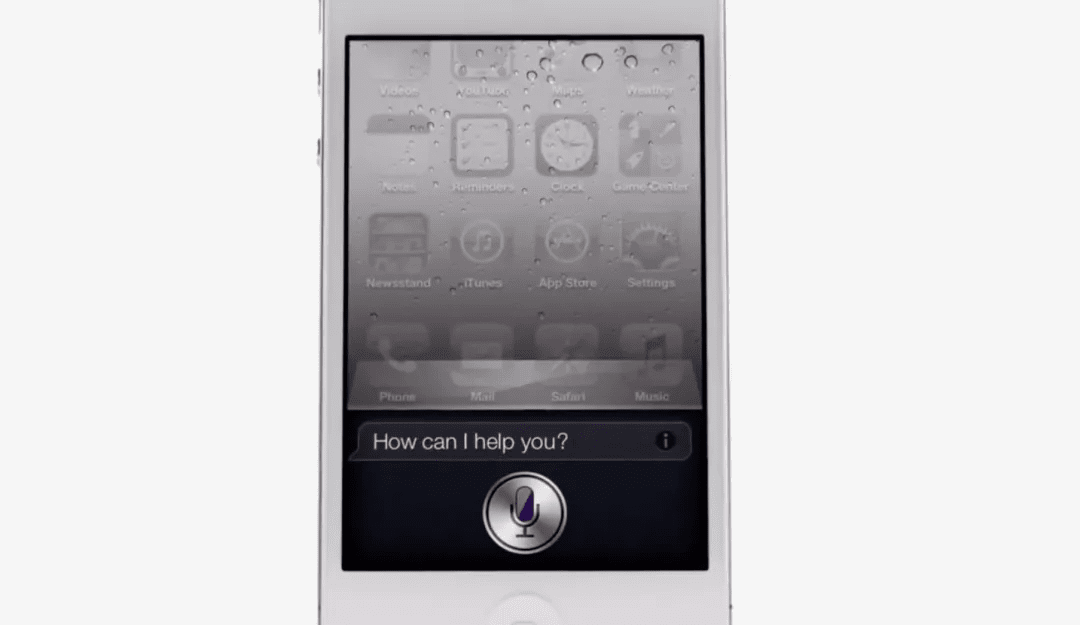
Siri was released with the legendary iPhone 4s | Image source: Apple
At that time, Jobs was not very interested in building a search engine.
Someone who used to work with him said: "Jobs didn't believe that users would actively search for things. He believed that Apple's job was to carefully select and show users what they wanted." This concept, like many of Jobs' beliefs, still deeply influences Apple after his death.
When Jobs first came into contact with Siri, which was still an app in the App Store, he was immediately attracted.
Siri co-founder Dag Kittlaus recalled that Siri's ultimate goal was "You can talk to the Internet and the assistant will handle everything for you. You don't even need to know the source of the information, and the problems found by apps and websites will be solved." This is the most widely used application scenario of large language models today.
Jobs immediately realized that Siri was far more than just an app. He soon contacted Kittlaus and invited the Siri team to his home for a meeting. In the three-hour meeting, Jobs proposed to acquire their company. Kittlaus initially rejected the acquisition proposal, but couldn't resist Jobs' continuous phone calls for 24 consecutive days to persuade him.
Eventually, Kittlaus agreed to sell Siri. Jobs immediately listed Siri as Apple's top development project and devoted himself to Siri's research and development at the end of his life.
At that time, Siri led the smart voice assistant market. However, in the years that followed, competitors such as Google, Amazon, and Xiaomi launched more advanced voice assistants and smart speakers, but Siri has not seen significant progress.
With the launch of Siri, Apple also began research on machine learning, but it was mainly used for facial and fingerprint recognition, intelligent suggestions (such as reminding you when to leave based on traffic conditions), improving maps, and the key projects at the time: head-mounted displays and cars.
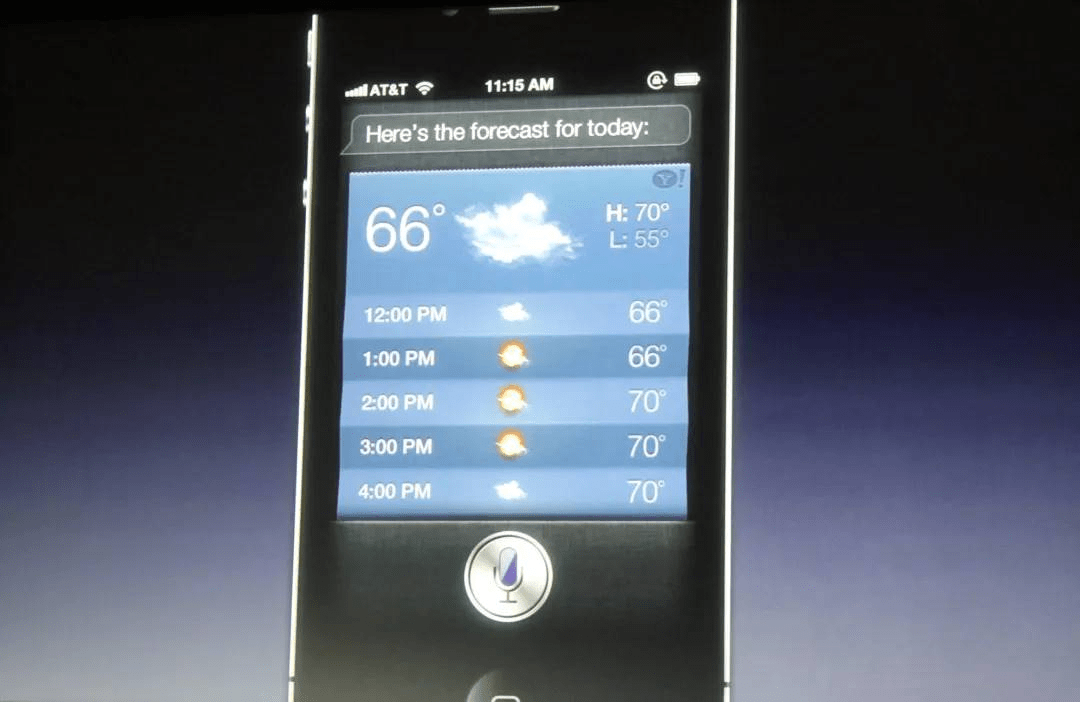
Using Siri to check the weather | Image source: Apple
In the early years, Siri's development focused only on basic tasks such as providing weather information, setting timers, playing music, and processing text messages.
Looking at the actions, Apple has long deployed in the AI industry. They have acquired several small AI companies, including machine learning companies Laserlike, Tuplejump, and Turi.
According to insiders, Apple even considered acquiring Mobileye Global Inc. for approximately $4 billion, which may be Apple's largest acquisition ever.
Mobileye was developing accelerated autonomous driving systems and computer vision technology. But Apple eventually abandoned the deal, and Intel acquired Mobileye for $15 billion in 2017.
So, looking at the direction, Apple is not betting AI on the voice assistant field.
At that time, OpenAI, which had only been established for half a year, claimed that it would manufacture "general" robots. But Siri was still doing what it did when it was acquired, setting alarms, checking the weather, and playing music on countless iPhones.
02 Expectations, infighting, exclusion
Why has Apple, with money, status, and strength, stumbled in AI? Perhaps only veteran Apple analyst Mark Gurman can access so much inside information. He used a great deal of space to report on Apple's internal strife over AI.
In 2018, Apple poached John Giannandrea (known in the industry as JG) from Google to be the head of AI.
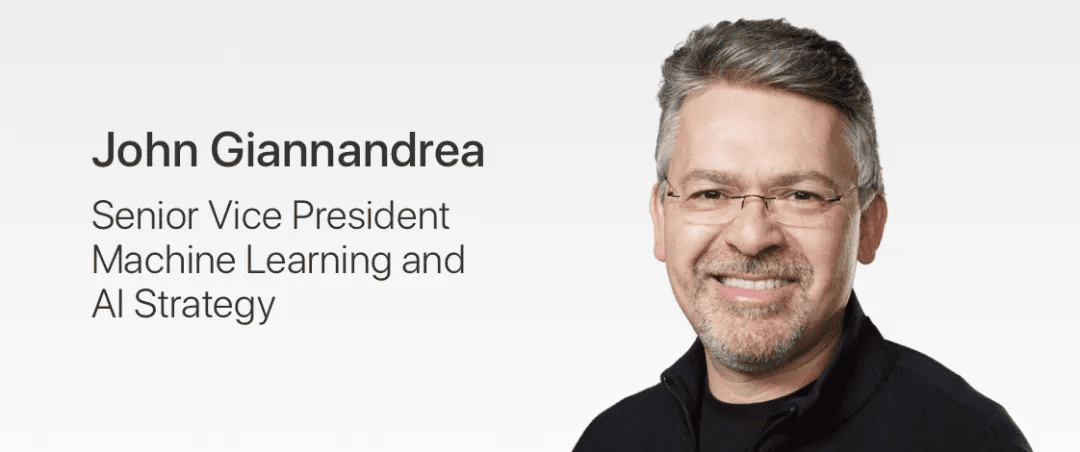
Apple AI chief John Giannandrea | Image source: Apple
JG was previously in charge of Google's search and AI departments, leading the team to deploy AI technology in products such as Google Photos, Translate, and Gmail.
"JG was not only regarded as the most influential executive at Google after the CEO, but also served as the chief technology officer of Internet pioneer Netscape." One person involved in the recruitment said: "Could there be anyone more suitable than him?"
For Apple, poaching JG not only severely hit competitor Google, but he was also expected to be the first step in transforming Apple into an AI leader.
In the official Apple press release at the time, Cook said, "Machine learning and AI are critical to Apple's future development. It will not only completely change the way people interact with technology, but also bring significant improvements to users' lives. We are very fortunate to be able to work side by side with John. As a leader in the field of AI, he will definitely be able to promote our long-term development in this key area."
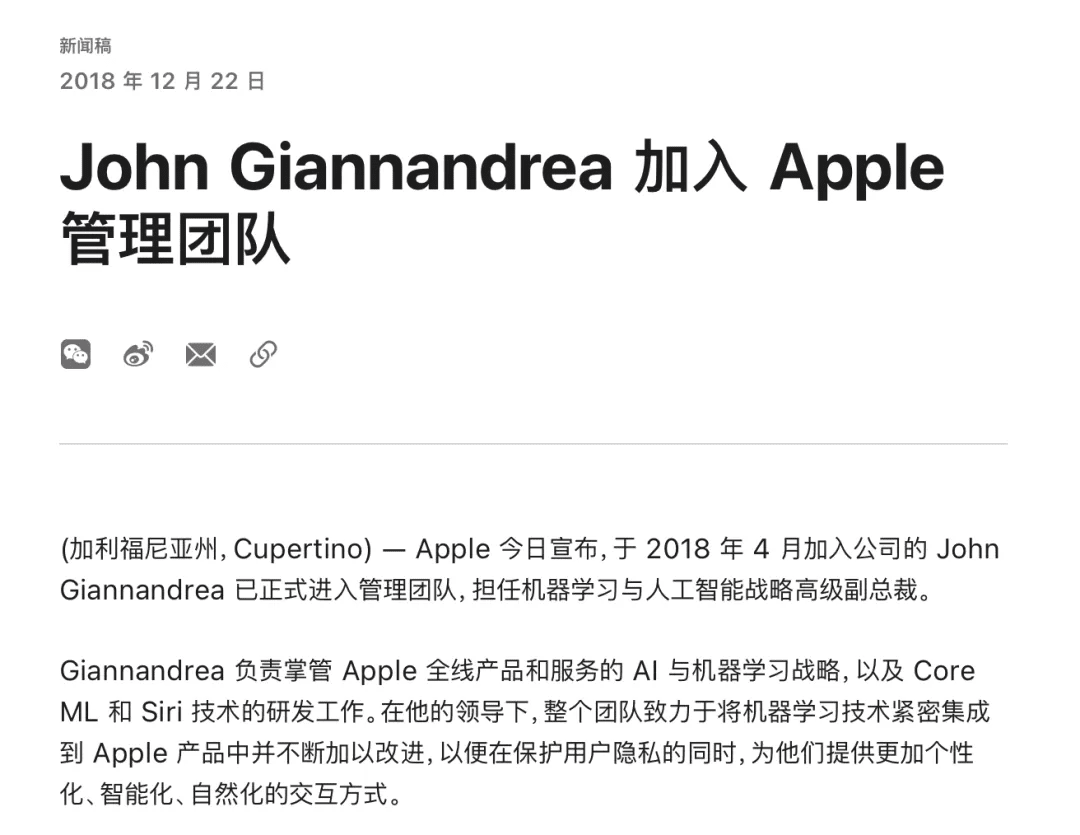
John Giannandrea joined Apple in 2018 as head of AI and machine learning | Image source: Apple
However, looking back seven years later, this expectation and optimism have vanished. Apple's AI has not only not improved, but has fallen further behind.
The core issue is:
Executives have inconsistent understanding of the AI route.
Some senior executives in charge of software engineering believe that Apple should highlight AI more in iOS. Around 2014, one executive said: "We quickly realized that this was a revolutionary technology, far more powerful than we initially understood." But they couldn't persuade Craig Federighi, who is in charge of iOS, to take AI seriously. "Many suggestions fell on deaf ears."
However, Cook unexpectedly has a good opinion of AI. Someone who used to work with him said: "Cook is one of the most optimistic people in Apple about AI. He has always been frustrated that Siri is behind Alexa. He is also dissatisfied that Apple has not gained a foothold in the smart speaker field."
JG, the person in charge, has been wavering in his judgment of AI.
When JG joined Apple in 2018, according to other executives' recollections, he believed that Apple's closed software ecosystem was a unique advantage that could instantly deploy the latest features to billions of devices.
But JG quickly discovered that Apple needed to invest hundreds of millions of dollars more for large-scale testing and image and text annotation to train large models. JG poached top AI researchers from Google and formed a team responsible for testing and data analysis. Then JG turned his attention to Siri, replaced the person in charge, and proposed cutting off Siri's rarely used functions.
However, JG's efforts are often blocked. According to several colleagues, software manager Craig Federighi is unwilling to invest heavily in AI. He does not think AI is a core capability of mobile devices.
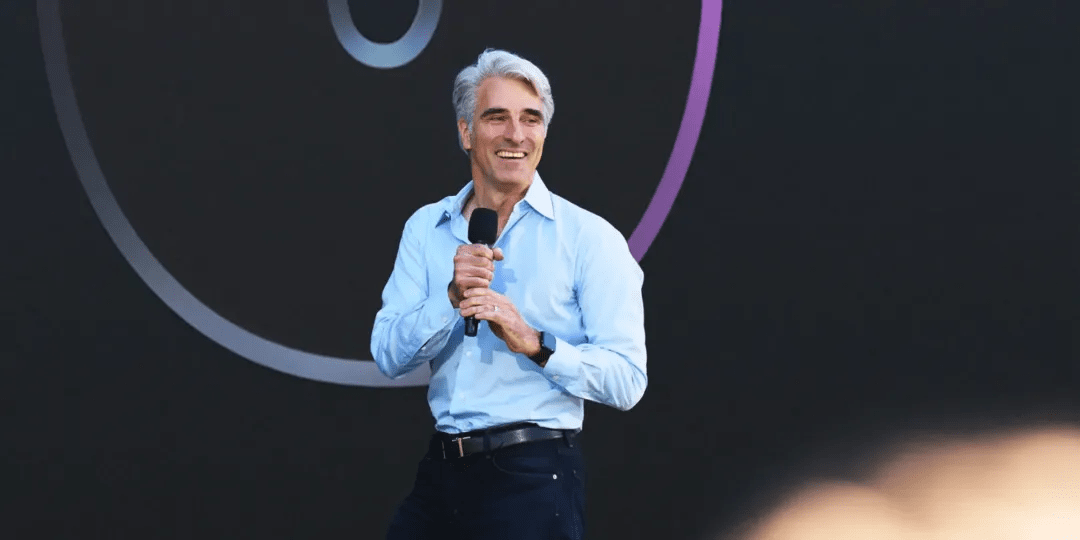
Craig Federighi is a familiar face at press conferences and has always been in charge of Apple's software team | Image source: Apple
A veteran executive who has worked at Apple for a long time said: "Craig is not the kind of guy who would say 'We have to do something big and need more budget and people'."
Other leaders also have similar reservations. One veteran executive said: "In the field of AI, you have to invest first to know what the product is. This is not Apple's way of doing things. When Apple develops a product, it already knows what the final goal is... Our usual strategy is to enter late, rely on over 1 billion users, steadily and surely, and eventually defeat everyone."
But this strategy doesn't work for AI. The release of ChatGPT in November 2022 caught Apple off guard.
A senior executive said that before that, Apple "didn't even have the concept of Apple Intelligence."
Another executive said: "OpenAI's actions are no secret. Anyone paying attention to the market should see it and fully invest in it."
Less than a month after ChatGPT was released, Craig Federighi started using generative AI to write code for software projects. According to insiders, he suddenly saw the potential of AI and joined JG and other executives to meet with AI companies such as OpenAI and Anthropic, and quickly learned about the latest models and market trends. Since then, Craig Federighi has required as many AI features as possible to be added to iOS 18 in 2024.
JG then began to form an AI team to develop large language models. At this time, they were already many years behind their competitors.
According to multiple employees, various product development teams within Apple are responsible for part of AI R&D, resulting in difficult unification of technology, progress, and compatibility.
At WWDC 2024, Apple Intelligence arrived as expected, but its capabilities were somewhat stretched.
Apple's generative AI capabilities are indeed lagging behind. According to Bloomberg, Apple has an internal chatbot that can handle basic image generation, but it's at least 25% behind ChatGPT and significantly less accurate when processing most queries.
In order to provide consumers with the AI products they really want, Apple has to negotiate with competitors such as Google, Anthropic, and OpenAI.
This has caused internal disagreements again. JG advocated for using Google's Gemini, arguing that OpenAI's protection of personal data and sustainable development capabilities were not as good as Google's. But Apple's corporate development team didn't think so. They were optimistic about OpenAI, so WWDC announced that requests that Siri cannot handle will be transferred to ChatGPT.
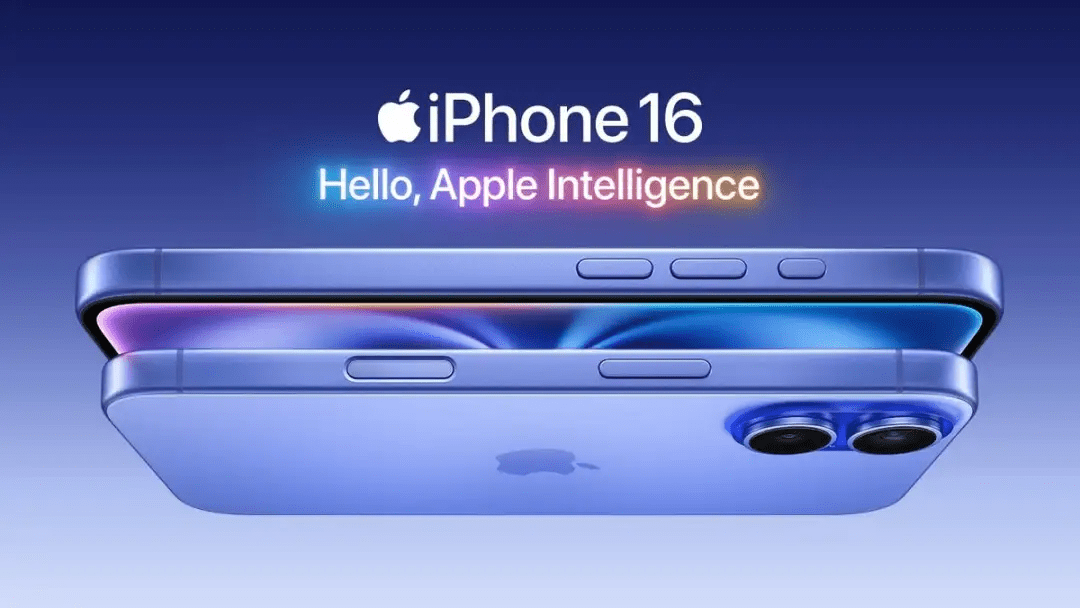
The iPhone 16, which focuses on Apple Intelligence, has not yet been "fulfilled" | Image source: Apple
Apple's lack of a self-developed AI chatbot makes many executives uneasy, but JG doesn't think large models are the future of AI.
According to multiple employees, JG believes that it will take many years for AI Agents to truly replace humans, and most consumers, like him, do not trust generative AI.
These employees say this explains why JG didn't fully build a consumer-facing ChatGPT competitor. They revealed that JG once said that consumers don't want tools like ChatGPT.
Within Apple, JG took most of the blame for delays and mistakes. According to multiple employees, JG has always had difficulty integrating into Apple's core executive circle "Those executives have worked together for decades and run the company like a family business."
JG's position is very embarrassing. He is an executive parachuted in from the outside and it is difficult to promote core changes at Apple. According to an employee who knows him, "JG should have been more active in fighting for large funds, but he is not a salesman, he is a technical expert."
Some people also say that JG is not hands-on enough and does not strictly demand employees. One executive said: "Other engineering teams at Apple go all out and deliver on time, but JG's team is not like that. Their execution is insufficient." This impression of "leniency" also extends to welfare.
Unlike other Silicon Valley giants, Apple headquarters employees have to pay for their own cafeteria meals. However, during the crunch time for Apple Intelligence, some of JG's engineers often received free meal tickets, which caused dissatisfaction among other teams. One employee said: "Apple doesn't provide free meals, but his team delivers a year later than others and gets free lunch." These subtle differences in treatment caused divisions between different teams within Apple.
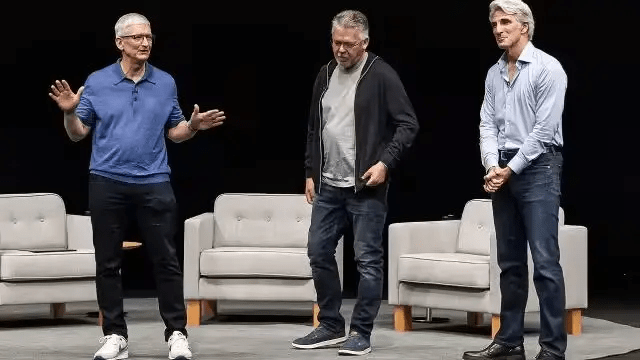
Left: Cook Middle: JG Right: Craig Federighi | Image source: Bloomberg
JG's so-called lack of urgency may not only be a matter of personality, but also a philosophical consideration of understanding AI.
He has always been conservative about the pace of AI development, doubted the value of chatbots, and believed that the threats from competitors such as OpenAI, Meta, and Google were not urgent.
Some Apple colleagues said that JG insists that the AI assistant that users want is the main interface of the device, not an app. Despite delays and setbacks, he still sticks to this vision.
In March of this year, JG was stripped of all product development control, including Siri and robot projects. According to other executives, Cook lost confidence in JG's execution of building new products.
JG retained supervisory control over AI, large language model development, AI analysis, and some development teams. According to insiders, some executives discussed reducing JG's responsibilities or letting him gradually retire, but Craig Federighi and others were worried that if JG left, the top researchers and engineers he brought might also leave.
Currently, JG has chosen to stay. He told his colleagues that he doesn't want to leave until Apple's AI work is on the right track. He also frankly said that he was relieved that he was no longer in charge of Siri.
03 Technical backwardness, the crossroads of privacy
The mistakes of technology giants cannot be simply blamed on JG alone.
The marketing and advertising teams promoted unfinished features in advance. Craig Federighi is the final decision-maker for software projects, and Cook set the product development culture for the entire company.
Even the former CFO was too conservative when purchasing GPUs. Apple did not use its market dominance and cash reserves, but purchased AI hardware slowly as usual. As a result, most of the world's GPUs were snapped up by competitors such as Amazon and Microsoft, resulting in slower AI model training speed for Apple.
According to executives at Apple and other companies, Apple has far fewer AI employees than its competitors and purchases fewer GPUs for training and running large language models.
For Apple, missing out on potential disruptive technologies isn't fatal. After all, Apple often lets its competitors explore new technologies to validate the market, and then refines the products to launch well-designed and easier-to-use versions to users.
This strategy has also shaped users' perception of Apple as "not seeking the latest, but seeking the best." All along, Apple has become the world's most valuable technology company with carefully crafted products, selected content, and annual software updates.
Apple also thinks so. At the earnings call in May, when Cook was asked by shareholders about the AI delay, he said that it just needs more time to meet Apple's quality standards. "There are not too many other reasons, it just took a little longer than we expected."
But the question is, how long is long? Apple has invested a lot of resources in AI but with little effect. What's more, AI is a faster and more complex technology.
Looking back on history, Apple's most successful products are built on internally developed core technologies, such as the iPhone's multi-touch and the Mac's self-developed M-series chips. But in AI, it's hard to see Apple's technical strength.
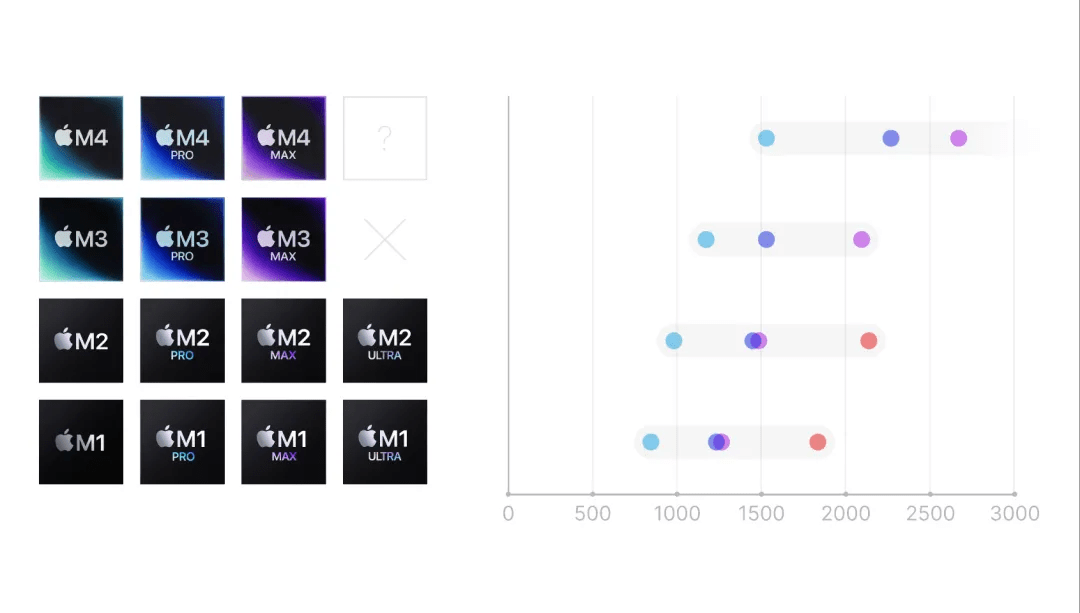
Apple's M-series self-developed chips have fully penetrated into the hardware line | Image source: Figma
What's more, in AI, Apple has a technical bottleneck that other giants don't have: data utilization.
For many years, Apple has been using protecting user privacy as a marketing selling point, but now this has become an obstacle to their AI development.
With 2.35 billion active devices, Apple has more web searches, user habits, and communication data than many competitors. But Apple's restrictions on AI developers accessing data are far stricter than those of Google, Meta, and OpenAI, which means that Apple's researchers can only use third-party licensed data sets and synthetic data (artificial data created specifically for training AI).
Someone who understands Apple's AI and software development said: "At Apple, every move in AI has hundreds of rejections. You have to fight with the privacy police to make progress." An executive with a similar view said: "Look at X's Grok, it keeps improving because they have all the data from X. What does Apple use to train its own AI?"
Apple stands at the crossroads of data and privacy. The advantages that it used to promote have become technical disadvantages. In the AI market that is running wild in the grass, Apple seems too "refined."
04 One move affects the whole body
Apple's weakness in AI affects more than just Apple Intelligence.
Last year, Apple terminated its multibillion-dollar, decade-long autonomous driving car project, partly because AI failed to deliver on its promise of fully autonomous driving.
According to Gurman's speculation, failure in AI may jeopardize Apple's future product plans, including AR glasses, robots, and Apple Watch and AirPods that can recognize surrounding objects.
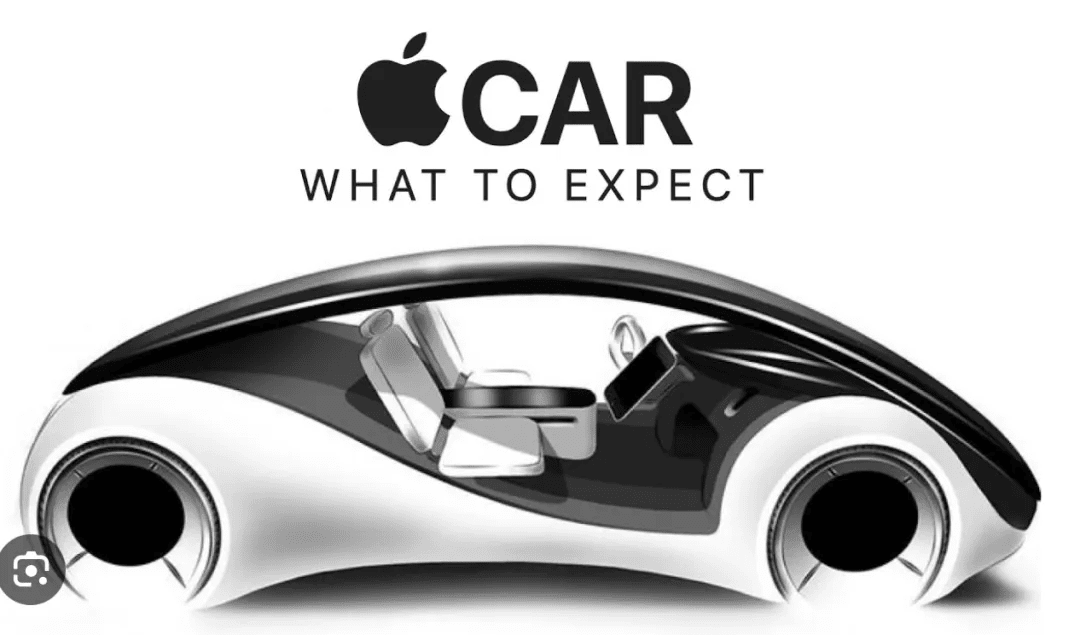
Apple made the wrong bet on car manufacturing | Image source: Apple Explained
If Apple cannot inject AI into hardware in the future, it will not only subvert Apple's value of "hardware is the carrier of software", but also affect Apple's proud software and hardware ecosystem.
Apple's Senior Vice President of Internet Software and Services, Eddy Cue, once told colleagues that Apple's dominance in the tech world was in jeopardy.
Last month, Google searches on Apple devices decreased. Eddy Cue said: "This hasn't happened in 22 years, and AI is the reason." He admitted that users are increasingly relying on large language models to get information.
Eddy Cue pointed out that Apple doesn't provide indispensable commodities like Exxon Mobil (a famous American oil company). He worries that AI might be to Apple what the iPhone was to Nokia. Nokia fell before Apple, and Apple might fall before AI.
He even bluntly said that the iPhone may become irrelevant in ten years, "It sounds crazy, but it is indeed possible."
An even bigger challenge comes from the outside. According to insiders, in order to comply with the expected new EU regulations, Apple is working on modifying the operating system to allow users to switch the default voice assistant from Siri to a third-party option.
This means that if Apple doesn't have a major breakthrough in voice assistants, users may not use Siri in the future, but instead use AI assistants from OpenAI, Anthropic, Meta, Alphabet, X, or even DeepSeek.
Apple is not sitting idly by. According to employees, Apple's AI office in Zurich is building a Siri that is completely based on large language models, aiming to make Siri more conversational and capable of information integration. The secret project is called LLM Siri.
Apple also has thousands of analysts in offices in Texas, Spain, and Ireland to review the accuracy of Apple Intelligence summaries, compare data biases, and assess the frequency of AI hallucinations.
As for Apple's self-developed chatbot, some executives now want to build Siri into a real ChatGPT competitor.
To this end, the company began to allow Siri to access the open web and integrate multi-source data. According to employees, Apple's internal testing of the chatbot has made significant progress in the past six months, and some executives believe its performance is comparable to recent versions of ChatGPT.
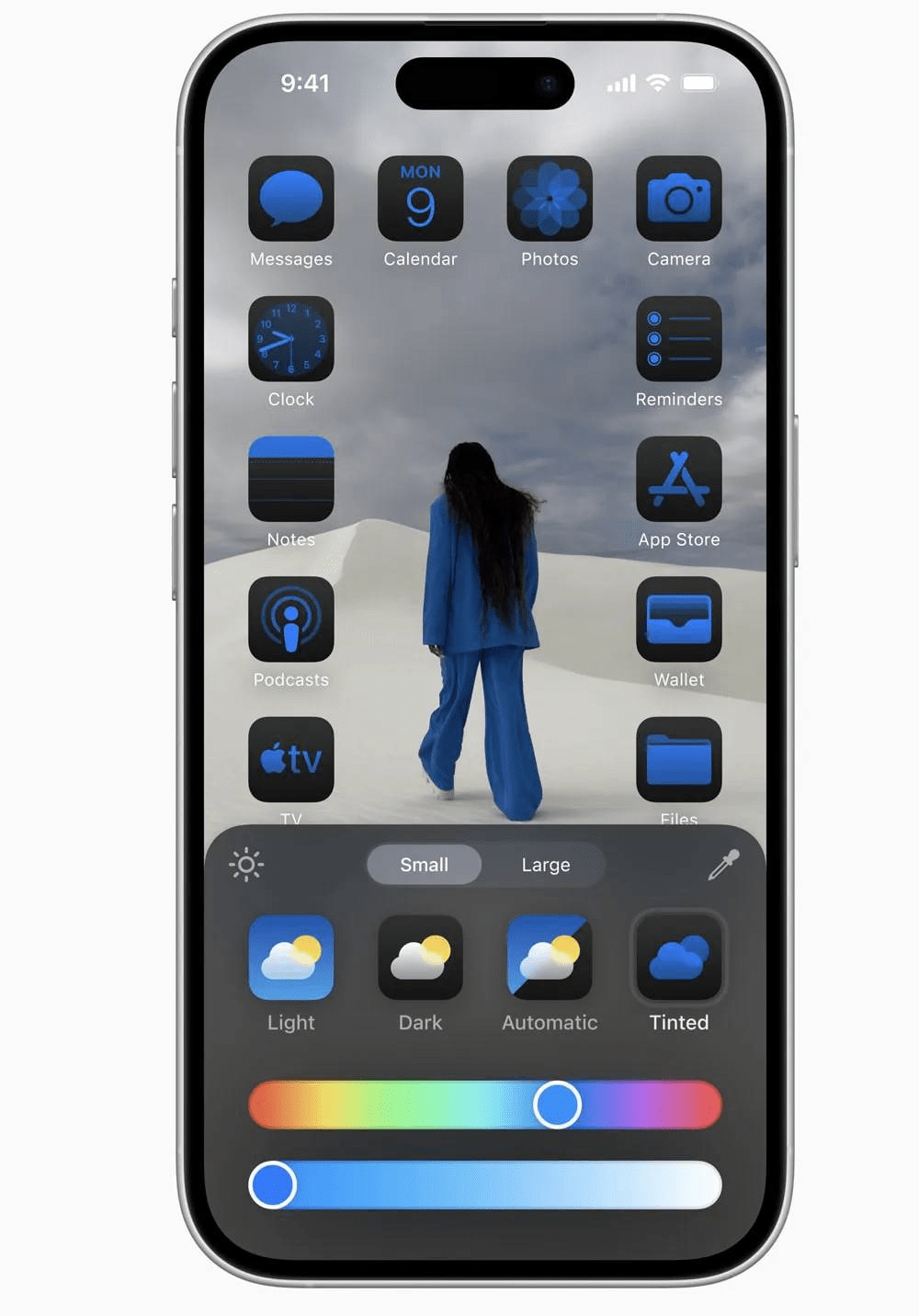
A new system that has been waiting for a year, the result is a color palette? | Image source: Apple
Apple insiders revealed that for next month's WWDC, the company plans to focus on upgrading existing Apple Intelligence features and adding some new features, such as AI-optimized battery management and virtual health coaches.
The major upgrades to Siri, or even the "pie in the sky" drawn a year ago, are unlikely to be mentioned too much at WWDC. Sources say that although Apple has high hopes for "LLM Siri" internally, Apple is preparing to separate Apple Intelligence from Siri in marketing.
On the one hand, they are worried that Siri, which is completely behind competing products, will drag down the company's AI publicity. On the other hand, Apple no longer dares to announce new features months in advance.
Remember Siri co-founder Kittlaus? He is still optimistic about Siri's AIization. He said: "All model companies don't know what an assistant is, and Apple has been studying this concept since 2010." He believes that Apple only needs to make Siri smarter: "Apple has devices and brands. As long as Siri is 'reprogrammed', it has a full chance to become the preferred assistant."
Fourteen years ago, Siri's release put Apple at the pinnacle of intelligent interaction. Jobs' vision ignited the voice assistant market and also conceived the chatbots that we can now chat with in natural language.
However, today's Apple is struggling in the AI race. Apple Intelligence's lateness and loss of color, Siri's stagnation and backwardness, the failure of autonomous driving...
Mark Gurman, who can get internal news, reveals not only Apple's superficial lag in AI, but also the wavering of internal strategy, the dilemma of technical paths, and the friction between core culture and the pulse of the times.
Those product strategies and corporate cultures that Apple was once proud of have become stumbling blocks for Apple in the face of AI, which is reshaping the technological landscape at an unprecedented speed.
Apple's future is being overshadowed by AI's shortcomings. Cook said it's just a matter of time. But how much time does Apple have left?
At least at next month's WWDC, we won't see the answers we expect.