


Camelot, as an "incubator" for Arbitrum ecosystem projects, has brought sufficient liquidity to Arbitrum. Its price has risen nearly 15 times in 30 days. What is Camelot? What is unique about it? Let's take a look.
What is Camelot?
Camelot is a decentralized exchange built on Arbitrum, which has developed a customizable liquidity infrastructure to provide more liquidity and composability for the Arbitrum ecosystem. In addition to DEX, Camelot also includes a Launchpad, which can help projects in the Arbitrum ecosystem to sell tokens and raise funds.
Camelot started on November 22, 2022, and launched its public token sale on the 29th of the same month. Camelot's name comes from King Arthur's Camelot Palace, which symbolizes the Round Table. All users and projects that use Camelot to build their liquidity pools are collectively referred to as Knights, symbolizing the knights participating in the Round Table. Since Camelot is centered on the Arbitrum ecosystem, these people can also be understood as "knights" who help build the Arbitrum ecosystem.
Camelot DEX
Camelot DEX is based on AMM and uses a dual liquidity model in transactions. It uses different calculation formulas for volatile trading pairs (such as $GRAIL:$ETH) and stable trading pairs with lower volatility (such as $WETH:$ETH).
For swing trading pairs, Camelot uses the standard constant product formula based on Uniswap v2.
For stability trading pairs, Camelot uses the Solidly curve formula.
Camelot DEX supports customizable dynamic directional transaction fee settings. Other project parties can set and adjust the transaction fees for AMM fund pools deployed in cooperation with Camelot, and set different transaction fee ratios for different buying and selling directions.
Camelot DEX transaction fee distribution ratio:
60% allocated to liquidity providers
22.5% is allocated to xGRAIL governance token holders
12.5% for the repurchase and destruction of the native token $GRAIL
5% allocated to the Camelot team
In addition to customizing transaction fees, Camelot DEX also supports custom liquidity incentives. By using the Nitro Pools function developed by Camelot DEX, AMM fund pool deployers can customize liquidity incentive parameters including incentive methods, reward tokens, incentive start and end times, etc., to meet the liquidity needs of projects at different stages.
Camelot Launchpad
Camelot Launchpad uses a unified bidding and price discovery method, that is, the issued token and $USDC form an AMM currency pair, and all participating users deposit money into the $USDC pool. The participation price of all participating users is determined by the ratio of the currency pair at the end of the bidding. Since the number of issued tokens is fixed, the price of the issued token gradually increases as the number of $USDC deposited by users increases. Currently, Camelot Launchpad only accepts participation in the use of $USDC, and during the bidding process, users can only deposit money into the liquidity pool and cannot withdraw it.
What is Camelot's rating?
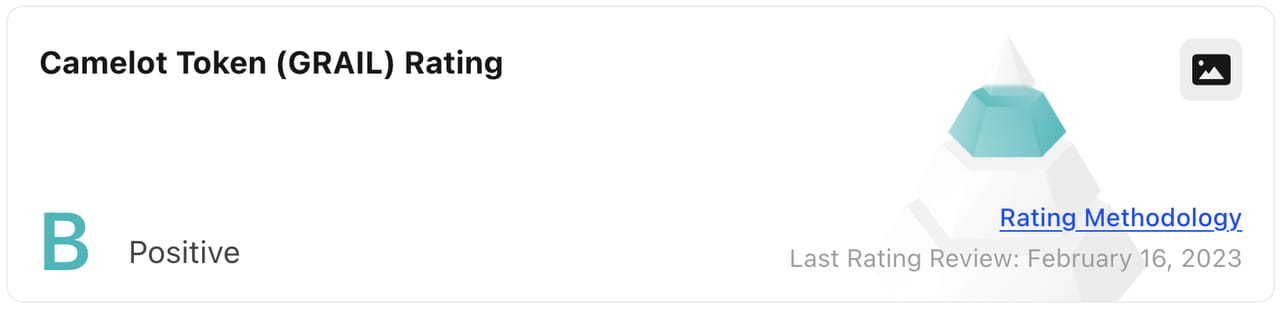
TokenInsight rated Camelot's current performance as B, with a positive outlook. Among all DEXs, it ranks in the middle. DEXs with the same B rating as Camelot include: Bonfida, ApolloX, etc.
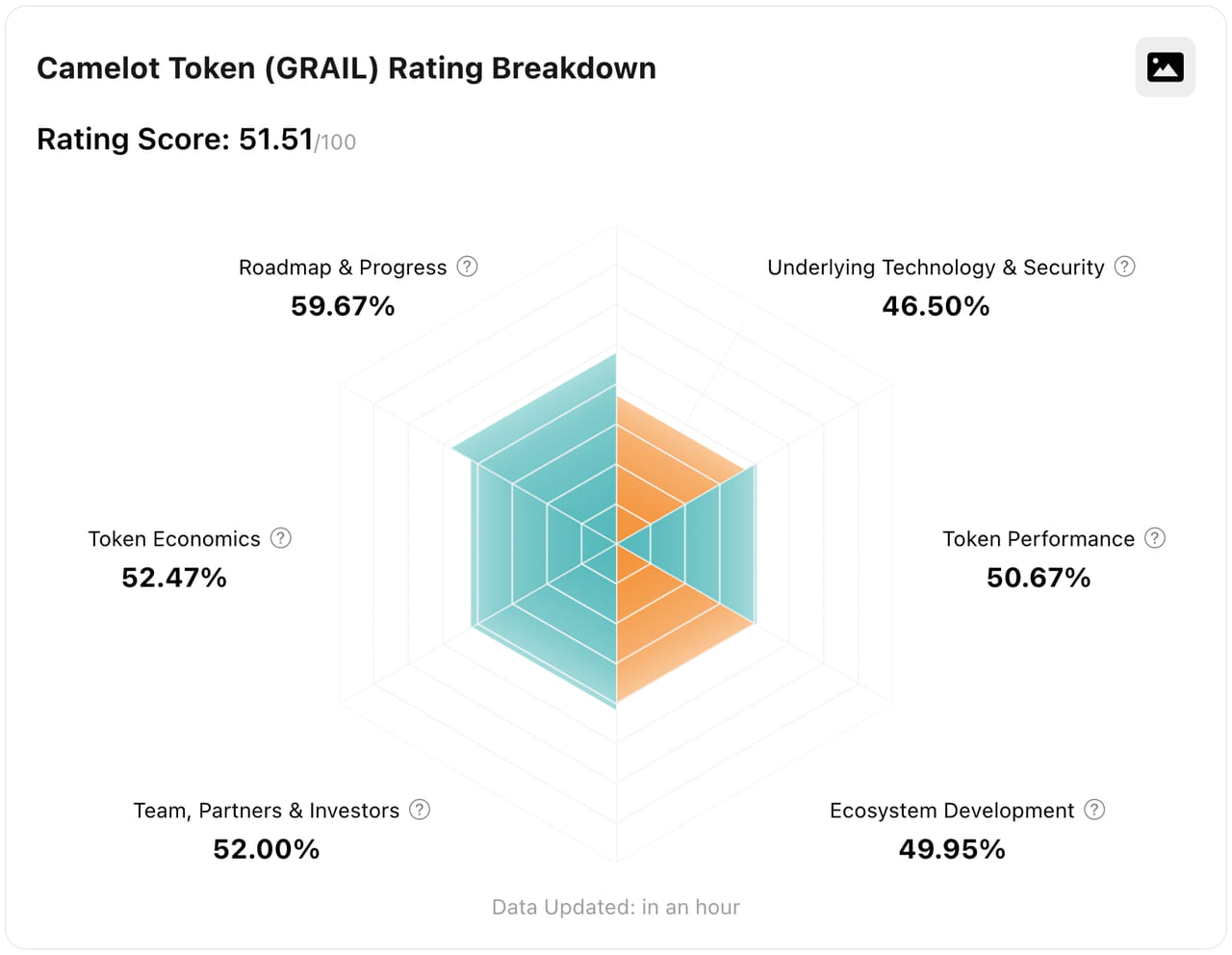
The specific analysis and scores of Camelot's rating results are as follows:
Underlying technology and security 46.5%
Roadmap and progress 59.67%
Token Economy 52.47%
Token secondary market performance 50.67%
Ecological development 49.95%
Team, partners and investors 52%
Underlying technology and security (46.5%)
Camelot does not have an official public GitHub. Its project-related codes are not open to the public.
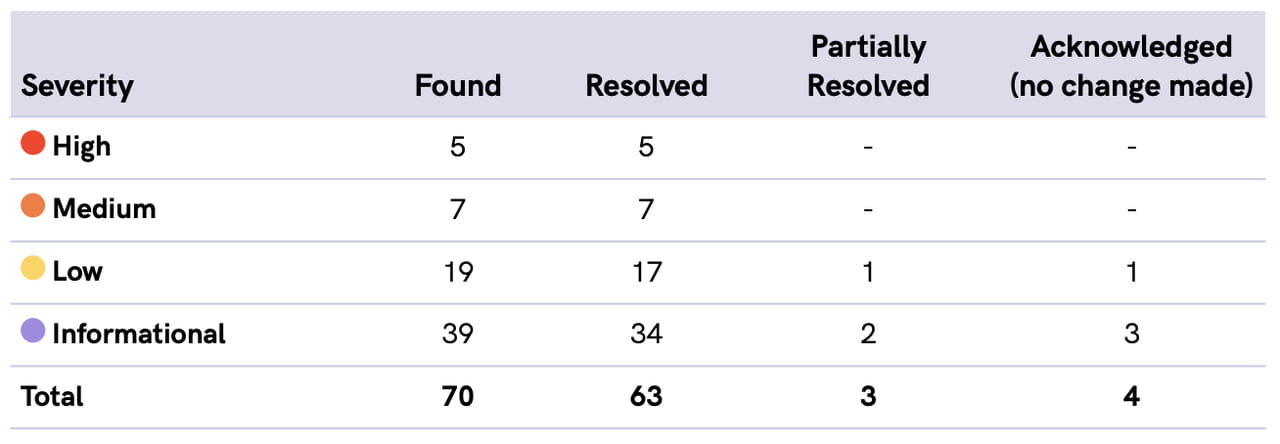
As of February 2023, Camelot has publicly disclosed 2 code audit reports in its official documents. Both reports were completed by Paladin, with the latest one on November 14, 2022. The audit content includes the smart contract code of $GRAIL and xGRAIL, as well as the relevant codes of major products such as YieldBooster and NitroPool. According to the report results, most of the security issues found in the audit have been fixed by Camelot.
As of February 2023, Camelot has not experienced any crisis events that affect security.
Token Economy (52.47%)
Camelot consists of two assets: the native token $GRAIL and the governance token xGRAIL.
Native Token ($GRAIL)
$GRAIL is the native token of Camelot, with a maximum supply of 100,000. $GRAIL itself has no substantive use, and simply holding $GRAIL does not provide any benefits.
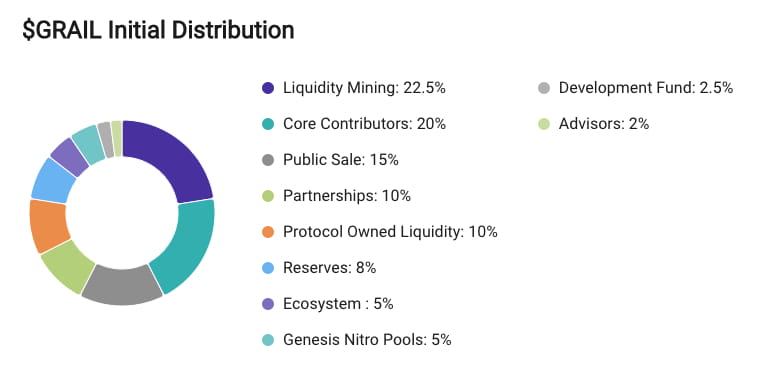
According to the distribution plan announced by Camelot, $GRAIL for public sale accounts for 15% of the total supply. Of the remaining part, 22.5% will be allocated to the liquidity mining plan for the next 3 years, 15% will be used to provide liquidity for the protocol, and 32% will be allocated to core contributors, partners and consultants. The $GRAIL allocated to the team/partners/consultants will be fully unlocked in 3 years. The specific distribution and unlocking plan is as follows:
Governance Token (xGRAIL)
xGRAIL is Camelot's governance token, which can be obtained by exchanging it with $GRAIL at a 1:1 ratio. xGRAIL is not tradable, and xGRAIL holders can obtain benefits including protocol revenue dividends, Launchpad exclusive shares, etc. At the same time, the number of xGRAIL held by users represents voting rights, which are used to vote on protocol governance proposals.
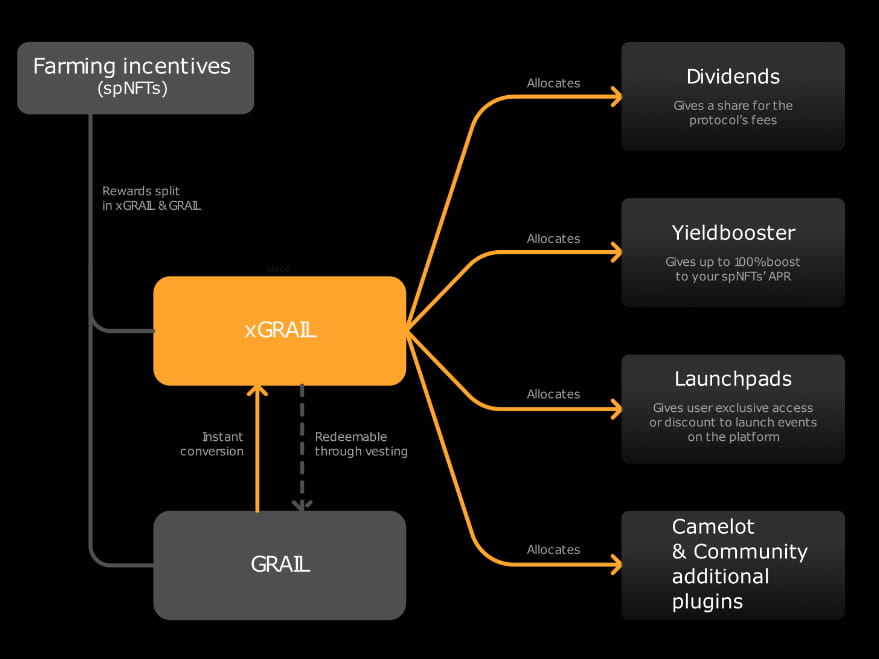
$GRAIL can be exchanged for xGRAIL at any time, but it takes some time to redeem xGRAIL for $GRAIL. When redeeming, users can choose a full redemption period of 15 days or 6 months. The redeemed $GRAIL will be unlocked day by day during the redemption period until it is fully unlocked at the end of the redemption period. Users who choose a 6-month redemption period will receive 100% of the xGRAIL amount in $GRAIL, and those who choose 15 days will only receive 50%, and the remaining 50% will be destroyed by the protocol.
Token secondary market performance (51.4%)
$GRAIL was officially launched on Camelot on December 7, 2022, with an initial liquidity of nearly $4 million. As of February 14, 2023, in addition to Camelot, $GRAIL has also been launched on multiple exchanges including MEXC Global, BingX, Uniswap (Arbitrum One), and Bitget. According to TokenInsight statistics, the exchange with the largest $GRAIL trading volume is Camelot DEX itself, accounting for 80% of the total trading volume.
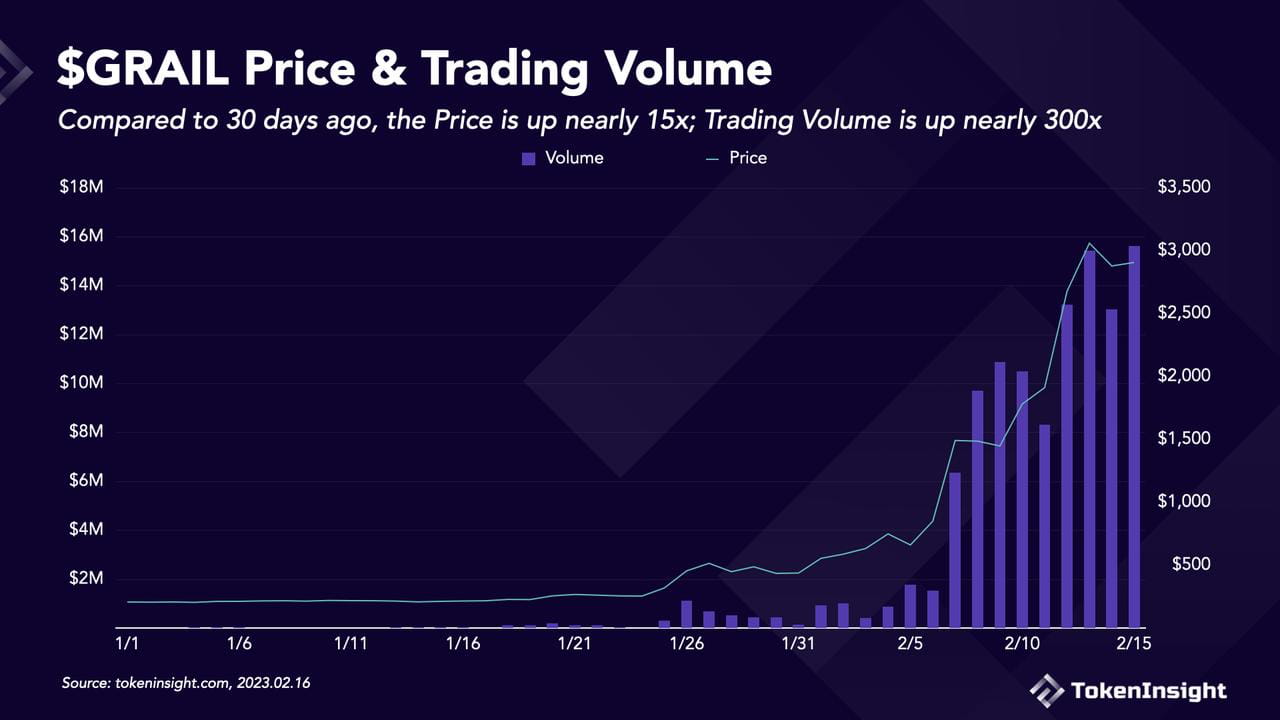
Positively influenced by the recent development of the Arbitrum ecosystem, $GRAIL's trading volume and price rose rapidly one month after its launch. Its price rose from the initial $200 to about $3,400, an increase of nearly 15 times compared to 30 days ago. According to the latest data, on February 16, $GRAIL's price fell back to around $3,000, a drop of about 12% from its ATH.
In terms of trading volume, $GRAIL’s 24h spot trading volume reached approximately $15.6 million on February 15, the peak of recent trading volume. Compared with 30 days ago, it has increased by nearly 300 times.
Ecological development (49.95%)
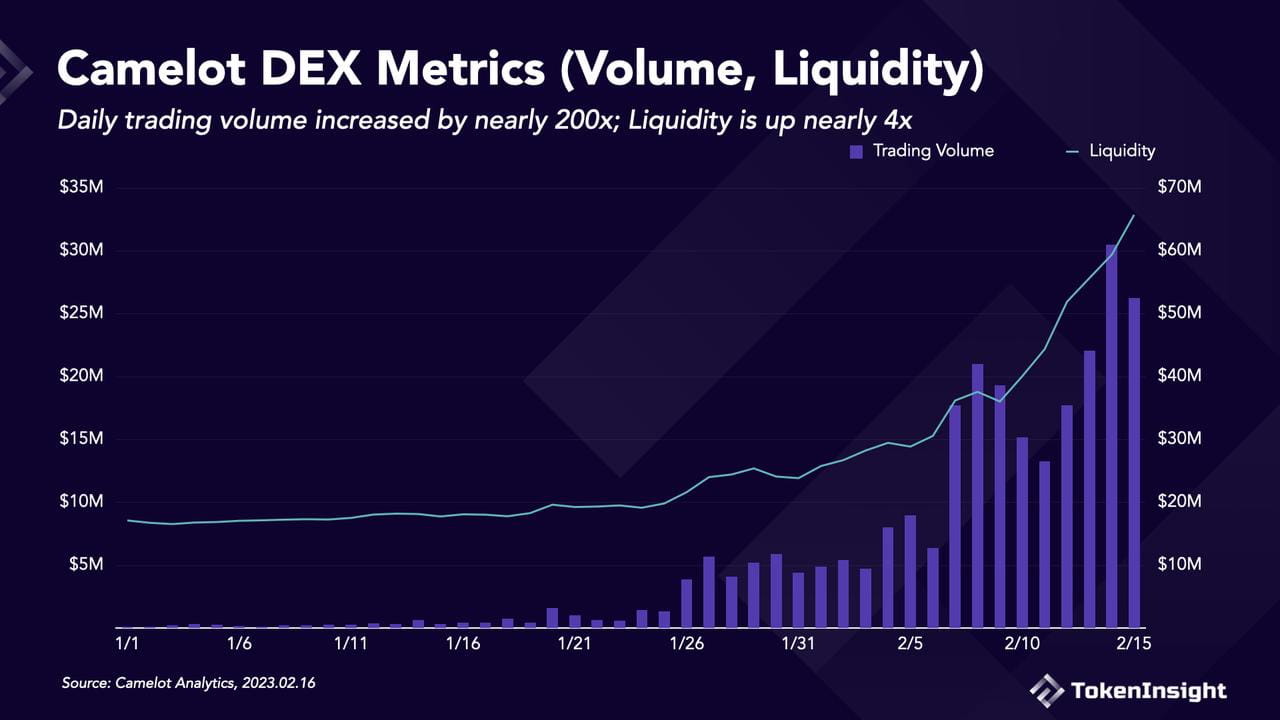
Affected by the rapid development of the Arbitrum ecosystem, Camelot's TVL has also experienced explosive growth. According to DeFiLlama data, Camelot's TVL has grown rapidly since the end of January, rising from $18M to a maximum of $63M (2023-02-16) in less than 30 days. As a new project that has been online for less than 3 months, Camelot's performance is quite impressive and is currently ranked 31st among all decentralized exchanges.
From the perspective of transaction data, Camelot's daily transaction volume has increased from about US$100,000 at the beginning of 2023 to a maximum of US$22 million, an increase of nearly 200 times, achieving a leap forward. Liquidity has also increased from US$17 million to nearly US$65 million, an increase of nearly 4 times.
In addition, as an "incubator" for new projects in the Arbitrum ecosystem, Camelot will launch many new projects' native assets in the coming period to provide them with liquidity use cases. This will provide Camelot with more liquidity and trading volume, thereby further promoting the development of the Camelot ecosystem.
Inventory of upcoming projects
Nitro Cartel (February 17)
Nitro Cartel will publicly sell its governance token $TROVE on Camelot on February 17, 2023. Nitro Cartel is a yield index and strategy library protocol on Arbitrum that aims to generate returns for users. Its first index ALP is a basket of selected blue chip tokens such as $GMX, $MAGIC, and $GRAIL.
The public sale will consist of 20% of the total $TROVE supply, with a starting price of $0.0025 per $TROVE, for a fully diluted valuation of $12.5 million. The sale will be conducted using a fair launch, price discovery model.
Factor DAO (February 20)
Factor DAO will publicly sell its native token $FCTR on Camelot on February 20, 2023. Factor DAO is an on-chain asset management platform that helps users integrate DeFi assets and increase returns through a variety of tools and strategies. $FCTR holders can obtain $veFCTR through staking and receive 50% of the platform's revenue.
The public sale will consist of 10% of the total $FCTR supply, allocated using a fair launch, price discovery model, with a starting price of $0.1 per $FCTR.
PerpyFinance (March 16)
PerpyFinance will publicly sell its native token $PRY on Camelot on March 16, 2023. Perpy is a social perpetual contract asset management protocol based on GMX in the Arbitrum ecosystem. Users can create their own portfolios directly on Perpy or copy other traders' portfolios through smart contracts to earn income. Copied traders can earn performance fees as compensation. In addition, Perpy also provides built-in social functions for sharing portfolios or discussions. Details about the public sale have not yet been disclosed.
Final Thoughts
As the core DEX of the Arbitrum ecosystem, Camelot’s functions are not limited to providing users with trading-related DeFi products. Camelot’s Launchpad can help “incubate” different types of new projects within the Arbitrum ecosystem and provide them with liquidity through its internal infrastructure. So strictly speaking, the overall development of the Arbitrum ecosystem is closely linked to Camelot. The liquidity brought by these new project tokens will be pooled to increase Camelot’s overall liquidity and accelerate the growth of its TVL and trading volume, thereby achieving the overall growth of the Arbitrum network.
In general, Camelot, as a DEX, has relatively few product innovations, but its special role in the Arbitrum network has made Camelot grow rapidly and become one of the most watched projects in recent times. Its token economic design is also quite excellent. Camelot incentivizes users to hold $GRAIL for a long time through xGRAIL, and has set up many token tightening mechanisms to incentivize the long-term value growth of $GRAIL.
Based on the above information, TokenInsight gives Camelot a rating of B with a positive outlook.
If you find this article helpful, please share it and give it a like ❤️
Follow us to get more crypto information
Read the full article here: https://tokeninsight.com/en/research/analysts-pick/what-is-camelot-innovative-dex-with-customizable-liquidity-launchpad-on-arbitrum-ratings-analysis