



This article is the second in the Biteye AI Blockchain in-depth research series, and more quality research reports will be released in the future. Friends interested in AI are welcome to follow!
01 Project overview and vision
Bittensor is an innovative project that combines blockchain and artificial intelligence, founded by Jacob Steeves and Ala Shaabana in 2019, aiming to build a "market economy for machine intelligence." Both founders have a strong background in artificial intelligence and distributed systems. The signed author of the project white paper, Yuma Rao, is regarded as the core technical advisor of the team, injecting a professional perspective in cryptography and consensus algorithms into the project.
This project aims to integrate global computing power resources through blockchain protocols, building a self-optimizing distributed neural network ecosystem. This vision transforms digital assets such as computing, data, storage, and models into intelligent value flows, creating a new economic form and ensuring the fair distribution of AI development dividends. Unlike centralized platforms like OpenAI, Bittensor establishes three core value pillars:
Breaking data silos: Utilizing the TAO token incentive system to promote knowledge sharing and model contributions.
Market-driven quality evaluation: Introducing game theory mechanisms to filter high-quality AI models, achieving survival of the fittest.
Network effect amplifier: The growth of participants is exponentially positively correlated with network value, forming a virtuous cycle.
In terms of investment layout, Polychain Capital has incubated Bittensor since 2019 and currently holds TAO tokens valued at approximately $200 million; Dao5 holds TAO valued at about $50 million and is also an early supporter of the Bittensor ecosystem. In 2024, Pantera Capital and Collab Currency further increased their investments through strategic investments. In August of the same year, Grayscale included TAO in its decentralized AI fund, marking a high recognition of the project value and long-term optimism from institutional investors.
02 Technical architecture and operational mechanisms
Bittensor has constructed a sophisticated network architecture composed of four collaborative layers:
Blockchain layer: Built on the Substrate framework, serving as the foundation of trust for the network, responsible for recording state changes and token issuance. The system generates a new block every 12 seconds and issues TAO tokens according to rules, ensuring network consensus and incentive distribution.
Neuron layer: Serving as the computing nodes of the network, neurons run various AI models to provide intelligent services. Each node clearly declares its service type and interface specifications through carefully designed configuration files, achieving modularization of functions and plug-and-play capability.
Synapse layer: The communication bridge of the network, dynamically optimizing the connection weights between nodes, forming a neural network structure to ensure efficient information transmission. The synapse also incorporates an economic model, where interactions and service calls between neurons require payment of TAO tokens, creating a closed-loop of value circulation.
Metagraph layer: Serving as the global knowledge graph of the system, continuously monitoring and evaluating the contribution value of each node, providing intelligent guidance for the entire network. The metagraph precisely calculates synaptic weights, thereby influencing resource allocation, reward mechanisms, and the influence of nodes within the network.
Bittensor's network framework
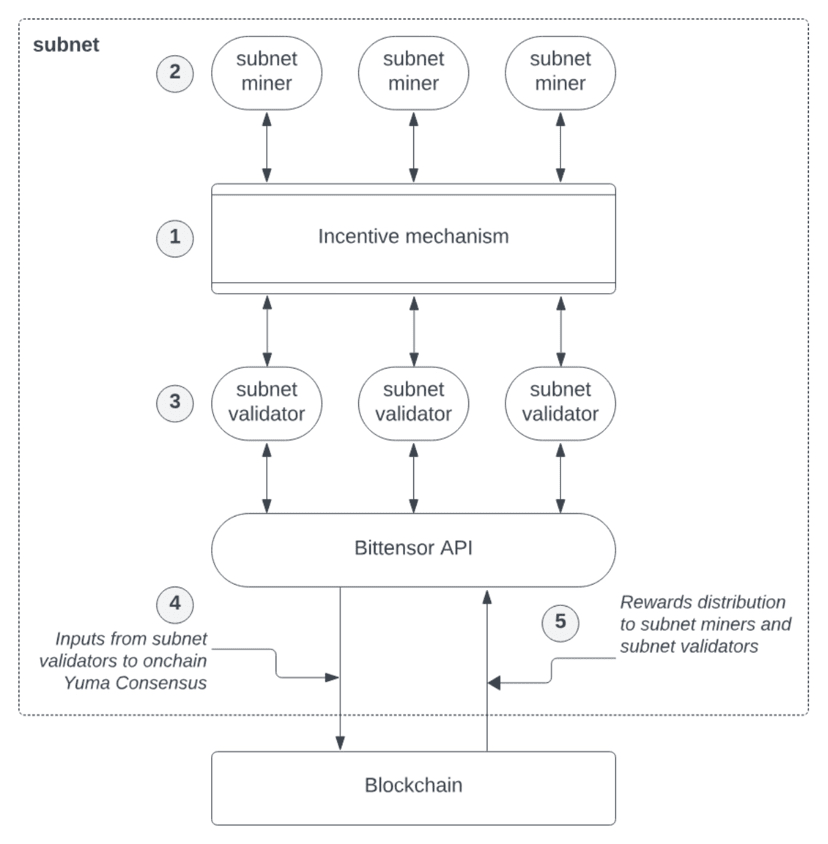
https://docs.bittensor.com/subnets/understanding-subnets
Yuma consensus mechanism
The network adopts a unique Yuma consensus algorithm, completing a round of reward distribution every 72 minutes. The validation process combines subjective evaluation and objective measurement:
Human scoring: Validators conduct subjective evaluations of miner output quality.
Fisher Information Matrix: Objectively quantifying the contribution of nodes to the overall network.
This "subjective + objective" hybrid mechanism effectively balances professional judgment and algorithmic fairness.
Subnet architecture and dTAO upgrade
Each subnet focuses on a specific AI service area, such as text generation, image recognition, etc., operating independently but maintaining a connection with the main blockchain subtensor, forming a highly flexible modular expansion architecture. In February 2025, Bittensor completed a milestone dTAO (Dynamic TAO) upgrade, transforming each subnet into an independent economic unit, intelligently regulating resource allocation through market demand signals. Its core innovation is the subnet token (Alpha token) mechanism:
Operational principle: Participants stake TAO to obtain Alpha tokens issued by each subnet, which represent market recognition and support for specific subnet services.
Resource allocation logic: The market price of Alpha tokens serves as a key indicator to measure the demand intensity of subnets. Initially, the prices of Alpha tokens in each subnet are the same, with only 1 TAO and 1 Alpha token in each liquidity pool. As trading activity increases and liquidity is injected, the price of Alpha tokens dynamically adjusts, and the distribution of TAO is intelligently allocated according to the proportion of subnet token prices, allowing subnets with high market heat to gain more resource allocation, achieving truly demand-driven resource optimization.
 Bittensor subnet token emission distribution https://taostats.io/
The dTAO upgrade has significantly enhanced ecological vitality and resource utilization efficiency, with the total market value of subnet tokens reaching $500 million, demonstrating strong growth momentum.

Bittensor subnet alpha token value https://taostats.io/
03 Ecological progress and application cases
3.1 Mainnet development history
The Bittensor network has undergone three key development stages:
January 2021: The mainnet officially launched, laying the foundation infrastructure.
October 2023: The "Revolution" upgrade introduced subnet architecture, achieving functional modularization.
February 2025: Completed the dTAO upgrade, establishing a market-driven resource allocation mechanism.
The subnet ecology is experiencing explosive growth: As of April 2025, there are already 95 specialized subnets, and it is expected to exceed 200 within the year.
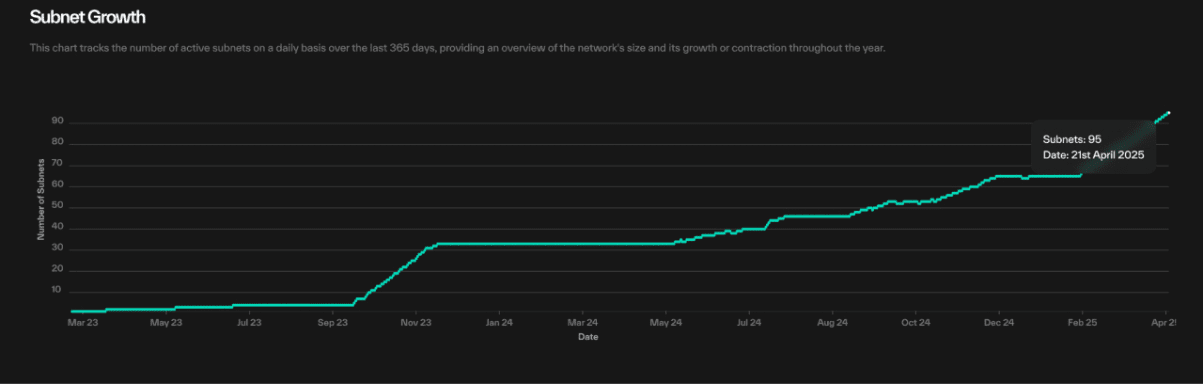 Number of Bittensor subnets https://taostats.io/
The types of ecological projects are diversified, covering cutting-edge fields such as AI agents (e.g., Tatsu), prediction markets (e.g., Bettensor), DeFi protocols (e.g., TaoFi), forming an innovative ecology of deep integration of AI and finance.
3.2 Representative ecological projects
TAOCAT: TAOCAT is the native AI agent in the Bittensor ecosystem, directly built on subnets, providing users with data-driven decision-making tools. Utilizing the large language model of Subnet 19, real-time data from Subnet 42, and Agent Arena from Subnet 59, it offers market insights and decision support. It received investment from DWF Labs, included in its $20 million AI agent fund, and launched on Binance Alpha.
OpenKaito: A subnet launched by the Kaito team on Bittensor, aiming to build a decentralized search engine for the crypto industry. It has currently indexed 500 million web resources, demonstrating the powerful capabilities of decentralized AI in handling massive data. Compared to traditional search engines, its core advantage lies in reducing commercial interest interference, providing more transparent and neutral data processing services, and offering a new paradigm for information access in the Web3 era.
Tensorplex Dojo: Developed by Tensorplex Labs, Subnet 52 focuses on crowdsourcing high-quality human-generated datasets through a decentralized platform, encouraging users to earn TAO tokens through data annotation. In March 2025, YZi Labs (formerly Binance Labs) announced an investment in Tensorplex Labs to support the development of Dojo and Backprop Finance.
CreatorBid: Operating on Subnet 6, it is a creative platform that combines AI and blockchain, integrated with Olas and other GPU networks (such as io.net), supporting content creators and AI model development.
3.3 Technology and industry collaboration
Bittensor has made breakthrough progress in cross-domain collaboration:
Established a deep model integration channel with Hugging Face, achieving seamless on-chain deployment of 50 mainstream AI models.
In 2024, jointly released the BTLM-3B model with high-performance AI chip manufacturer Cerebras, with cumulative downloads exceeding 160,000.
In March 2025, a strategic partnership was reached with DeFi giant Aave to jointly explore the application scenarios of rsTAO as high-quality lending collateral.
04 Participation methods
Bittensor has designed diversified paths for ecological participation, forming a complete value creation and distribution system:
Mining: Deploying miner nodes to produce high-quality digital goods (such as AI model services), obtaining TAO rewards based on the quality of contributions.
Validation: Running validator nodes to assess the work results of miners, maintaining network quality standards, and obtaining corresponding TAO incentives.
Staking: Holding and staking TAO to support high-quality validator nodes and obtaining passive income based on validator performance.
Development: Using the Bittensor SDK and CLI tools to build innovative applications, practical tools, or entirely new subnets, actively participating in ecological construction.
Using services: Accessing AI services provided by the network through a user-friendly client application interface, such as text generation or image recognition.
Trading: Participating in the market trading of subnet tokenized assets to capture potential value growth opportunities.
 Distribution of subnet alpha tokens to participants
05 Future prospects and risk considerations
Despite demonstrating exceptional potential, Bittensor, as a frontier technology exploration, still faces multidimensional challenges. On the technical level, the security threats faced by distributed AI networks (such as model theft and adversarial attacks) are more complex than those of centralized systems, requiring continuous optimization of privacy computing and security protection solutions; in terms of economic models, there were early inflation pressures, and the subnet token market exhibits high volatility, necessitating caution against possible speculative bubbles; regarding the regulatory environment, although the SEC has classified TAO as a utility token, the differences in regulatory frameworks across global regions may still restrict ecological expansion; meanwhile, facing fierce competition from resource-rich centralized AI platforms, decentralized solutions need to prove their long-term competitive advantages in user experience and cost-effectiveness.
As the 2025 halving cycle approaches, Bittensor's development will focus on four strategic directions: further deepening the specialization of subnet divisions, enhancing the service quality and performance of vertical field applications; accelerating deep integration with the DeFi ecosystem, expanding the boundaries of smart contract applications with the newly introduced EVM compatibility; gradually transitioning network governance weight from TAO to Alpha tokens through the dTAO mechanism within the next 100 days, promoting the decentralization of governance; while actively expanding interoperability with other mainstream public chains to broaden ecological boundaries and application scenarios. These synergistic strategic measures will jointly promote Bittensor's steady progress toward the grand vision of a "market economy for machine intelligence."