


Author: Jagjit Singh, Cointelegraph; Translated by: Songxue, Golden Finance
1. Mainnet Basics
Mainnet, short for “main network,” is the main blockchain network where actual transactions take place and are conducted using the native cryptocurrency.
It is not the same as a testnet or experimental environment; rather, it is the product of development activity. The mainnet features its own cryptocurrency, a digital asset necessary for the network to function. This native currency is essential for the ecosystem's governance procedures, staking programs, and transaction fees.
Blockchain platforms often go through a testnet phase before launching on the mainnet. These test environments allow developers to try out real cryptocurrencies without using them. The platform moves to the mainnet, where transactions of real assets can take place once it is deemed ready. The mainnet uses a specific consensus process to verify and confirm transactions, such as Proof of Work (PoW) or Proof of Stake (PoS).
Validators and miners are crucial on the mainnet, depending on the consensus mechanism. Proof-of-Work networks use complex mathematical puzzles that miners must solve in order to confirm transactions, add new blocks to the blockchain, and get paid in cryptocurrency. Proof-of-Stake networks, on the other hand, rely on validators who choose to create blocks based on the amount of cryptocurrency they hold and are willing to "stake" as collateral.
The degree of decentralization varies depending on the blockchain network, but it is a fundamental component of many mainnets. Increased decentralization requires more nodes to participate in the verification process. Due to the security and immutability of the mainnet, confirmed transactions cannot be manipulated or changed.
The mainnet often supports decentralized applications (DApps) and smart contracts, which expand the network's functionality. The mainnet may be upgraded periodically to improve functionality or address security issues, which sometimes results in forks. Forks can be soft forks (backwards-compatible changes) or hard forks (not backwards-compatible).
Cryptocurrency wallets allow users to communicate with the mainnet and send and receive transactions more efficiently. Because they provide accessibility and liquidity to consumers, exchanges are critical to the mainnet's ability to trade native tokens.
2. How does the mainnet work?
The mainnet of a blockchain platform consists of several important parts that work together to allow the network to operate and process transactions and maintain the integrity of the distributed ledger.
The basic elements of the mainnet are as follows:
Blockchain Protocol
A specific blockchain protocol powers the mainnet and establishes the guidelines and processes for validating transactions and appending them to the blockchain. Examples of blockchain protocols are Ethereum (which uses the Ethereum protocol) and Bitcoin (which uses the Bitcoin protocol).
Native cryptocurrency
Each mainnet contains a native cryptocurrency that is used for different network functions. This includes paying transaction fees, rewarding validators (miners or stakeholders), and participating in the governance process. For example, Ethereum (ETH) for the Ethereum mainnet and Bitcoin (BTC) for the Bitcoin mainnet.
Consensus Mechanism
The method or technique that a network uses to reach a consensus on the current state of the blockchain is called a consensus mechanism. PoW, PoS, Delegated Proof of Stake, and other similar programs are common consensus techniques. This system prevents double spending and ensures the validity of transactions.
Miners or validators
As mentioned earlier, miners solve complex mathematical puzzles in PoW networks, while validators in PoS networks are selected based on the amount of cryptocurrency they own and are prepared to stake.
Decentralized Nodes
A single computer or server that keeps a copy of the entire blockchain to participate in the network is called a node. These nodes talk to each other to reach a consensus on the current state of the blockchain. A large number of decentralized nodes enhances the decentralization and security of the network.
Smart Contracts
Smart contracts are self-executing contracts where the conditions of the agreement are clearly coded. A large number of mainnets support smart contracts. Smart contracts can automatically execute and enforce contractual obligations without the need for intermediaries.
Decentralized Applications
DApps are blockchain-based programs that use smart contracts to provide decentralized functions and services. They often interact with native tokens and increase the overall functionality of the mainnet.
wallet
Wallets are essential for protecting and accessing cryptocurrency assets. Users interact with the mainnet through cryptocurrency wallets, which store their private keys and enable them to send, receive, and manage their digital assets.
comminicate
Cryptocurrency exchanges facilitate the trading of native cryptocurrencies on the mainnet. The ability for users to buy, sell, and exchange digital assets gives the market liquidity.
Governance Mechanism
On some mainnets, participants can propose and vote on major issues such as protocol changes. These methods promote decentralized governance and strengthen the democratic and community-driven characteristics of blockchain networks.
Importance of Mainnet for Users and Developers
The mainnet provides users with real transactions and secure asset handling, while providing developers with a playground for deploying innovations such as DApps and smart contracts.
In the blockchain ecosystem, the mainnet is crucial for developers and users. Users view the mainnet as an active real-world environment where actual transactions occur and where they can use their native currency for a variety of purposes. Users can be confident in the integrity of their digital assets because it guarantees the security and immutability of transactions.
Cryptocurrency wallets allow users to transfer, receive, and manage their holdings while interacting with the mainnet. Mainnet cryptocurrency exchanges provide users with a trading and liquidity access platform, increasing the utility of their assets.
The mainnet provides an ideal environment for developers to test and deploy DApps and smart contracts. It represents a shift from development and testing in closed environments, such as testing, to implementing innovations in the real world. Developers use the mainnet to demonstrate the practicality and functionality of their blockchain systems.
In addition, the decentralized structure and consensus process of the mainnet provide a solid foundation for the development of secure, open and impenetrable applications. As a hub for user interaction and innovation, the mainnet promotes the development and expansion of the larger blockchain ecosystem.
4. Testnet and Mainnet
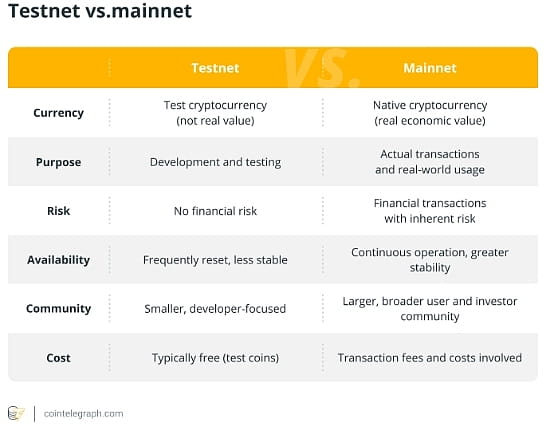
A testnet is a simulated environment for experimenting with cryptocurrencies, while a mainnet is a live, running blockchain network.
In the blockchain development process, testnets and mainnets have different functions. In order to provide a risk-free debugging and code optimization environment, testnets are simulated environments that allow developers to test and experiment with new features or applications without using real cryptocurrency.
Mainnet, on the other hand, is the live blockchain network where real cryptocurrency transactions take place. It is a real-life experience that comes with all the risks and rewards of using a production version of a blockchain.
5. Mainnet deployment challenges faced by developers
Mainnet deployment challenges facing blockchain developers include security, scalability, interoperability, compliance, and governance, requiring meticulous code review, network architecture design, and regulatory compliance to ensure a seamless, user-centric blockchain experience.
One of the biggest hurdles facing blockchain developers is mainnet deployment. There are challenges in developing in a controlled, risk-free environment on a testnet and moving to a mainnet that has real-world consequences.
Another hurdle is ensuring that smart contracts and DApps are robust and secure enough to protect users and their assets. Since any bug could result in monetary loss or exploitation, developers must carefully audit and test their code to find vulnerabilities.
Another key factor to consider when deploying a mainnet is scalability.
As user adoption increases, the network capacity must be able to handle the increase in transaction volume without sacrificing efficiency and speed. Striking a balance between scalability and decentralization is a complex undertaking that requires careful consideration of the network architecture and consensus process.
Another difficulty is related to interoperability. In order to promote a coherent blockchain ecosystem, developers must ensure smooth communication with other decentralized platforms, protocols, and external systems. On the mainnet, managing regulatory compliance also becomes more important, as developers must adhere to changing legislative frameworks that may differ around the world.
In addition, strategic planning and community involvement are necessary to manage network upgrades or hard forks without disrupting currently running services. In order to provide a smooth and user-friendly blockchain experience, developers must address security, scalability, interoperability, compliance, and governance issues in mainnet deployments.