


Written by: Lawrence
On May 19, the Binance Alpha platform announced that it will launch the SOON token ($SOON) on May 23, becoming the first trading platform to integrate this project. This move not only marks a key breakthrough for the Solana Virtual Machine (SVM) ecosystem in the Layer2 track but also signifies a new stage in the large-scale application of modular blockchain technology.
As a star project with over 22 million USD in financing in 2025, SOON aims to solve the performance bottlenecks and cross-chain interoperability challenges of public chains like Ethereum with its architecture design of 'decoupled SVM + OP Stack + configurable DA layer', and its community-led distribution mechanism and potential value capture capability have attracted significant market attention.
1. Team background: From Aleo to SVM infrastructure, gathering top industry resources
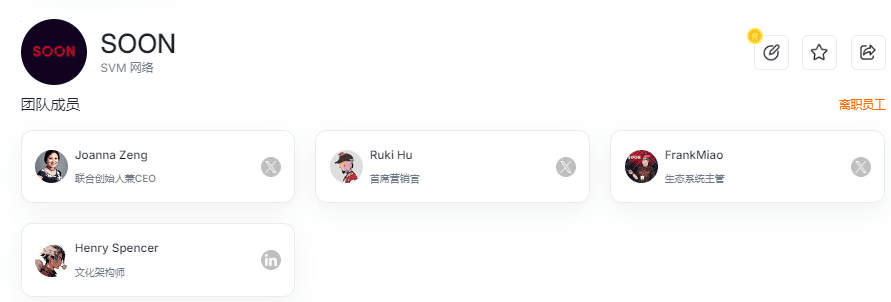
SOON's core team can be described as an 'all-star lineup' in the blockchain field.
CEO Joanna Zeng previously served as vice president of the privacy public chain Aleo, leading the commercialization of zero-knowledge proof technology, and earlier accumulated substantial Layer2 development experience at institutions like Coinbase and OP Labs.
Marketing director Ruki Hu comes from Hong Kong's top investment bank JDI Global and has led investments in SVM ecosystem projects such as Sonic SVM. His strategic management background at the HSBC Business School of Peking University provides methodological support for SOON's market expansion.
Technical lead Andrew Z is a Rust language expert who has participated in the development of the Solana core client and has deep experience in optimizing SVM architecture.
It is noteworthy that SOON's advisory team includes heavyweight figures such as Solana co-founder Anatoly Yakovenko and Celestia core developer Mustafa Al-Bassam. This integration of 'technology + capital + ecosystem' resources has allowed it to quickly stand out in the fiercely competitive Rollup track.
2. Financing history: Community fundraising paradigm innovation, building a moat with 22 million USD
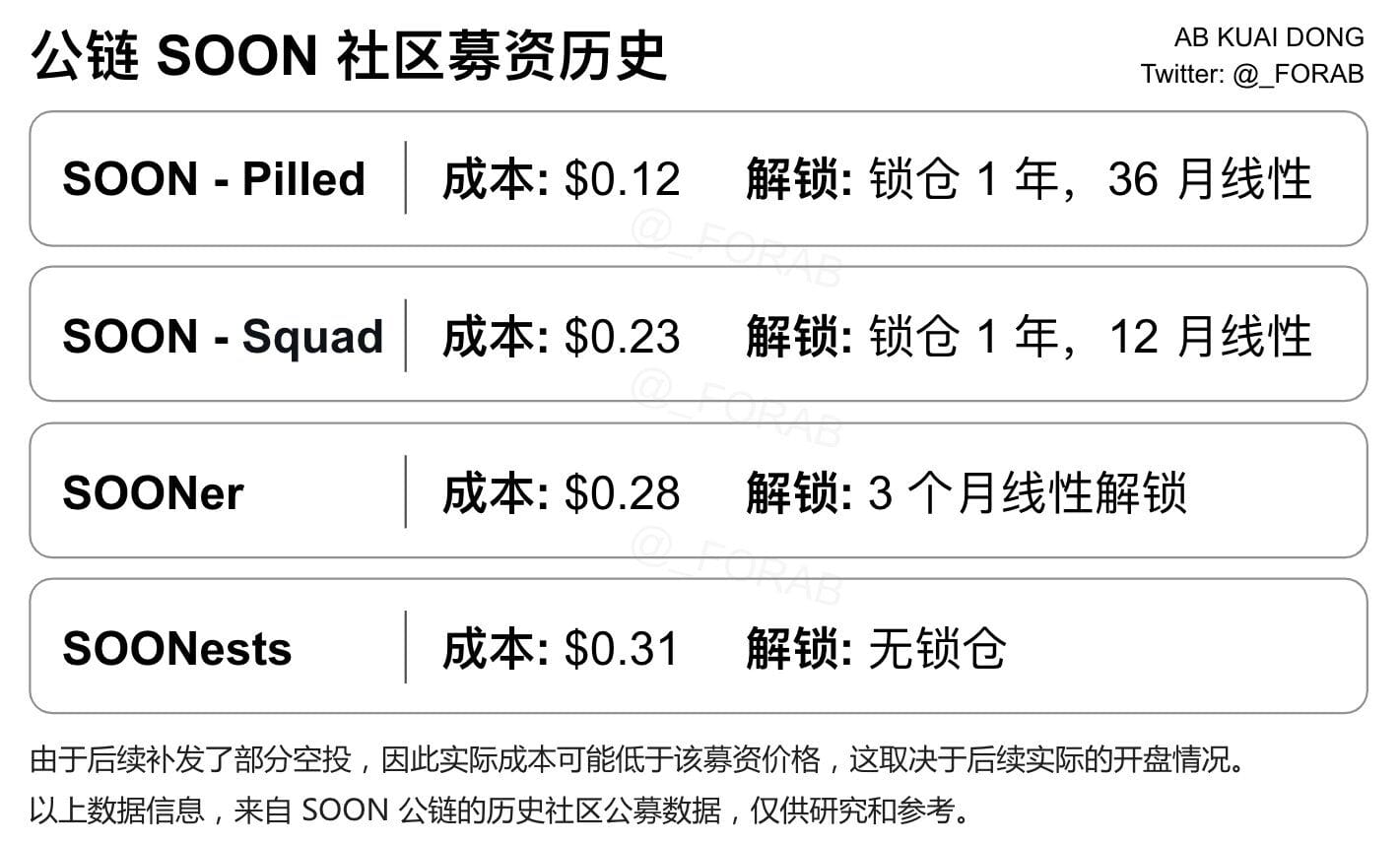 Image source: @_FORAB
SOON's financing path breaks the traditional venture capital-led model and creates an innovative fundraising mechanism of 'NFT sale + community co-creation'.
In January 2025, the project raised 22 million USD through a tiered NFT sale, among which 51% of the tokens were fairly distributed through three categories of NFTs: the 900 USD tier provides short-term liquidity with a 3-month linear unlocking, the 2,850 USD tier is designed with a 12-month lockup period to filter long-term holders, and the 22,500 USD high-tier investors participate in deep strategic investments. This design avoids the impact of VC shares on the secondary market's selling pressure while distinguishing user risk preferences through the time dimension.
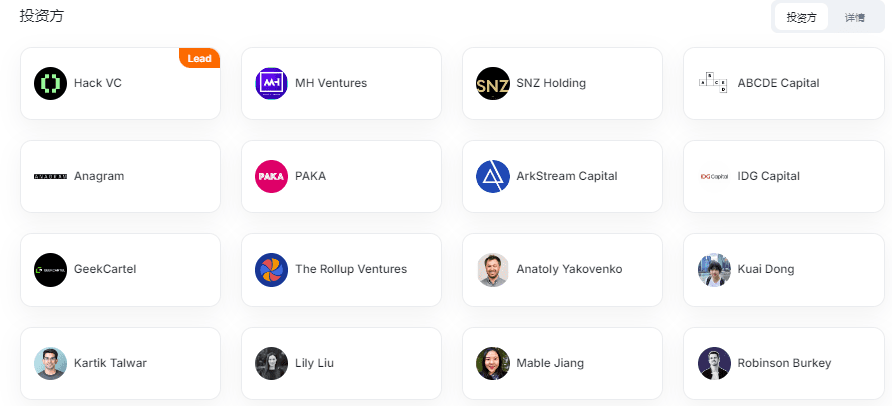
The investor lineup also reflects industry recognition—top institutions like Hack VC and ABCDE Capital lead the investment, with backing from strategic parties like the Solana Ecosystem Fund and Celestia Labs, and even traditional capital firms like IDG and PAKA making rare layouts. Funds are mainly directed toward three major areas: 40% for mainnet and cross-chain protocol development, 30% for developer ecosystem incentive programs, and the remaining 30% reserved for dealing with market fluctuations and security audits.
3. Technical architecture: Decoupled SVM reconstructing performance boundaries, modular design defining industry standards
SOON's technological innovation revolves around three core components:
1. SOON Mainnet: The first SVM Rollup execution layer on Ethereum
By decoupling the Solana Virtual Machine (SVM) from its native consensus, SOON's mainnet achieves 50 milliseconds block time and 30,000 TPS throughput on Ethereum, more than five times the improvement over OP Rollups like Optimism. Its key technological breakthroughs include:
Merkelization Optimization: Using Merkle root to compress state verification data, improving cross-chain transaction verification efficiency by 80%;
Horizontal scaling architecture: Distributed nodes process transactions in parallel, combined with data availability solutions like EigenDA, flexibly scaling up to 650,000 TPS;
Native cross-chain settlement: Utilizing Ethereum as the final settlement layer, while also compatible with modular DA solutions like Celestia and Avail, reducing gas costs to 1/10 of Arbitrum.
2. SOON Stack: A multi-chain Rollup deployment framework
Developers can deploy customized SVM Layer2 on public chains like BNB Chain and Ton with one click through the SOON Stack. Testnet data shows that the svmBNB chain built on this framework has achieved 15,000 TPS and supports high-performance scenarios such as AI agent trading and real-time game engines. This 'Lego-style' architecture makes SOON the first universal Rollup solution spanning EVM and non-EVM ecosystems.
3. InterSOON Protocol: A non-intermediary cross-chain communication layer
Based on the improved messaging protocol of Hyperlane, assets and smart contracts can interact directly across multiple chains, eliminating the custodial risks of cross-chain bridges. In test cases between Solana and Ethereum, the cross-chain transfer of USDC has reduced the average transfer time from 8 minutes to 22 seconds, and transaction fees have decreased by 95%.
SOON token investment value assessment: The dual risks of unlocking selling pressure and valuation bubbles
Although SOON has attracted market attention with its innovative technical architecture and community-focused token distribution mechanism, its investment risks are significantly amplified under the dual pressures of the token unlocking cycle and valuation model imbalance. The following analysis will cover potential risks from structural flaws in token economics, market supply-demand imbalance, and comparisons with similar projects.
1. The token unlocking mechanism hides the risk of massive selling pressure
According to the token distribution plan announced by SOON, 51% of the tokens are allocated through community distribution (including NFT presales), while the team and co-builders hold 10% of the share, and the foundation and ecosystem incentive parts account for 31%. Although the project party emphasizes a 'linear unlocking' design, the actual unlocking rhythm may still trigger a market sell-off wave:
Short-term arbitrage motivation for NFT holders: Among the 510 million tokens distributed to the community, the first tranche (900 USD NFT) corresponds to 3,200 tokens that are only locked for 3 months. This type of investor has costs concentrated in the 0.28-0.31 USD range; if the price exceeds 0.5 USD at the initial listing, the profit-taking pressure will be quickly released. Historical data shows that retail investors sell off 65%-80% of their holdings within 30 days of unlocking, which may lead to a surge in circulation of over 50%.
The delayed impact of team and institutional unlocks: Although the team holds 100 million tokens with a 12-month lockup period, based on experience from similar projects, core members typically reduce their holdings by over 40% on average after the lock-up period expires. Based on the current FDV (fully diluted valuation), the potential selling pressure reaches 400 million USD. Additionally, strategic investors (such as Hack VC, ABCDE Capital) may transfer their over-the-counter holdings in advance through the OTC market, indirectly increasing secondary market supply.
The token dumping risk of ecological incentives: The ecological development fund, which accounts for 25% of the total (250 million tokens), uses a 'demand release' mechanism, but project parties often overissue rewards to attract developers. Based on operational data from projects like Optimism, the actual circulation speed of ecological incentive tokens is 2-3 times faster than planned, potentially releasing an additional 50 million tokens each year.
2. Valuation bubble: FDV/TVL ratio severely deviates from industry benchmarks
Analyzing the fully diluted valuation (FDV) before the launch of SOON's mainnet, if the preset total supply of 1 billion tokens is calculated based on the minimum valuation of the NFT presale (0.9 million USD FDV), the FDV/TVL (total locked value) ratio reaches as high as 18.7 (assuming TVL is 5 million USD), far exceeding the mature 2.313 million USD, far exceeding the mature 1.30 million USD, far exceeding the mature 1.383 million USD, far exceeding the mature 1.30 million USD. Even when compared to Sonic SVM (FDV 22 million USD, TVL 11 million USD), SOON's valuation still has a significant premium, but the technological differentiation has yet to form a moat.
What is more worrying is that market sentiment has advanced technical expectations. Although SOON's mainnet TPS (30,000) is higher than mainstream Rollups, the Celestia DA layer it relies on has yet to undergo large-scale stress testing, and its actual performance may be discounted by 30%-50%. If there are outages or security incidents after the mainnet launch, the support logic of FDV will quickly collapse.
3. Deterioration of competitive landscape: The window of technological first-mover advantage shortens
SOON's core narrative—decoupling SVM and modular architecture—is facing direct impact from projects like Eclipse and Movement. Eclipse has secured 50 million USD in financing led by Polychain Capital and announced the deployment of a general Rollup based on SVM on Solana, with developer tool compatibility and ecosystem resource integration capabilities superior to SOON. Furthermore, the cost advantage of the native DA layer in Celestia (60% lower than SOON) further weakens the persuasive power of its modular narrative.
In terms of market share, SOON's testnet has attracted only over 80 DApps to migrate, while Arbitrum and zkSync have seen over 3,000 developers during the same period; the lag in ecosystem cold start may lead it to become a 'technical laboratory' rather than a practical application layer.
4. Investment Advice: Risk aversion in a high-volatility cycle
In summary, SOON's token will enter a risk concentration release period between May and August 2025:
Short term (1-3 months): The liquidity premium in the early stages of Binance Alpha may push the price up to 0.4-0.5 USD, but as the first round of NFT unlocks (in August) approaches, market panic will trigger a pullback, with support looking down to 0.22 USD.
Mid-term (6-12 months): The unlocking of team and institutional tokens (Q1 2026) may create secondary selling pressure. If the TVL does not exceed 200 million USD during the same period, the FDV/TVL ratio will revert to the industry average, and the token price may halve to the 0.1-0.15 USD range.
Long-term (over 1 year): As competition in the modular track intensifies, if SOON fails to achieve breakthroughs in cross-chain interoperability, the token may become a 'governance tool', losing its value capture capability.
For investors with lower risk tolerance, it is recommended to observe the on-chain data (TVL, cross-chain asset scale, developer activity) for 3 months after the mainnet goes live, and choose opportunities for layout after technical validation and token supply-demand rebalancing.
Conclusion: Valuation traps under innovative narratives
The modular vision of SOON, while aligned with industry evolution trends, has yet to establish a safety margin in its token model design and market competition landscape. Once the technological halo fades, the resonance of unlocking selling pressure and valuation bubbles may trigger a Davis double kill. As the Layer2 war enters the decisive stage of 'application landing', investors should focus more on the real value creation of the ecosystem rather than the inward spiral of technical parameters.
(The above content is excerpted and reprinted with the authorization of partner Marsbit, original link)
"Binance Alpha launches SOON: Can 22 million USD financing withstand 'valuation bubbles'?" This article was originally published on (Block客).