

Many investors are currently expecting Ethereum to regain growth momentum soon, but remain uncertain. After months of slow volatility, questioning whether Ethereum is a good investment in 2025 is completely reasonable. The network has successfully implemented important upgrades like Pectra, but the upward momentum has only recently appeared. If you are still unsure about ETH's role in your portfolio, this analysis will provide the necessary information — both advantages and difficulties.
Is Ethereum a good investment option?
After months of low volatility and poor performance, the top altcoin by market cap has finally begun to show signs of recovery in May 2025. The recent price breakout, steady growth in staking activity, and the completed upgrade cycle are drawing renewed attention from investors.
It can be seen that Ethereum in 2025 is in a transitional phase. It is no longer a speculative bet like meme tokens, but has not yet regained its dominant position as in previous cycles. This creates a different type of opportunity, less dependent on hype and more on long-term confidence.
Can Ethereum's roadmap bring stable demand across layer 2 solutions (L2), creating sustainable momentum for holders and increasing interest from institutions? If you are looking for quick profits in the short term, Ethereum may not be the right choice. However, if you are monitoring network recovery, supply mechanisms, and usage growth, then ETH remains a fitting part of a long-term investment allocation strategy.
What is the current price action of ETH?
Ethereum (ETH) is currently trading at $2,607, a significant recovery from the low of nearly $1,400 in April. This upward momentum reflects renewed interest from investors, particularly following the successful deployment of the Pectra upgrade, which improved transaction speeds and reduced costs.
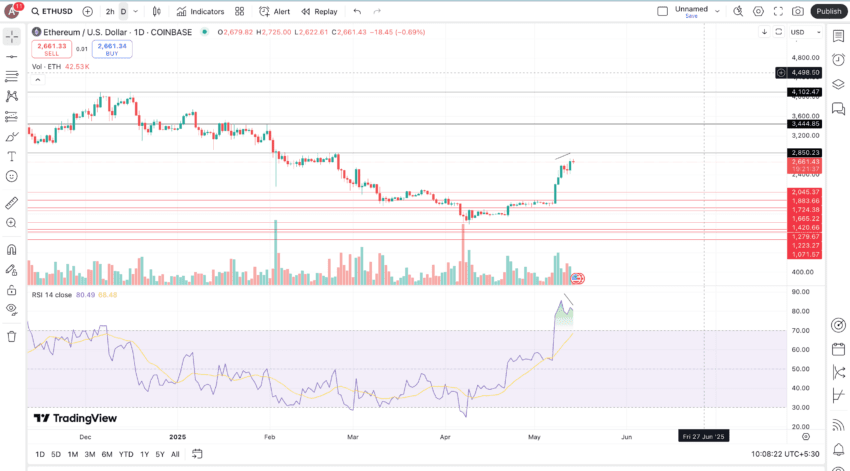
ETH price action | Source: TradingView
If you are looking from a medium to long-term perspective, note that trading volumes are at a fairly moderate level (not too high) and there are signs of bullish divergence when compared to the relative strength index (RSI). Simply put, this indicates that ETH prices still have the potential to continue rising, with $2,850 being a critical level to surpass. If this threshold is crossed, we can expect ETH to reach a short-term peak of around $3,444.
Conversely, if investing with a long-term view, the $4,102 level will be a threshold to watch, and if this level is surpassed, ETH could very well reach $5,000 by 2025 — provided that general market indicators continue to support the upward trend.
Reasons to invest in Ethereum.
Based on current data and market developments, here are the key factors supporting investment in Ethereum in 2025:
The supply of ETH is shrinking.
Since EIP-1559 was implemented, Ethereum has begun to burn a portion of transaction fees. In 2025, the issuance of ETH remains lower than the amount burned, meaning the total supply is gradually decreasing. For long-term holders, the scarce supply will support price increases.
Strong staking activity.
The participation rate of Ethereum validators reached 99.7% in Q1 2025. This is a sign that the network is stable, reliable, and trusted by the community. For investors, stable staking means steady yields and a secure system.
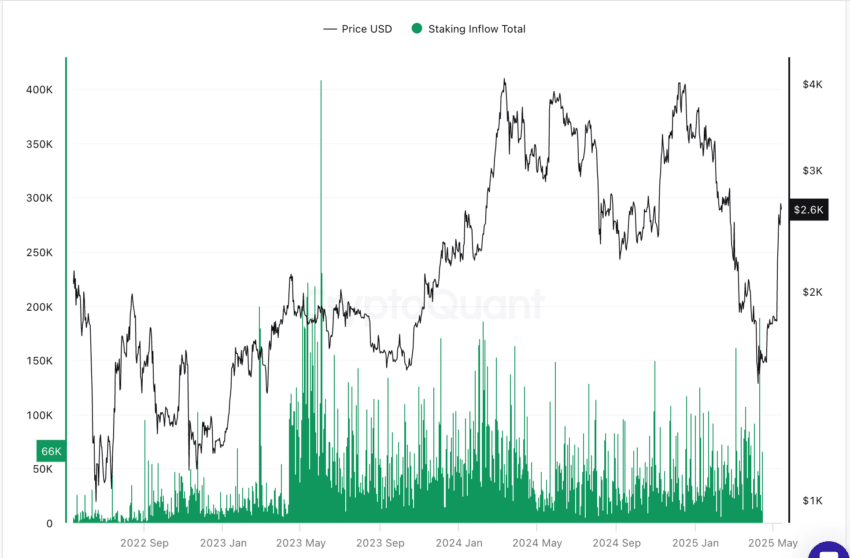
Staking inflows | Source: CryptoQuant
Ethereum still leads in the DeFi space.
With a total value locked (TVL) of $51.9 billion, Ethereum remains the primary platform for lending, stablecoins, and on-chain trading. If you believe in the future of on-chain finance, then ETH remains a core foundational asset.
Layer 2 solutions are developing, and ETH is benefiting.
As of May 2025, Ethereum-based layer 2 solutions like Arbitrum and Optimism have attracted over $42 billion in value. Even as most activity moves to rollup solutions, Ethereum remains the ultimate payment infrastructure layer and benefits from usage demand.
Institutions are participating.
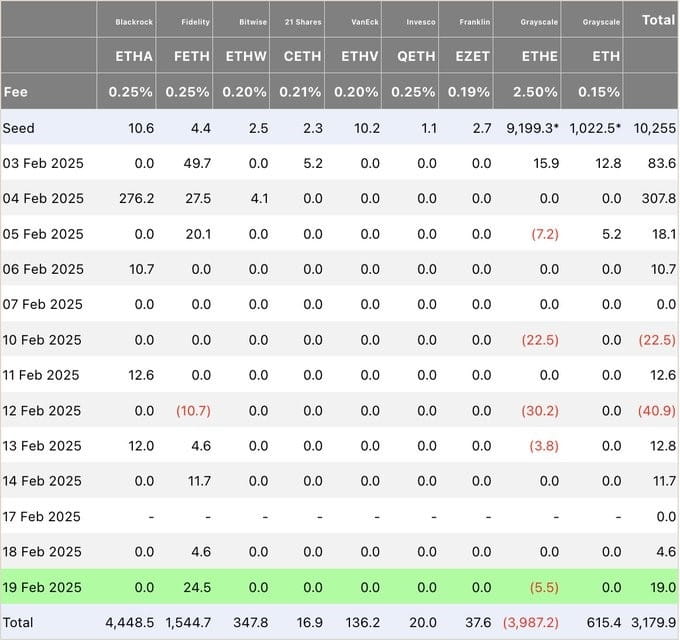
The U.S. Securities and Exchange Commission (SEC) approved spot Ethereum ETF funds in May 2024. Although they have not reached the scale of Bitcoin ETFs, they have paved the way for investment funds, family offices, and financial advisors to enter the market. Broader accessibility means more potential buyers.
Source: Ted
Smooth deployment of the Pectra upgrade.
Launched in early 2025, Pectra has made staking operations more flexible and accelerated some components of the network. Fortunately, the deployment process did not encounter any snags or delays, helping to build trust within the community — crucial for attracting investment capital.
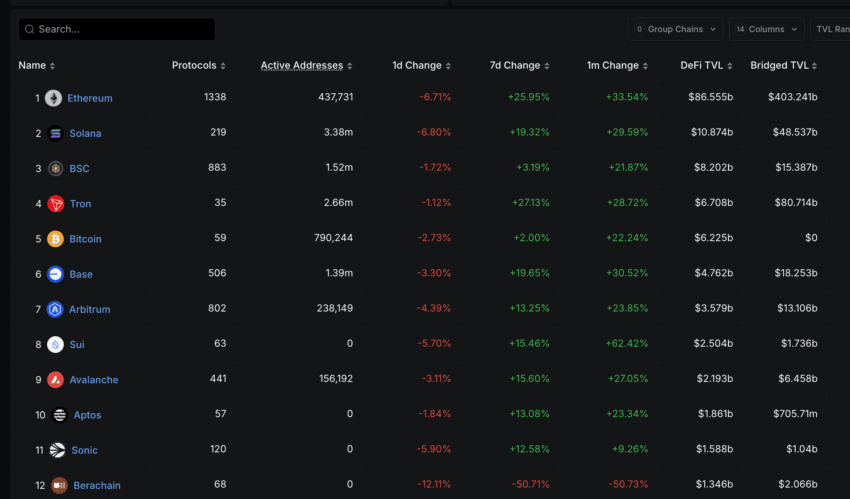
Ethereum leads the DeFi space | Source: Defillama
The above are positive arguments showing that ETH has significant potential to become an attractive investment in 2025. However, to have a comprehensive and objective view, we also need to consider the other side of the issue — the risks and challenges that Ethereum may face.
Reasons not to invest in Ethereum.
Not all current trends support Ethereum. Below are the main risks and concerns still affecting investors' decisions.
Poor performance year-to-date.
As of May 16, 2025, Ethereum is trading at $2,607, down about 20% from the end of December (~$3,240). Meanwhile, Bitcoin has increased 6.5% year-to-date, and even Solana has maintained a sideways trend. This performance gap has led investors to adjust their portfolios, shifting capital to assets with stronger growth momentum. For investors, ETH currently lacks convincing short-term signals.
Fragmented user experience.
On-chain activity is still affected by high gas fees (often from $3–12 per transaction) and poor interoperability between rollup solutions. Although adoption of layer 2 is increasing, most users still have to navigate fragmented bridges, change RPCs manually, and use multiple wallets. From the investors' perspective, a poor user experience will limit the accessibility for the average user, thus directly impacting the demand for ETH.
Increasing competition from faster blockchains.
High-speed blockchains like Solana (with 850,000 daily active users) and Sui (with 350,000 daily active users) continue to attract developers and users thanks to low transaction fees and near-instant finality. Meanwhile, Ethereum layer 1 only records about 400,000 daily active users, with higher delays and costs.
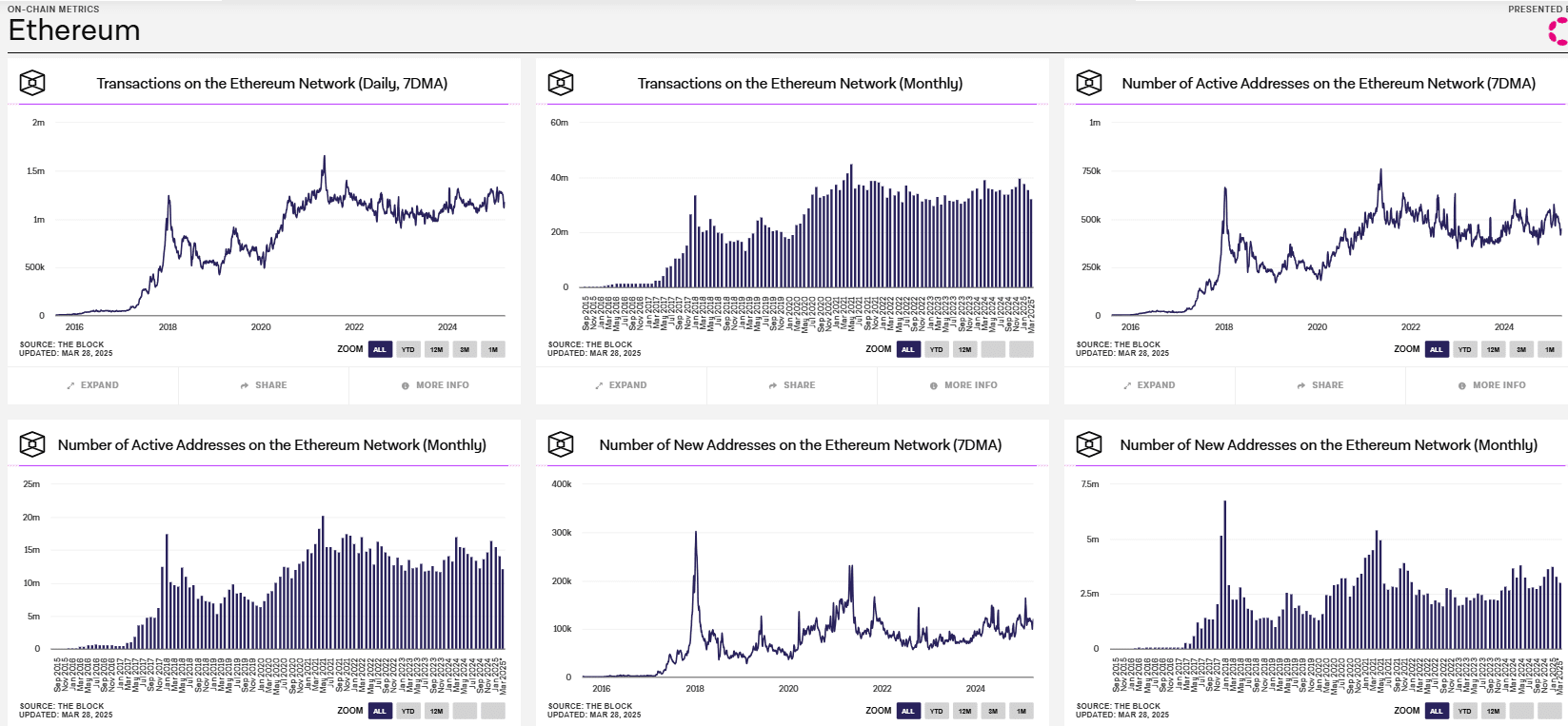
Source: X
This puts Ethereum at risk of losing market share, which in turn affects long-term demand for ETH as a gas fee asset.
Delays in roadmap deployment.
The Pectra upgrade was released in Q1 2025, but subsequent milestones — Verkle Trees and Single-Slot Finality — have now been postponed to late 2025 or 2026, instead of the original target of Q3 2025. These delays mean that scalability and user experience will improve more slowly — two key factors for the long-term value of ETH.
Commitment from institutions remains limited.
As previously mentioned, Ethereum ETF funds were approved in 2024, but have only attracted $2.1 billion in assets under management (AUM), compared to $14.5 billion for Bitcoin ETFs. Major custody institutions like Fidelity and Schwab have yet to offer ETH staking services at scale. Institutional demand is rising, but remains low, reducing the price potential of ETH compared to BTC in asset allocation-focused portfolios.
What are investors currently doing with ETH?
The recent price increase of ETH has been primarily driven by investor behavior. This is clearly reflected in on-chain data.
Net inflows on exchanges show selling pressure.
On May 12, 2025, Ethereum recorded a net inflow of 178,900 ETH into exchanges, the largest inflow this year. Such large inflows often indicate that investors are preparing to sell their assets.
Institutions withdraw from Ethereum ETF funds.
On May 12, 2025, Ethereum ETF funds recorded a net outflow of $17.6 million, mainly from funds like FETH and ETHE. While not a large withdrawal, this is a sign that institutional investors are hesitant after ETH's recent price surge. This indicates a risk-off sentiment in the short term, rather than a complete withdrawal.
Staking inflows tell a different story.
Although some funds have reduced their involvement, ETH staking is still growing. In the past week, inflows into staking contracts have increased — a sign that many holders are leaning towards retaining their assets and opting to lock them up for yield rather than selling.
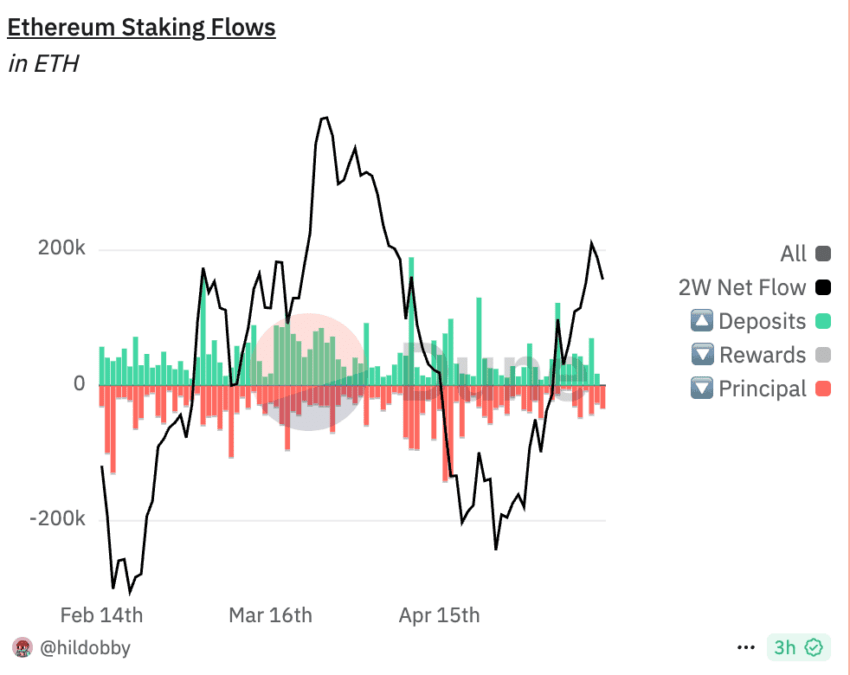
Ethereum staking inflows | Source: Dune
A whale is making a big bet on ETH's bearish scenario.
On May 1, 2025, a large wallet increased its short position by 10,000 ETH — equivalent to about $18.4 million — by borrowing an additional 4,000 ETH. This is not a common move. It shows that at least some large investors are preparing for a price downturn.
Overall, the current picture is quite mixed: outflows from ETFs, short positions from whales, but also an increase in staking activity. Market sentiment is unclear, making it even more important for investors to monitor on-chain trends.
Will Ethereum outperform Bitcoin in 2025?
As of mid-May 2025, ETH is still lagging behind Bitcoin this year, down about 20% compared to Bitcoin's 11% increase. However, momentum may be changing.
In just May, ETH rose 45%, far exceeding Bitcoin's 10.7% increase. This period coincided with the implementation of the Pectra upgrade, which improved staking performance and validators, providing clearer reasons for investors to re-evaluate Ethereum.
After a long period of decline, the ETH/BTC ratio has started to recover. The amount of OI (open interest) in ETH futures contracts is also increasing. This is not a hype signal but a sign of re-entry from large capital.
Nevertheless, ETH is still in catch-up mode. Leading the pack is not yet a certainty, but the important thing is that Ethereum is back in the game and once again being seriously considered as a potential investment option.
Things to consider before investing in Ethereum.
If you are evaluating whether Ethereum is a good investment in 2025, you need to consider many factors beyond just hype. Although the narrative around Ethereum is changing, investors still face structural and strategic issues that could affect returns.
Ethereum remains volatile.
Daily price fluctuations of 3–5% are common, and strong movements are often influenced by macro news, ETF capital flows, or increased network activity. Therefore, short-term entry points carry inherent risks, so investors need to scale appropriately or commit to long-term investments.
Tax regimes remain unclear in many areas.
Staking rewards for ETH are still taxed as income in some areas, including the U.S. and Germany. At the same time, there is no regulation on how to handle long-term locked assets. This affects the net returns of investors planning to hodl or stake for an extended period.
Expansion still depends on external rollups.
Although layer 2 is developing, Ethereum still struggles to handle high-volume transactions. Most improvements in scalability are driven by rollups like Arbitrum and Optimism, rather than the main chain. Investors relying on the utility growth of ETH need to monitor whether the consolidation of rollups translates into demand for the main layer.
Layer 2 competition is heating up.
Many layer 2 solutions, while built on the Ethereum platform, are now issuing their own tokens and incentive programs, which could distract attention away from Ethereum itself. This risks diminishing the role of ETH as the primary asset attracting value within its own ecosystem.
The strength of Ethereum depends on the deployment of the roadmap.
With technologies like Verkle Trees, single-slot finality, and statelessness* still not deployed, much of Ethereum's potential relies on achieving future goals. Investors should monitor technical progress, not just price action.
Ethereum in 2025 has growth potential, but faces challenges. Those assessing Ethereum as an investment should consider volatility, tax complexities, and deployment risks before allocating capital.
What are institutional investors doing with ETH?
If you're wondering whether Ethereum is a good investment in 2025, the behavior of institutional investors will provide part of the answer. Investment capital is cautious, but flows are still moving selectively.
Ethereum ETF funds are recovering capital inflows.
On May 13, 2025, net inflows into Ethereum ETF funds reached $13.5 million, with Grayscale's mini-Ether fund leading with $7.4 million. For investors, this signals that capital from institutions is returning to Ethereum, particularly through regulatory-compliant vehicles.
Abraxas Capital purchased over 240,000 ETH.
This asset manager added 242,652 ETH (approximately $561 million) to their portfolio in just one week, marking one of the largest moves from institutions this year. Large-scale accumulation activities support the view that Ethereum is positioning itself as a long-term strategic asset, rather than just speculative trading.
Ethereum staking for institutions.
Distributed validator technology is being integrated into institutional custody platforms, allowing for ETH staking without compromising compliance or decentralization. This makes ETH more attractive for funds seeking passive yield from on-chain assets.
Staking-linked ETF funds are actively being developed.
Many applications for Ethereum ETF funds, including staking yields, are underway. The final approval decision is still uncertain, but some issuers expect to launch products in Q4 2025. If approved, this will open up access to ETH yielding returns for retirement accounts and fund structures.
So far, Ethereum in 2025 is receiving selective but significant attention from institutional investors.
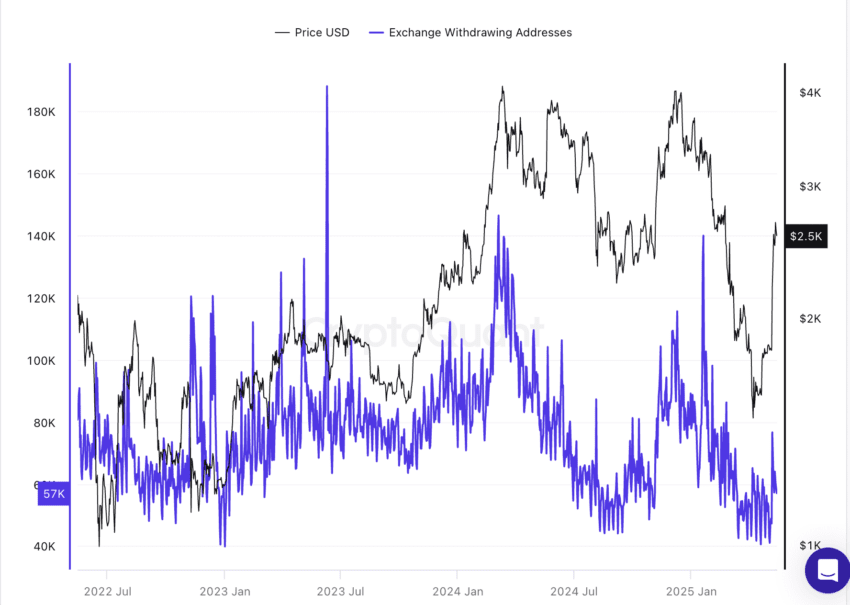
Decreasing number of ETH addresses withdrawing from exchanges | Source: CryptoQuant
What do analysts predict for Ethereum in 2025?
When you assess whether Ethereum is a good investment in 2025, analysts' forecasts provide useful context, but there is no consensus. Predictions vary widely, depending on each analyst's views on roadmap deployment, market cycles, and regulatory outcomes.
Julian Hosp predicts ETH will hit $11,111, based on potential ETF capital inflows and long-term confidence in Ethereum's role in the crypto infrastructure. This forecast reflects a strongly confident viewpoint, tied to regulatory victories and adoption momentum.
Michaël van de Poppe predicts Ethereum will hover around $3,000, suggesting the price may consolidate unless Bitcoin enters a strong macro trend. This forecast aligns with cautious expectations, especially for investors monitoring short-term performance.
Taki Tsaklanos, an independent analyst, predicts a wide range from $2,500 to $7,500, depending on risk appetite and breakout confirmation across layer 1 ecosystems. For investors, this is a “watch and react” situation relating to broader market dynamics.
Fred Schebesta predicts ETH will range from $5,710 to $7,996 in the long term, based on technical analysis and sentiment indicators. This forecast falls within an optimistic yet realistic range, assuming that upgrades will continue to be deployed.
Standard Chartered has revised its 2025 target down from $10,000 to $4,000, citing value dilution from layer 2 as a contributing factor. From an investment perspective, this serves as a reminder that usage does not always translate into direct demand for ETH.
Finder's council (over 50 fintech experts) gives an average of $5,770, with key factors being the ETF infrastructure, staking demand, and Ethereum's resilience. This represents the average of the institutional market: optimistic but not overly excited.
Thus, price targets range from $2,200 to $11,111 — a range that reflects Ethereum's dual identity: a foundational platform maturing but still valued with the volatility of a startup. Overall, analysts' forecasts reflect both growth potential from the roadmap's deployment and price declines due to delays, regulations, or macro pressures.
Ethereum in 2025: Buy, hodl, or avoid?
If you are still wondering if Ethereum is a good investment in 2025, the answer depends on your timeframe. Short-term is linked to volatility factors. But in the long term, stronger fundamentals and ongoing upgrades are in play. Ethereum in 2025 is no longer in its early stages, but if you are an investor monitoring usage levels, staking, and roadmap progress, ETH may still deserve a place in your portfolio.
*According to the Ethereum Foundation, the concept of statelessness refers to eliminating dependence on centralized service providers in validating operational activities for the network.
Traders are changing their views on Bitcoin's role in their portfolios as the price consolidates above $100,000.
Today, $3.3 billion in BTC and ETH options expire: Temporary volatility or the start of a new trend?
EIP-7702 upgrades Ethereum wallets: Over 11,000 delegated transactions 7 days after the Pectra upgrade.
Minh Anh
Disclaimer: This article is for informational purposes only and is not investment advice. Investors should conduct thorough research before making decisions. We are not responsible for your investment decisions.


