


Original author: Kaori, BlockBeats
Reprint: Oliver, Mars Finance
Binance Alpha has already formed a value consensus among various circles, such as project parties, yield farmers, and retail investors. Project parties 'supply' to Alpha, yield farmers conduct KYC in bulk to open a new round of yield farming journeys, while retail investors navigate profits between point restrictions, lucky tail numbers, and trading friction.
From the moment it went live on Alpha, it became the best exit window for meme coins. From the earliest rounds of 'violent money distribution' in Alpha 2.0 to implementing a point-based user screening system and token issuers queuing to launch on Alpha, Binance has gradually reclaimed the flow and pricing power in the on-chain market. Behind all this is Binance's ambition to reorganize its ecosystem on the asset side after being overtaken by OKX on the product side.
After 150 days, Binance Alpha has evolved from a wallet feature into the most influential structural mechanism in the entire cryptocurrency market.
What has Alpha accomplished in 5 months?
In 2024, the cryptocurrency market welcomed a bull market boom under the dual stimuli of the approval of Bitcoin spot ETFs and the meme frenzy. However, beneath the surface of recovering liquidity lies a deeper issue: the pricing mechanism between the primary and secondary markets is gradually failing. VC project valuations are inflated, project parties are extending their token issuance cycles, and user participation thresholds are continuously rising, while the final listing window often turns into the endpoint for project parties and early investors to cash out, leaving retail investors with nothing but scraps.
It is against this backdrop that Binance launched Binance Alpha on December 17, 2024. Initially, it was just an experimental feature in the Binance Web3 wallet for discovering quality projects, but it quickly evolved into a core tool for Binance to reconstruct pricing power in the on-chain market.
Binance co-founder He Yi acknowledged in a Space responding to community disputes that there is a 'peak at the opening' issue with new listings on Binance, and admitted that traditional listing mechanisms are difficult to sustain under current scale and regulatory constraints. Binance has also implemented mechanisms such as voting for listings and Dutch auctions to curb the price performance of new coins after they go live, but the results have been unsatisfactory.
Thus, Alpha listing has become the strategic alternative within Binance's controllable range during that phase.
‘Putting these hot projects in the Binance Alpha; projects entering the observation area cannot guarantee a listing on Binance. A project can only generate revenue and profit when it is beneficial to society, which may lead to sharing profits with users.’ He Yi made such a commitment in the Space.
On December 18, Binance Alpha announced the first batch of project lists. By February 13, Binance Alpha had launched over 80 tokens across ecosystems such as BSC, Solana, and Base, primarily focusing on meme and AI tokens. However, the market did not respond as Binance had anticipated, reducing the criticism of VC coins that drop immediately after launch, and instead, launching on Alpha became the last stop for meme coins.
It wasn't until early February 2025 that the BSC ecosystem, starting with the test token TST, opened the channel between Alpha and traffic, and from that time on, Alpha began to launch non-meme tokens such as ONDO, MORPHO, and AERO.
In March, due to the shutdown of OKX DEX, Binance Wallet launched Binance Alpha 2.0 at this time, allowing users to directly trade Alpha tokens using funds within the centralized exchange (CEX) by integrating Binance Alpha directly into the CEX. Consequently, the trading volume and active users of Binance Wallet surged, capturing 80% of the trading volume in cryptocurrency wallets, becoming the steepest growth segment in wallet products.
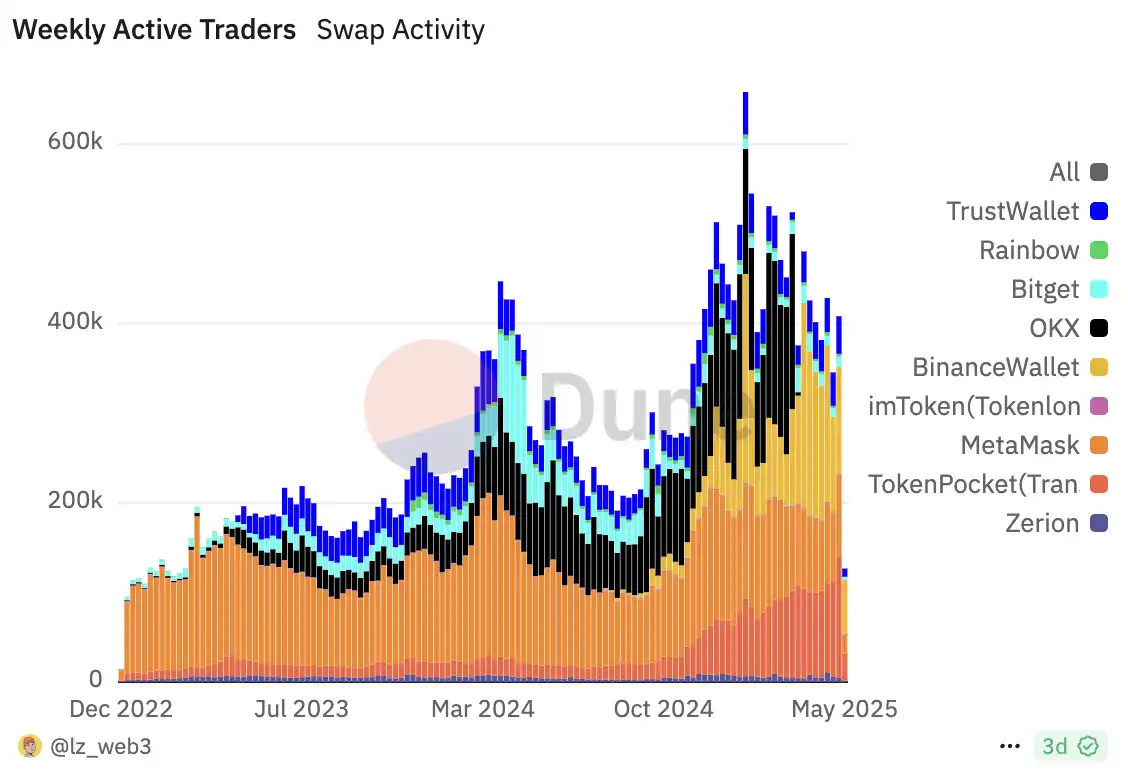
At the same time, Binance's selection criteria for Alpha users are constantly evolving. The initial 'task-based point system' is no longer sufficient to form effective differentiation. The platform quickly introduced mechanisms such as lucky tail numbers and point consumption to stimulate more frequent interactions. This mechanism balances user participation continuity and differentiation, providing project parties with a relatively precise target group for airdrops.
The project team no longer hesitates.
From the moment the Alpha mechanism was introduced, the choices available to project parties have already changed.
Faced with the high uncertainty of the main site’s listing windows, the pressure to cash out in on-chain communities, and the valuation inversion of VC accounts, more and more teams are beginning to realize: to gain market attention and liquidity support, relying solely on storytelling, maintaining communities, or waiting for traditional listing processes may not be enough.
Rather than continue to waste time on routes with unpredictable outcomes, it is better to actively adapt to the new paradigm brought by Alpha. In the Alpha system, token flow, airdrop amounts, and trading activity can be directly reflected as observable data for the platform. These data may very well serve as a preliminary ticket to being officially listed on Binance, and going up Alpha can also garner market attention with almost no negative impact.
Because of this, project parties have begun to quickly adjust their strategies, no longer hesitating about whether to issue, when to issue, or how to issue, but rather proactively tailoring a 'low-cost listing on Binance' execution model for the Alpha mechanism.
Betraying the community has become the norm.
Currently, Binance Alpha offers two types of listing options: either circulating projects or new projects that are not yet circulating, with different detailed indicators for evaluation based on these two main lines. This makes Alpha a clear entry point with defined standards.
On the execution level, the rhythm of Binance Alpha leading to main site spot trading is extremely restrained, with the number of spot listing quotas over the past five months far below Binance's previous pace for spot listings. This limited and scarce design has built a typical Web2-style growth flywheel - spending money to acquire traffic, setting thresholds to filter users, continuously optimizing internal competition rules, ultimately achieving user retention and structural strengthening of the ecosystem.
To enter this system, project parties typically need to make significant adjustments, including but not limited to deploying or mapping tokens to BSC, redesigning incentive structures, and sacrificing some originally intended airdrop amounts for the community. To some extent, Alpha is not just a wallet product, but rather a lightweight, centralized on-chain token issuance protocol that aligns with Binance platform's data selection and risk hedging needs.
After Zora from the Base ecosystem announced its debut on Binance Alpha, someone in the group said, 'Don’t set your expectations too high; it might take years to get what others get from Alpha,' which turned out to be prophetic. Eligible Binance Alpha users received 4,276 ZORA tokens, worth nearly $90; however, many users in the community who had maintained attention and participated in ecological activities since Zora's launch reported that they only received $30 in airdrops, with even fewer tokens in single digits.
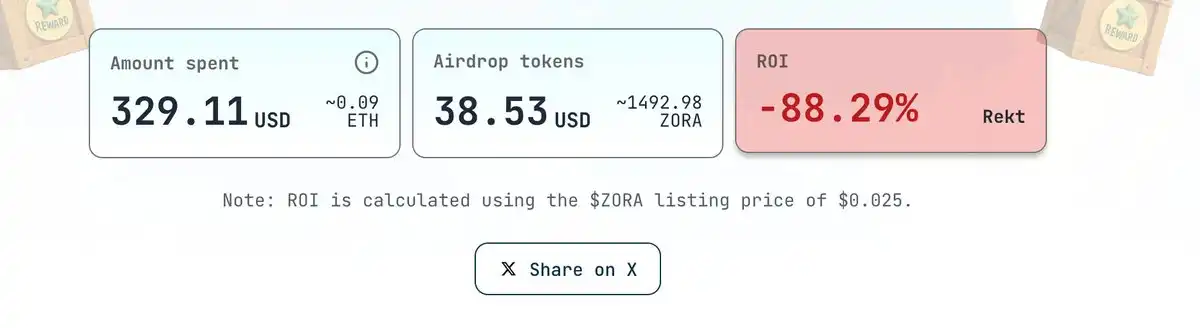
Screenshots of airdrop earnings shared by Zora ecosystem users in the community; Image source: @zkgoudan
This situation of bypassing original communities to directly serve Alpha users is not uncommon among projects that have already gone live on Alpha.
For example, with PRAI, feedback from users involved in its KOL round indicated that 'VC and KOL rounds yield losses.' On one hand, the project implements a lock-up policy for community users, restricting token circulation; on the other hand, Alpha users do not bear the costs of early participation or capital lock-up and can obtain airdrops worth nearly $100 just based on wallet points and interaction records. This apparent disparity in incentives breaks the project's original 'internal equity' within the ecosystem.
Users who participated in the Sui ecosystem lending protocol Haedal told BlockBeats that Haedal's airdrop amounts varied greatly, almost ignoring the participation costs of early depositors, leaving significant returns for Alpha users.
Before MilkyWay, a liquidity staking derivative protocol on Celestia, launched Alpha, community users not only faced a decline in TIA but also received very little allocation from the project parties for early users, requiring both lock-up and task completion to unlock. Meanwhile, just holding NFTs without binding to the point system does not qualify for airdrops, and the window period is short, yielding far lower returns than Alpha users.
This approach of deviating from the project’s original supporting community and reallocating resources to Alpha users has sparked widespread discussion, but for most project parties, it is a practical choice: under the premise of limited resources, prioritizing resource allocation to paths that can bring secondary liquidity and platform exposure is a strategy for maximizing efficiency.
After going live on Alpha
The core indicator for listing on Binance Alpha is how many chips it can provide, which aligns with the concept of 'embracing the Binance ecosystem and BNB chain'.
According to crypto KOL AB Kuai.Dong's statistics, Puffer launched Alpha seven months after its token issuance. According to on-chain data, the project party mapped approximately 3.16% of its tokens to the BNB chain, with 1.24% directly allocated to the Alpha user airdrop pool, while injecting nearly 500,000 USDC liquidity into PancakeSwap. Overall, it is estimated that Puffer incurred total costs close to $3 million for this Alpha airdrop.
As AB said, 'the price is not small, but the benefits are obvious.' By directly accessing the Binance CEX trading channel through the Alpha function, liquidity preheating and market awareness were completed in advance before futures or main listings.
A similar path can also be seen in the star project of the ZK track, Polyhedra, whose token ZKJ entered Alpha without launching on the Binance main site, becoming the first top 100 market cap token to be included in this mechanism. Project parties have launched staking yields as high as 150% and point competitions in succession to attract users to increase trading behavior and accumulate wallet activity. Strategically, project parties may want to leverage internal indicators from Alpha to build influence and ultimately drive the realization of Binance listing decisions.
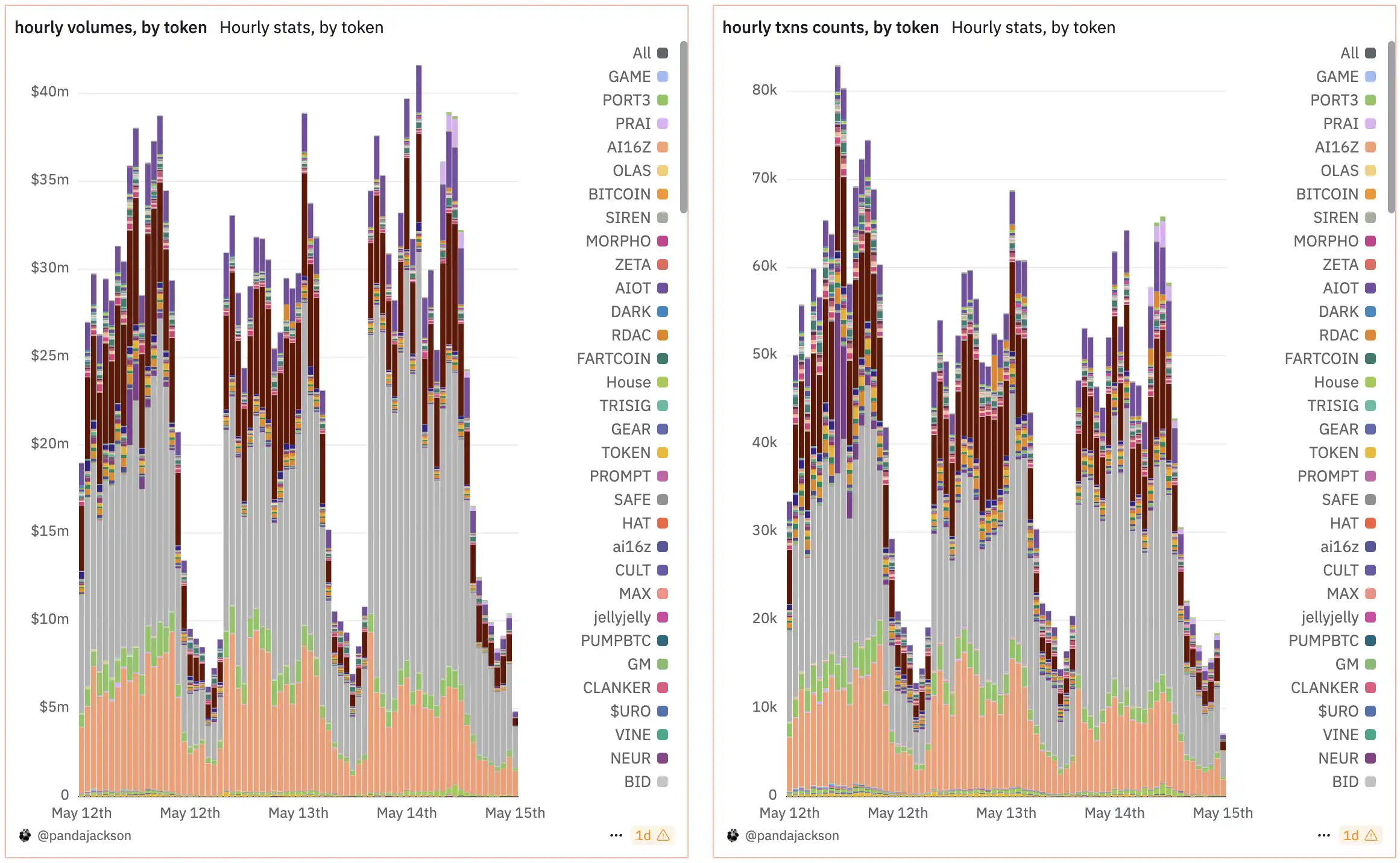
ZKJ has recently consistently topped the Alpha trading volume rankings; Image source: Panda Jackson (@pandajackson42)
This closed loop of on-chain behavior - point rewards - platform inclusion has restructured the game structure between Binance and project parties: in the past, 'market cap + community' determined whether a project could be listed, whereas now 'on-chain data + Alpha performance' dominates the rhythm of listings.
The strategy for new projects is more aggressive. Since Stakestone went live on Binance Alpha in mid-April, it has adopted an extremely proactive market approach, starting with a 5% token distribution through wallet IDO, followed by a 1.5% airdrop covering Alpha users, and an additional nearly 4% incentive for long-time community users, cumulatively distributing over 10% of the total supply.
Meanwhile, project parties have directly invested part of their financing into the secondary market to guide coin prices to remain stable in the early stages of public circulation. This series of operations ultimately earned them a listing channel on Binance. As industry insiders familiar with the process said, 'after Binance's listing standards changed, projects no longer need to tell stories but need to demonstrate data and control.'
Retail psychology
Compared to the well-calculated and meticulously laid strategies of project parties, the role of retail investors appears complex and ambiguous.
In traditional listing logic, retail investors could seize primary arbitrage opportunities through information sensitivity and capital agility. However, under the point system established by Alpha, the profit path for retail investors has been institutionalized and made transparent while also becoming highly competitive. Alpha does not activate the imagination of coin price growth, but rather the on-chain conversion mechanism of 'points - airdrops - listings'.
For some users, this mechanism indeed reconstructs the concept of fairness. Small and medium-sized users who have long stayed in wallets can still gain returns far exceeding costs if they remain active, even if their capital is not large. Since the Alpha point system was launched, according to BlockBeats, if ordinary users participate in each Alpha airdrop and wallet IDO event, they could earn nearly $1,700.
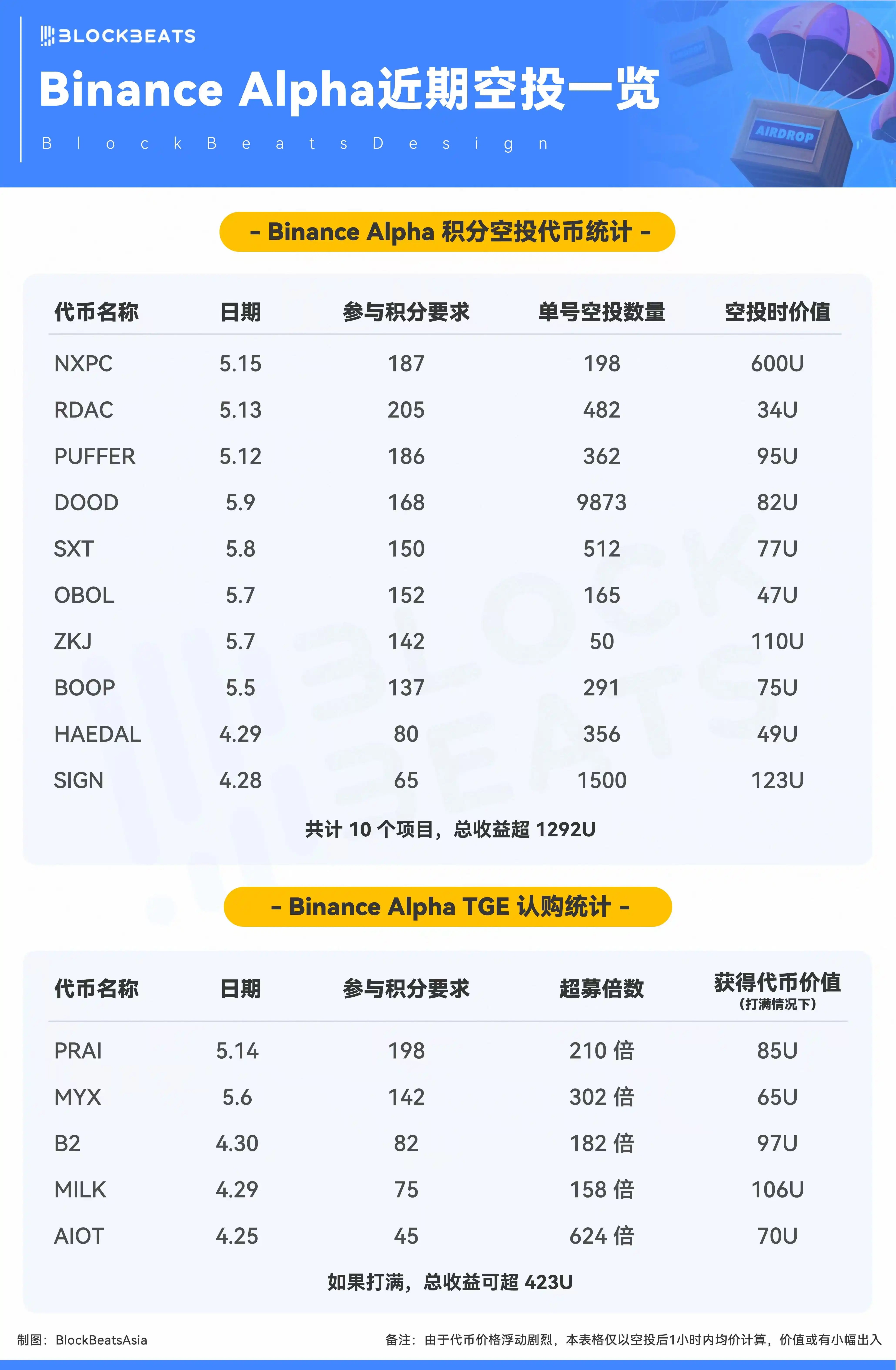
However, the high returns come with a highly structured selection system. This seemingly participatory point game actually sets implicit thresholds, imposing significant requirements on users' behavioral paths, trading frequency, and even continuity of participation.
Binance does not directly issue airdrops but provides infrastructure such as point distribution, data screening, and user classification. The airdrops are borne by the project parties, but who receives them and on what standards is determined by the Binance Alpha mechanism. The core of this system design is not 'rewards' but 'screening'. Those who can be identified as 'high-value users' can continuously receive airdrops.
Questions have also arisen, with some users pointing out that the trading volume on Alpha deviates from actual user demand, stating that 'without points and airdrops, there is no trading,' leading to inflated project data and superficial user retention. 'What difference does this incentive method have from ghost chains or fake game airdrops that no one uses after TGE?'
According to statistics from crypto KOL Guhe, in the sample statistics, only 22% of users who trade normally every day can earn enough points to obtain airdrops, while the rest need to continuously repeat trades or are unable to keep up with the point rhythm and abandon participation.
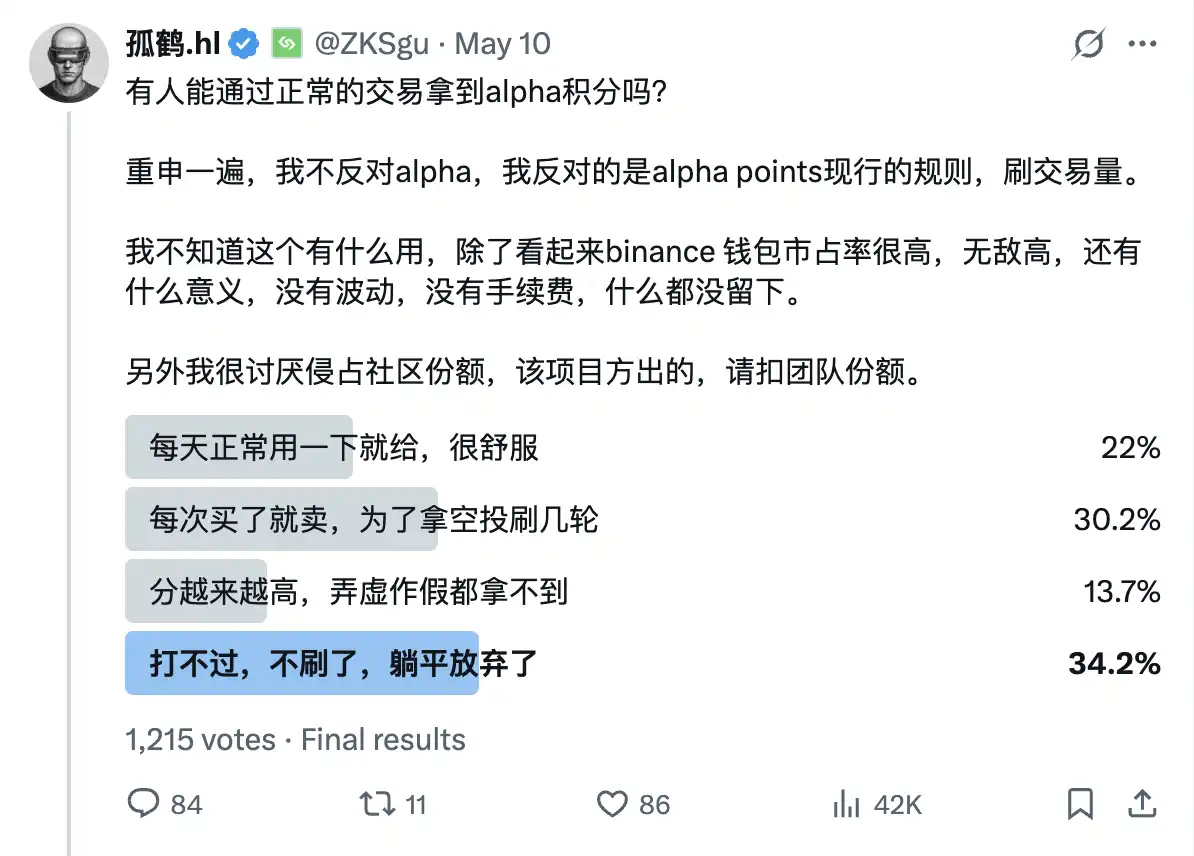
However, it is undeniable that in the current market context of overall liquidity scarcity and a lack of sustained attention mechanisms for projects, Alpha remains one of the few channels where doing something could potentially yield rewards. Under the premise of both returns and certainty, this mechanism still has strong appeal. In this system, the participation logic of retail investors shifts from value judgment to mechanism competition; their returns no longer depend on their judgment of a project's future but rather on their understanding of and ability to execute the Alpha mechanism.
Who are the real beneficiaries of Alpha?
Although retail investors and project parties each engage in competition within the Alpha mechanism, returning to the overall framework, what Alpha truly reshapes is the underlying relationship between trading platforms and assets.
In terms of product experience and tool ecology, Binance does not have significant advantages compared to platforms like OKX, but through the liquidity entry mechanism built by Alpha, it still maintains strong influence in the asset launch phase.
Even if a project does not launch on Binance, the traffic screening and point path provided by Alpha are sufficient to complete a round of market warming and price anchoring before a large number of new coins connect to main site trading pairs. It has changed the starting point for issuing coins and extended Binance's influence boundary on the asset side.
The recently launched Alpha game NXPC is a great example. After the liquidity pool opened on-chain, the Alpha airdrop was promptly distributed to point users shortly after, while Binance contracts and spot trades lagged by nearly half an hour to several hours, leading to some price differences on other trading platforms like Bybit and Upbit. The trading windows at different paces determined profits at various stages and reinforced Alpha’s preemptive role in liquidity activation.
In the past, a project going live on Binance meant completing primary pricing and reaching a final destination. Now, Alpha is the starting point for project listings and the source of pricing, moving the cold-start arena originally belonging to other trading platforms like OKX and Bybit back into the Binance system. Once Alpha projects rise, there is a reason to connect to Binance contracts and spot trades, and projects are naturally willing to 'supply' shares according to the rules, providing token shares and capital infusion in exchange for platform exposure and liquidity paving, creating a closed loop of traffic feeding back into the platform.
This also relieves Binance from bearing the past burden of 'listings peaking immediately'. CZ has expressed a desire to eliminate the premium effect brought by listings on Binance, allowing the market to return to fundamentals. Alpha is essentially his pathway to fulfill this statement, establishing a new liquidity selection mechanism through Alpha rather than directly relying on 'Binance listings' as authority, leveling the starting line between projects and then determining who can continue to advance based on on-chain data.
Currently, this path appears to be successful. Alpha is no longer just a feature in the Binance wallet; behind this mechanism is Binance's re-understanding of its role. Its success does not lie in whether the product experience is ultimate, but in its ability to organize Binance's primary asset capabilities from behind the scenes to on-chain, publicly, and quantitatively.
Compared to OKX's product refinement route in the wallet domain, Binance chooses to exchange points for traffic and airdrops for attention. Winson, head of Binance Wallet business, has publicly stated that Binance Wallet does not intend to replicate any competing product models but chooses to develop in a differentiated manner, asserting that 'the market does not need two identical wallets.' He believes it is better to reconstruct the scene than to redo the product.
Faced with issues such as airdrop volume manipulation and distorted trading data, Binance does not attempt to eliminate such behaviors, but instead builds a mechanism where projects must first self-demonstrate their attraction before observing whether they can form a stable user base and genuine trading depth. The boundary between volume manipulation and genuine behavior is delayed in judgment and quantified within Alpha's point system.
From another perspective, Binance Alpha has successfully attracted yield farmers but has not attracted genuine trading volume; users still do not consider the Binance wallet as their first choice when choosing on-chain behavior.
The previous cycle was, to some extent, 'to VCs', relying on storytelling to raise funds. Now, it is 'to liquidity', and Alpha is the anchor point for Binance to reclaim liquidity. In an era where VCs are no longer reliable, communities have dissipated, and product competition has become homogenized, Binance Alpha may not be the optimal solution for innovation, but it is the most effective way to absorb the bubble.